
Global and Thai Economy
High fiscal-risk economies face mounting pressure from elevated bond yields. Thai MPC is expected to hold rates and favor targeted measures.
Global
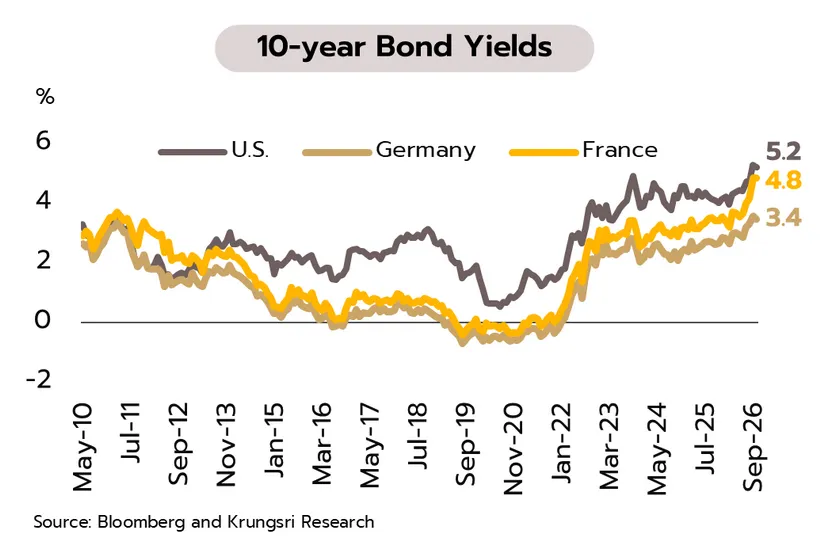
Major Economies: Persistent fiscal stimulus, rising inflation concerns, and increased fundraising demand from AI-related firms have pushed financing costs higher. Long-term government bond yields have risen significantly in recent months, particularly in countries with high public debt and ongoing fiscal deficits. The U.S. public debt has reached a record USD 40 trillion, equivalent to around 125% of GDP. Fiscal vulnerabilities vary across the Eurozone, with France, Italy, and Belgium particularly exposed, as public debt in these countries exceeds 100% of GDP. Japan continues to have the highest public debt among G7 economies, at over 200% of GDP. Against this backdrop,
10-year government bond yields in these economies have climbed to multi-decade highs. Japan’s yield has reached 3.0%, its highest level in 30 years, while yields in the U.S., Germany, and France have risen to 5.2%, 3.4%, and 4.8%, respectively, marking their highest levels in 24, 15, and 18 years.
China’s trade tensions with the EU ease. China will halve hybrid electric car exports, reduce import duties on car parts, olive oil, and footwear, as well as expedite export licenses for rare earths and permanent magnets. Meanwhile, the EU will facilitate export licenses for some dual-use items. Both also agree to notify in advance of export controls.
This shows that the likelihood of a full-blown trade war in the near term remains low.
Thailand
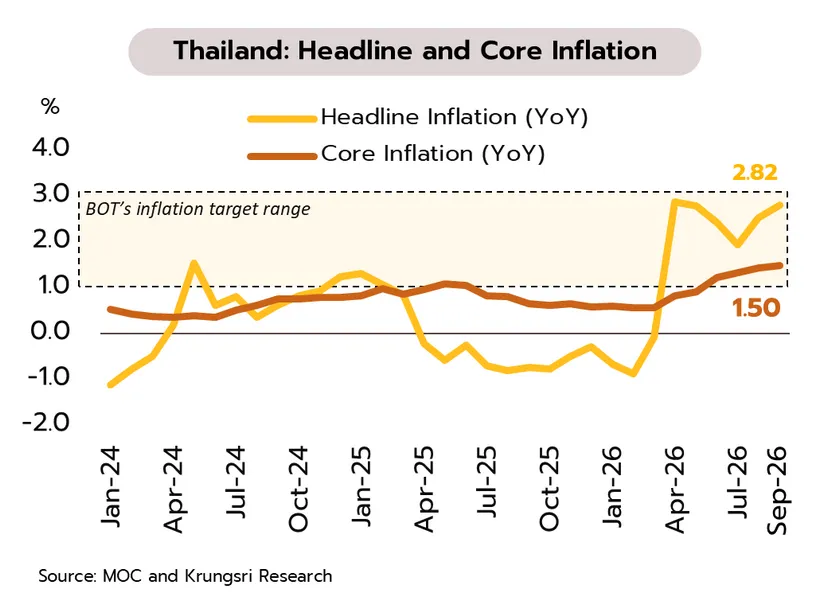
Inflation accelerated amid higher energy prices, but the Monetary Policy Committee (MPC) is expected to keep the policy rate unchanged. According to the Ministry of Commerce, headline inflation rose to 2.82% YoY in September from 2.53% in August, primarily driven by elevated domestic energy prices. Core inflation (excludes fresh food and energy) also increased to 1.50% from 1.44%, reflecting higher prices of prepared food and travel-related expenses.
Although rising inflation may prompt major central banks, including in the U.S., the EU, and Japan, to consider further policy rate hikes, the MPC is expected to maintain its policy rate, prioritizing domestic conditions. Key considerations include (i) Thailand’s growth remaining below potential, with additional disruptions from recent flooding and the fading impact of stimulus measures; (ii) subdued credit growth and an uneven recovery across business sectors; and (iii) inflation driven by supply-side pressures, with limited second-round effects amid weak domestic demand. Against this backdrop, the MPC is expected to keep the policy rate unchanged at 1.00% p.a. at its October 28 meeting, maintaining a policy stance supportive of economic recovery. Meanwhile, the Bank of Thailand is likely to place greater emphasis on targeted policies, such as the SMEs Credit Boost program, amid the uneven recovery across sectors.