
Weekly Economic Review

Weekly Economic Review

7 April 2026

Global and Thai Economy


Middle East tensions show no signs of easing, posing risks to global and Thai economies. China prioritizes quality-driven growth.


Global


Global: Tensions in the Middle East remain high, with uncertainty intensifying after Donald Trump threatened to target Iran’s infrastructure and power plants if U.S. demands are not met. Oil prices remain elevated amid disruptions to flows through the Strait of Hormuz, while Iran has ramped up military readiness following increased U.S. troop deployments in the region. Meanwhile, Global Manufacturing PMI is slowing, especially in ASEAN, amid rising geopolitical uncertainty.

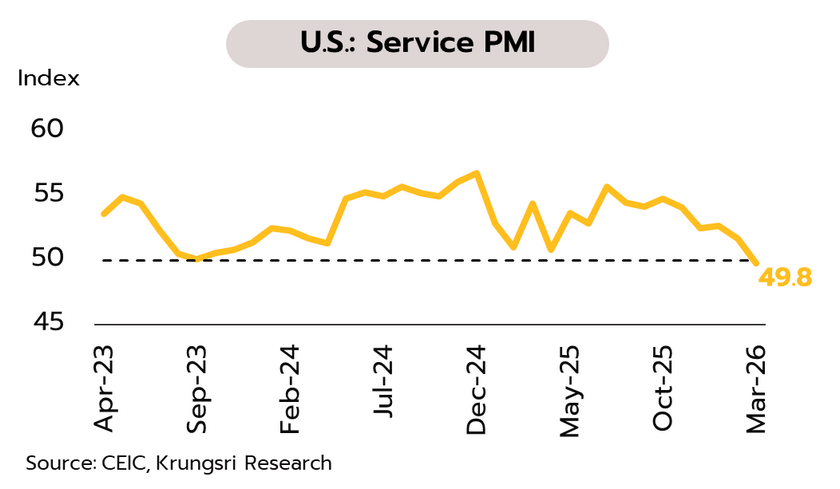
U.S.: Although employment data came in better than expected, the services sector has been affected by the war. Nonfarm payrolls rose by 178,000 in March, partly driven by the end of strikes and improved weather conditions. However, the Services PMI contracted for the first time in three years amid conflict in the Middle East. Furthermore, mounting risks in the private credit market threaten to hinder the economic recovery.

Weekly Economic Review

 
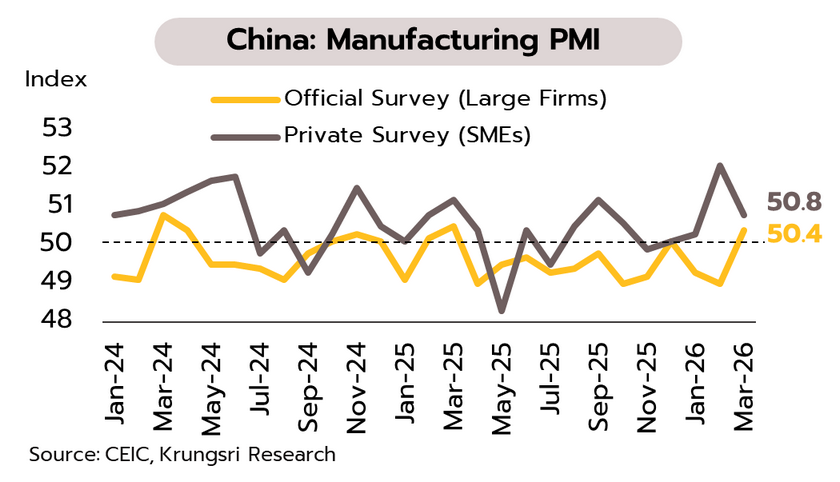
China moves to stabilize domestic fuel prices by setting price ceilings and urging refineries to maintain fuel production capacity at least at last year’s level. Although such measures may partly mitigate the oil crisis, and large-firm PMI continues to expand, businesses overall still face multiple challenges. These include weak domestic demand, rising production costs, and slowing global demand. Recently, SMEs PMI has begun to slow (figure).

Weekly Economic Review


Thailand


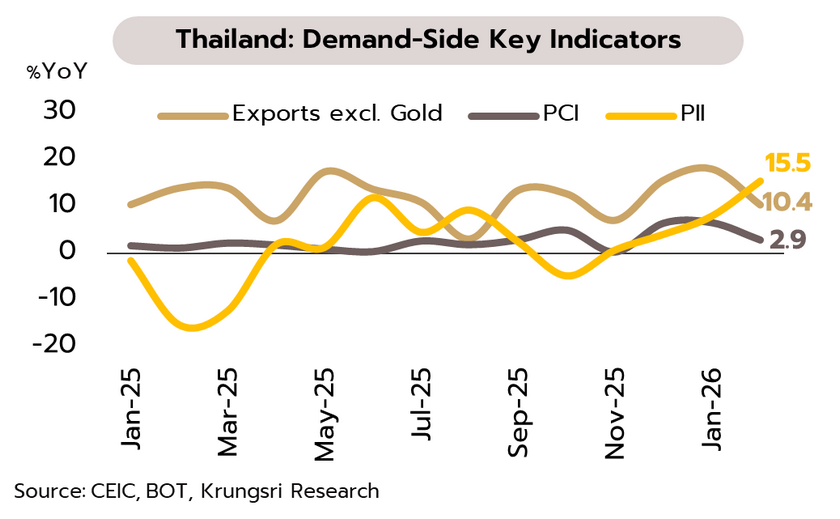
Thailand’s economy showed signs of deceleration even before the recent Middle East tensions. The Bank of Thailand reported a slowdown in both domestic and external demand in February. Growth of private consumption index (PCI) slowed to +2.9% YoY from +6.7% in January. Merchandise exports excluding gold grew slower by +10.4%, down from +18.1%. In contrast, private investment index (PII) accelerated to 15.5%, while public spending increased following transport disbursements and fiscal carry-overs. 

Even before the escalation of Middle East tensions on February 28, Thai exports and consumption had already shown signs of a slowdown, aligned with a deceleration in both manufacturing and services. Looking ahead, exports may gain short-term support from front-loading following a U.S. tariff cut from 19% to 10%. However, the Middle East tensions pose downside risks via higher oil prices, rising costs, supply disruptions, and softer tourism. Foreign arrivals grew 2.0% YoY in March (down from 4.6% in February), with sharp declines from Europe and the Middle East (-33.3%). Meanwhile, key risks to monitor include the new government’s policy statement to the parliament (April 9–10), progress in U.S. trade negotiations, and measures to address energy-related pressures from the Middle East tensions.

Weekly Economic Review


Announced :07 April 2026
Back
Press keyword to search