
Weekly Economic Review

Weekly Economic Review

17 February 2026

Global and Thai Economy


U.S. jobs data backs Fed pause; China still under pressure from excess supply; Thai 4Q25 GDP +2.5%, 2026 forecast sees upward bias


Global


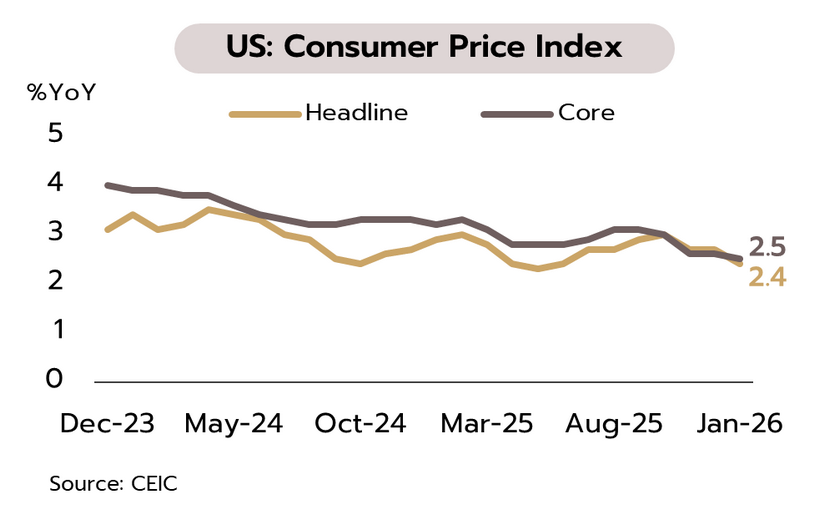
US: January nonfarm payrolls beat expectations, supporting a near-term Fed pause. Nevertheless, labor market shows signs of slowing, reflected in the job openings-to-unemployed ratio falling to its lowest since February 2021 and average hourly earnings growth slowing to its weakest in 18 months. Meanwhile, inflation eased to an eight-month low of 2.4% YoY, although it remains above the Fed’s 2% target. These developments provide room for the Fed to cut policy rates by another 1–2 times starting from mid-year. 

Weekly Economic Review
 

Europe: EU lawmakers have agreed to resume trade deal with the US after President Trump withdrew tariff threats on EU goods. Meanwhile, the EU–India trade agreement is expected to provide limited economic gains, given that India accounts for only 2.0% of the EU’s total exports.

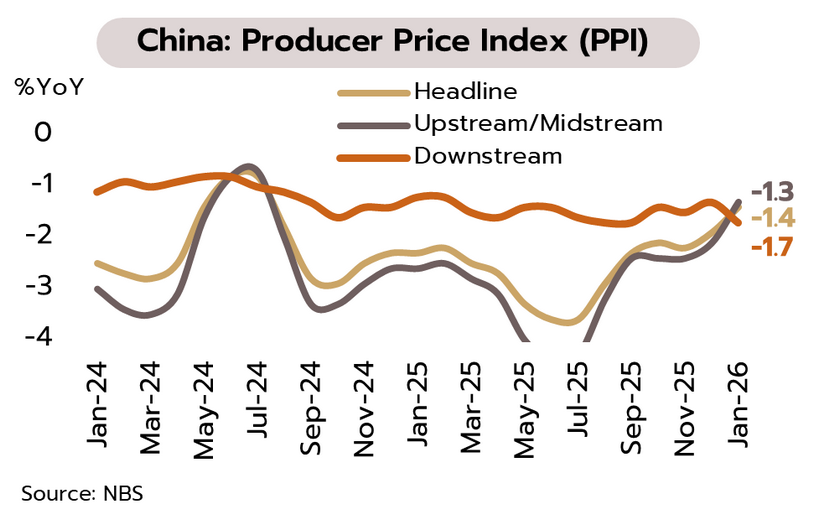
China: Excess supply continues to pressure economy. Although the decline in headline PPI has eased, the drop in prices of final goods has become more severe, in contrast to prices of raw materials and intermediate goods. This reflects that downstream sectors face intense price competition and excess supply. Meanwhile, weak demand limits the ability to pass through costs to consumers. All these factors therefore contribute to the ongoing profit decline in various industries. 

Weekly Economic Review


Thailand


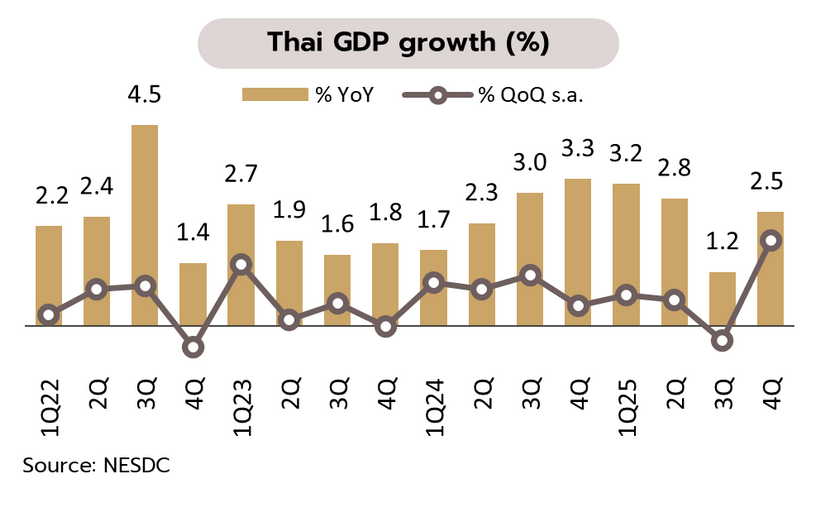
Thai 4Q25 GDP recorded significant upside surprise. 2026 growth tends to soften. The NESDC reported that Thai GDP growth accelerated from 1.2% YoY in 3Q25 to 2.5% in 4Q25, exceeding Krungsri Research’s forecast (1.2%) and the consensus (1.3%). The expansion reflected a rebound in private consumption, private investment, public investment, and public consumption. However, exports weakened, while the NESDC raised its 2026 GDP growth forecast to 2.0% from 1.7%.

4Q25 GDP came out above expectations, driven by several temporary factors, including (i) measures to boost domestic spending—particularly the Half-Half Plus program; (ii) front-loaded domestically-made EV purchases ahead of the EV 3.0 subsidy expiration; (iii) accelerated budget disbursement ahead of the dissolution of parliament; and (iv) inventory accumulation. Looking ahead, Growth is expected to slow amid fading stimulus, limited fiscal spending during the caretaker period, and U.S. tariff pressures. However, our 2026 GDP forecast of 1.8% is under review (scheduled for release on February 26) with a modest upward bias, supported by favorable base effects and expectations of improved policy continuity if political stability materializes.

Weekly Economic Review

 
Announced :17 February 2026
Back
Press keyword to search