
Weekly Economic Review

Weekly Economic Review

10 February 2026

Global and Thai Economy


U.S.–Iran tensions ease; Japan’s LDP wins a landslide; Thailand election surprise improves prospects for government stability 


Global


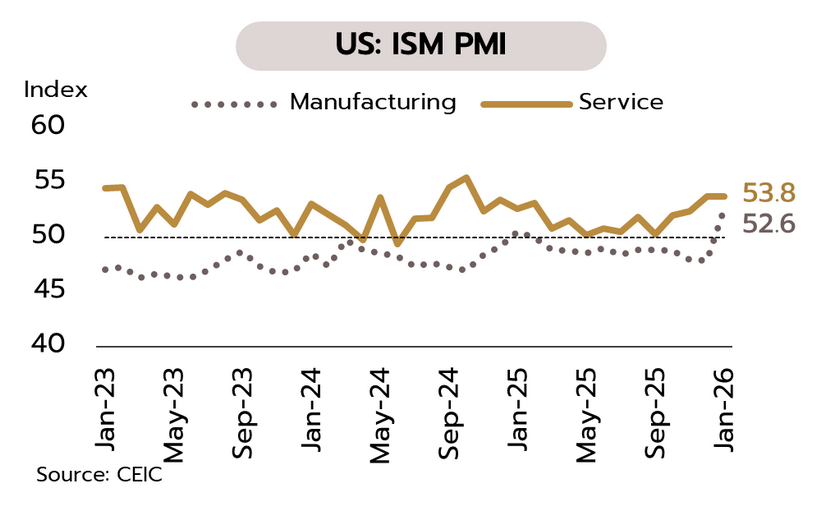
US: Economy continues to expand, supporting the Fed’s decision to hold rates. This is reflected in the expansion of manufacturing and services PMIs, higher labor productivity, and strong consumption, which reduces the likelihood of a March rate cut. Meanwhile, U.S.–Iran tensions have eased following nuclear talks, reducing the risk of military confrontation. 

Weekly Economic Review
 

Japan: The Liberal Democratic Party (LDP) won election, securing 310 out of 465 seats in the House of Representatives, the largest postwar majority in Japan’s history. This provides strong momentum for the government to advance key policies, including expansionary fiscal measures. However, rising long-term bond yields could push up borrowing costs, while pressure on the BOJ to raise interest rates may increase.

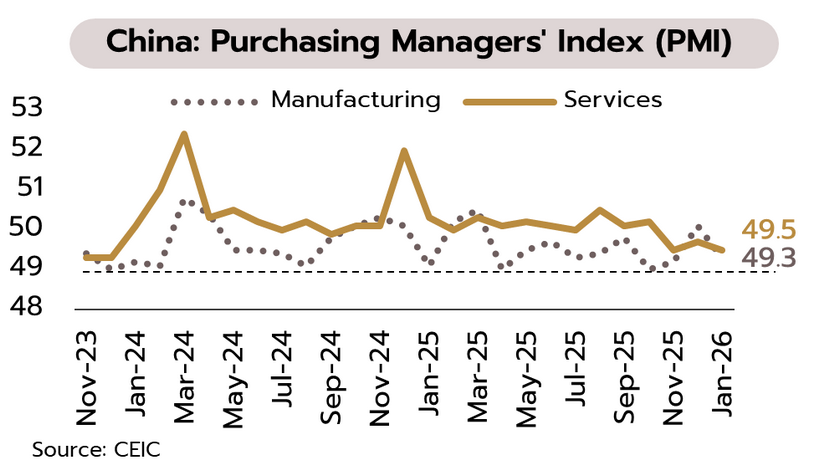
China: Pinning hopes on exports as economic pulses weaken. The manufacturing PMI slipped back to contraction in January, while the services PMI contracted for a third straight month. Meanwhile, China has gradually secured trade agreements with Canada, the EU, and UK, which could help mitigate risks as the economy continues to rely on exports. However, trade tensions stemming from U.S. tariff policies, and China’s exports control on strategic goods, remain concerns. 

Weekly Economic Review


Thailand


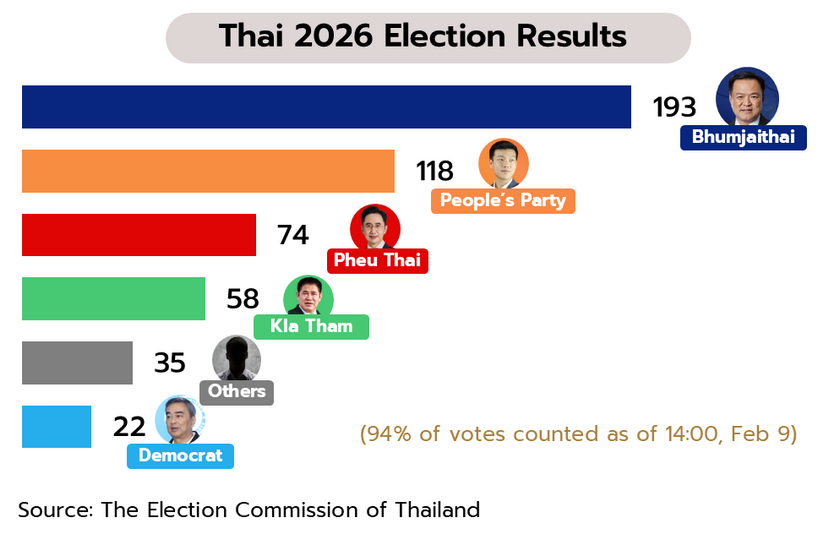
The Thai general election held on 8 February delivered a notable surprise. The Bhumjaithai Party emerged as the largest party in the House of Representatives, securing approximately 190–195 of the 500 seats. As the leading party in government formation, Bhumjaithai could secure a parliamentary majority with the Klatham Party (around 58 seats). Including the Pheu Thai Party (around 74 seats) and/or smaller parties would lift the governing bloc above 300 seats.

Based on the election outcome, a new administration is likely to be established in the near term, earlier than our previous expectation. The results also suggest a higher likelihood of political stability. Given the strong parliamentary majority, this should facilitate smoother budget approval and policy implementation, while improving investor sentiment. Overall, the political outcome may introduce upside to the economic outlook, but the magnitude of this upside remains limited by fiscal constraints, domestic structural headwinds, and external challenges.

Weekly Economic Review
 
Announced :10 February 2026
Back
Press keyword to search