
Global: Geopolitical tensions have intensified following U.S. and Israeli strike on Iran, which led to the deaths of Iran’s Supreme Leader and triggered retaliatory actions across the region. In case of prolonged or escalating conflicts, the global economy would be affected via three main channels: (i) higher energy prices and inflation especially if the Strait of Hormuz, a route carrying about 20% of global oil shipments, is disrupted; (ii) global trade and tourism could slow due to higher costs and increased risks; (iii) financial market volatility increases. If tensions ease and return to diplomacy, the economic impact may be limited. However, in a worst-case scenario—a prolonged military confrontation with the closure of the Strait of Hormuz and attacks on oil infrastructure, could severely disrupt global energy supply and pose significant downside risks to the global economy.
China: Lunar New Year helped spur economic activity, with holiday spending reaching a record high of CNY 804 bn (19% YoY). Meanwhile, the current U.S. effective tariff rates (ETR) on China have fallen to 29-31% from 39% in 4Q25, likely accelerating exports in the short term. However, the U.S. may impose additional tariffs, while China could tighten rare earth export controls to exert pressure on the U.S. This could further roil the global supply chain in the period ahead.
Economic activity in January was underpinned by both domestic and external demand. The Bank of Thailand reported strong merchandise export growth excluding gold (+18.1% YoY), led by electronics. Foreign tourist arrivals continued to increase (+3.3%). Private consumption (+7.6%) and investment (+8.3%) grew on temporary factors, notably EV subsidy measures. At the same time, public spending growth slowed, reflecting front-loaded effect in the preceding month.
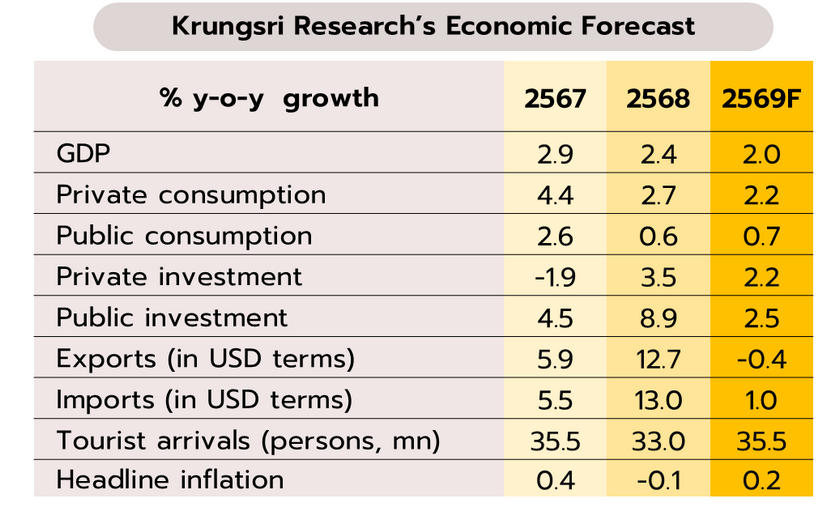
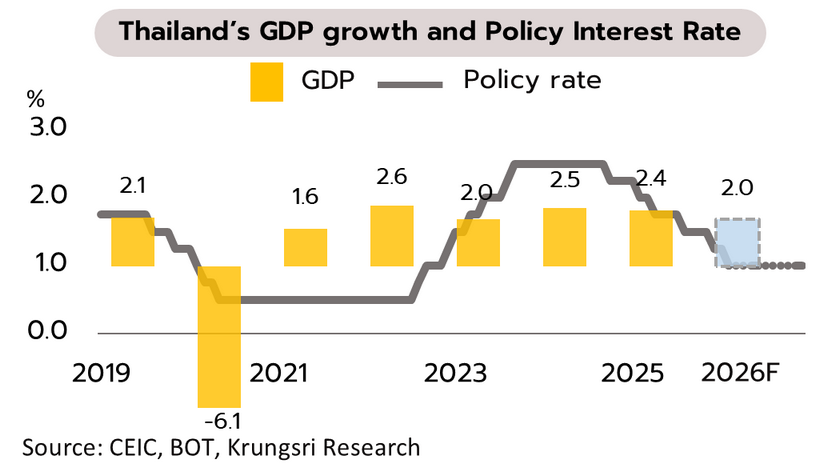
Although the Thai economy in early 2026 was supported by export growth and stimulus measures, the positive effects are expected to wane. Amid fiscal constraints and U.S. tariff headwinds, our 2026 GDP growth is projected to slow to 2.0% (from 2.4% in 2025), slightly above our previous 1.8% forecast. The outlook for key growth drivers is as follows: (i) Tourism should expand further, with arrivals rising to 35.5 million, though still below pre-COVID levels. (ii) Private investment would continue to grow amid record investment promotion applications to the BOI and improving sentiment given political stability. (iii) Despite an electronics upcycle, export growth will slow, hit by U.S. tariff effects. (iv) Private consumption faces structural headwinds, with its 2026 growth projected to decelerate to 2.2% from 2.7% in 2025. (v) Fiscal constraints may affect public spending, as total budget rose only 0.7% in FY2026 (vs. a 4.2% growth in FY2025).
In February, the MPC cut the policy rate earlier than expected amid weak growth, subdued inflation, and tight liquidity from credit contraction. We expect the rate to remain at 1.00% for the remainder of the year, a level the MPC views as sufficiently accommodative while preserving limited monetary policy space.