
Global and Thai Economy
Major central banks are expected to hold rates this week. Moody’s has upgraded Thailand’s rating outlook to Stable.
Global
Global: Despite a ceasefire extension and plans for renewed talks, U.S.-Iran tensions remains fragile. This is due to significant differences in the demands of both sides, as well as the use of military force to control energy transportation routes, which continues to pose risks to energy supply, production costs, and the cost of living. These pressures are already becoming evident in April’s economic data.
U.S. consumer confidence has declined sharply, services activity in Europe and Japan has slowed markedly, and inflationary pressures have reaccelerated across several economies. Together, these dynamics may constrain the scope for monetary easing in the period ahead. Major central banks—including the
Fed, ECB, and BOJ—are likely to hold rates this week as they await clearer geopolitical signals and assess downside risks to global growth.
China: Hi-tech exports show strong growth, especially electronics (+59.3% YoY in 1Q26) and the “New Three” industries (+52.3%), which include electric vehicles, solar panels, and lithium-ion batteries. In addition,
China is promoting related services to support advanced manufacturing as a key driver going forward via loan interest subsidies and government investment funds. Examples of these services include industrial software, R&D and logistics.
Thailand
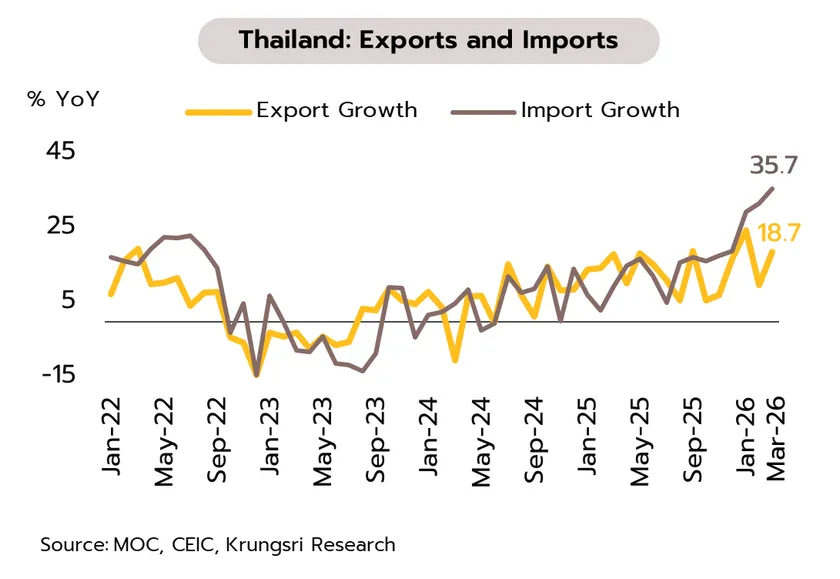
Thai exports expanded for the 21st straight month in March, driven in part by a temporary front-loading effect. This followed the U.S. replacing the 19% reciprocal tariff with a 10% tariff under Section 122. In March, export value grew by 18.7% YoY to USD 35.2 billion, while imports surged by 35.7% to USD 38.5 billion, resulting in a trade deficit of USD 3.3 billion.
Looking ahead, exports face headwinds from Middle East tensions, which have disrupted raw material supplies, weakened regional demand, and increased production and transportation costs. In addition, the U.S. has initiated a Section 301 investigation into Thai goods, potentially leading to further tariffs on targeted products, posing risks to the export and manufacturing sectors.
Moody’s has upgraded Thailand’s rating outlook to ‘stable’ from ‘negative’, citing (i) easing impacts from U.S. import tariffs, (ii) a recovery in investment momentum, and (iii) improved political stability supported by a sizeable parliamentary majority. The agency affirmed Thailand’s credit rating at Baa1. Nevertheless,
Thailand’s economic and fiscal outlook remains subject to pressure from the Middle East conflict. Meanwhile, measures to mitigate the energy crisis may further strain fiscal conditions going forward.