
Global and Thai Economy
Houthi escalation in the Red Sea intensifies the war, while Thailand’s exports are set to slow amid Middle East tensions.
Global
Global: Middle East tensions are already being felt across of the U.S., the Eurozone, and Japan. Although the U.S. has postponed its planned strike on Iranian power grid to April 6 and proposed a 15-point peace plan, Iran has refused direct negotiations unless the U.S. guarantees no further attacks. Meanwhile, the Houthi’s involvement and threats to close the Bab el-Mandeb Strait could prolong the conflict and the energy crisis.
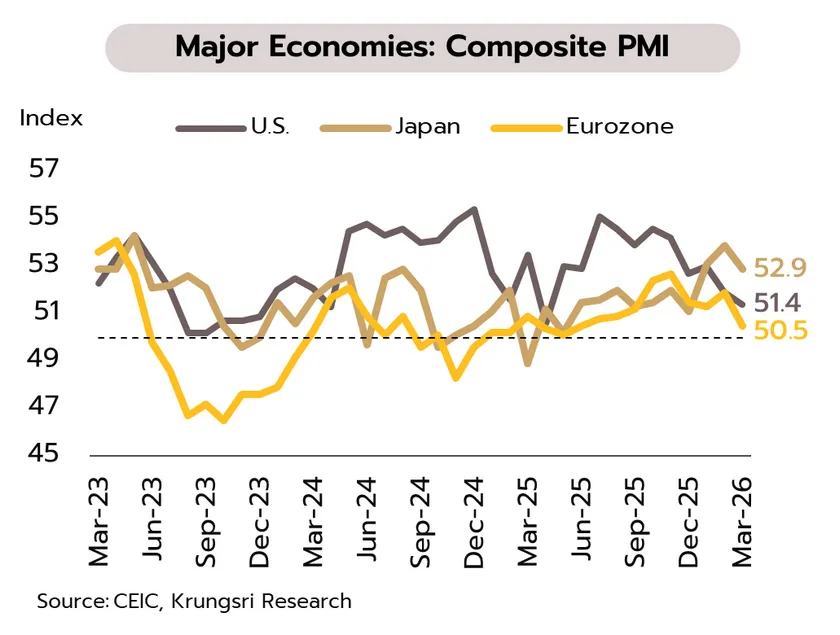
The economic impact is becoming more pronounced. Flash composite PMI for the U.S., Eurozone, and Japan in March fell to their lowest levels in 11, 10, and 3 months, respectively—driven in particular by a clear slowdown in the services sector. This is compounded by rising cost pressures from higher energy prices and supply chain disruptions, as reflected in longer supplier delivery times and declining business confidence.
China: Oil shock impacts begin to materialize, despite its robust buffer. The price ceilings for diesel and gasoline were raised by a record THB 4.45 and 4.02 per liter on March 24.
Without these caps, diesel and gasoline price ceilings could have risen by THB 8.45 and 7.64 per liter, under the current price-adjusting mechanism. Higher oil prices will exert pressure on the cost of living, already-weak demand and petroleum-reliant firms.
Thailand
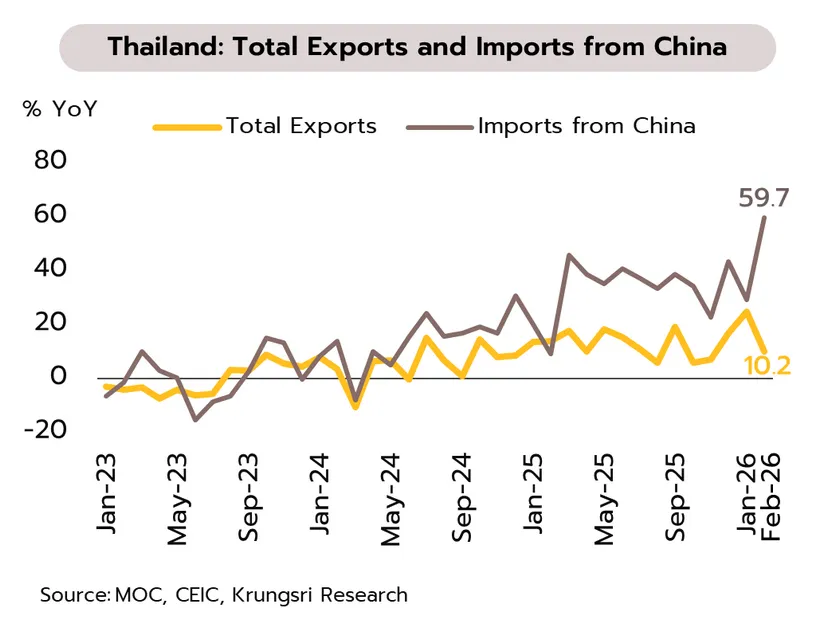
Thailand’s exports continued expanding for a 20th consecutive month but showed signs of moderation, rising 9.9% YoY to USD 29.4 bn in February, driven by electronics (+49.8%) and automotive shipments (+6.3%). The strong growth was also seen in exports to the U.S. (+40.5%) and Japan (+9.7%). Imports outpaced exports, increasing 31.8% to USD 32.3 bn, resulting in a trade deficit of USD 2.8 bn.
Despite support from the electronics upcycle, export growth slowed significantly from January’s +24.4%. This contrasts with accelerated imports, particularly from China (+59.7% in February). In the near term, exports may be supported by front-loading effects following the replacement of a 19% reciprocal tariff with a 10% tariff under Section 122. However, such gains are likely to be short-lived as the US has launched a Section 301 trade investigation into Thailand, with potential tariffs on key exports -- automobiles and parts, rubber, and machinery— which account for 8.5%, 4.1%, and 3.4% of Thai exports, respectively. Moreover, export performance faces mounting headwinds from the Middle East tensions, disrupting key raw material supplies (petrochemicals), weakening demand from the region (passenger vehicles), and raising production and transportation costs.