
Weekly Economic Review

Weekly Economic Review

19 May 2026

Global and Thai Economy


Financial markets remain cautious after Trump-Xi summit; Thai 1Q26 GDP +2.8%, momentum may soften ahead


Global


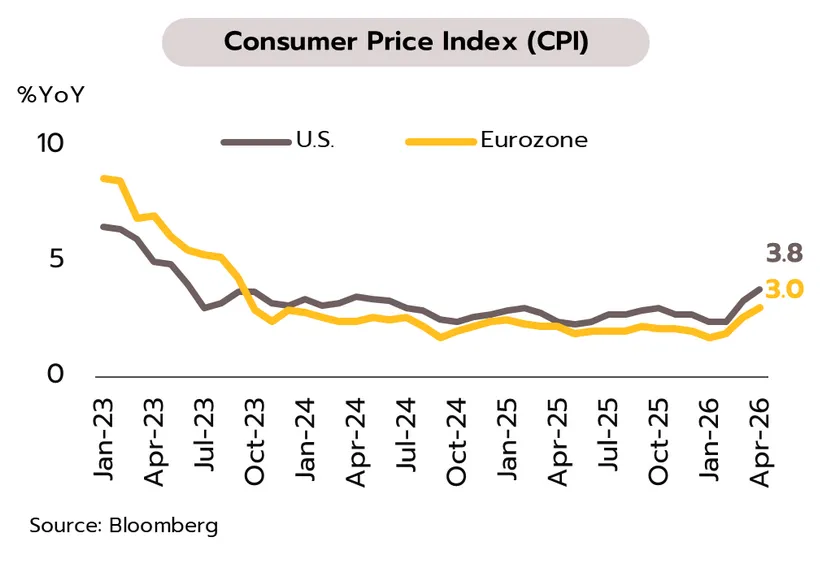
Global: Markets disappointed as U.S.–China talks in Beijing yielded no breakthroughs. Both sides agreed to strengthen cooperation under a framework of managed competition, ease geopolitical tensions, and support trade and investment. However, financial markets remained cautious amid limited details on tariff policies and tensions surrounding the Strait of Hormuz. Meanwhile, inflationary pressures stemming from heightened tensions in the Middle East have become more evident across major economies. In April, consumer inflation in the U.S. and the Eurozone accelerated to 3.8% YoY and 3.0% — the highest levels in 35 and 31 months, respectively — while U.S. producer inflation rose to a 40-month high of 6.0%. Rising inflation is increasing risks of slower economic growth and limiting the scope for monetary policy easing in the period ahead.

Weekly Economic Review

China: Trump’s recent visit to China signals an attempt to ease tensions based on “strategic stability” and “measured competition.” The preliminary promises include tariff reductions, increased purchases of certain goods, and the establishment of the “Board of Trade.” However, such efforts might prove fragile, and trade tensions could reignite through tariffs and export controls. Eventually, economic decoupling will continue.


Thailand


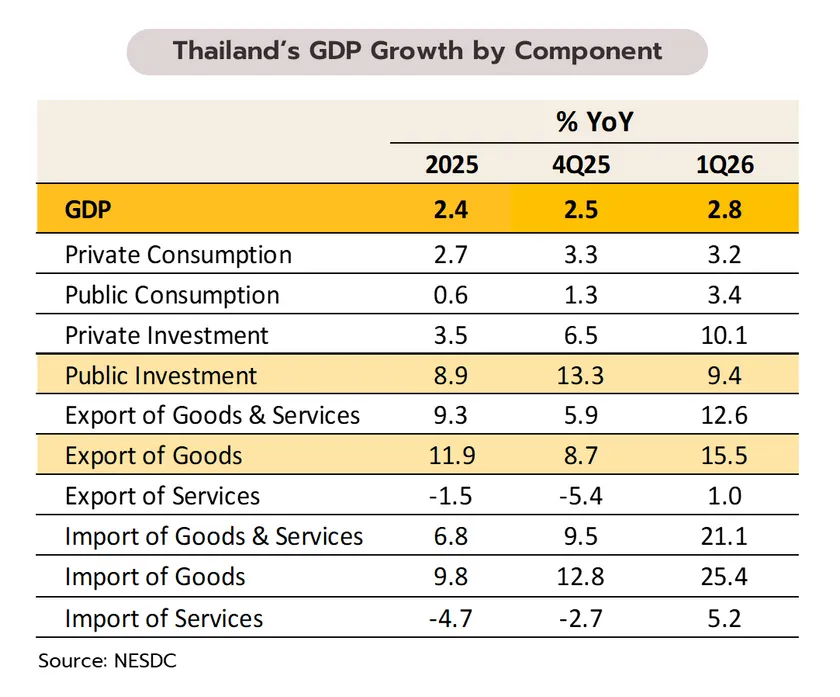
Thailand’s 1Q26 GDP surprised on the upside, supported by temporary factors but momentum may weaken. The NESDC reported GDP grew by 2.8% YoY in 1Q26, up from 2.5% in 4Q25 and surpassing both Krungsri Research’s and market expectations of 2.3% and 2.2%, respectively. Growth was driven by private consumption and investment, public consumption, and exports of goods and services. However, imports surged in 1Q26 while Thailand posted the first trade deficit in 14 quarters. The NESDC projected 2026 GDP growth at 1.5–2.5% (a median of 2.0%), incorporating the impact of Middle East tensions and domestic stimulus measures.

The stronger-than-expected growth in 1Q26 was supported by temporary factors, including (i) front-loaded exports amid U.S. tariff uncertainty, (ii) front-loaded purchases of EVs, (iii) rebounding private investment following the election, and (iv) inventory accumulation. Looking ahead, despite policy support from mid-2026, the economy is set to lose momentum as Middle East tensions raise energy costs, disrupt supply chains, and weigh on tourism. Krungsri Research expects a quarter-on-quarter GDP contraction in 2Q26.
 
Weekly Economic Review
 
Announced :19 May 2026
Back
Press keyword to search