
Weekly Economic Review

Weekly Economic Review

5 January 2026

The Thai Economy in 2025 and Outlook for 2026


In 2025, despite strong export growth, overall economic expansion is weighed down by structural problems and multiple headwinds


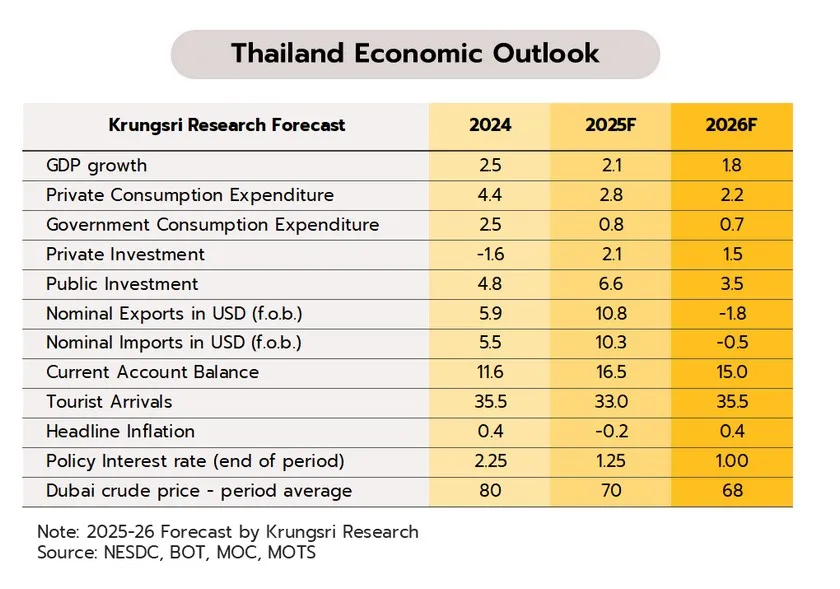
The Thai economy is expected to grow by 2.1% in 2025, slowing from 2.5% in 2024. This comes despite exports benefiting from front-loading ahead of the implementation of new U.S. import tariffs. Nevertheless, overall economic growth was constrained by stalled tourism recovery, weak domestic spending, and subdued business investment, amid heightened concerns over several risk factors, including the March earthquake, U.S. tariff hikes, the Thai–Cambodian border tension, rising domestic political uncertainty, and severe flooding in the southern region. 

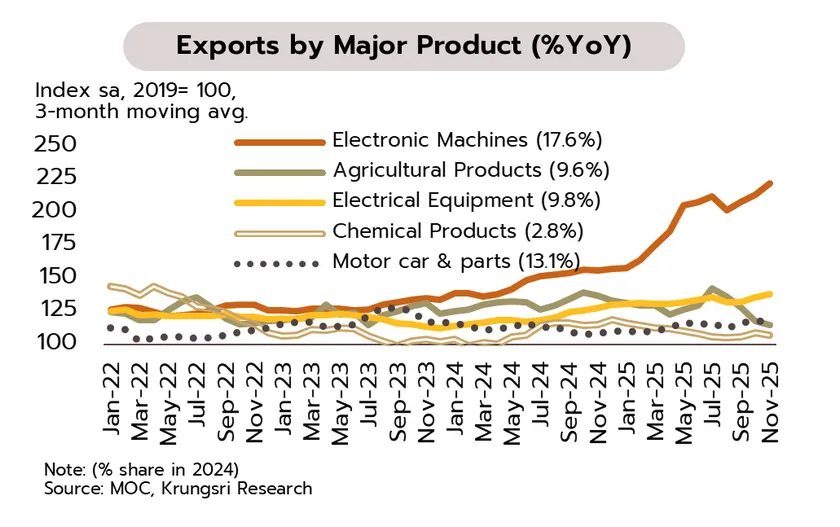
Thai exports grew surprisingly on temporary factors with expected growth of 10.8% in 2025, up from 5.9% in 2024, amid front-loaded shipments and rising demand for technology and electronic products driven by investment in the AI industry. However, export momentum began to fade after the U.S. raised import tariffs to 19% in August. 

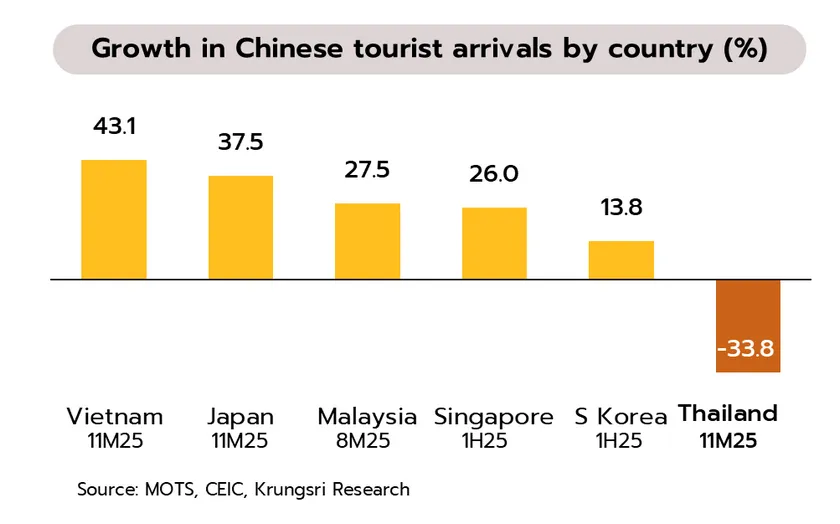
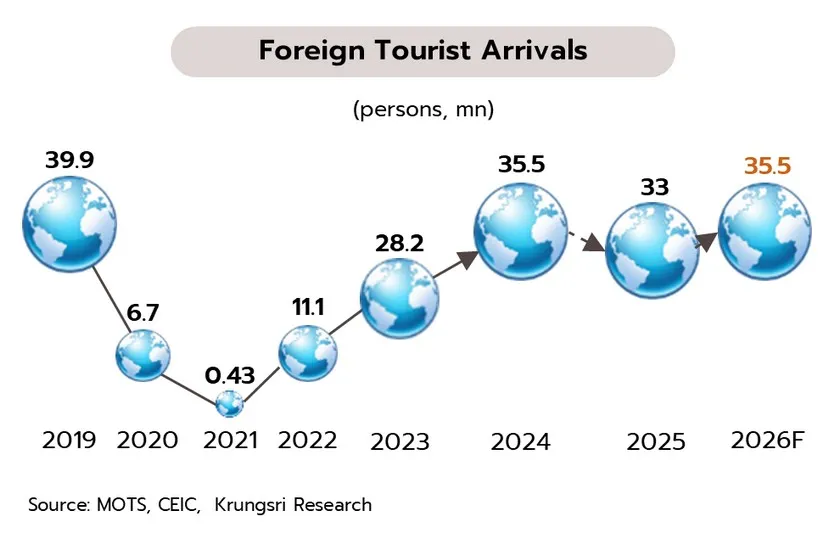
The tourism recovery stalled for the first time since the post-COVID rebound, due to safety concerns and scam-related issues, the March 28 earthquake in Bangkok, and intensifying competition from regional peers. As a result, the number of tourist arrivals declined to 33 million in 2025, from 35.5 million in 2024. 
 
Weekly Economic Review
 

Government spending provided limited support to the economy. Public consumption and investment contracted sharply in 3Q25 amid rising political tensions during the Prime Minister change in August. Although additional stimulus measures were introduced in 4Q25, the dissolution of parliament in December heightened concerns over delays in budget disbursement. 

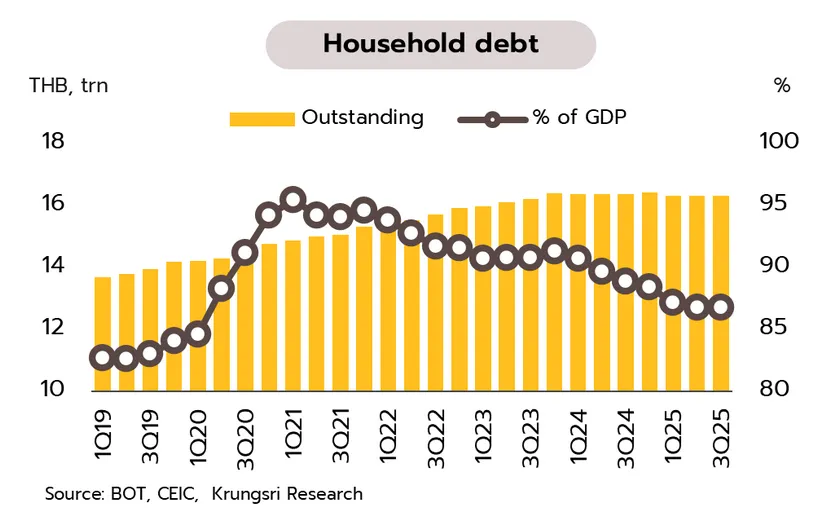
Despite stimulus measures, private consumption growth slowed to an estimated 2.8% in 2025, from 4.4% in 2024. Short-term stimulus measures included the THB 10,000 cash handout, cost-of-living relief for low-income households, Co-payment Plus program, and tourism tax incentives. However, declining farm income and structural constraints stemming from high household debt continue to weigh on domestic spending.

Private investment improved from low-base effect, with expected growth of 2.1% in 2025, compared with -1.6% in 2024. Although there were partial signs of recovery, growth remained suppressed by concerns over domestic political uncertainty, the impact of U.S. tariffs, low-capacity utilization, and a slow recovery in the tourism sector. 
Weekly Economic Review
 

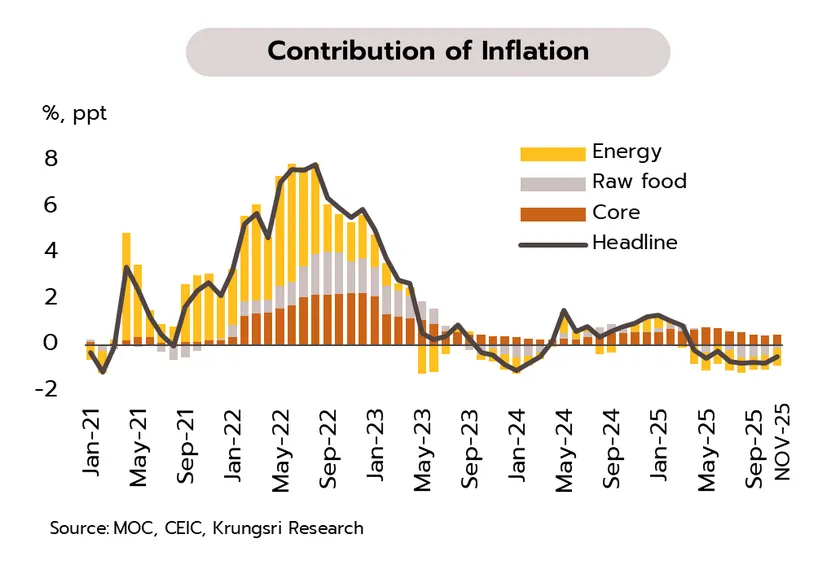
Headline inflation was negative in 2025, aligning with weak domestic demand amid lower prices of fresh food, energy, and electricity charges, as well as subsidies on energy prices. As a result, the annual inflation rate averaged at -0.2%, down from 0.4% in 2024. Against the backdrop of low inflation and a slowing economy, the Monetary Policy Committee (MPC) eased the policy interest rate by a total of 100 basis points in 2025 to 1.25% aimed to support the economic recovery, ease debt burdens for vulnerable groups, and enhance the effectiveness of additional monetary and fiscal policy. 

The Thai baht appreciated to a four-year high of 31.5 baht per U.S. dollar toward the end of the year, strengthening by more than 8.5% in 2025. This was supported by U.S. dollar weakness amid expectations of Fed rate cuts, as well as gold prices surging to record highs. The Bank of Thailand (BOT) is considering regulatory measures on gold trading volumes, such as setting transaction caps on online gold trading platforms, as part of efforts to manage baht strength going forward.
 
Weekly Economic Review


Thailand’s economic outlook for 2026: In the shadow of transitions
 

Thailand’s economy in 2026 is expected to be a year of “stabilization” rather than accelerated growth, as it faces headwinds from a slowing global economy, intensifying trade protectionism, domestic structural vulnerabilities, and rising political uncertainty during the general election. Krungsri Research projects Thailand’s GDP growth at only 1.8% in 2026, slowing from an estimated 2.1% in 2025.

Exports may face full-year impact of U.S. tariff hikes and product-specific duties. Temporary support from front-loaded exports is also expected to fade, with potential transshipment tariffs posing further downside risks. As a result, Thai exports are expected to contract by 1.8% in 2026. Public expenditure is likely to slow due to tight fiscal space and political uncertainty. The FY2026 budget allocates slightly lower current and capital expenditures, while a caretaker government budget disbursement and public investment may be delayed during the first half of 2026. Private consumption continues to face weak purchasing power and structural problem, amid household debt remaining above 80% of GDP, sluggish income recovery, weak farm income, and impacts of export weakness in employment. 
Weekly Economic Review  

Meanwhile, positive impacts from previous short-term stimulus schemes—Digital Wallet, Co-payment Plus programs, tourism tax incentives—will fade, leaving households reliant on slow-growing regular income. As a result, private consumption growth is expected to slow to 2.2% in 2026. 

On the positive side, tourism may regain a role of key growth support, with international tourist arrivals expected to reach 35.5 million in 2026, supported by more winter flights and new routes from China and India. However, recovery is slow—especially from China, due to safety concerns and rising competition—keeping arrivals below the pre-COVID level of 40 million. Private investment is expected to maintain momentum, albeit at a slow pace, supported by: (i) Rising BOI-approved project value, continued FDI inflows (especially in digital, EV, and renewable energy); (ii) Streamlined procedures through the BOI’s Thailand FastPass mechanism; and (iii) Ongoing supply-chain shifts from China to ASEAN, including Thailand. 

Headline inflation may return positive in 2Q26 but stay below the BOT’s target of 1-3% in 2026. The annual inflation rate average is projected at just 0.4%, amid stable global oil prices, continued energy cost-relief measures, and weak domestic demand.
 
Weekly Economic Review
 

Given weak growth momentum, low inflation, and tight liquidity conditions, Krungsri Research expects the policy interest rate to be cut by 25 basis point to 1.00% in the first half of 2026, as a counter-cyclical policy to help mitigate downside risks—particularly during the caretaker government period, when fiscal stimulus may be limited. 

Overall, 2026 will be a year of navigating through uncertainty, both domestic and global. While tourism, FDI, and some domestic demand will provide support, significant risks remain: (i) Intensifying  global trade tensions, uncertain U.S. economic policies, and geopolitical risks, (ii) Twin influx risk from surging Chinese imports and U.S. goods under trade agreements, pressuring Thai producers, (iii) Climate volatility affecting farm incomes, (iv) Structural issues such as high household debt and eroding competitiveness in some industries, (v) Policy uncertainty and political risk. These factors underscore the need for careful management to withstand multiple pressures in 2026.
 
Weekly Economic Review
 
Announced :05 January 2026
Back
Press keyword to search