
Global and Thai Economy
Geopolitical tensions increase global economic risks. Thailand’s tourism sets for gradual recovery, while inflation remains subdued.
Global
U.S.: Military actions against Venezuela and threats to seize Greenland reflect a strategic shift toward power politics. While the U.S. may seek gains from access to Venezuela’s oil industry, realizing such benefits will take time due to infrastructure constraints and large investment requirements. In the short term, impacts on global economy and energy prices should be limited, as Venezuela’s crude oil output accounts for less than 1% of global supply.
However, if U.S. intervention extends to Greenland or other regions, such as the Middle East, global economic risks will increase. In particular, small-open economies like ASEAN could be affected by heightened financial volatility, higher risk premiums, and deteriorating sentiment, eventually slowing foreign direct investment.
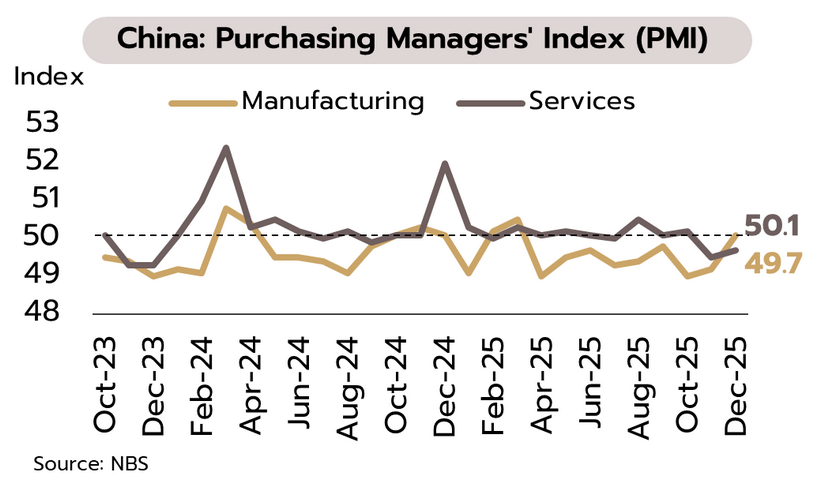
China: Economy remains fundamentally weak. While manufacturing expanded for the first time in nine months, services continued to contract. Additionally, headline inflation has remained below 1% for 34 straight months, in line with a three-year decline in the Producer Price Index.
Such data show that weak domestic demand and excess supply continue to weigh on the economy. Meanwhile, the government is likely to issue additional stimulus, especially at a time when exports visibly lose momentum.
Thailand
Foreign tourist arrivals expected to rebound to 35.5 mn in 2026 from 33 mn in 2025. In December 2025, foreign tourist arrivals stood at 3.37 mn (-7.1% YoY). 2025 arrivals declined for the first year since the post-COVID rebound, by -7.2% to 32.97 mn, while tourism revenue fell by -4.7% to THB 1.53 trn.
In 2026, tourism is expected to play a greater role in driving the economy, with foreign arrivals projected to rise to 35.5 mn, supported by increasing flights and new routes from China and India. However, the recovery would be gradual, especially in the Chinese market due to safety concerns and intensifying competition, keeping total arrivals below the pre-COVID level of 39.9 mn in 2019.
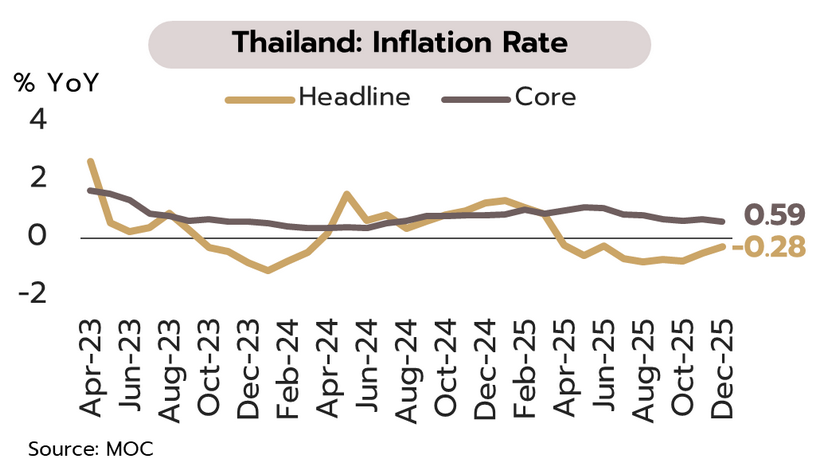
Krungsri Research expects 2026 inflation to remain low at 0.4% after first negative rate in five years in 2025. Headline inflation stood at -0.28% YoY, posting negative rate for the ninth straight month, while core inflation (excluding raw food and energy) slowed to 0.59%. For 2025, average headline and core inflation were -0.14% and 0.84%, respectively.
2026 headline inflation may turn positive in Q2, but still below the BOT’s 1-3% target range, averaging at an estimated 0.4% for the year, amid global oil prices broadly in line with the previous year, energy price subsidies, and weak domestic demand.