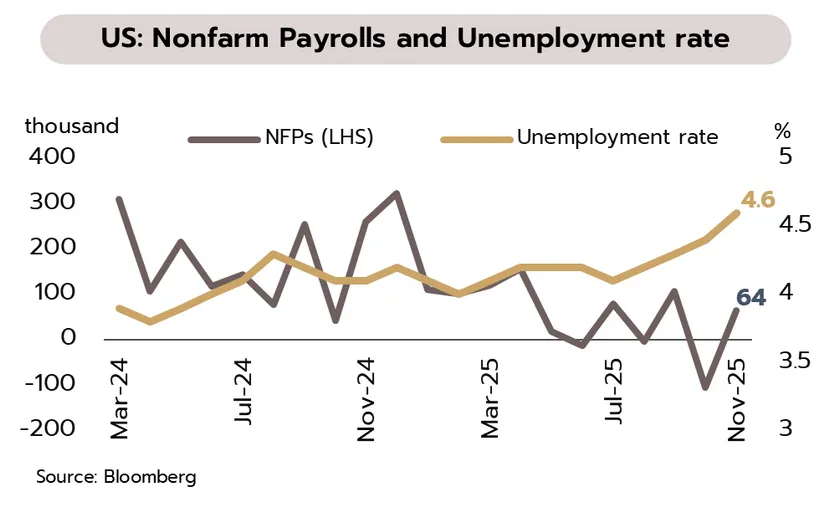

The U.S. economy still faces downside risks, but inflationary pressures may limit further rate cuts. Although nonfarm payrolls rose by 64,000 in November following a 108,000 drop in October, the unemployment rate rose to 4.6%. Meanwhile, growth of average hourly earnings continued to decelerate to its lowest level since February 2021. Headline and core inflation in October eased to 2.7% YoY and 2.6%, respectively, but both remain above the Fed’s long-term target of 2%.
The latest indicators continue to signal an economic slowdown, such as retail sales growth slowing to a five-month low, weak consumer confidence, the deepest contraction of manufacturing PMI in five months, and the unemployment rate rising to its highest level since September 2021. However, the risk of a sharp economic downturn remains low, given ongoing expansion in the services sector and fiscal policy support. In addition, the Fed’s plan to purchase USD 40 bn in Treasury bills per month and earlier policy rate cuts are expected to help support growth momentum. Against this backdrop, Krungsri Research expects the Fed to deliver only one additional rate cut in 2026.
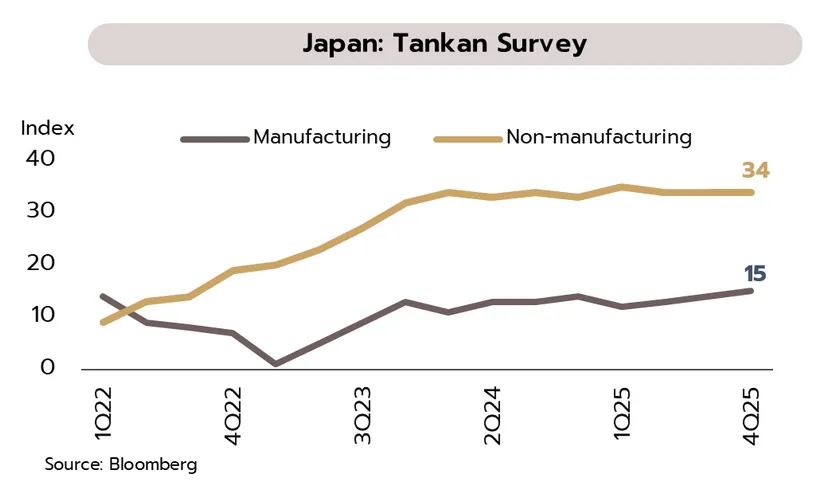
BOJ raises policy rate to a 30-year high amid improving economic conditions and lingering inflation risks. The BOJ raised its policy rate by 25 bps to 0.75%, the highest level in 30 year, and signaled openness to further tightening if economic and inflation conditions evolve in line with its projections. The Tankan index for large manufacturers rose to a four-year high of 15.0 in 4Q25, while the services sector index remained elevated at 34, close to its strongest level since 1990. Meanwhile, exports expanded for a third consecutive month in November, rising 6.1% YoY—the fastest pace in eight months.
Japan’s economic outlook has improved, underpinned by (i) a marked improvement in sentiment among large enterprises, (ii) a services PMI that remains firmly in expansionary territory, (iii) continued growth in the tourism sector, and (iv) a recovery in exports. Furthermore, fiscal stimulus measures and planned wage increases are expected to provide additional support to the economic recovery in the period ahead. Krungsri Research assesses that if economic outlook remains positive and inflation risk—currently hovering around 2.7–3.0% —remains, the BOJ may proceed with gradual and measured policy rate hikes in 2026.

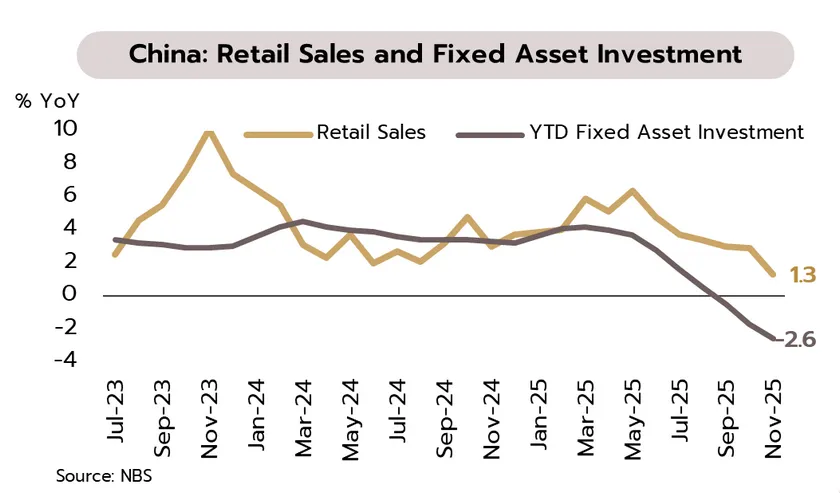
China’s economic momentum has continued to weaken. Retail sales grew by just 1.3% YoY in November, hitting a record low (excl. the COVID period). Fixed asset investment fell further from -1.7% in the first ten months to -2.6% in the first eleven months. Meanwhile, new and second-hand home prices have continued to decline by -2.8% and -5.7%, respectively. In addition, the property crisis has signaled spillover risks to the financial sector, following missed payments by the shadow banks. On another front, the government announced a plan to issue ultra-long-term special government bonds to subsidize trade-in and equipment upgrade programs.
Manufacturing, consumption, investment, and exports have visibly weakened. The property sector is showing stronger negative signs, including a continuous fall in home sales and prices, developers’ liquidity problems, and risks from shadow banks. We expect that, despite the recent expansion, exports risk encountering protectionist measures from other countries, beyond the U.S. Meanwhile, the Chinese New Year festival and stimulus measures may support consumption only temporarily and in some areas. Overall, the economic recovery will remain fragile in the coming period.


MPC cuts policy rate to a three-year low of 1.25%, signaling prolonged low growth and rising downside risks. At the Monetary Policy Committee (MPC) meeting on 17 December, the Committee unanimously voted to cut the policy rate by 25 bps to 1.25%. The MPC viewed that, amid a clear economic slowdown and rising risks, monetary policy could be further eased, in order to ensure that financial conditions support the economic recovery and help alleviate debt burdens for vulnerable groups, while also enhancing the effectiveness of financial measures and other government policies.
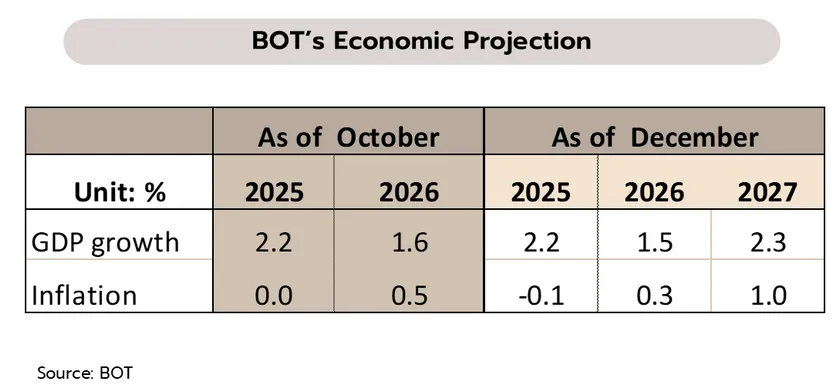
The MPC assesses that the Thai economy is clearly slowing amid rising downside risks. The BOT maintains its GDP growth forecast for this year at 2.2%, before revising down its projection for 2026 to 1.5% (from a previous estimate of 1.6%), followed by a recovery to 2.3% in 2027. For 2026, private consumption is expected to decelerate in line with weaker income growth, while merchandise exports are likely to be affected by U.S. tariff measures. Meanwhile, the tourism sector is projected to recover a gradual pace. Headline inflation is expected to remain low, with projections of –0.1% in 2025, 0.3% in 2026, and 1.0% in 2027, reflecting lower global energy prices, ongoing cost-of-living support measures, and limited demand-side inflationary pressures. The MPC has also emphasized the need to closely monitor deflation risks. Against the backdrop of economic growth remaining below potential, tight financial conditions—evidenced by contracting credit—and a diminishing role of fiscal policy support during the caretaker government period, monetary policy should serve as one of the key tools to help support economic momentum and mitigate downside risks, acting as a counter-cyclical policy. Accordingly, Krungsri Research expects the MPC to further cut the policy rate by 25 bps to 1.0% by the first half of 2026.
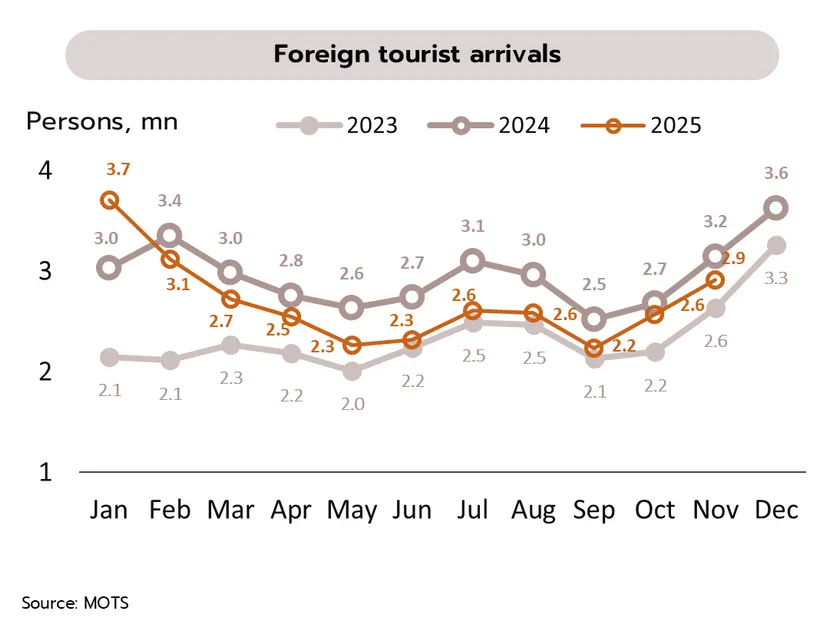
Tourism recovers gradually, with foreign arrivals projected to rise to 35.5 mn in 2026. In November, foreign tourist arrivals to Thailand totaled 2.91 mn, representing a 7.5% YoY decline. As a result, total foreign arrivals in the first 11 months of 2025 stood at 29.6 mn, down 7.3%. Meanwhile, the latest data for 1–14 December show an additional 1.37 mn foreign arrivals, bringing the cumulative total since the beginning of the year to 31.0 mn. Going forward, the recovery in the second half of December warrants close monitoring, as there remains a risk that total foreign tourist arrivals for 2025 could fall short of Krungsri Research’s forecast of 33.3 mn.
For 2026, Thailand’s tourism sector is expected to recover only gradually, as it continues to face several constraints, including safety concerns among Chinese tourists, heightened tensions along the Thai–Cambodian border, intensifying competition from other regional tourist destinations, and a stronger baht relative to key competitors. Nevertheless, support from the recovery in global tourism, along with expanded international flight routes and increased flight frequencies, should help underpin Thailand’s tourism sector going forward. Overall, foreign tourist arrivals in 2026 are projected to rise to 35.5 mn, signaling a rebound toward levels seen in 2024, amid vulnerability to both domestic and external risk factors.