
U.S. Fed delivered a rate cut, as expected, but the policy outlook remains uncertain. At its December 9–10 meeting, the Fed voted 9–3 to reduce the policy rate by 25 bps to 3.50–3.75%. and announced the resumption of U.S. Treasury purchases starting December 12. The Fed also revised up its GDP growth forecasts for 2025 and 2026 from 1.6% and 1.9% to 1.7% and 2.3%, respectively. The Fed’s Dot Plot suggests one additional 25-bp rate cut in 2026 and another in 2027, bringing the long-run policy rate to 3%.
Although the U.S. economy is slowing, there are no signs of a severe downturn. This is reflected in continued consumption growth, a still-stable labor market, and an expansion in the services sector, alongside support from fiscal policy and investment in AI-related technologies. In addition, the Fed’s plan to purchase USD 40 bn in Treasury bills per month is expected to support financial market liquidity. Together with earlier rate cuts, these factors should help cushion downside risks to economic activity. As a result, Krungsri Research expects the Fed to deliver only one additional rate cut in 2026.

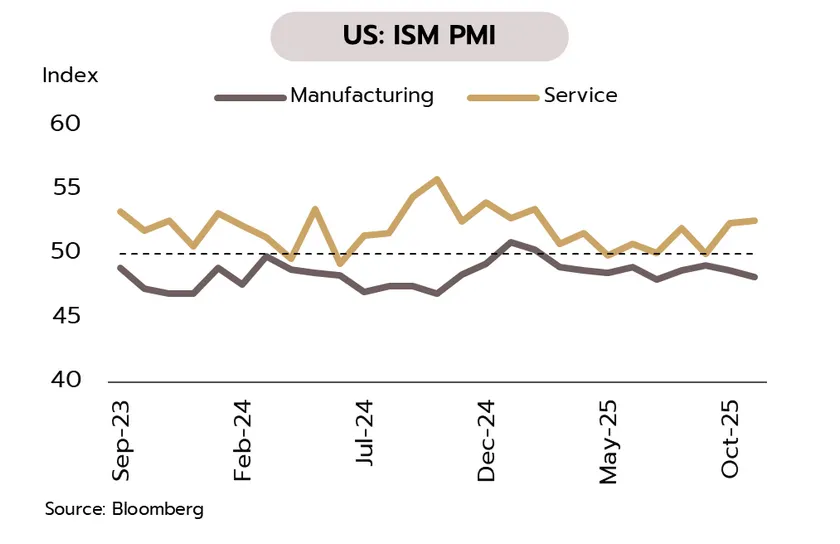
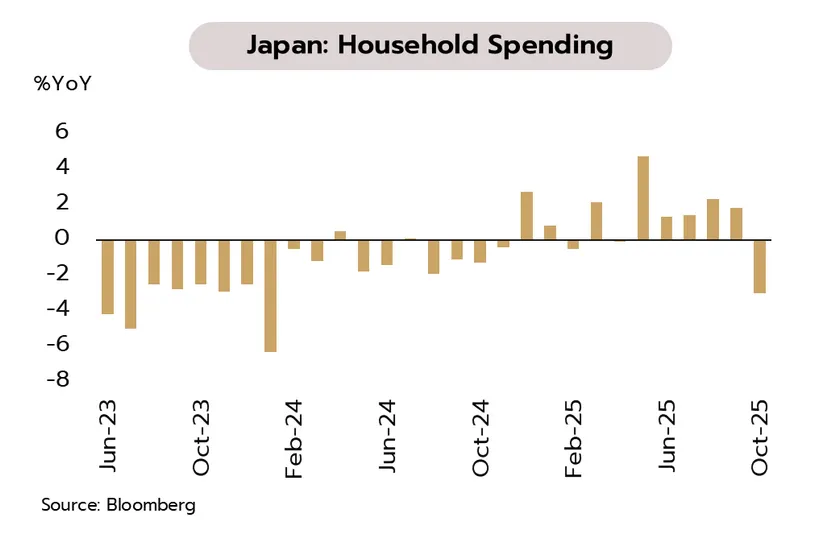
Although economic indicators remained weak in 3Q25, several factors support the prospect of a rate hike in December. In November, the manufacturing PMI contracted for a fifth consecutive month to 48.7, while the services PMI remained in expansionary territory for the eighth straight month at 53.2. In 3Q25, GDP contracted for the first time in 6 quarters at -0.6% QoQ, reflecting weaker business investment amid uncertainty over U.S. tariffs and weak exports. Household spending also fell sharply, posting its steepest decline since January 2024 at -3.0% YoY.
Japan’s economy slipped into contraction in 3Q25 as business spending declined and consumption remained pressured by elevated inflation. However, the economic outlook is expected to gradually improve, supported by the Takaichi government’s stimulus package worth JPY 21.3 trn—the largest since the COVID-19 crisis—aimed at addressing inflation and promoting investment. Against this backdrop, and with inflation remaining elevated, Krungsri Research assesses that the Bank of Japan (BOJ) is likely to raise the policy rate by 25-bps to 0.75% at its December 18–19 meeting.

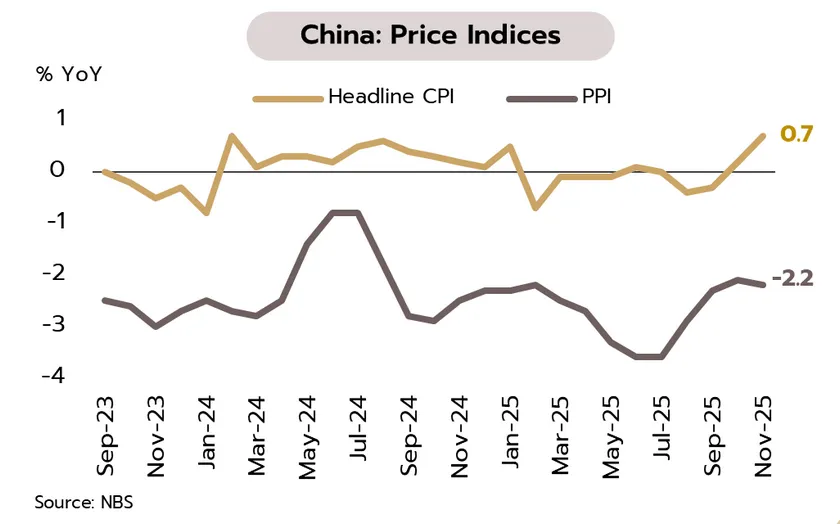
China’s Economy: Weak Within, Threatened Without. Headline inflation in November has remained below 1% YoY for more than 30 months, while the Producer Price Index (PPI) has contracted for nearly four years. Meanwhile, exports rebounded to 5.9% in November from -1.1% in October. A decline in exports to the U.S. accelerated from -25.2% to -28.2%, despite the U.S.-China trade truce in early November. In contrast, exports to other partners saw robust growth, including the EU (14.8%), ASEAN (8.2%), and Africa (27.6%).
The domestic economy shows no signs of recovery in the near term, while exports, which have continued to support growth, face rising risks from trade protectionism. Recently, Mexico voted to approve tariffs on Asian nations, reaching as high as 50% on certain goods. The EU is also considering tariff hikes on Chinese goods. Meanwhile, the government continues to prioritize stimulating consumption and supporting the New Quality Productive Forces in 2026. Nevertheless, such measures may be constrained by concerns over government debt. In addition, using ‘drastic measures’ to eliminate excess supply may affect the labor market and exacerbate weakness in consumption.


The recent House dissolution has implications for Thai economic outlook across multiple dimensions. On 11 December 2025, Prime Minister Anutin Charnvirakul announced the dissolution of the House of Representatives, earlier than the previously expected timeline in late January 2026. This move resets Thailand’s political cycle and triggers a snap election within the constitutionally mandated 45–60 days, likely around early February 2026, with a new government potentially formed by May-early June.
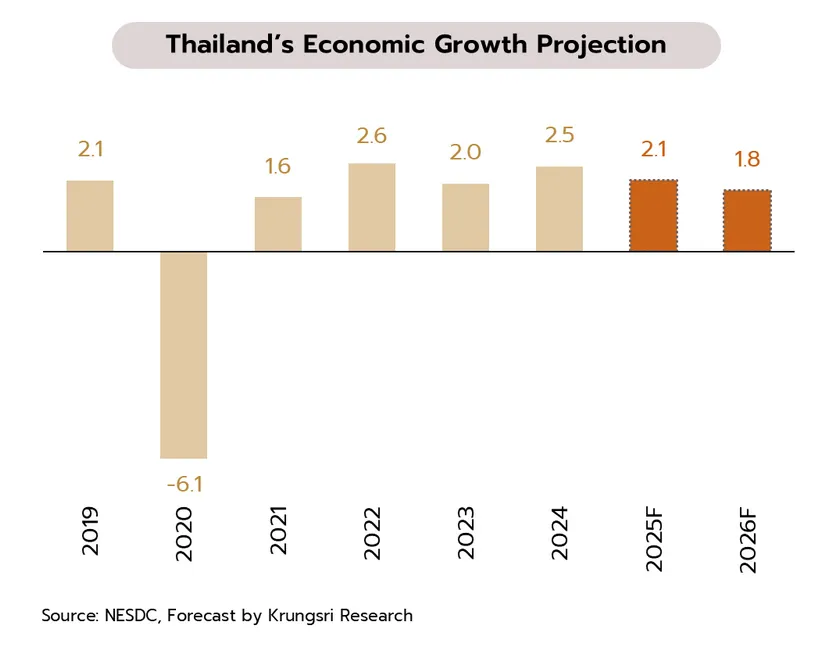
The political transition has significantly heightened policy uncertainty, as the caretaker government faces constraints in implementation of additional stimulus measures, as well as the approval and disbursement of budgets for new public investment projects. As a result, overall economic momentum is likely to soften. At the same time, the political vacuum may weaken Thailand’s capacity to conduct diplomacy and engage in trade negotiations, amid ongoing external pressures and domestic structural challenges. Against this backdrop, Krungsri Research expects Thailand’s economy to slow in the first half of 2026. However, assuming a new government can be formed by May-early June, economic momentum could improve in the second half of the year, supported by the rollout of stimulus measures, the resumption of policy implementation, and the timely preparation of the FY2027 budget. Under this baseline scenario, Krungsri Research maintains our forecast that the Thai economy will grow by 1.8% in 2026, down from an estimated 2.1% in 2025. Downside risks could rise if political uncertainty persists or government formation is delayed, weighing further on the economic recovery.
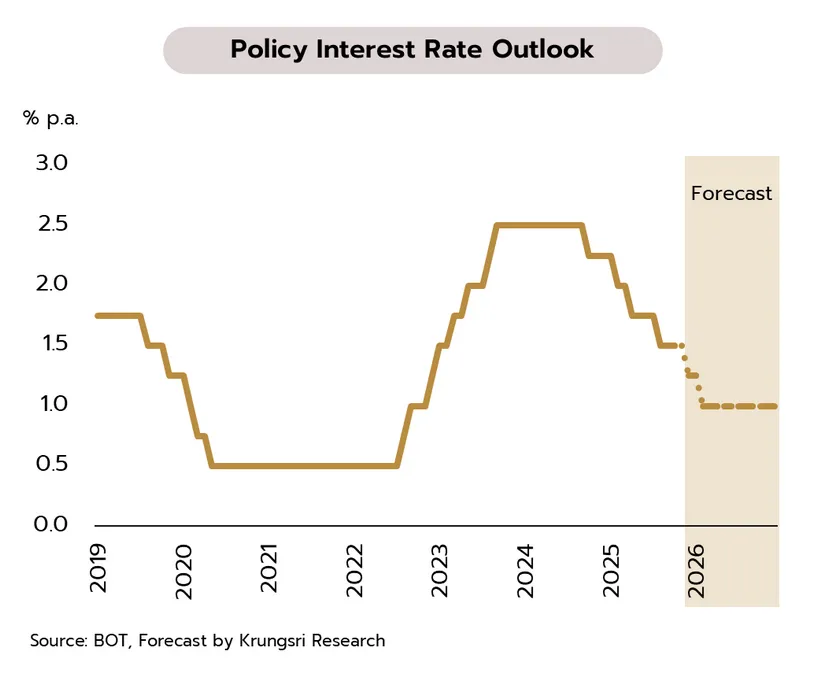
MPC may cut the policy rate to 1.25% at its final meeting of the year, amid economic pressures and political risks. At the Monetary Policy Committee (MPC) meeting scheduled on 17 December, Krungsri Research expects the MPC to cut the policy rate to 1.25%, marking the fourth rate cut this year. This assessment is based on several factors. (i) Thai economy has clearly slowed, with GDP contracting for the first time in nearly three years in 3Q25 (–0.6% QoQ sa), reflecting a loss of growth momentum. While economic activity in the final quarter of the year may receive a temporary boost from stimulus measures such as the Half-Half Copayment Plus and Tourism tax incentive programs, these positive effects are likely to be partly offset by impacts of severe flooding in the southern region. (ii) Inflationary pressures remain subdued, with headline inflation in 2025 expected to average slightly negative at around –0.2% and likely to stay below the BOT’s target range of 1–3% throughout 2026. (iii) For a financial stability front, businesses and households continue to face elevated debt burdens, while private-sector credit has contracted for several consecutive quarters. (iv) For the recent political developments, the caretaker government status could delay budget disbursement and new public investment projects, further weakening economic momentum from late 2025 onward. Under these fiscal constraints, monetary policy is expected to play a more prominent role as a counter-cyclical policy to support the economy during the transition period. As a result, Krungsri Research sees a rising likelihood that the MPC could further cut the policy rate from the current 1.50% to 1.00% by the first half of 2026.