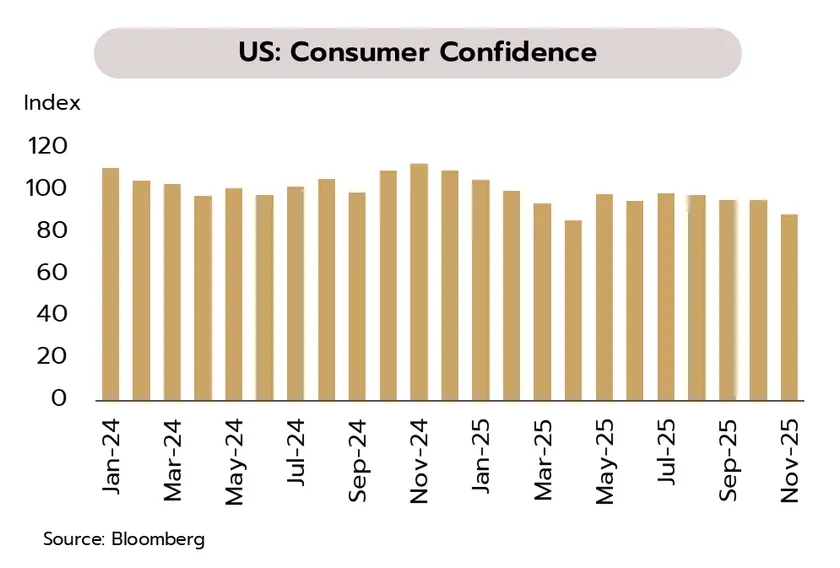

Softening U.S. economic data strengthen the case for a Fed rate cut later this year. Retail sales grew 4.26% YoY in September, slowing from 5.02% in August. Consumer confidence index declined to a seven-month low of 88.7 in November. Continuing jobless claims rose to 1.960 mn in the week ending November 22nd, up from 1.953 mn in the previous week.
Although the release of October employment and inflation data has been postponed to mid-December, other recently published indicators point to weakening consumer sentiment, domestic spending, labor-market conditions, and housing activity. These developments are consistent with the U.S. Beige Book, which reported slower labor-market conditions and softer consumption from early October to mid-November. Based on these factors, Krungsri Research expects the Fed to cut its policy rate by 25bps, bringing it to 3.50–3.75% at the December 9–10 meeting.

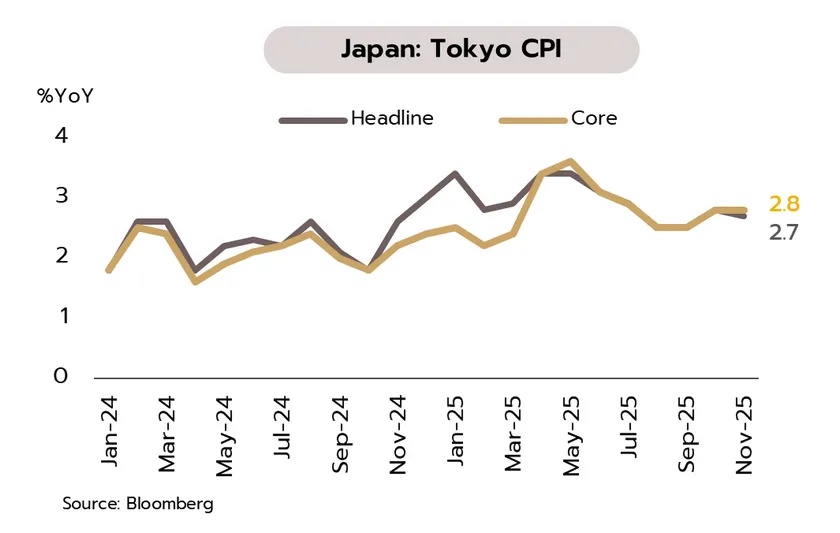
Proactive fiscal policy and planned wage hikes are expected to support Japan’s economy next year. In November, Tokyo’s headline CPI rose 2.7% YoY, compared with 2.8% in the previous month, while core CPI rose at the same pace as the previous month at 2.8%. Retail sales growth improved to 1.7% YoY in October from 0.2% in September. In addition, the Cabinet approved an extra budget for FY2025 totaling JPY 18.3 trn to fund its economic stimulus.
Although the overall economy remains weak, conditions are expected to gradually improve next year due to: (i) continued wage growth, following Rengo’s proposal for at least a 5% wage increase in 2026; (ii) easing inflationary pressures driven by lower energy prices and government subsidies; and (iii) support from stimulus measures targeting inflation relief and investment promotion. In addition, the impact of U.S. tariffs on Japan may be milder than on many other countries, as the average tariff rate on Japanese goods is relatively low. However, tensions with China remain a key risk, with potential implications for Japan’s tourism sector and export performance going forward.

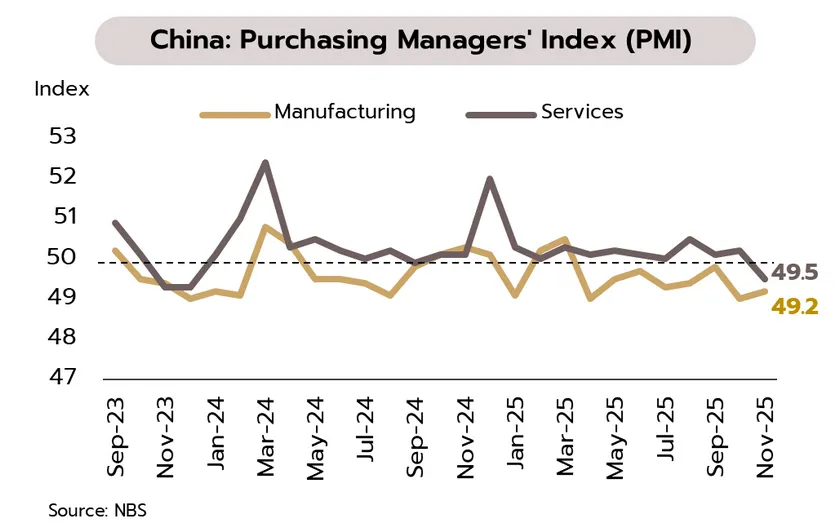
Signs of China’s economic slowdown persist. The manufacturing PMI remained in contraction territory for the eighth consecutive month at 49.2 in November, up slightly from 49.0 in October. The services PMI slipped back into the contraction zone for the first time in a year, at 49.5 from 50.2. Industrial profit growth also decelerated, from 3.2% YoY in the first nine months to 1.9% in the first ten months. Meanwhile, major developer Vanke is preparing to delay the repayment of a CNY 2 bn bond due December 15.
Manufacturing remains weak, and services have now begun to contract. Meanwhile, a consumption recovery path remains unclear, suggesting that recent stimulus measures have yielded only short-term benefits. This sluggishness in consumption is partly due to the real estate crisis and still-weak confidence. With exports softening, if the government fails to swiftly address the property crisis or sufficiently boost consumption, manufacturing may face prolonged weakness, which could worsen the excess supply. Although additional stimulus is necessary to mitigate the economic slowdown going forward, such measures may be constrained by concerns over government debt.


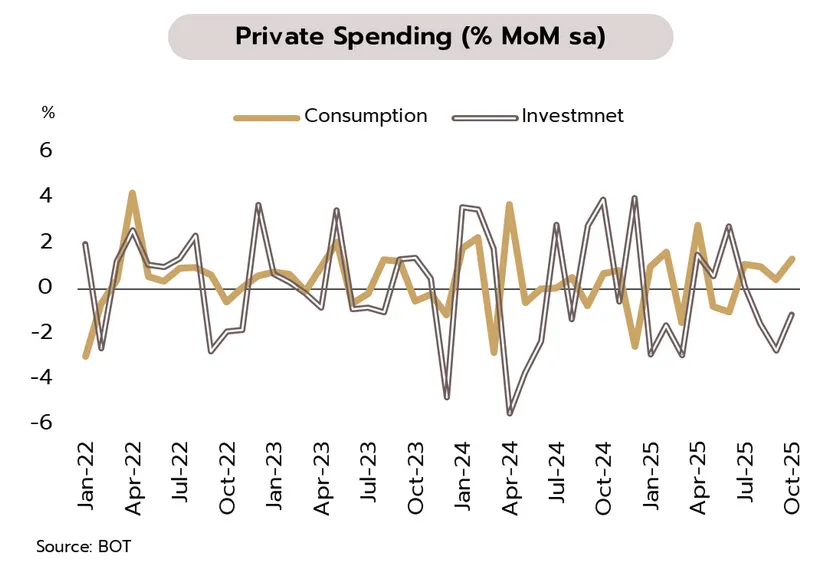
Tourism, consumption, and some exports support Thailand’s 4Q25 economy, but Southern floods pose downside risks. The Bank of Thailand (BOT) reported that in October, the number of foreign tourists and seasonally adjusted tourism revenue increased from the previous month by 11.0% and 1.9% MoM sa, respectively. Private consumption rose across nearly all categories by 1.3%, consistent with improved consumer confidence. The value of merchandise exports excluding gold also increased by 0.7% from the previous month, driven by growth in electronic product exports. However, private investment continued to contract by 1.1%, mainly due to a decline in investment in machinery and equipment.
Thailand’s economy in the final quarter of the year shows signs of recovery from the previous quarter, supported by: (i) the tourism sector entering the high season; (ii) government stimulus measures such as the Half-Half Plus co-payment program, Tourism Tax Incentive scheme, and additional welfare cardholder top-ups, all of which helped boost growth in private consumption; and (iii) an expansion in electronics exports. However, economic activity still faces headwinds from weak private investment and downside risks from severe flooding in several southern provinces, which could disrupt local economic activities. Krungsri Research estimates the potential economic losses under three scenarios: (i) In the Best Case (minimum damage), business and service sectors face operational disruption and recovery for a total of 15 days, projecting a damage value of approximately THB 11.8 bn; (ii) In the Base Case, operational disruption and recovery last 25 days, projecting a damage value of approximately THB 19.7 bn; (iii) In the Worst Case, operational disruption and recovery last 30 days, projecting a damage value of approximately THB 23.6 bn.

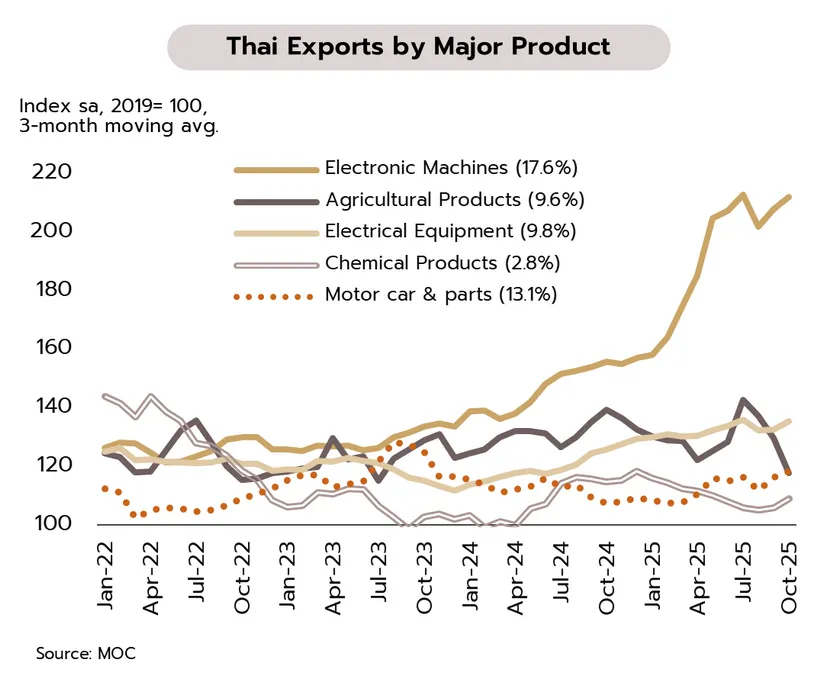
Export growth slowed in October but the value stayed above the year-to-date average. The Ministry of Commerce reported that Thai export value in October reached USD 28.8 bn, expanding by 5.7% YoY. Excluding oil-related products and gold, exports grew by 15.7%. Key products that contributed to this growth included Computers and parts, Telephones and accessories, Automobiles and parts, and Integrated circuits. Meanwhile, agricultural exports continued to decline, particularly rice, rubber, and fresh, chilled, frozen, and dried fruits. Exports to most major countries, including the U.S., China, the EU, Japan, and ASEAN-5, all posted an expansion. For the first ten months of 2025, total Thai exports grew by 13.0% YoY to USD 283 bn.
Although Thailand’s export growth in October slowed to single digits—the lowest rate of the year—the export value remained high at USD 28.8 bn, above the 10-month average of USD 28.3 bn. The continued strength in demand for electronics was key supporting factor. While exports are expected to moderate in the remaining months of 2025, the strong performance over the first ten months suggests full-year export growth could exceed expectations, reaching around 11%. However, in 2026, Thai exports are likely to face stronger headwinds, particularly from the full-year impact of the U.S. tariff hike to 19%, along with product-specific tariffs. The risk is likely to heighten if tariff measures expand to cover more technology-related goods—Thailand’s key export sector. Furthermore, the WTO projects global trade growth will slow to just 0.5% in 2026, down from 2.4% in 2025. These factors could cause Thai exports to contract next year after stronger-than-expected growth in 2025.