
Weekly Economic Review

Weekly Economic Review

10 March 2026

Global and Thai Economy


Middle East tensions show no signs of easing, posing risks to global and Thai economies. China prioritizes quality-driven growth.


Global


Global: Tensions in the Middle East remain elevated and highly uncertain as the conflict between the U.S., Israel, and Iran has entered its second week and continues to intensify. Attacks on energy infrastructure have raised concerns over energy supply and higher transport costs, putting pressure on energy-importing economies, particularly in Asia. 
 
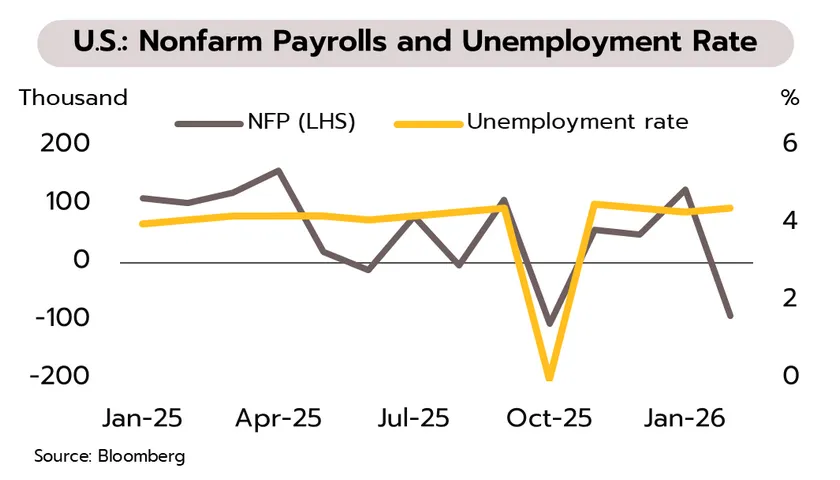
U.S.: The Economy faces increasing risks, although the impact from energy supply disruptions may be smaller than in other countries, due to the U.S. being a major net oil exporter with the world’s largest Strategic Petroleum Reserve (SPR). Higher energy prices could weigh on domestic producers and consumers. Moreover, costs of military engagement could strain fiscal conditions and political stability. Meanwhile, economic data show signs of slowing, with payrolls marking a decline for the third time in the past five months and unemployment rising to 4.4%.

Weekly Economic Review


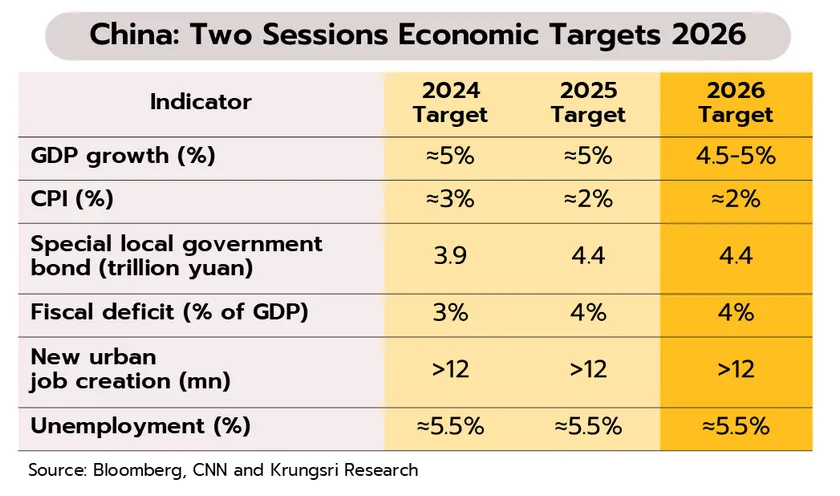
China: Lowers growth target to 4.5-5%, while preparing to boost consumption via trade-in subsidies, strengthen income security and social protection, as well as promote high-tech sectors. Such reduction of growth target reflects a policy shift from quantity-driven growth to long-term resilience via structural transition, while preserving some policy space to buffer against geopolitical risks.

 
Weekly Economic Review


Thailand


Headline inflation in February stood at -0.88% YoY, remaining in negative territory for the 11th consecutive month, mainly due to lower energy prices. Meanwhile, core inflation (excluding raw food and energy) edged up to 0.56% YoY. The Business Sentiment Index (BSI) in February rose slightly to 49.6, with sentiment improving across most industries, supported by stronger domestic demand and exports. 

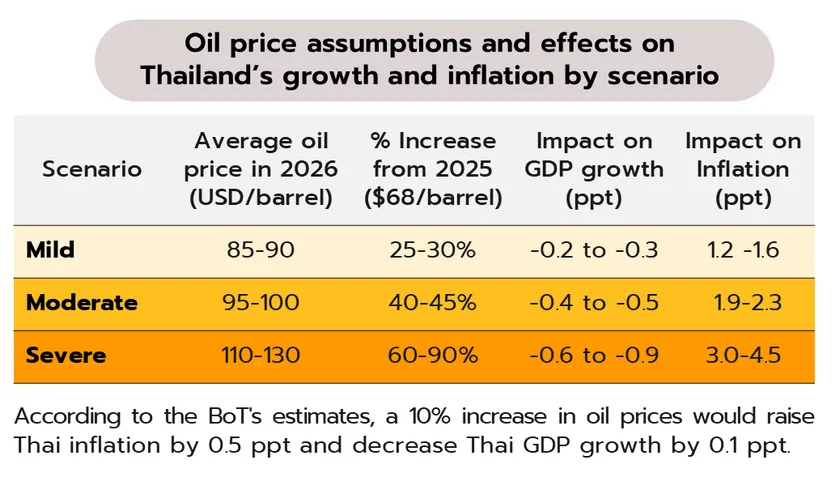
Despite negative headline inflation, inflationary pressures may rise amid tensions in the Middle East, which could push up energy prices and production costs. Thailand is a net energy importer, with energy accounting for 13% of total imports, and relies heavily on Middle Eastern crude oil (approximately 55%). If oil prices increase to an average of USD 85–90 per barrel, inflation would rise and GDP could fall by about 0.2–0.3% from the baseline. In a severe case and prolonged tensions, with oil surging to USD 110–130 per barrel, inflation could rise sharply and GDP may decline by around 0.6–0.9% from the baseline (see table). The overall impact will also depend on oil reserves (latest official estimate at around 95 days) and government measures to stabilize domestic fuel prices, such as the diesel price cap through the Oil Fuel Fund. 

Weekly Economic Review

 
Announced :10 March 2026
Back
Press keyword to search