
Weekly Economic Review

Weekly Economic Review

6 May 2026

Global and Thai Economy


Middle East tensions persist, trade war risks rise, China’s growth remains uneven, and Thai economic slowdown keeps rates on hold.


Global
 

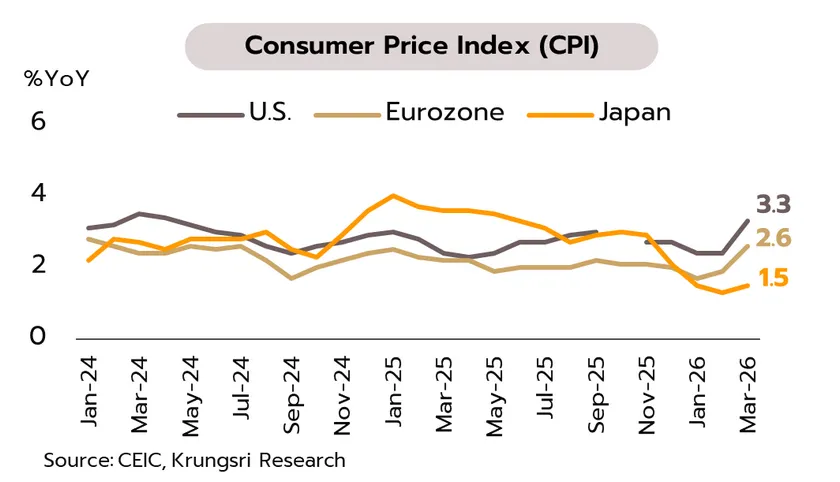
Global: The U.S.–Iran ceasefire is increasingly fragile amid renewed Middle East tensions, with reports of Iranian attacks on the United Arab Emirates (UAE) and vessels in the Strait of Hormuz, and U.S. threats to strike Iranian ships if they interfere efforts to protect commercial shipping. Meanwhile, Trump plans to raise tariffs on European cars and trucks to 25% from 15% this week—highlighting escalating trade war risks that could further pressure the global economy. Meanwhile, major central banks have decided to keep policy rates unchanged as they monitor and assess the impact of Middle East developments. The ECB and BOJ have signaled a greater likelihood of future rate hikes. Meanwhile, the Fed delivered its most divided decision in over 30 years (8–4 vote), underscoring the policy dilemma amid slowing economic growth and rising inflation.

Weekly Economic Review
 

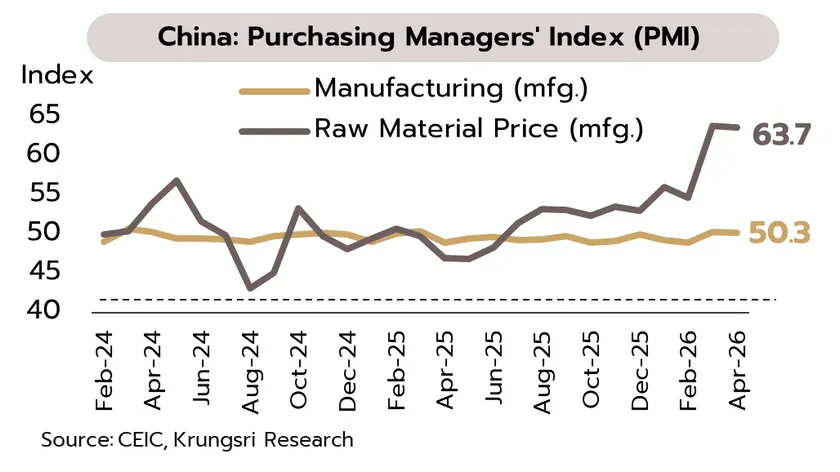
China: Manufacturing continues to expand, despite the energy crisis driving up costs over the past two months (figure). This expansion is supported by external demand for electronics and green products, in line with 1Q26 profits in the manufacturing and electronics sectors, which rose by 19.1% YoY and 124.5%. Growth, however, remains uneven with some sectors facing shrinking profits, such as autos (-17.7%), textiles (-7.8%), and apparel (-17.6%).

Weekly Economic Review


Thailand


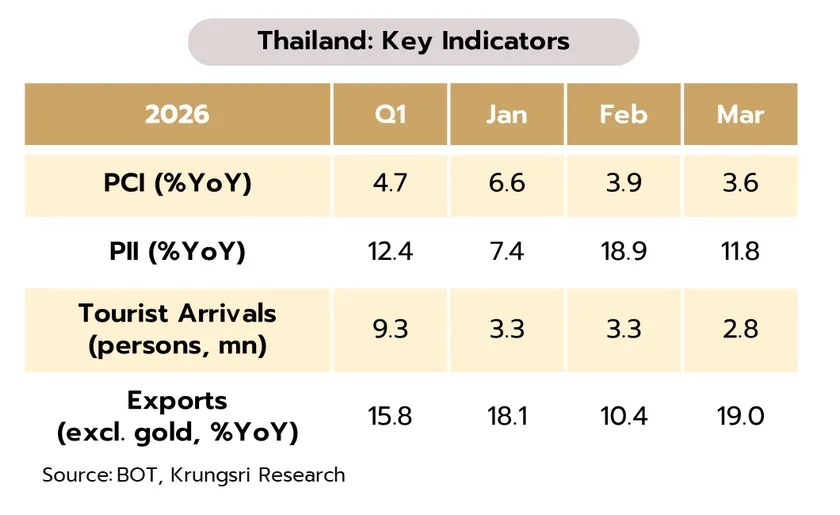
Thailand’s economy is slowing amid Middle East tensions, while the BOT is expected to keep rates on hold despite rising inflation. According to the Bank of Thailand (BOT), March economic activity softened, as reflected in private consumption index (PCI +3.6% YoY vs +3.9% in February), private investment index (PII +11.8% vs +18.9%), and foreign tourist arrivals (2.8 mn vs 3.3 mn). However, growth of exports excluding gold accelerated (+19.0%). Public spending increased, supported by disbursement of transport-related investment budgets and carry-over expenditures. In 1Q26, domestic and external demands improved from 4Q25 (PCI +4.7%, PII +12.4%, exports +15.8%). 

The Middle East war is increasingly weighing on domestic consumption, investment, and tourism. The BOT and the Fiscal Policy Office (FPO) project Thai GDP growth at 1.5% and 1.6% in 2026, respectively, down from 2.4% in 2025. Inflation is expected at 2.9% and 3.0%, respectively, up sharply from -0.1% in 2025. At its April 19 meeting, the Monetary Policy Committee (MPC) voted to hold the policy rate at 1.0%, despite rising inflation risks that could exceed the target. In our view, weaker domestic demand limits inflationary pressure, while credit growth remains subdued despite lower real interest rates. These factors suggest the MPC will keep the policy rate unchanged this year.

Weekly Economic Review

 
Announced :06 May 2026
Back
Press keyword to search