
Weekly Economic Review

Weekly Economic Review

9 June 2026

Global and Thai Economy


Global trade risks re-emerge as Trump prepares additional import tariffs; Thailand faces rising living costs and trade uncertainty


Global


Global: Stalled U.S.-Iran peace talks are likely to prolong Middle East tensions and energy market disruptions. Although the U.S. House of Representatives has approved legislation aimed at curbing President Trump's war powers, its chances of becoming law remain low. Meanwhile, trade tensions have resurfaced as the U.S. prepares to impose additional tariffs under Section 301 on imports from 60 countries accused of failing to curb forced-labor-linked goods.

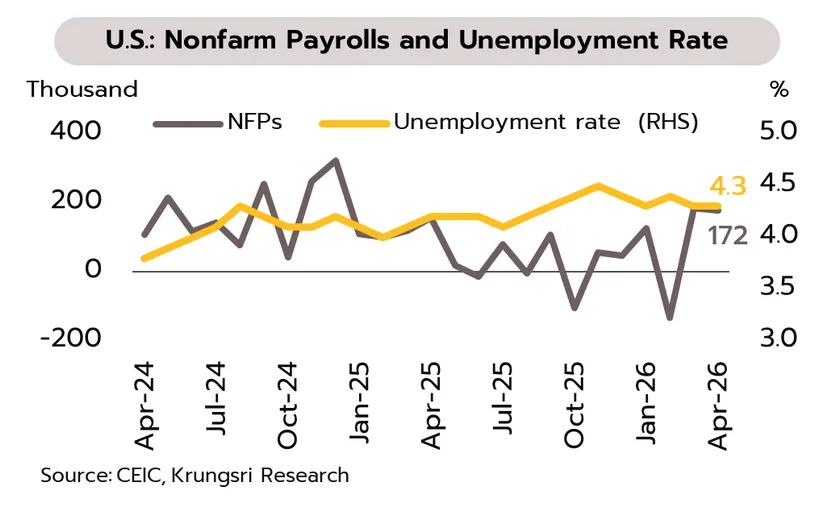
U.S.: Labor market data came in stronger than expected though signs of moderation remain. Nonfarm payrolls increased by 172,000 jobs in May, down from 179,000 in April. Retail sales slowed from 1.6% to 0.5% MoM in April, amid rising living costs. Against this backdrop, Krungsri research expects the Fed to keep its policy rate at 3.50–3.75% to support the economy amid geopolitical uncertainty and weakening confidence.

Weekly Economic Review
 

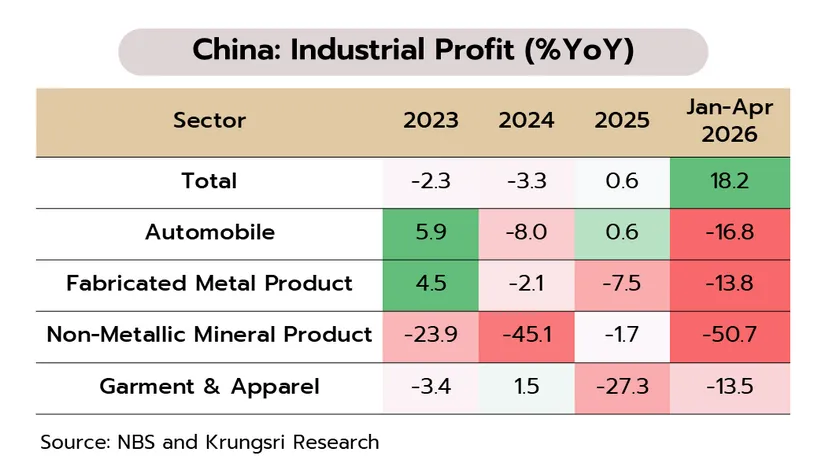
China: Uneven growth poses risks to the labor market. Electronics exports surged by 43.8% YoY in April, in line with profit growth during the first four months (more than doubled). However, many sectors continue to face shrinking profits (figure), which may eventually weigh on employment and consumption going forward. Notably, employees in sectors with shrinking profits account for 60% of total industrial employees.
 
Weekly Economic Review


Thailand


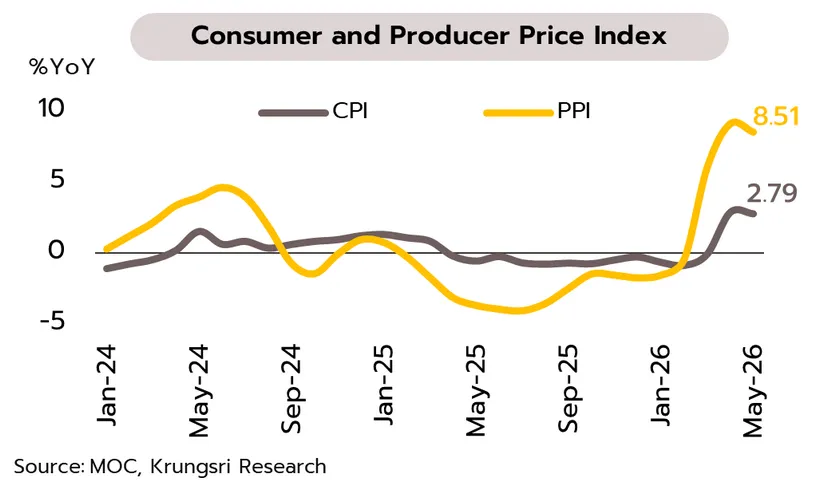
Prolonged Middle East tensions and escalating U.S. tariff risks weigh on Thailand's economic outlook. In May, headline inflation remained elevated at +2.79% YoY, compare with +2.89% in April and an average of -0.54% during January-March, driven by higher production costs amid disruptions in the Strait of Hormuz and prolonged ceasefire negotiations. Core inflation (excluding fresh food and energy) edged up to +0.92% from +0.83%. Producer prices index remained elevated (+8.51% vs +9.10%).

Thailand’s economy faces risks from  prolonged Middle East tensions and U.S. trade policy uncertainty. High producer and consumer inflation reflects rising business costs and living costs. Further pass-through effects may weigh on purchasing power and limit the effectiveness of the Thai Chuay Thai Plus policy. Meanwhile, manufacturing and export sectors face risks from potential U.S. tariff measures, including a proposed 12.5% Section 301 tariff on imports linked to forced labor concerns. Further clarity is expected after the U.S. public hearing on July 7, ahead of the expiration of the 10% Section 122 tariff measure on July 24. Additional Section 301 investigations targeting excess production capacity, particularly in automobiles and parts, rubber products, and machinery, could intensify pressure on Thailand’s exports and supply chains.
 
Weekly Economic Review
 
Announced :09 June 2026
Back
Press keyword to search