
Weekly Economic Review

Weekly Economic Review

30 June 2026

Global and Thai Economy


Global economic indicators show signs of weakness amid Middle East tensions, while Thai export growth moderates.


Global


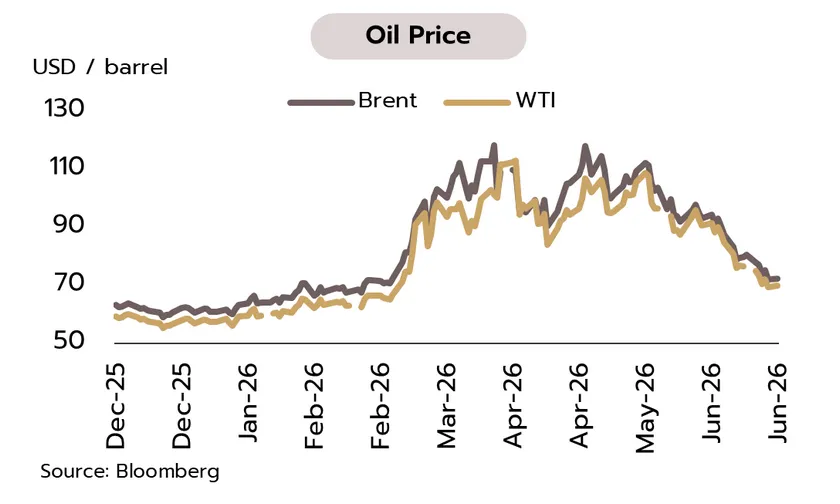
Global: Geopolitical tensions in the Middle East remain elevated, weighing on the global economic outlook. The conflict escalated after Iranian forces attacked U.S. military bases in the Middle East in retaliation for U.S. airstrikes on June 27. Although both sides have agreed to a temporary ceasefire and will hold talks on June 30, downside risks remain high. Markets are likely to stay volatile given the uncertainty surrounding the durability of the ceasefire and the possibility that the conflict in Lebanon could escalate further, which could renew volatility in global energy prices. Several economic indicators saw negative signs, as evidenced by June Flash PMIs in major economies, including: (i) Services activity in the U.S., the Eurozone, and Japan continued to expand at a slower pace; (ii) Global input costs rose; (iii) Business confidence weakened; and (iv) Employment indicators deteriorated across most economies. Together, these trends point to a further moderation in global economic growth ahead.

Weekly Economic Review

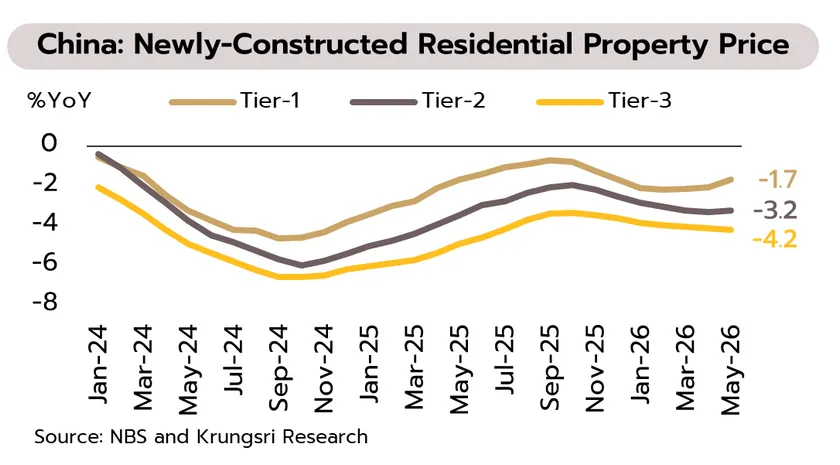
China: Property sector continues to dampen the economy. Although residential property prices in the first- and second-tier cities contracted at a slower pace, prices in third-tier cities declined further (figure). Meanwhile, falling sales (-14.4% YoY in the first five months), high inventory, and liquidity risks remain visible. Thus, the property crisis is likely to continue weighing on wealth and consumption, amid a weak labor market and the energy crisis.
 
Weekly Economic Review


Thailand


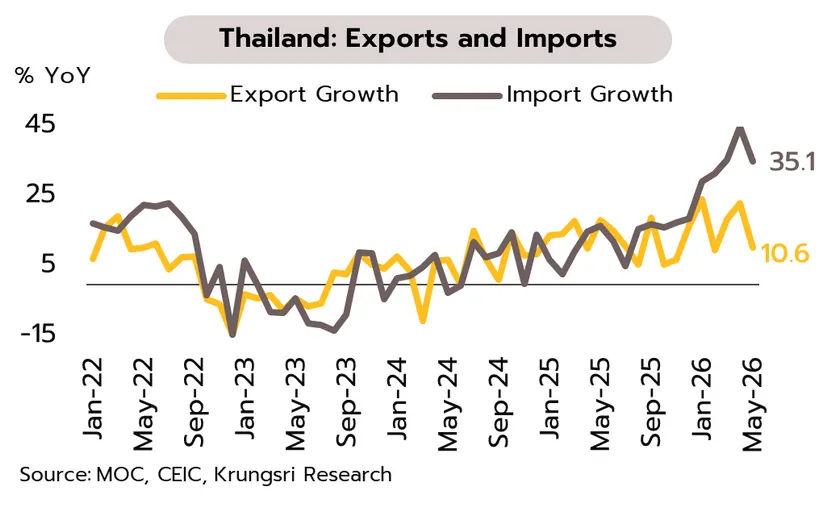
Thailand’s exports in May expanded for the 23rd consecutive month, by 10.6% YoY to USD 34.3 bn, but slowing from 23.1% growth in April. Meanwhile, imports surged 35.1% to USD 40.0 bn, resulting in a trade deficit of USD 5.7 bn. For the first five months of 2026, exports grew 17.0% while imports soared 35.6%, leading to a cumulative trade deficit of USD 25.2 bn.

Further export expansion remains uneven and concentrated in the electronics sector, supported by global demand for advanced technology products, particularly investment related to artificial intelligence (AI) and data centers. In contrast, agricultural and agro-industrial exports continued to contract by -3.1% and -13.2%, respectively. Looking ahead, Thailand’s exports and manufacturing supply chains may face additional risks from potential U.S. Section 301 tariff measures related to forced-labor imported-goods and excess production capacity concerns. Meanwhile, the sharp rise in imports was driven mainly by raw materials and intermediate goods (43.9% share), and capital goods (26.2%). Going forward, it will be important to assess whether the surge in imports mainly reflects higher prices or stronger underlying demand. If the momentum of demand for those items continues, it could further support export-oriented production, strengthen Thailand's integration into global value chains (GVCs), and underpin a new wave of investment.
 

Weekly Economic Review


Announced :30 June 2026
Back
Press keyword to search