
Weekly Economic Review

Weekly Economic Review

16 June 2026

Global and Thai Economy


U.S. and Iran prepare to sign a peace deal, but energy crisis continues to affect global economy. Thailand likely to maintain policy rate.


Global


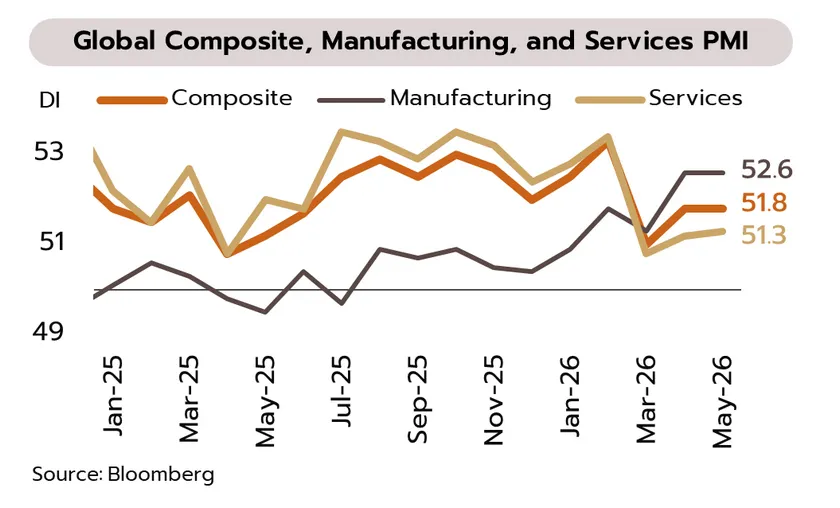
Global: Financial markets responded positively after the U.S. and Iran reached a peace deal. However, conditions for reopening the Strait of Hormuz and Iran’s nuclear program remain uncertain. Meanwhile, key economic indicators soften, with May Global Services PMI staying below pre-conflict levels, weaker business confidence, the lowest employment since mid-2020, and input costs across manufacturing and services rising to a multi-year high.
Weekly Economic Review
 

U.S.: Despite rising inflation, the Fed is likely to keep rates unchanged this week. May producer and consumer inflation rise to multi-year highs of 4.2% and 6.5%, respectively. Wage growth slowed to 3.4% YoY, while real disposable income contracted for a second month, pointing to weaker consumption ahead. As a result, the Fed is expected to leave policy rates unchanged at its June 16–17 meeting, given softer economic momentum.


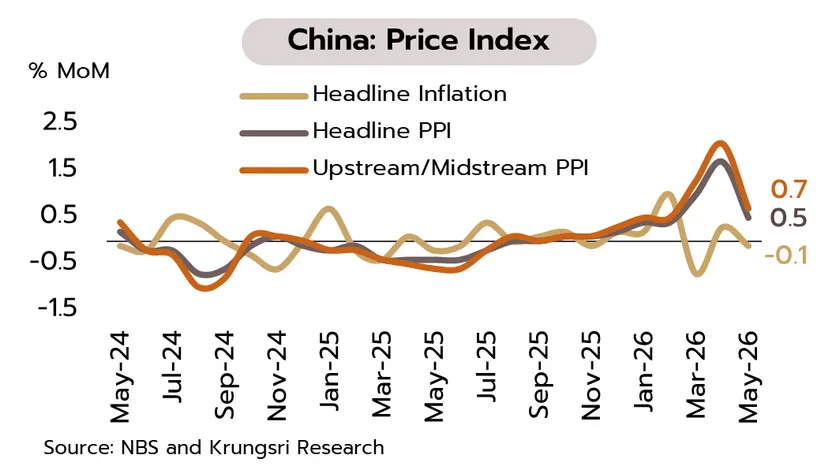
China: The Middle East conflict aggravates pressures on producers. Upstream PPI have risen, but inflation has slightly changed (figure). This reflects producers’ limited ability to pass on costs to consumers, amid intense price competition and shrinking profits. Although exports (+19.4% YoY in May) currently help support manufacturing, this might not suffice going forward if the conflict is prolonged and domestic demand remains weak.
 
Weekly Economic Review


Thailand


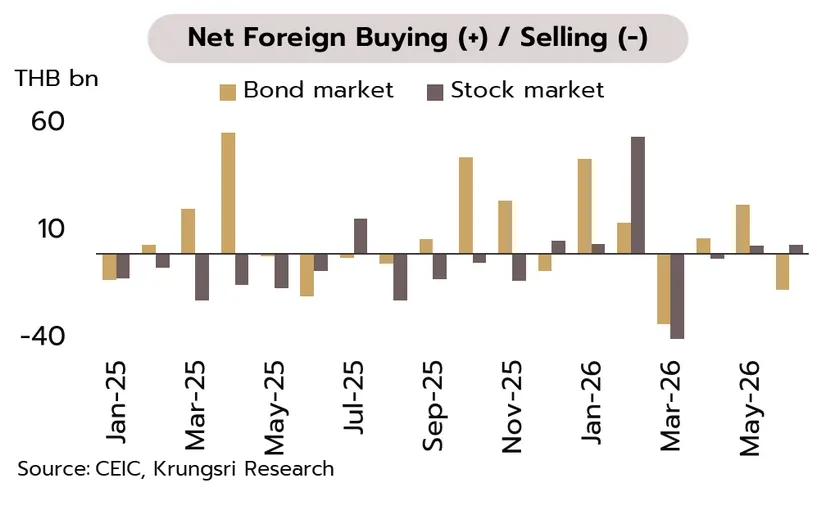
Foreign funds have flowed into Thailand despite short-term volatility. The MPC is expected to maintain the policy rate at its June 24 meeting. During 1–12 June, foreign investors recorded net purchases of THB 4.2 bn in Thai equities, while posting net sales of THB 17 bn in the bond market. As of June 12, the Thai baht against USD weakened by only 0.7% from end-May. On a year-to-date basis, foreign investors remained net buyers of both Thai equities and bonds, totaling THB 25 bn and THB 39 bn, respectively, while the baht depreciated by around 4%.

Many countries are facing impacts of energy crisis on inflation, fiscal burden, and current account balance. In some countries, policy governance challenges have further undermined investor confidence, triggering capital outflows and exchange rate pressures, prompting them to raise interest rates. However, Thailand’s macroeconomic conditions differ. Despite a current account deficit, foreign funds have posted net inflows into Thai bond and equity markets so far this year, while the Thai baht has weakened only moderately. Moreover, inflation remains largely supply-driven from higher energy prices and is expected to be temporary. Against this backdrop, the MPC is expected to maintain the policy rate, as rate hikes could weigh on domestic demand while having only a limited impact on supply-side inflation.

Weekly Economic Review

 
Announced :16 June 2026
Back
Press keyword to search