
Weekly Economic Review

Weekly Economic Review

21 July 2026

Global and Thai Economy


Middle East tensions heighten global inflation and energy supply risks. Thailand’s government measures remain key to the growth outlook.


Global


Global: Fighting between the U.S. and Iran has intensified, damaging infrastructure across the Middle East, including bridges, airports, power plants, and desalination facilities. Meanwhile, Iran's renewed attacks in the Strait of Hormuz and pressure on the Houthis to disrupt Red Sea shipping have heightened energy supply risks, driving oil prices up more than 11% since the temporary ceasefire MoU signed on June 17.

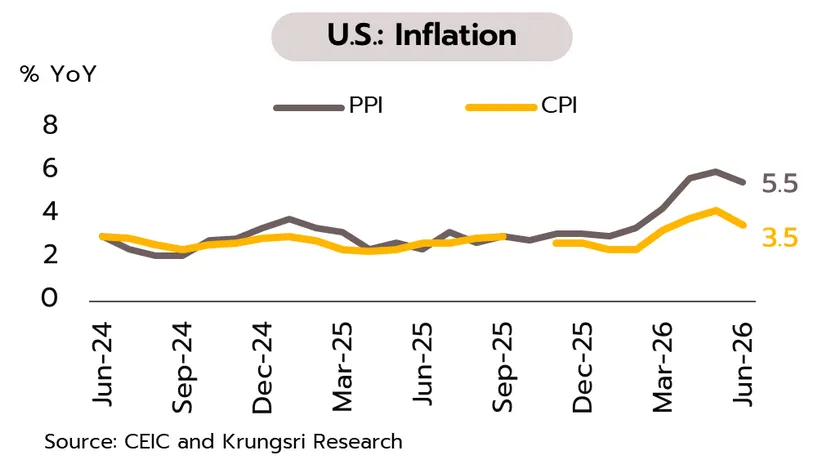
U.S.: Although inflation has eased, concerns over rising price pressures remain. Producer and consumer inflation slowed to 5.5% and 3.5% YoY, respectively, in June, from 6.0% and 4.2% in May. The moderation in inflation, labor market conditions, and wage growth suggests that the Fed is likely to keep interest rates unchanged this year. However, renewed Middle East tensions have increased uncertainty over the outlook for energy prices, inflation, and economic growth.

Weekly Economic Review
 
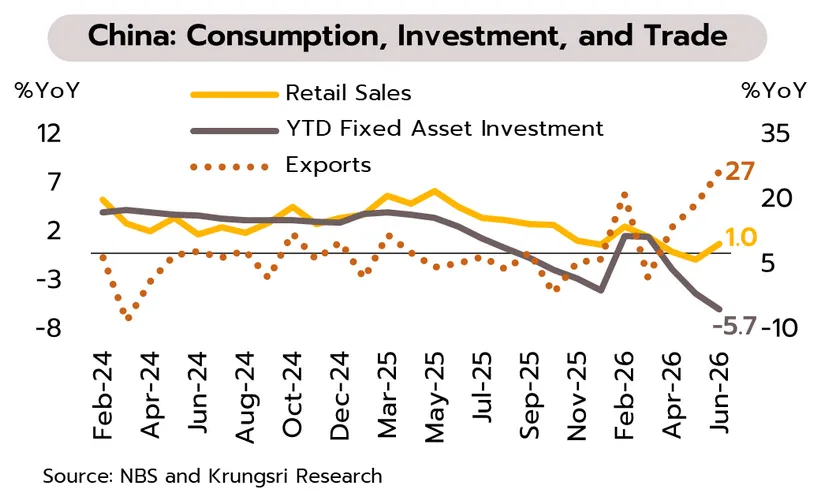
China: The economic grew 4.3% YoY in 2Q26, the slowest in over three years, compared to 5% in 1Q26. This is partly due to the energy crisis, which has aggravated already-weak consumption and investment. Retail sales grew by just 1% in June, while fixed asset investment continued to contract by -5.7% in 1H26. Thus, exports, especially electronics, are expected to underpin growth going forward, given that other economic drivers remain weak.
 
 Weekly Economic Review


Thailand


Thailand’s 4Q26 growth may be supported by the Thai Travel Thai Plus scheme but face a payback effect after the Thai Chuay Thai Plus program expires. The Ministry of Tourism and Sports is introducing the THB 1.75 billion travel co-payment scheme, similar to the previous We Travel Together program. The government will subsidize up to THB 3,000 per booking and cover 50% of eligible travel expenses, with participants paying the remaining 50%. The scheme is expected to be launched in 4Q26 to stimulate domestic tourism amid heightened global uncertainty.

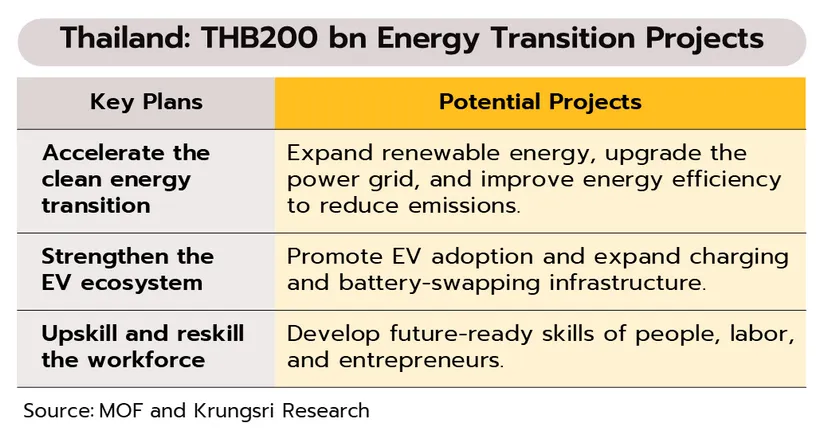
Krungsri Research expects the program to provide support to consumption and domestic tourism in 4Q26, helping cushion the payback effect following the expiration of the Thai Chuay Thai Plus program at end-September. However, the positive impact is likely to be temporary, with its overall economic impact depending on the program’s scale, eligibility criteria, and other details. Looking ahead, Thailand’s economy continues to face downside risks from Middle East tensions, U.S. tariff policies uncertainty, and potential El Niño-related impacts. Although the THB 200 billion energy transition program (see Table) could provide additional support, its effectiveness will depend on implementation details, the pace of disbursement, and the import content of projects, all of which will influence investment, employment, and economic growth going forward.

Weekly Economic Review


Announced :21 July 2026
Back
Press keyword to search