
Weekly Economic Review

Weekly Economic Review

25 August 2026

Global and Thai Economy


U.S. prepares major sanctions on Iran, raising uncertainty. In Thailand, MPC is expected to hold rates despite loan growth hitting a 3-year high.


Global


Global: Tensions in the Middle East remain elevated following the expiration of the 60-day US-Iran negotiation framework without an agreement. While the U.S. has intensified economic pressure through a maritime blockade and new sanctions, this raises the risk of Iranian retaliation by pushing up global oil prices, adding pressure on the global economy, particularly the US amid elevated living costs, fiscal deficits, and bond yields.

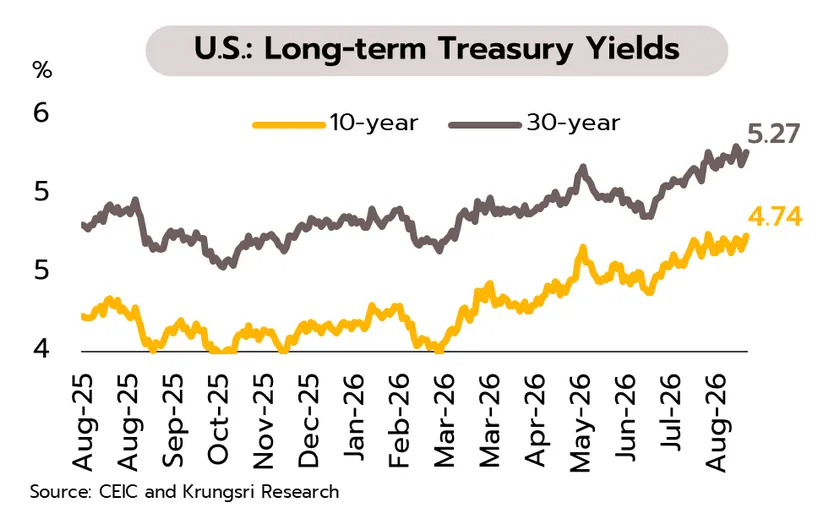
U.S.: Long-term bond yields temporarily declined after the U.S. Treasury announced an increase in the maximum size of its bond buyback operations for 10–20-year and 20–30-year maturities, from USD 2 bn to at least USD 4 bn, from September 9 to November 4. However, the support is likely temporary amid high fiscal deficits and inflation. Given tighter financial conditions, Krungsri Research expects the Fed to keep rates unchanged while monitoring economic and inflation developments in 2H26.

Weekly Economic Review
 

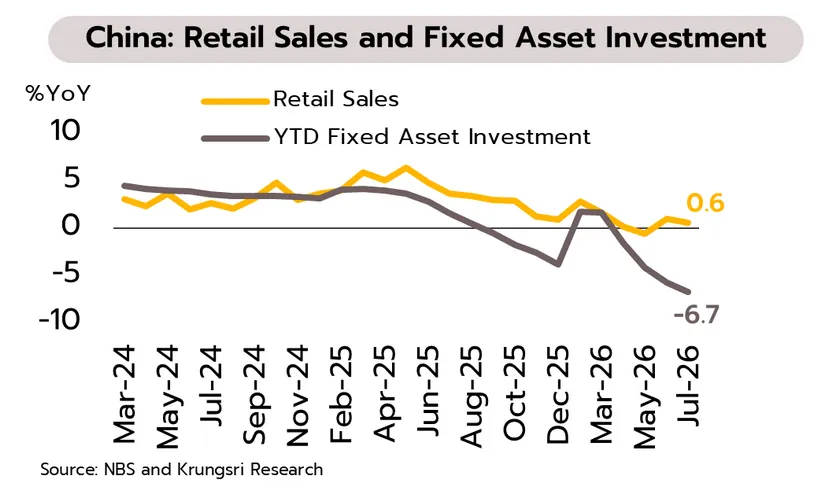
China: Domestic economy weakens (figure). Retail sales growth slowed to only 0.6% YoY in July. Investment in the first 7 months decelerated, including infrastructure (-37.6%), real estate (-11.4%), and manufacturing (-4.4%). Meanwhile, intense price competition still weighs on profits and employment, while the property sector drags on wealth. This suggests that robust export growth has not generated significant spillovers to the domestic economy.

Weekly Economic Review  


Thailand

 
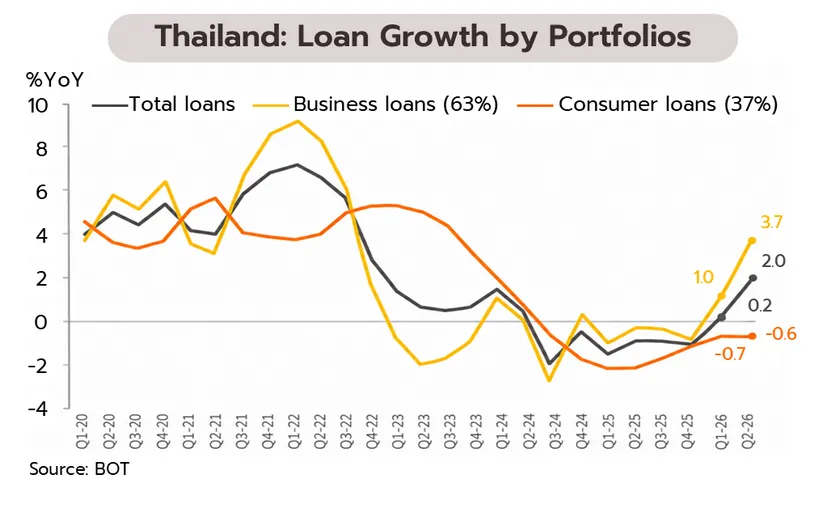
Commercial bank credit in 2Q26 expanded by 2.0% YoY but financial conditions for SMEs and households remained tight. According to the Bank of Thailand (BOT), the loan growth was driven mainly by large corporate lending (+6.6%), reflecting higher working-capital needs amid rising energy and raw material costs. In contrast, SME and consumer lending continued to contract by -4.6% and -0.6%, respectively, amid elevated credit risks. The NPL ratio edged down to 2.82% from 2.85% in the previous quarter, supported by ongoing NPL management through debt sales, write-offs, and debt restructuring.

Despite the recovery in overall loan growth and large corporate lending, SME lending has contracted for four consecutive years, while consumer lending has declined for three years, indicating that financial conditions remain tight.. Against this backdrop, with Thailand’s economic recovery still below potential and headline inflation expected to exceed the official target only temporarily before returning to the target range by 1H27, the Monetary Policy Committee (MPC) is expected to keep the policy rate unchanged at 1.00% p.a. at its 26 August meeting, providing continued financial relief and supporting the ongoing economic recovery. 

Weekly Economic Review
 
Announced :25 August 2026
Back
Press keyword to search