
Global and Thai Economy
Rising inflation risks support further rate hikes by the Fed and BOJ. Thailand prepares additional stimulus as consumption may lose momentum.
Global
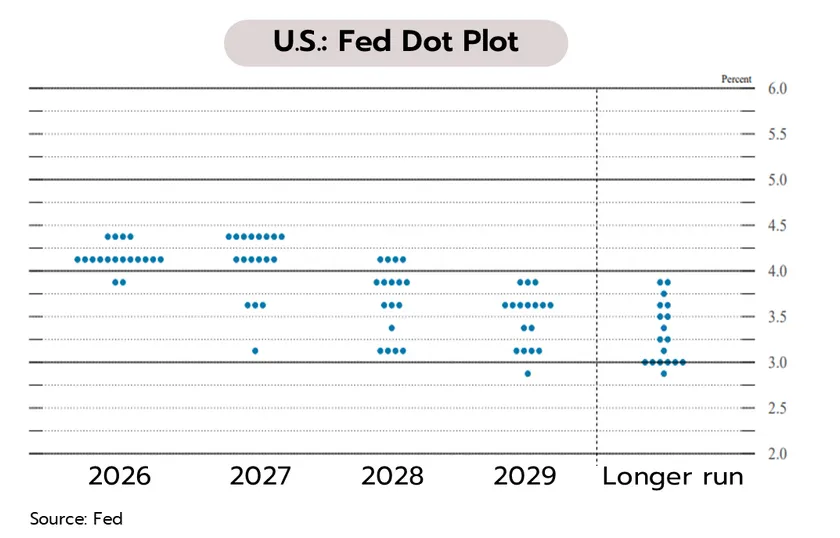
U.S.: Prolonged Middle East tensions are raising inflation risks. The Fed unanimously hiked its policy rate by 25 bps to 3.75–4.00% p.a. on September 16, raising its GDP growth forecasts to 2.3% in 2026 and 2.4% in 2027. Inflation is projected at 3.7% in 2026 before easing to 2.3% in 2027. The Fed has become increasingly concerned about inflation remaining above its target amid escalating tensions in the Middle East, while economic growth remains above its potential level. These factors increase the likelihood of another rate hike toward the end of this year.
Japan: The BOJ raised its policy rate by 0.25% to 1.25% p.a. at its September 18 meeting, the highest level in 31 years, to ease inflationary pressures from higher oil prices and a weaker yen. The BOJ also signaled that further rate hikes remain possible, as it is concerned that inflation could remain above its 2.0% target for an extended period and weigh on the economy.
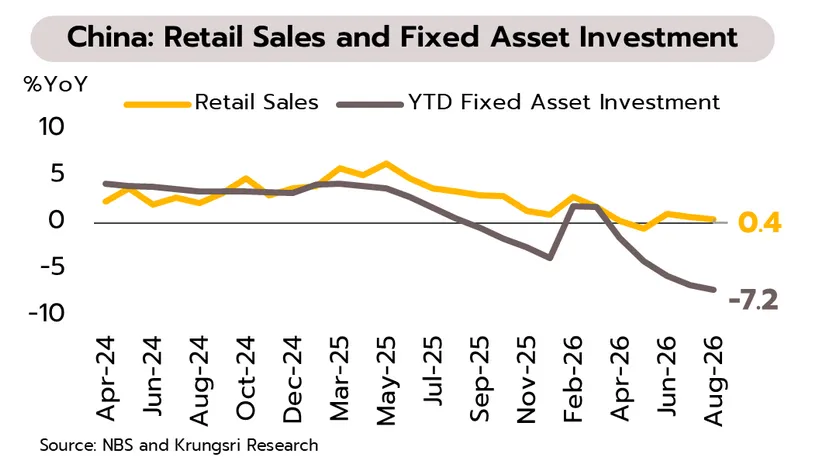
China: The domestic economy continues to slow. Retail sales edged up by just 0.4% YoY in August, while fixed asset investment contracted deeper. Moreover, excess supply, intense price competition, and the Middle East conflict continue to weigh on firms. The real estate sector also remains in a slump, with new home sales contracting by -18.3% in July.
Although exports grew robustly (+25%), the gains have yet to meaningfully support domestic activity.
Thailand
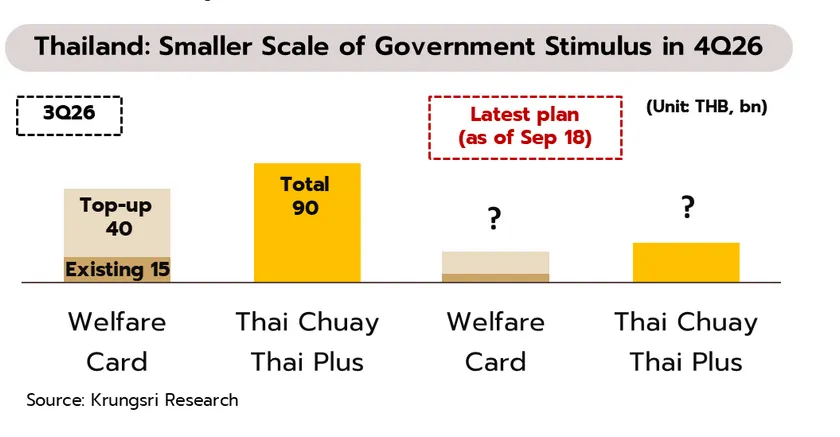
Private consumption is likely to lose momentum amid several headwinds, while the scale of government stimulus may be reduced. In recent months, private consumption has been boosted by the Thai Chuay Thai Plus scheme, which helped improve purchasing power from June to September, generating cumulative spending of THB 138.4 billion, comprising THB 79.5 billion in government support and THB 58.9 billion in co-payments by participants. Recently, the government planned to extend the Thai Chuay Thai Plus scheme for another two months in 4Q26, while the Thai Travel Thai Plus scheme, previously expected to boost spending in 4Q26, has been postponed to next year.
Government stimulus has been an important driver of domestic spending, but private consumption is likely to moderate in the period ahead due to several factors: (i) a smaller scale of fiscal support, with the second phase of the Thai Chuay Thai Plus scheme tentatively allocated THB 30 billion, compared with around THB 120 billion in the first phase; (ii) heightened Middle East tensions and elevated energy prices, which could raise living costs to consumers (Pass-through Effect); and (iii) weak labor income, which contracted by 0.25% YoY in 2Q26, together with elevated household debt, could weigh on private consumption going forward.