
Weekly Economic Review

Weekly Economic Review

6 October 2026

Global and Thai Economy


Global manufacturing PMI hits four-and-a-half-year high. Thailand’s growth is driven by exports and investment amid risks from flooding.


Global

 
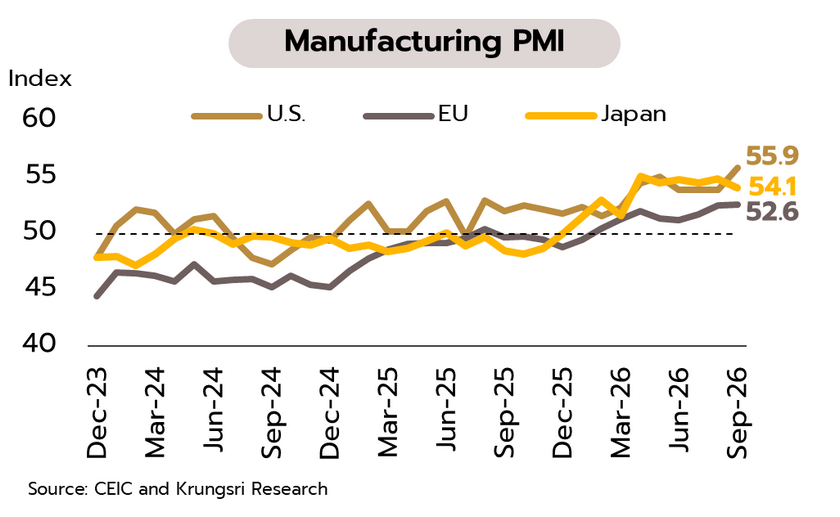
Global: manufacturing PMI reached a four-and-a-half-year high in September, supported by stronger investment in AI, data centers, and electronics. The U.S. PMI reached its highest level since May 2022, while the Eurozone posted its strongest expansion in over four years. Japan remained in expansion despite a slight slowdown. However, growth remains concentrated in selected sectors and faces risks from high energy costs and tariff uncertainty.

Weekly Economic Review

U.S.: The likelihood of a Fed rate hike in October has declined as the labor market shows clearer signs of slowdown. While 2Q26 GDP and the PMI continue to point to a continued expansion in the economy and manufacturing, labor market conditions have weakened. Nonfarm payrolls rose by only 29,000 in September, down from a 133,000 rise in August, while unemployment increased to 4.2% and wage growth slowed to a 64-month low. Krungsri Research therefore expects the Fed to keep rates unchanged at its October 27–28 meeting.

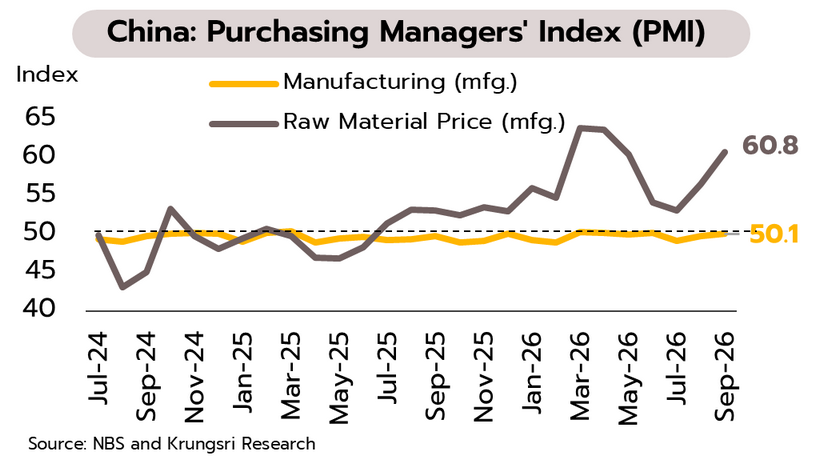
China: Manufacturing picks up but remains under cost and demand pressures. Recently, the government rolled out additional stimulus, including mortgage subsidies, an interest-rate cut to support infrastructure investment, expanding re-lending facility quotas, and allowing the local government to tap unused bond quotas from previous years. While the impact is likely to be limited, these should keep GDP growth on track to reach the 4.5-5.0% target this year.
 
 
Weekly Economic Review  


Thailand


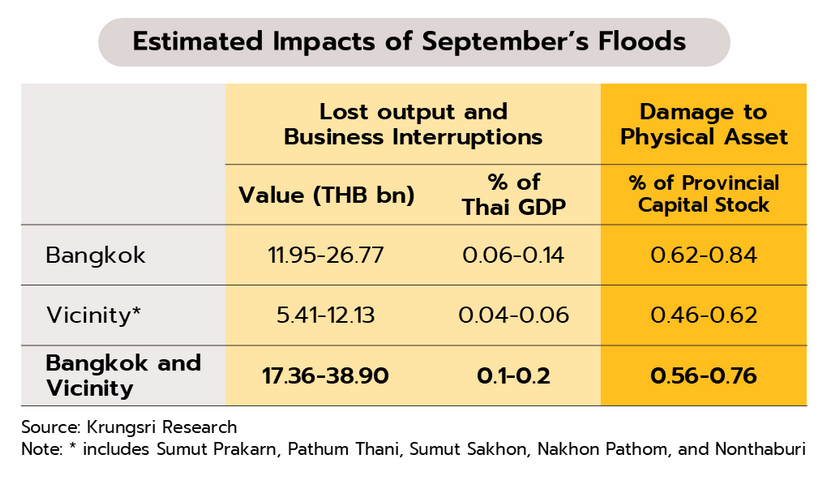
Thailand’s economy is being driven by exports and investment, while the recent flooding could disrupt economic activity by an estimated 0.1–0.2% of GDP. In August, the Private Consumption Index (PCI) grew faster by +3.7% YoY (vs +3.0% in July), led by durable-goods consumption, particularly passenger car sales. Meanwhile, growth of the Private Investment Index (PII) accelerated to +21.8% from +12.3%, following machinery sales and imports of capital goods, particularly computers. Excluding gold, merchandise exports continued to expand by +21.7% (vs +25.0%). Foreign tourist arrivals held steady at 2.5 million.

Despite momentum from private investment and exports, overall economic expansion could be constrained by several factors: (i) a potential slowdown in private consumption weighed by elevated household debt and fragile purchasing power; (ii) pressure from U.S. import tariffs, especially the Section 301 investigation on excess production capacity; (iii) the potential escalation of the Middle East tensions; and (iv) flooding situation. Assuming the situation does not deteriorate, Krungsri Research estimates that lost output and business disruptions since late September could amount to THB 17–39 billion, equivalent to around 0.1–0.2% of GDP. Physical asset damage is expected to be significantly larger, at around 0.6–0.8% of total capital stock in Bangkok and its vicinity.
 
Weekly Economic Review
 
Announced :06 October 2026
Back
Press keyword to search