
Global and Thai Economy
IMF cuts global growth forecast amid mounting geopolitical and trade risks, while inflation continues to weigh on Thailand’s economy
Global
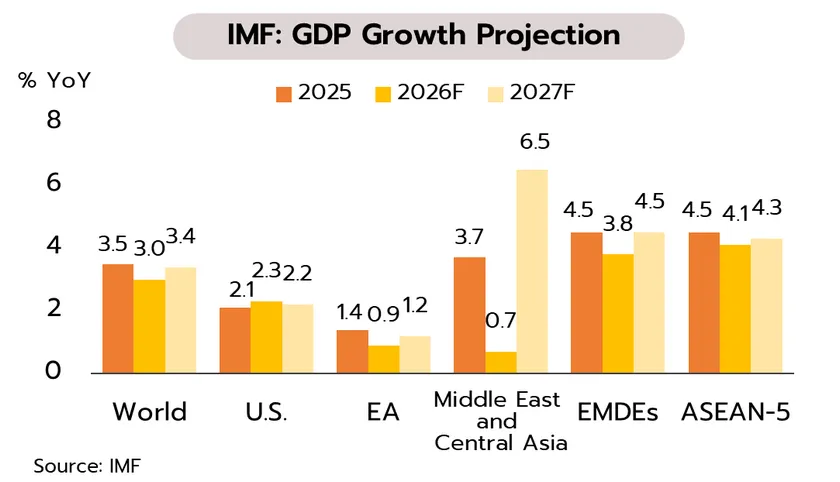
Global: The IMF has trimmed its 2026 global growth forecast to 3.0% from 3.1% in the previous forecast, reflecting the economic impact of renewed conflict in the Middle East and trade tensions. The revised projection is also below the 3.5% average global growth recorded in 2024–25. Meanwhile, the IMF expects global inflation to accelerate to 4.7% in 2026, up from 4.1% in 2025. Global trade growth is projected to moderate to 3.5% in 2026 from 5.0% in 2025. The IMF upgraded growth forecasts for energy-exporting economies and countries benefiting from AI-related investment.. Looking ahead,
the U.S.'s renewed military operations against Iran could lead to greater volatility in energy prices and further heighten uncertainty surrounding the global economic outlook.
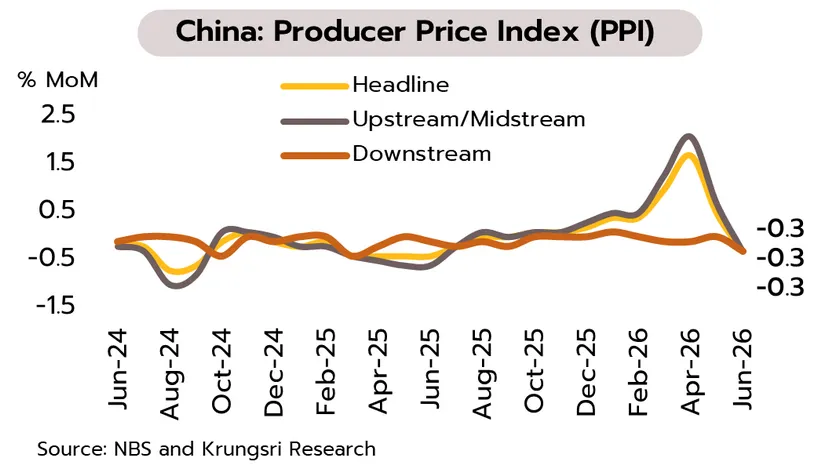
China: The IMF revised up its 2026 growth forecast from 4.4% to 4.6%. However, growth remains concentrated in hi-tech goods, while weak demand and fierce competition still exert pressure on many industries. Producers, thus, face limitations in passing on costs to consumers.
Despite some easing of the energy crisis, downstream firms are unlikely to see a marked gain. Moreover, the Middle East uncertainty remains high and might drive costs up again.
Thailand
The IMF raised Thailand’s 2026 GDP growth forecast to 1.9%, from 1.5% projected in April. Despite commodity market disruptions caused by the war, Thailand’s growth outlook has been better than expected, supported by its deeper integration into the global technology value chain. Thailand is now ranked among the world’s four largest net exporters of AI-related hardware, alongside Taiwan, South Korea, and Malaysia. Besides, growth prospect has also been underpinned by fiscal stimulus and investment expansion.
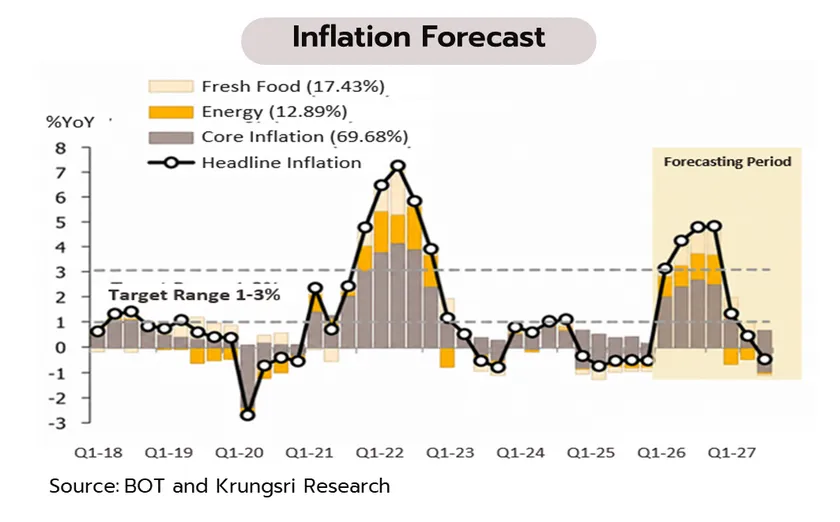
Krungsri Research likewise has projected 2026 GDP growth of 1.9%, in line with the IMF’s latest forecast. Nevertheless, the recovery remains fragile and uneven, with household purchasing power facing pressure from rising inflation as producers have increasingly passed higher costs on to consumers (Pass-through Effect). Private consumption also faces downside risks from the payback effect following the expiration of the Thai Chuay Thai Plus stimulus measure in 4Q26. Meanwhile, the Constitutional Court’s ruling upholding the THB 400 billion emergency decree provides positive support for the government’s THB 200 billion energy transition investment program. However, the effectiveness of the program, its import intensity, and its impacts for the trade balance and economic growth outlook will require close monitoring.