
Weekly Economic Review

Weekly Economic Review

7 July 2026

Global and Thai Economy


Weak U.S. jobs data eases Fed rate-hike expectations. Thailand's recovery remains weak and uneven.


Global


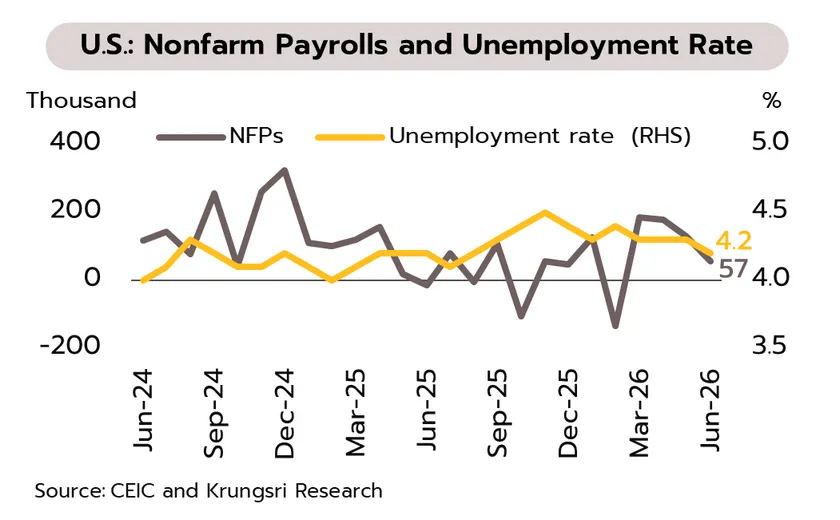
U.S.: Fed Chair Kevin Warsh reaffirmed the Fed’s commitment to restoring price stability while ending forward guidance on policy rates. Meanwhile, expectations of rate hikes have eased after June nonfarm payrolls rose by just 57,000, well below the 114,000 consensus and 129,000 in May. This signals softer consumer spending and economic momentum. Krungsri Research expects the Fed to keep the policy rate unchanged at 3.50–3.75% for the remainder of the year.

Weekly Economic Review

Japan: Beyond elevated energy costs, the weaker yen continues to raise import costs,. particularly for SMEs, According to Tokyo Shoko Research,  45 companies went bankrupt due to yen depreciation in the first half of 2026—the highest since records began in 2022. The growing cost pressures could support the Bank of Japan (BOJ) in gradually raising its policy rate to narrow the interest rate differential and help curb further yen depreciation.

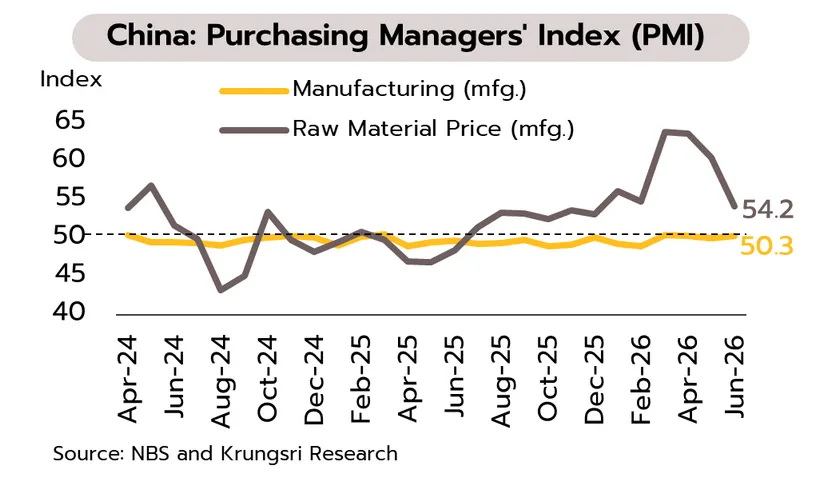
China: Impacts from the energy crisis remain but begin to subside. Manufacturing PMI continues to expand, especially hi-tech goods. Meanwhile, production costs are rising at a slower pace (figure). This is in accordance with domestic fuel prices, which are currently  15-16% above pre-conflict levels (vs. 28-30% in early April). Despite such positive signs and robust exports, 2Q26 growth is likely to slow as a result of weak demand and investment. 

Weekly Economic Review


Thailand


Thailand’s economy showed modest improvement, while export growth softened. MPC is likely to maintain the policy rate this year. The Bank of Thailand (BOT) reported mixed economic indicators in May, with improvements in the Private Consumption Index (PCI +2.7% YoY from +1.4% in April) and the Private Investment Index (PII +14.8% from +11.1%). Government spending also grew, supported by personnel, healthcare, and carry-over budget expenditures. However, foreign tourist arrivals edged down (2.3 million from 2.4 million), while merchandise exports excluding gold slowed (+8.4% from +23.2%).

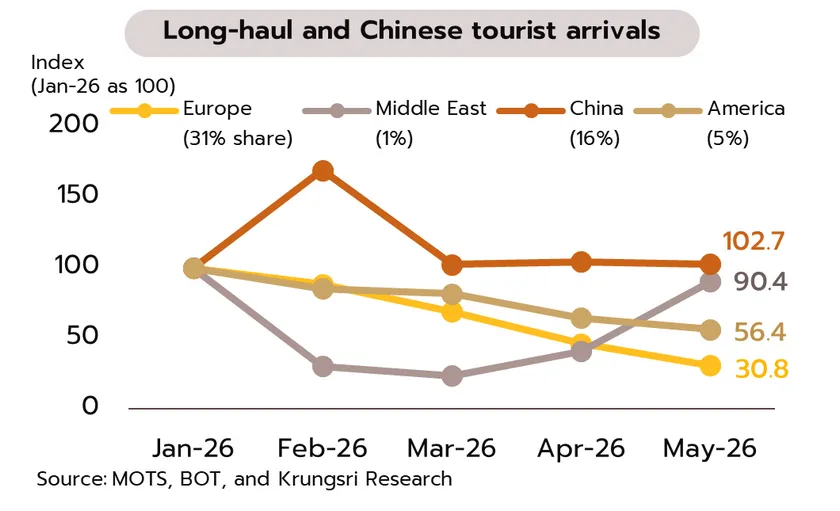
Tourist arrivals from the Middle East and China showed signs of recovery (90.4% and 102.7% of pre-conflict levels, respectively), while arrivals from the Americas and Europe remained subdued (56.4% and 30.8% of pre-conflict levels). Amid easing geopolitical tensions and declining travel costs, a gradual recovery in long-haul tourism could underpin Thailand’s still-fragile and uneven economic growth. Meanwhile, the Monetary Policy Committee (MPC) on 24 June kept the policy rate unchanged at 1.00% to support economic recovery. Krungsri Research expects the BOT to continue prioritizing domestic economic conditions over external pressures, including policy rate hikes by many countries, reinforcing expectations that the Thai policy rate will remain unchanged through year-end.
 
Weekly Economic Review

 
Announced :07 July 2026
Back
Press keyword to search