
Weekly Economic Review

Weekly Economic Review

23 June 2026

Global and Thai Economy


Progress towards U.S.–Iran deal eases market concerns. In Thailand, stability is improving, but long-term growth remains constrained.


Global


Global: The preliminary U.S.-Iran agreement has eased concerns over global energy supplies, pushing oil prices to a three-month low. A proposed USD 300bn investment package for Iran may support progress toward a final deal. However, uncertainty remains as nuclear negotiations are unresolved and clashes in Lebanon could increase Middle East tensions.

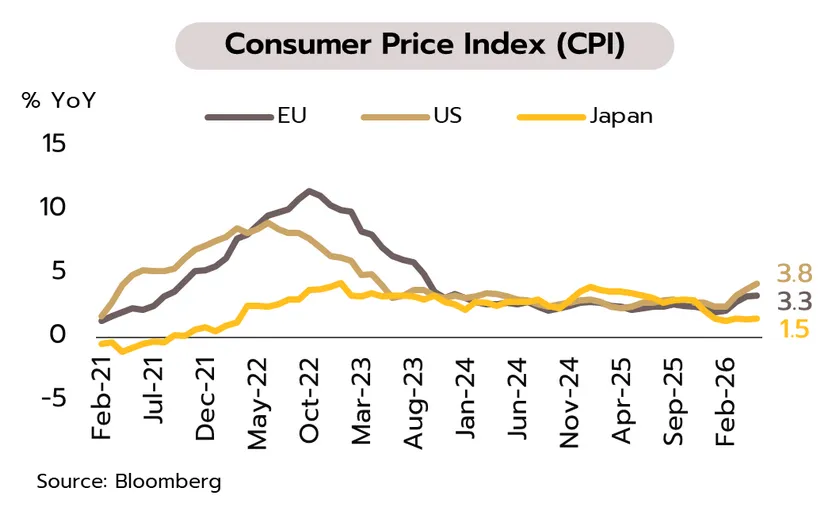
Policy rate outlook: Rising inflation risks prompted the ECB and BOJ to hike policy rates, while the Fed signaled a hawkish bias. On June 18, the Fed held the policy rate at 3.50–3.75%. The Dot Plot shows nine policymakers expect a rate hike this year, eight expect no change, and one expects a cut. Although Fed Chair did not submit an interest rate projection this round, he placed greater emphasis on maintaining price stability. That said, this outlook could change if U.S.-Iran negotiations make further progress, which would help reduce upside inflation risks.
Weekly Economic Review
 

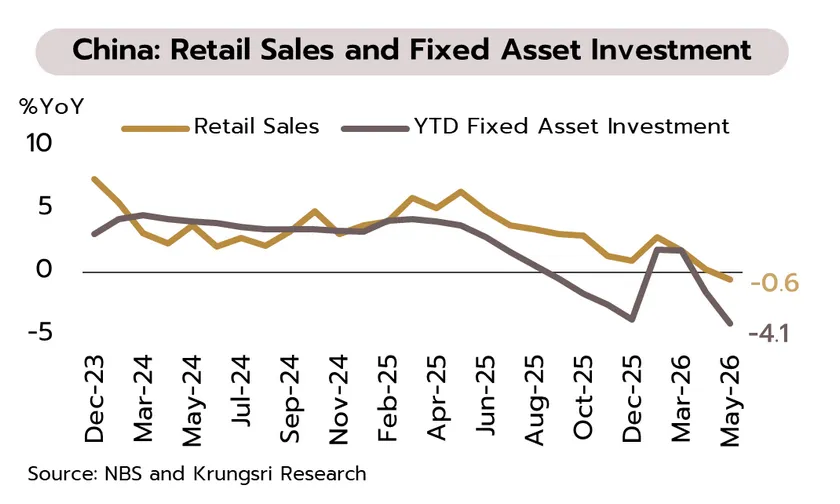
China: Domestic economy weakens. Retail sales in May fell for the first time since COVID, while fixed asset investment contracted further (figure). In addition, outstanding loan growth reached a record low of 5.5% in May. Therefore, a long-term solution hinges on enhancing productivity, fostering innovation, and developing high technology, coupled with tackling debt issues and accelerating a systematic recovery in the property sector.
 
Weekly Economic Review


Thailand


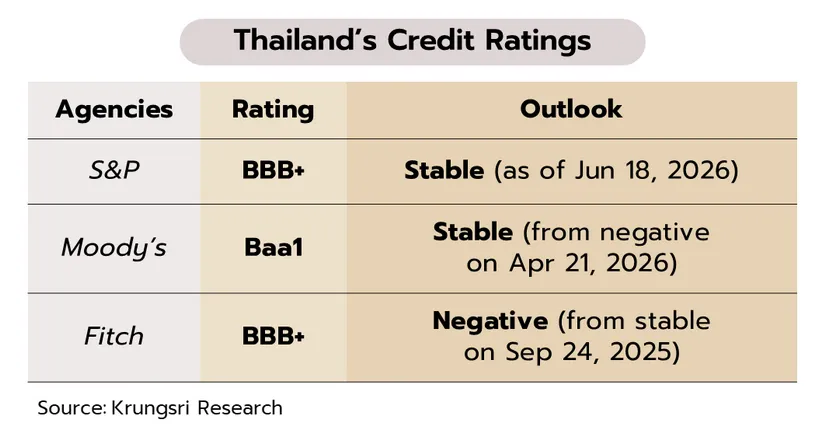
Thailand’s IMD competitiveness ranking improved while S&P maintained the country’s sovereign rating, though both institutions expressed concerns about Thailand’s growth potential. S&P affirmed Thailand’s sovereign credit rating at BBB+ with a Stable Outlook, reflecting confidence in the country’s economic fundamentals, particularly political stability and policy continuity. Meanwhile, IMD raised Thailand’s competitiveness ranking by four places to 26th in 2026, from 30th in 2025, supported by improvements in business efficiency and infrastructure, although the ranking remains below 25th place recorded in 2024.

S&P viewed that improved political stability supports policy continuity and could facilitate more strategic investment, particularly in infrastructure projects that are critical for economic restructuring and enhancing the country’s competitiveness. Consistent with this view, the value of BOI investment promotion certificates in 1Q26 rose sharply by +62% YoY to over THB 380 bn. Despite Thailand’s relatively strong macroeconomic stability, both S&P and IMD highlighted challenges to the country’s potential growth, stemming from structural issues including sluggish productivity growth, aged population, and weakening competitiveness across several manufacturing sectors.
 

Weekly Economic Review


Announced :23 June 2026
Back
Press keyword to search