
Global and Thai Economy
U.S.-Iran resume military action for the first time in a month. Thai exports expand unevenly, and MPC is expected to maintain rates further.
Global
Global: Middle East tensions have intensified again after the U.S. and Iran resumed military action. Iran’s Islamic Revolutionary Guard Corps (IRGC) launched missiles and drones at several U.S. air bases in Jordan in retaliation for U.S. and Israeli airstrikes on Larak Island late Sunday. The latest escalation reflects the continued intensification of the conflict following the U.S. announcement on August 24 to expand sanctions on Iran, aimed at pressuring other countries to sever ties with Tehran.
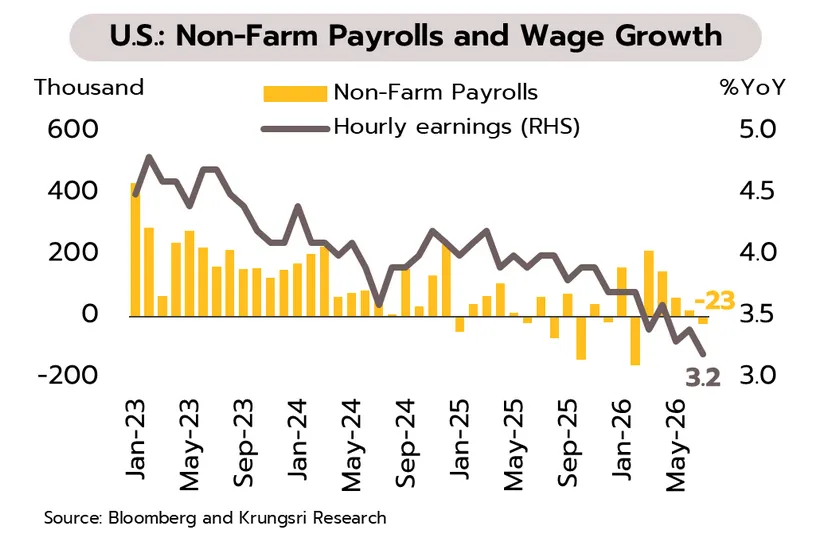
U.S.: Fed Chair acknowledged the central bank’s commitment to returning inflation to target, while refraining from providing guidance on the future path of interest rates. However, weaker employment, wage growth, and consumer confidence suggest that the risk of second-round inflation effects remains limited. Krungsri Research therefore expects the Fed to keep its policy rate unchanged to support the economic recovery and prevent a sharp increase in government bond yields.
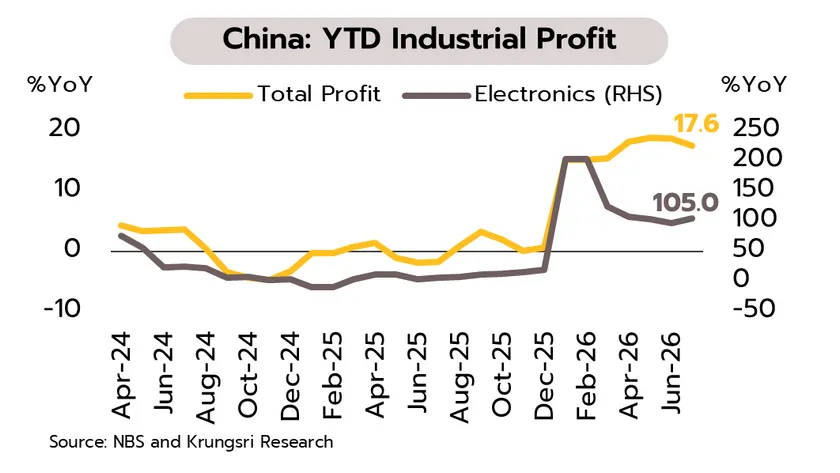
China: Industrial profits continue to expand (figure), led by electronics sector amid the AI boom. However, some sectors continue to face shrinking profits, such as autos (-20.4%) and furniture (-58.2%), partly due to weak demand, a property crisis, and excess supply. Overall, profit concentration in a few sectors reflects that the AI boom has yet to bring widespread benefits to businesses and economic growth.
Thailand
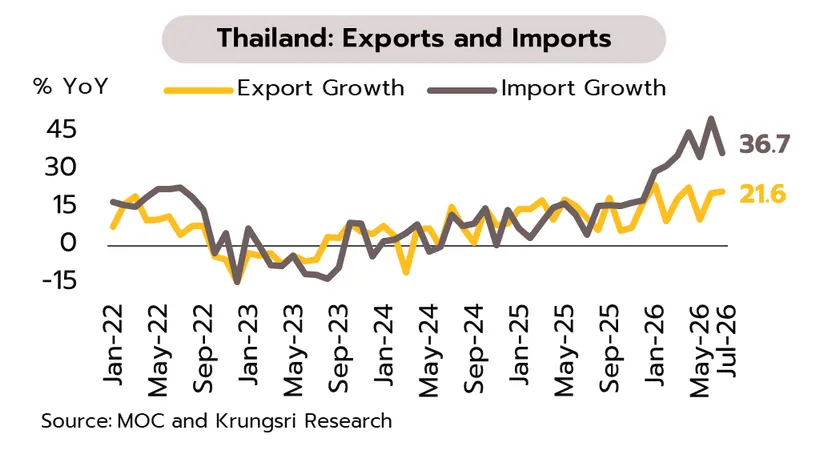
Thai exports continued to expand but remained concentrated in a few sectors. In July, exports expanded for the 25th consecutive month, rising 21.6% YoY to USD 34.8 billion, up from 20.8% growth in June. Imports grew at a faster pace, rising 36.7% to USD 38.4 billion, resulting in a trade deficit of USD 3.6 billion. During the first seven months of 2026, exports grew 18.2%, while imports surged 37.8%, bringing the cumulative trade deficit to USD 35.4 billion.
Krungsri Research expects Thai exports to continue benefiting from AI-related investment and the electronics upcycle. However, export growth remains uneven, as strong gains in industrial exports (+24.2% YoY in July) contrasted with stagnant agricultural exports (+0.6%) and a contraction in agro-industrial exports (-3.3%). Downside risks also stem from U.S. trade measures, particularly the Section 301 investigation into excess capacity, while Thailand’s Tier-2 classification in the U.S. “The Great Transshipment Scam” report could heighten the risk of further tariffs. Despite strong exports, Thailand’s economic growth remains low and uneven, supporting a continued accommodative monetary stance. Krungsri Research expects the MPC to maintain the policy rate at 1.00% p.a. throughout 2026, as the key challenge shifts from the level of policy rate to the effectiveness of policies, e.g. targeted financial measures to support vulnerable borrowers and potential SMEs.