
Global and Thai Economy
U.S. midterm election results could constrain policy implementation. AI continues to support Thailand’s growth, but with rising challenges.
Global
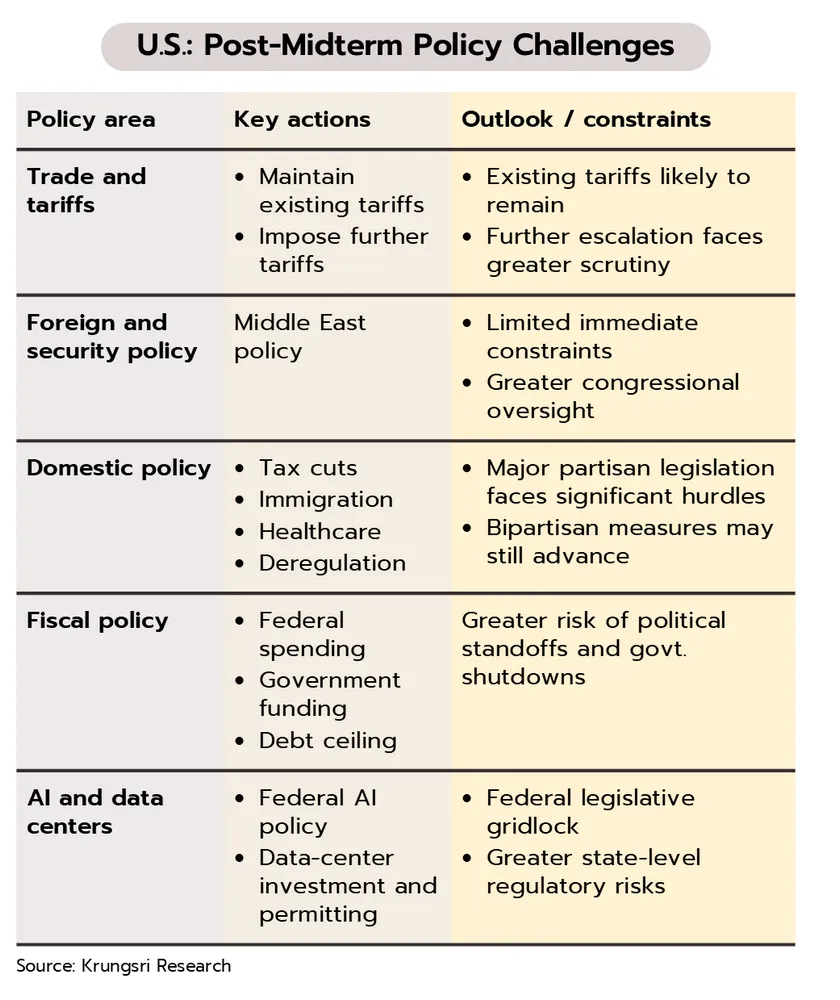
U.S.: Midterm election results could constrain policy implementation. Although Democrats secured majorities in both chambers of Congress following the November 3 elections, Trump's veto and executive powers remain significant barriers to major policy changes. Key implications include: (i)
Trade: Existing tariffs are likely to remain, while further increases could face greater scrutiny. (ii)
Foreign policy: Trump retains military authority, making a swift end to the war with Iran unlikely, although further military operations could face tighter budget constraints. (iii)
Fiscal policy: Tax cuts, increased government spending, and debt ceiling negotiations could become more challenging, increasing the risk of government shutdowns. (iv) AI: Investment support is likely to continue, but tighter oversight could emerge, particularly regarding AI safety and data centers' energy consumption. Overall,
while the election results are unlikely to fundamentally change key policies, they could intensify political gridlock and negotiations ahead.
China: Support from exports is moderating. The manufacturing PMI and new export orders index returned to contraction in October. Given China’s continued reliance on electronics exports,
tighter oversight of the AI industry if pursued by the Democrats following their midterm victory, could weigh on China's growth. On a separate front, the PBOC raised the foreign exchange reserve requirement ratio from 4% to 6% to slow the yuan’s appreciation.
Thailand
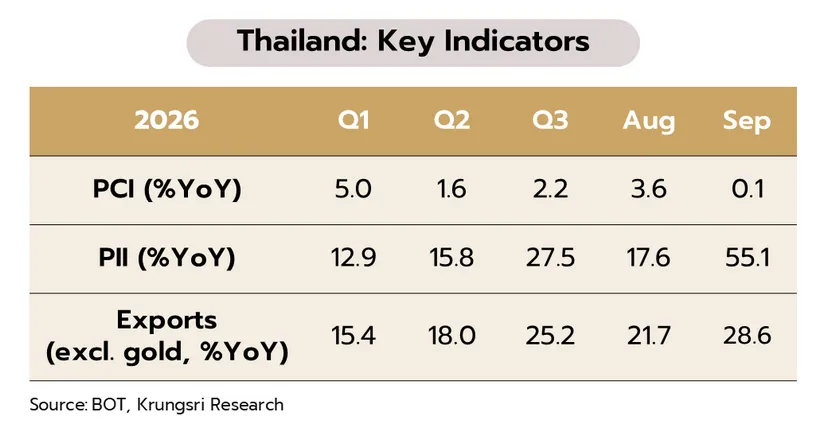
Thailand’s economy continued to gain momentum from private investment and exports, particularly those linked to AI while U.S. policy uncertainty warrants monitoring. In September, the Private Investment Index (PII) surged by +55.1% YoY (from +17.6% in August), driven by imports of capital goods for AI and data center investment. Exports excluding gold grew further by +28.6% (from +21.7%), led by electronics and electrical appliances. In contrast, the Private Consumption Index (PCI) was nearly flat at +0.1% (compared to +3.6%), reflecting weaker tourism-related spending.
Looking ahead, Thailand’s growth momentum will remain supported by private investment and exports. However, the direction of U.S. policy developments following the midterm elections warrant close monitoring through three key channels. (i) Trade policy: A Democrat-controlled Congress may reduce the risk of tariff hikes, although trade tensions are likely to persist. (ii) AI investment: The implications are mixed. Slower U.S. AI investment could weaken global demand and weigh on Thailand’s AI-related exports. However, supply-chain diversification and digital infrastructure expansion may create opportunities to attract new investment. The net impact hinges on whether new investment offsets weaker external demand. (iii) Fiscal and foreign policies: Despite institutional checks and balances, Trump’s executive orders and veto powers could raise concerns over government shutdowns and geopolitical uncertainty, posing risks to economic outlook and financial conditions for the global and Thai economies.