
Weekly Economic Review

Weekly Economic Review

20 October 2026

Global and Thai Economy


Geopolitical risks and high bond yields weigh on global growth and fiscal positions. IMF raises Thai growth forecast, but challenges lie ahead.


Global


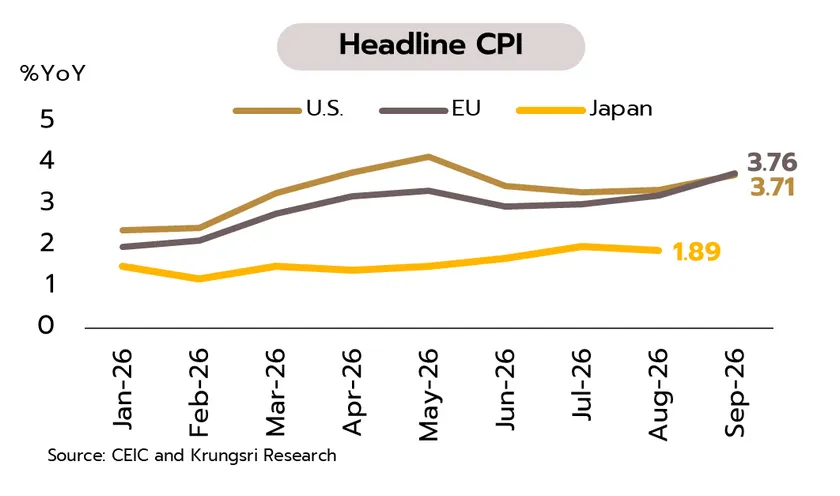
Global: IMF sees the global economy remains resilient, supported by AI investment, but continues to face three key risks: (1) geopolitical tensions, which fuel inflation and increase debt burdens; (2) uneven growth, particularly in low-income countries that rely heavily on energy imports and have limited gains from AI investment; and (3) surging bond yields, which tighten financial conditions and complicate central banks’ efforts to control inflation. Regarding monetary policy, (i) the U.S. is placing greater emphasis on inflation control, but a cooling labor market suggests the Fed will raise rates only once more this year; (ii) while Eurozone is prioritizing fiscal stability, slowing growth with above-target inflation is expected to limit the ECB to one additional rate hike this year; and (iii) Japan remains focused on maintaining price stability, aiming to keep underlying inflation around its 2.0% target while signaling further policy rate hikes.

Weekly Economic Review

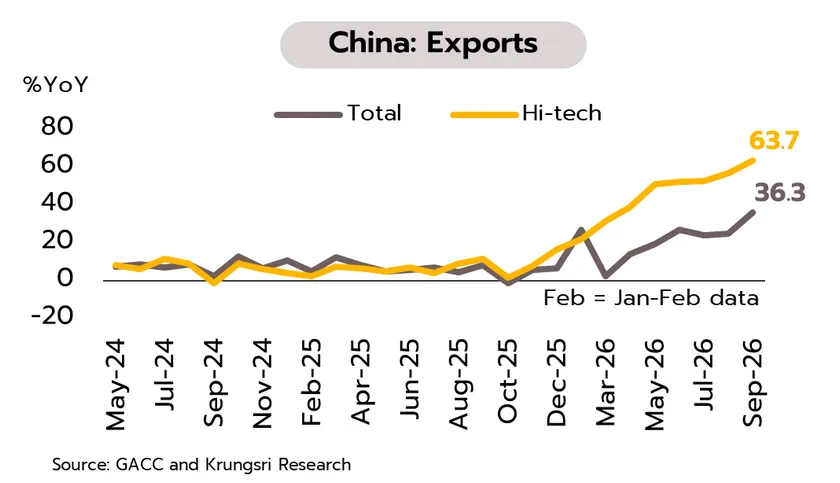
China: The IMF trimmed its 2026 growth forecast by 0.1 ppt to 4.5%, the lower end of the official 4.5-5.0% growth target range, due to weak domestic demand and the energy crisis. Recently, the upstream/midstream Producer Price Index (PPI) jumped 6.5% YoY in September, in contrast to the downstream PPI (-0.1%), reflecting producers’ limited ability to pass on costs. Thus, exports are likely to remain a key economic engine going forward, especially high-tech sectors.

Weekly Economic Review


Thailand


IMF upgrades Thailand’s GDP Forecast, while tailwinds and headwinds lie ahead. The International Monetary Fund (IMF) has revised up its forecast for Thailand’s economic growth in 2026 to 2.1%, from 1.9%, and projects growth of 2.2% in 2027. The upward revision is largely driven by exports of AI-related and electronic products, which help cushion the impact of the energy crisis. Nevertheless, Thailand’s growth is expected to moderate from 2.4% in 2025.

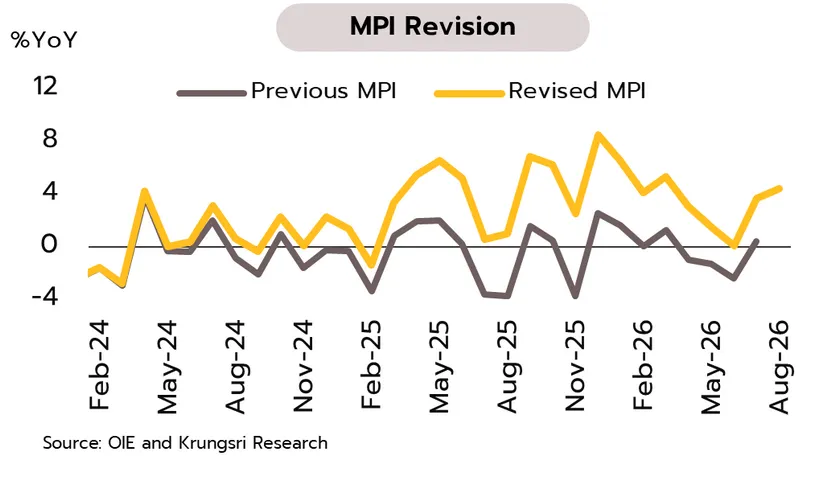
Krungsri Research forecasts Thailand’s GDP to grow by 2.1% in 2026, in line with the IMF’s latest projection. Growth is expected to be supported by (i) private investment, boosted by FDI and investment promotion approvals by BOI; (ii) continued export growth amid the technology upcycle; and (iii) the extension of the Thai Chuay Thai Plus scheme. However, the forecast does not incorporate (i) adverse GDP impact from late-September flooding as well as the impact of flood relief and recovery measures under the THB 4.7 bn budget framework; and (ii) the positive technical impact from the overhaul of the Manufacturing Production Index (MPI). Its growth in August was revised to 4.44% YoY, compared with 0.46% in July under the previous series. The revision expands coverage of AI- and electronics-related industries, such as notebooks, laptops, and optical transceivers, and adds major electronics factories to the sample. Therefore, the overhaul better captures manufacturing activity, making sector performance appear stronger than previously indicated.


Weekly Economic Review

 
Announced :20 October 2026
Back
Press keyword to search