
Weekly Economic Review

Weekly Economic Review

24 November 2026

Global and Thai Economy


Geopolitical uncertainty keeps inflation risks elevated. Thailand-U.S. trade deal reached in principle; implications remain uncertain.


Global


The U.S., China, and Russia issued a declaration on peace on November 19. It called for (i) reforming the UN to respond more effectively to challenges, (ii) expanding petroleum production capacity to strengthen energy security, (iii) respecting state sovereignty and limiting the scope of the International Criminal Court’s authority, and (iv) reducing the risks posed by nuclear weapons. Despite this cooperation, the three powers outlined no concrete steps to end the geopolitical conflicts.

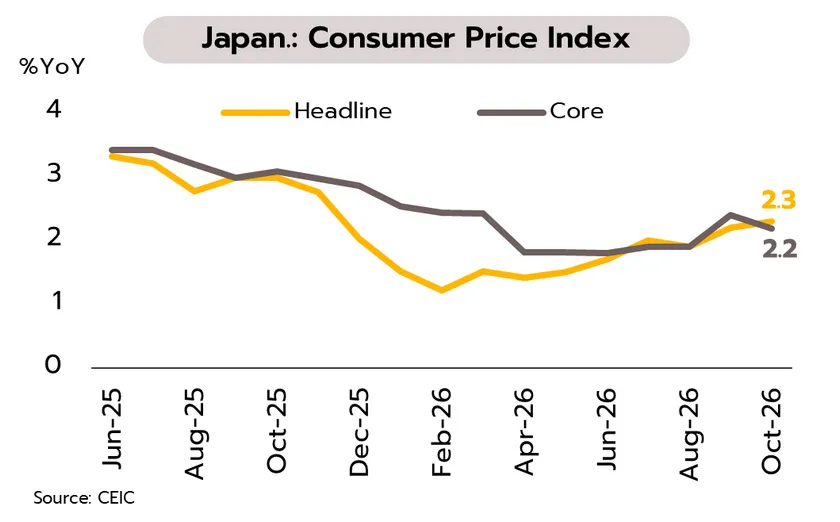
Japan: Accelerating inflation raises the likelihood of year-end rate hike. Japan’s economy contracted by -0.1% QoQ in 3Q26, its first decline in four quarters. Consumption fell by -0.3%, hit by higher living costs, earthquake, and heavy rainfall. Headline inflation reached a one-year high of 2.3% YoY in October. The pickup in inflation and the BOJ’s increased emphasis on inflation risks strengthen the case for a year-end rate hike. 

Weekly Economic Review
 

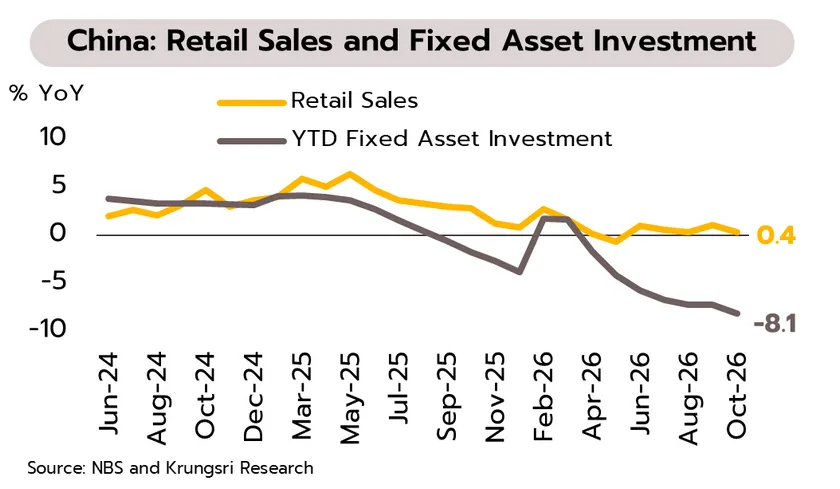
China: The domestic economy weakens, while external risks increase. Retail sales growth slowed, while fixed asset investment contracted further. Moreover, the U.S. has issued a rule to impede China’s access to high-tech chips via third countries. Nvidia has also halted H200 chip sales to China. Although such measures may negatively affect China, we expect China to continue expediting efforts to foster high-tech sectors as a main economic driver.
 
Weekly Economic Review   


Thailand


The preliminary trade agreement between Thailand and the U.S. highlights the need for Thailand to prepare across several industries, particularly agriculture and digital services. On 17 November, Thailand and the U.S. signed a Joint Statement confirming key understandings under the Agreement on Reciprocal Trade (ART). The agreement mainly covers tariff reductions, easing barriers to trade in services, and measures to prevent trade circumvention through third-country transshipment.

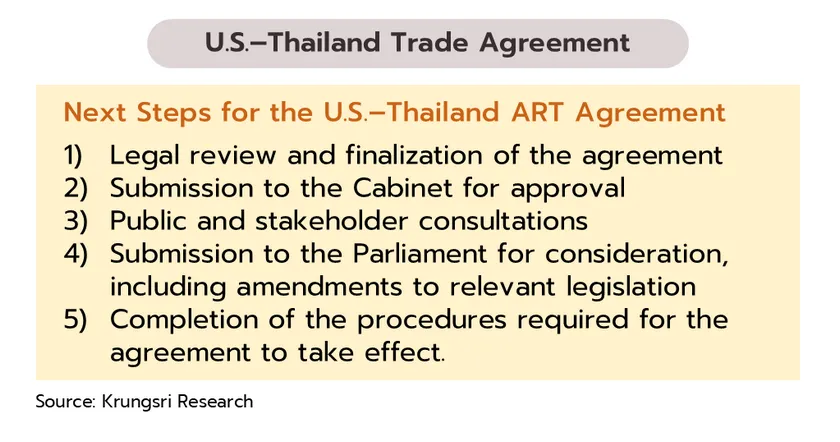
The agreement is expected to support Thailand’s exports, as U.S. tariffs on Thai goods are likely to remain broadly in line with those applied to regional peers. Lower tariffs on U.S. imports could also reduce business input costs. However, risks remain, particularly pressure on domestic farmers and SMEs due to potential import surges from the U.S. alongside continued inflows of Chinese goods, creating a “Twin Influx” effect. Further clarity is needed  regarding tariff concessions, the relaxation on non-tariff barrier (NTB) relaxation, and product standards, particularly for agricultural products and digital services. The details of the agreement and any mitigation measures also warrant monitoring. Importantly, the agreement has only been reached in principle and must still undergo legal scrubbing, Cabinet approval, public consultation, parliamentary consideration, and any required legislative amendments before entering into force.
 
Weekly Economic Review
Announced :24 November 2026
Back
Press keyword to search