
Weekly Economic Review

Weekly Economic Review

3 November 2026

Global and Thai Economy


Major countries’ above-target inflation points to rate hikes late this year. Thailand’s MPC holds rate but flags risks of prolonged low rates.


Global


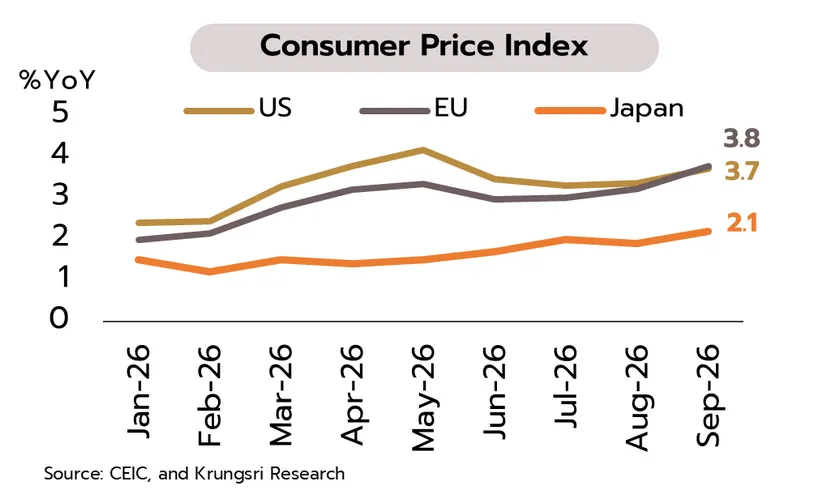
U.S., Eurozone, and Japan maintained policy rates in October, but rising inflation risks point to potential rate hikes toward year-end. (i) The Fed maintained its policy rate at 3.75–4.00%, awaiting additional economic data. However, continued economic expansion and above-target inflation are expected to pave the way for another rate hike in December. (ii) The ECB kept its policy rate unchanged at 2.50% amid tight financial conditions. Nevertheless, tensions in the Middle East and higher winter energy demand could intensify inflation risks, potentially prompting a December rate hike. (iii) The BOJ also held its policy rate at 1.25%, with the likelihood of a December hike increasing as underlying inflation reached the 2.0% target for the first time in 14 years. In addition, accelerating annual ETF sales from JPY 330 billion to JPY 860 billion starting in January 2027 will help unwind extraordinary monetary easing while increasing funding available for government stimulus measures.


Weekly Economic Review
 

China may ramp up exports to global markets amid rising trade tensions with Europe. The EU plans to expand import controls to cover chemicals, furniture, and machinery following an agreement on Chinese hybrid car import controls. The EU also prepares measures to diversify its sources of imports and limit market access. This may prompt Chinese firms to divert exports to other markets, worsening the influx of Chinese goods into those countries.


Thailand


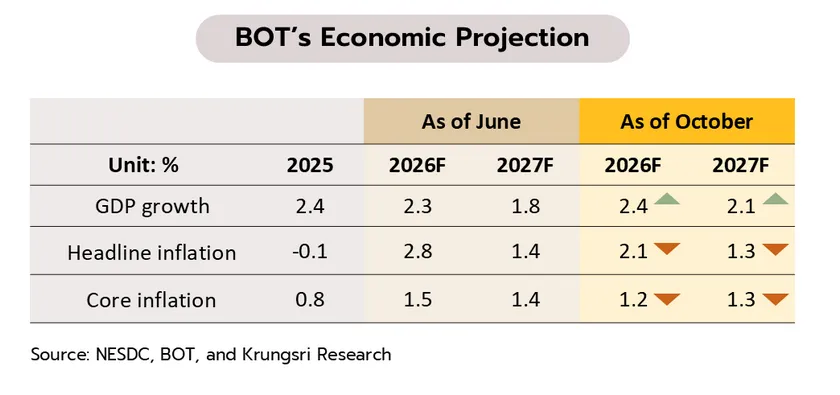
The MPC maintained the policy rate at 1.00% as expected, amid below-potential and uneven economic growth. At its October 28 meeting, the Monetary Policy Committee (MPC) unanimously voted to keep the policy rate unchanged at 1.00% p.a. It also revised up GDP growth forecasts to 2.4% in 2026 and 2.1% in 2027, viewing the current policy rate as accommodative and supportive of the economic recovery.

Krungsri Research expects the MPC to maintain the policy rate for an extended period, supported by several factors. First, Thailand’s economic growth remains below potential and uneven across sectors. Consumption also faces pressure from high household debt and a fragile labor market. Second, inflationary pressures are supply-driven and could be temporary. Third, despite a weaker baht and higher global interest rates, Thailand’s external stability helps cushion financial market volatility. An accommodative policy therefore remains necessary given the vulnerability of households and businesses. Nevertheless, the likelihood of a rate hike has increased in  the medium term, as reflected in the MPC’s latest communication. First, growth momentum has improved, and the MPI data revision points to potential upside to GDP. Second, inflation risks warrant close monitoring. Third, for the first time, the MPC stated that “it would monitor the effects of low interest rates on long-term macro-financial stability”, signaling greater concern over the risks of keeping interest rates low for too long.

 
Weekly Economic Review

 
Announced :03 November 2026
Back
Press keyword to search