
Global and Thai Economy
IMF warns of downside global risks, while U.S.-EU tensions are escalating. In Thailand, export momentum likely to weaken in 2026.
Global
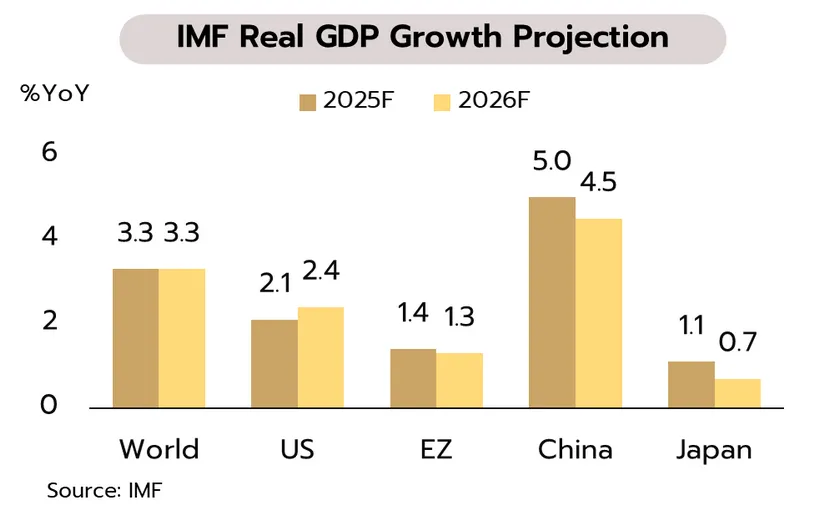
Global: The IMF expects global growth to remain steady at 3.3% in 2026, supported by investment in the technology sector. U.S. growth is projected to be modest, while growth in the euro area, Japan, and China are slowing.
Global risks are tilted to the downside, driven by uncertainty over trade policy, AI bubbles, and geopolitical tensions that could disrupt supply chains, dampen investment, and undermine confidence.
U.S.-Europe: Geopolitical and trade risks have increased. Despite President Trump pausing new tariffs on European goods and ruling out military action in Greenland, the European Parliament has suspended ratification of the July 2025 U.S.–EU trade deal. This move poses risks to exports, manufacturing, and consumption on both sides amid growing global trade fragmentation.
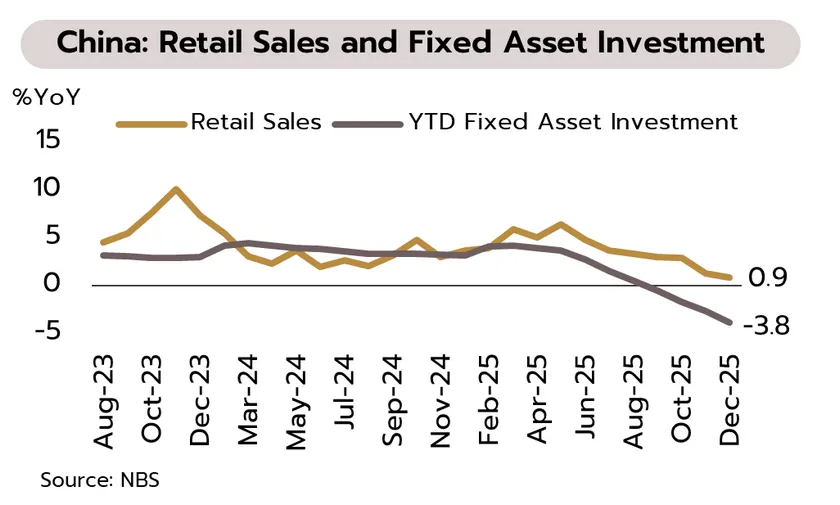
China: Economy met the 5% growth target in 2025, but domestic drivers remain weak. Consumption has slowed and investment continues to decline. In addition, home sales remain 50% below the pre-COVID level and developers continue to face liquidity issues. In 2026, China is expected to prioritize structural issues and targeted policies to support high-quality growth, with the target likely to be adjusted to a range of 4.5-5.0%.
Thailand
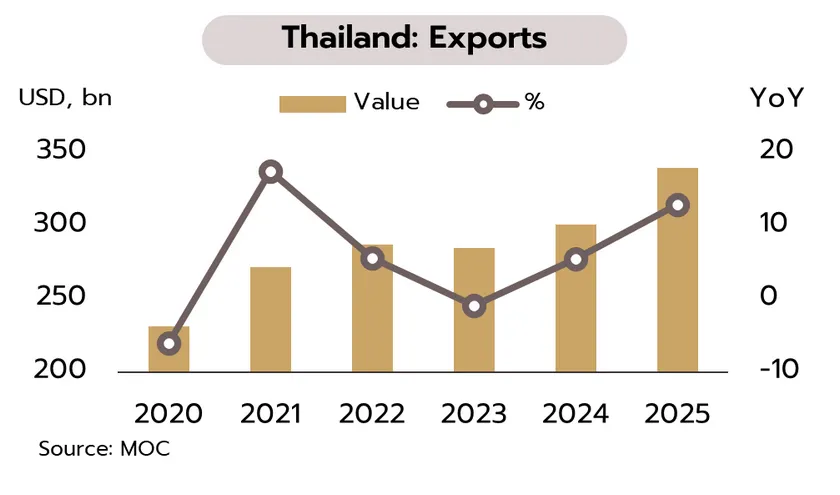
December exports surged 16.8%, pushing 2025 growth to be above expectations at 12.9%, but momentum sets to ease in 2026. In December, exports expanded for the 18th consecutive month at 16.8% YoY to USD 28.9 bn, led by exports of electronics and electrical appliances and exports to the U.S. In 2025, exports reached USD 339.6 bn, rising 12.9%, the highest growth in four years.
Although Thai exports grew better than expected in 2025, its momentum is facing several concerns: (i) export growth is concentrated in a few markets and some products, partly driven by front-loading shipments to the U.S.; (ii) manufacturing production index (MPI) contracted by 1.1% in the first 11 months of 2025, indicating limited gains from surging exports; and (iii) despite sluggish production and domestic demand, Thai imports accelerated, particularly from China (+33.5%), raising concerns over transshipment trade that could distort export figures. As a result, although exports were a key growth driver in 2025, the underlying growth fundamentals remain fragile. Export momentum is likely to soften in 2026 amid rising trade tensions and competitiveness challenges across several Thai industries.