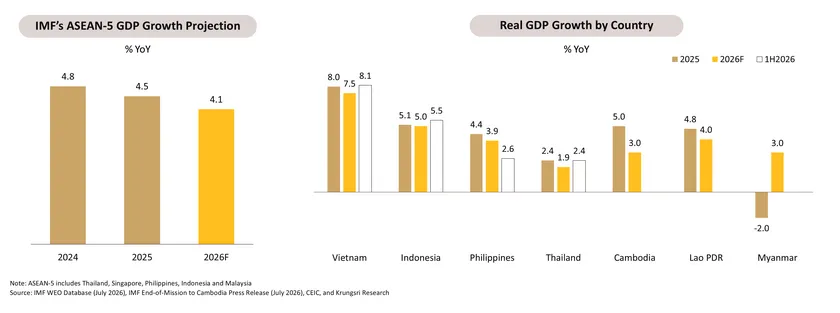

In 2026, ASEAN-5 growth is expected to slightly decelerate to 4.1% from 4.5% last year. The slowdown results from lingering effects following the Middle East conflicts, mainly rising fuel prices. Countries with high reliance on imports, compounded by country-specific issues like Indonesia, the Philippines, and Lao PDR, are relatively more vulnerable than ASEAN peers.
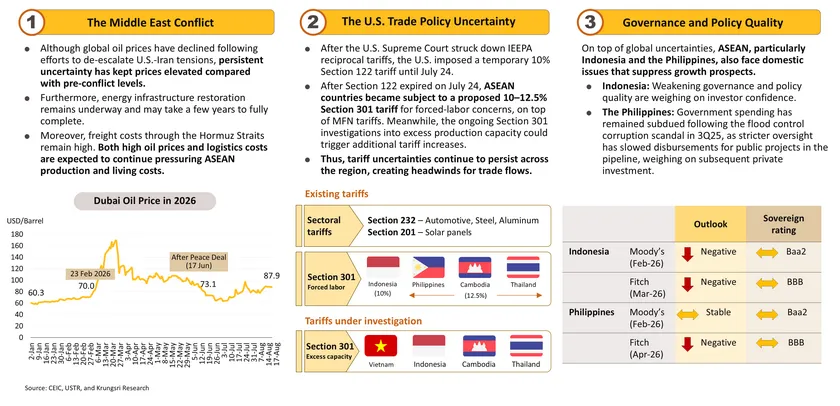
Since the last report, major changes include 1) Surging oil prices and higher cost of inputs, stemming from the Middle East conflicts since late February. Uncertainty surrounding the U.S.-Iran negotiations has kept oil prices elevated above pre-conflict levels, weighing on production costs and household purchasing power. 2) U.S. trade policy uncertainty: ASEAN continues to confront tariff uncertainty. Existing sectoral tariffs remain in place, while the ongoing investigations under other trade provisions leave room for additional tariffs. 3) Country-specific challenges: weak governance and policy quality, particularly in the Philippines and Indonesia, undermine public investment momentum and the overall investment climate.
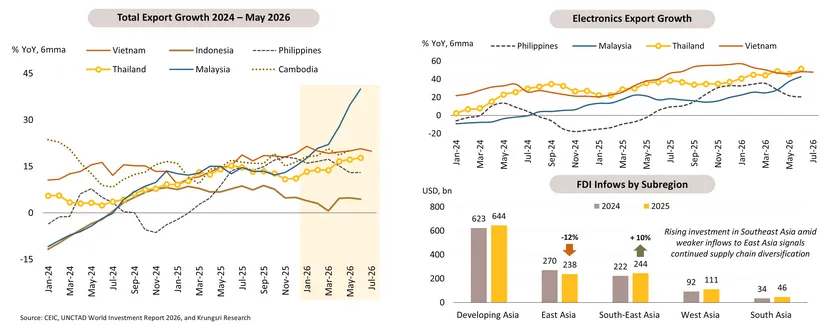
Major growth drivers in 1H26 led by exports and investment in tech-led industries. Despite expectations of a post-frontloading slowdown, growing electronics demand sustained export momentum. Meanwhile, FDI remains the key driver of ASEAN's medium-term growth, fueled by investment relocation and the technology/AI upcycle, with investment shifting toward technology-related sectors.
Private consumption in most countries has held up well, supported by continued policy support and favorable economic momentum, though downside pressures are expected to build. Rising fuel prices have passed through to higher living costs. At the same time, the increasing risk of El Niño could place further upward pressure on food prices. As a result, economies that are highly dependent on energy and food imports, such as Lao PDR and the Philippines, are likely to face stronger inflationary pressures.
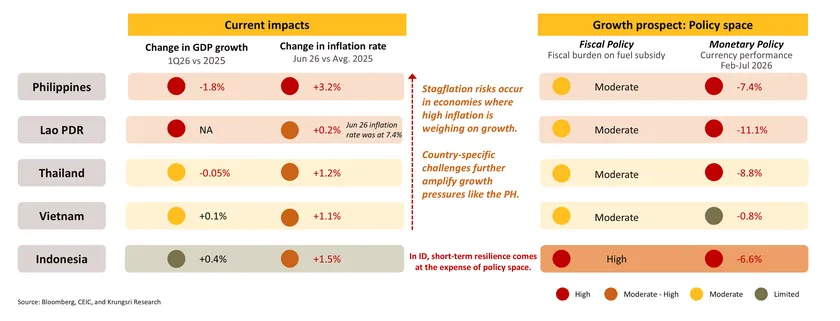
Policy space is constrained. On the fiscal front, subsidy programs have increased fiscal burdens, reducing policy space compared with the pre-conflict period. On the monetary front, central banks have raised or maintained policy rates to contain second-round inflationary effects and limit currency depreciation pressures, leaving policymakers to balance macroeconomic stability against growth.
What to monitor: 1) Cost-push pressures from the Middle East conflict and the increasing risk of El Niño. 2) Governance and policy quality, as stronger governance and credible policy actions could strengthen investor confidence and revive the investment climate. 3) Stagflation risks, particularly in economies with limited policy space, where the ability to cushion slower growth while containing inflation remains constrained.
The IMF projects ASEAN-5 GDP growth to moderate to 4.1% in 2026, from 4.5% in 2025 (July 2026 WEO Update). The slowdown reflects the impact of the Middle East conflict, which has disrupted energy markets and supply chains, pushing up production costs and inflation, thereby eroding purchasing power. Nevertheless, growth of 4.1% remains relatively robust, sustained by the technology upcycle, which continues to boost electronics exports and related investment.
ASEAN countries' growth projections are diverging, reflecting the asymmetric impact of the Middle East conflict and varying gains from the technology upcycle. Developments in country-specific factors also justify differing growth trajectories, especially in countries where growth has fallen short of expectations, such as the Philippines and Cambodia.

The technology and AI upcycle continues to drive the region’s exports, with electronics—fueled by the global technology investment cycle—accounting for a disproportionately large share of export earnings and providing a meaningful buffer against broader external headwinds.
FDI remains a key growth driver for ASEAN. Investment continues to concentrate in semiconductors, digital infrastructure, and energy transition, reflecting the shift toward advanced manufacturing and innovation. However, FDI growth remains uneven across the region, with Malaysia, Thailand, and Vietnam attracting increasing inflows (UNCTAD, 2026). This suggests a more nuanced investment landscape, as differences in quality factors—particularly in technology and digital competitiveness—are increasingly shaping countries’ attractiveness to investors.


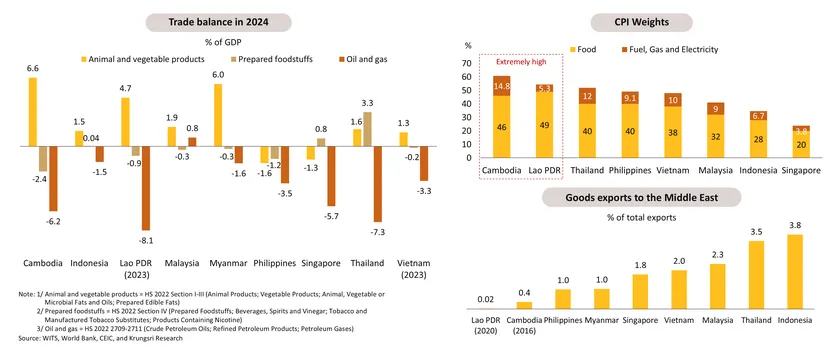
The most significant impact from the Middle East conflict on ASEAN comes through the supply side—higher costs of energy, food, and key production inputs. Countries that are heavily reliant on food and energy imports, particularly those with a high weight of these components in their CPI baskets, face greater exposure to inflationary pressures.
Demand-side spillovers are expected to remain limited, reflecting ASEAN's relatively low direct trade exposure to the Middle East. However, an escalation of the conflict could weigh on tourism, as higher airfares and security concerns discourage arrivals from Europe and the U.S.

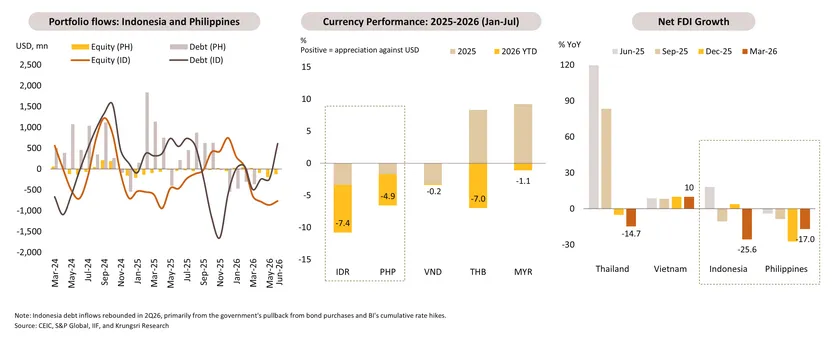
Beyond the Middle East conflict, country-specific governance and policy challenges have undermined investor confidence, triggering currency depreciation and capital outflows, particularly in Indonesia and, to a lesser extent, the Philippines. These challenges are increasingly spilling over to the real economy, with weaker investment conditions contributing to declining net FDI, in contrast to regional peers.
As competitive advantages increasingly extend beyond costs to quality-related factors, countries that fail to strengthen governance and institutional quality risk undermining key medium-term growth drivers, particularly FDI inflows.

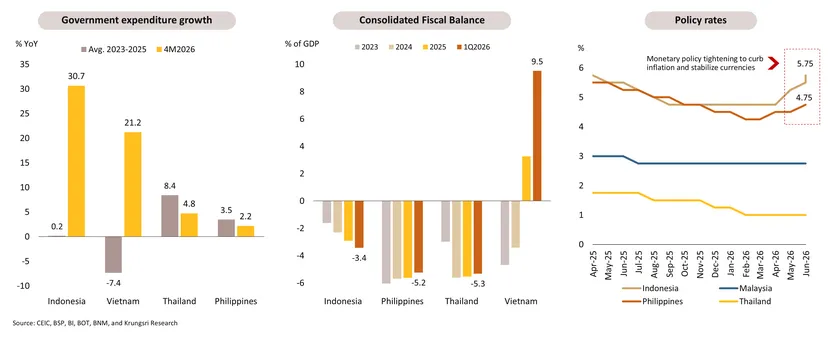
Fiscal space across ASEAN has continued to tighten, as governments face elevated spending pressures in 1Q26. The dual shock of high energy prices and slowing growth has forced governments to expand spending rapidly, drawing down post-pandemic fiscal buffers faster than anticipated.
On the monetary front, tighter global financial conditions following the Middle East conflict leave externally financed economies—particularly Indonesia and the Philippines—more vulnerable. Monetary policy is therefore likely to remain relatively tight to keep domestic yields attractive and support FX stability. In Indonesia, however, the recent policy rate hikes were mainly driven by concerns over policy credibility and fiscal sustainability.

Recent conflicts in the Middle East, together with country-specific challenges, are heightening stagflation risks across ASEAN economies. Higher energy, food, and production input costs are weighing on economic activity while fueling inflation. In addition, the increasing risk of El Niño could intensify food price pressures, particularly in economies that are highly dependent on food imports and where food carries a large weight in the consumer price basket (see p. 6).
Beyond the immediate impact, there are the longer-term consequences of today's policy responses. In many countries, particularly Indonesia, short-term resilience has come at the expense of future fiscal space. With fiscal space depleted by support measures and monetary policy remaining tight, the scope for countercyclical policy in the next downturn is becoming more limited. Overall, while ASEAN remains resilient, risks are increasingly structural and uneven, shaped by each country's economic structure and policy framework.

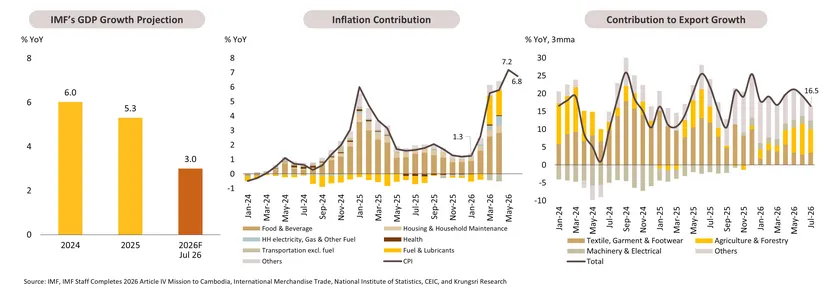
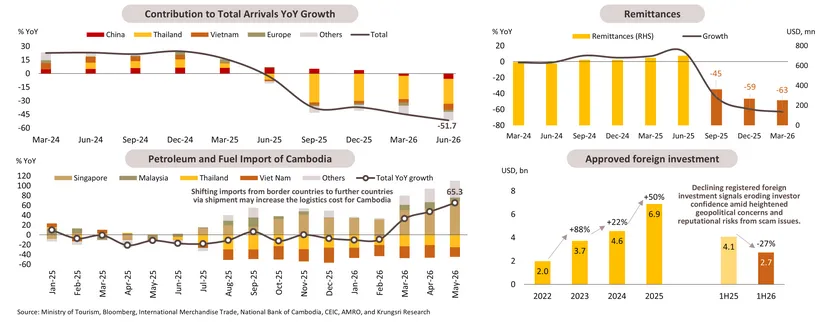
The IMF lowered its 2026 GDP growth forecast for Cambodia to 3.0% in July, from 4.0% in its mid-April assessment, marking a sharp slowdown from 5.3% growth in 2025. The downgrade reflects the continued drag from the border conflict with Thailand and the fallout from the scam industry on economic activity and banking stability, while the Middle East conflict has further intensified these headwinds.
Resilient export growth remains the economy's sole growth engine. Exports held firm in 1H26, led by garments to major markets in the US and the EU, as buyers brought orders forward due to uncertainties over sectoral tariffs and the expiry of Section 122. However, US trade policy uncertainty, particularly potential Section 301 measures related to forced labor and excess production capacity, is expected to weigh on export momentum going forward.
Inflation spiked to 7.2% YoY in May 2026 (vs. 2025 avg. 2.5%), driven by fuel and food price pressures following the Middle East conflict. Despite early signs of easing, the oil supply shock and high fuel prices are likely to persist, continuing to pressure household purchasing power.

Domestic demand has become an increasing drag on growth, with both private consumption and investment under pressure. Household spending has been eroded by higher inflation, a sharp decline in remittance inflows, and weaker tourist arrivals due to the border conflict and security concerns related to scam operations. With the border closure likely to persist, energy prices remaining elevated, and the scam industry continuing to weigh on economic fundamentals with no near-term resolution, a meaningful recovery in domestic demand is likely to remain slow and challenging.
Investment momentum has likewise weakened, with approved FDI declining as of 1H26, reflecting mounting investor caution driven by scam-related risks and sanctions, as well as prolonged security concerns along the Thai border. As a result, capital commitments are likely to be delayed or scaled back.

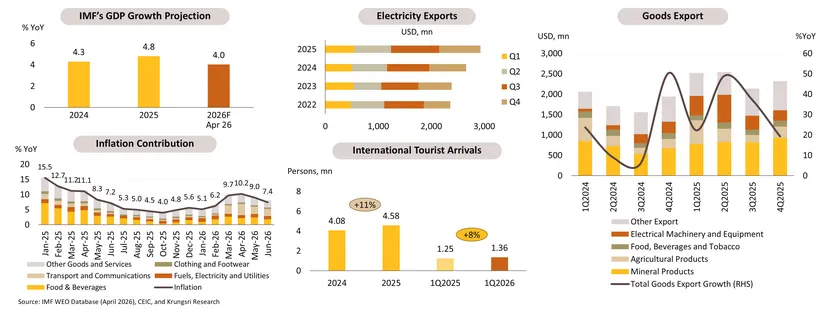
The IMF projected Laos’ economic growth at 4.0% in 2026 (as of April 2026), down from 4.8% last year. The growth outlook is weighed down by the Middle East conflicts, which cause global supply chain disruptions and higher energy prices. On the domestic front, higher import prices and persistently high cost of living have pressured consumption. A significant share of food, fuels, electricity, and transport in the CPI basket (69%), combined with the rising prices for these items, has pushed Lao’s inflation rate up to 10.2% in April 2026 after the Middle East conflicts.
Goods and services exports remain resilient and a crucial driver of continued growth. Services exports, including electricity and tourism, continue to grow robustly. In 1Q26, Laos welcomed around 1.3 mn tourists, growing 8.8% YoY. In 2025, goods exports grew by 30.9% YoY, benefiting from the upgraded Lao-China railway, particularly electronics and agricultural exports to China. Exports in 1Q26 still showed continuous growth of 11.3% YoY, driven by mineral and agricultural products.

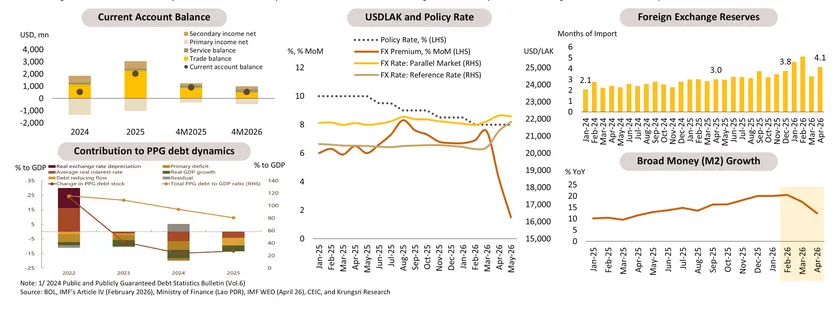
External financial stability improved. Despite higher oil import costs, strong export performance continued to support the current account, keeping foreign exchange reserves at around four months of import cover as of April 2026. On the currency front, although the kip has depreciated since March 2026 following the conflict, the FX premium (the gap between official and commercial bank FX rates) has narrowed and largely closed, suggesting contained FX shortages and limited near-term depreciation pressures.
While external debt has peaked and improved, supported by debt repayments and the deferral of debt repayments to China until 2026, Laos’s external debt remains elevated. USDLAK depreciation may increase debt servicing costs in KIP-denominated terms in 2026. Plus, deferred debt repayment to China may not sustain Laos’s financial stability. However, the government expects to reduce the PPG debt to GDP to 70% in 20301/.
One of the key measures supporting the kip and containing inflation has been monetary tightening, as reflected in slower growth of broad money (M2). While this policy has strengthened external stability, it has come at the expense of domestic demand, as tighter monetary conditions weigh on domestic activity.

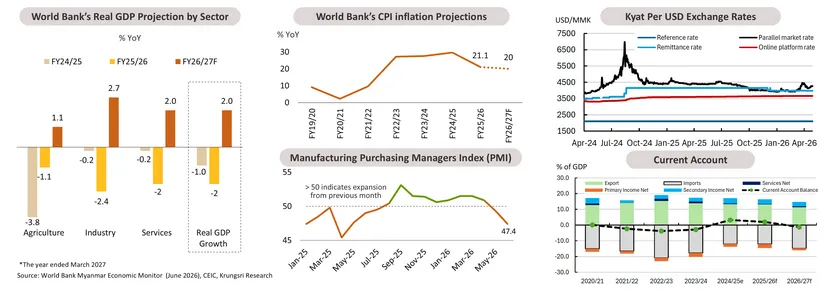
According to the World Bank, Myanmar’s economy is projected to rebound to 2.0% in FY2026/27* from an estimated contraction in the prior fiscal year, though this forecast was revised down from 3.0% projected in December 2025. While economic activity showed signs of recovery through late 2025, partly supported by earthquake reconstruction activity, the Middle East fuel shock sharply worsened Myanmar's pre-existing economic vulnerabilities, reversing early gains before they could materialize.
Inflation reaccelerated sharply from March 2026, propelled by surging fuel costs that fed broadly into transport and food prices. Manufacturing, which had gained traction with PMI in expansion territory since 2H25, reversed course as input costs hit a 43-month high following the fuel shock.
The kyat came under renewed pressure as surging import costs drove up demand for foreign currency. After a period of relative stability in late 2025, supported by heavy central bank intervention and foreign exchange controls, the parallel market premium widened sharply from 8.3% in Feb to 17% against the online platform rate by May 2026, exposing the structural fragility underlying that earlier calm. Current account is projected to shift from a surplus to a deficit of 1.2% of GDP in FY2026/27, as the fuel import bill rises while export performance remains subdued.

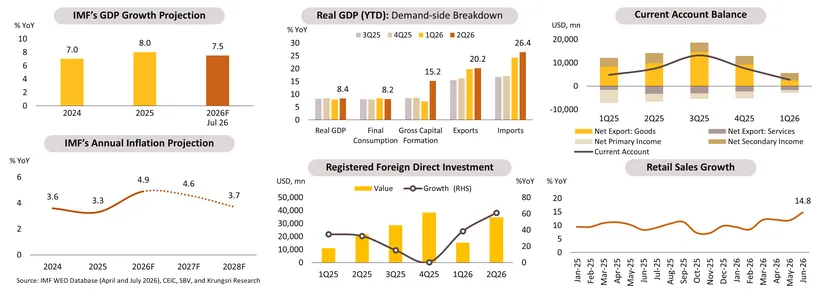
The IMF forecasted Vietnam’s GDP at 7.5% in 2026 (as of July 2026), making this newly upper-middle income country secure the fastest growth country in the region. Resilient exports and firm domestic demand remain key growth drivers of Vietnam’s economy. Exports grew by 20% YoY in 1H26, backed by electronic products, machinery and equipment. However, trade surplus gains have narrowed due to rising raw materials and capital goods imports for manufacturing sectors, compounded by rising import prices owing to the Middle East conflicts. Another growth driver is resilient domestic consumption as reflected in a double-digit retail sales growth of 14.8% YoY in June, underpinned by continued policy support and robust economic momentum.
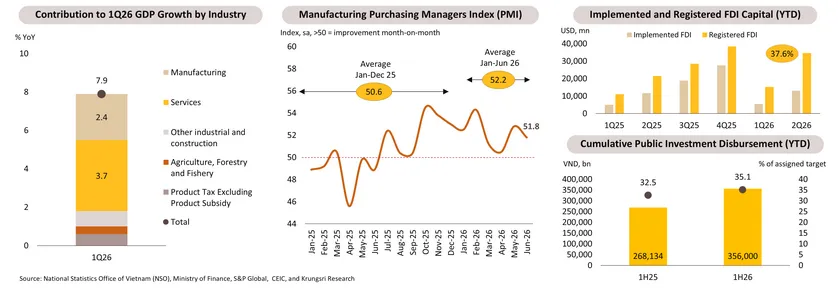
Investment emerged as a major growth engine in 1H26, likely reflecting a strong public investment push and robust FDI inflows, which supported private capital expenditure. Vietnam continued to attract foreign investment, with registered FDI increasing by 61% YoY in 1Q26. The favorable investment climate was further reflected in sustained credit expansion, with YTD total outstanding loans growing by 7.4% as of June 2026. According to the SBV, around 77% of total outstanding loans were allocated to production and business activities, with notable growth in exports and high-technology sectors as of May 2026.

From the supply side, manufacturing and services were the main contributors to GDP growth in 1Q26, in line with strong export momentum and resilient domestic economic activity. The manufacturing PMI also reflected this trend, averaging 52.2 in 1H26, up from 50.6 in 2025. Looking ahead, the technology upcycle and resilient domestic demand should continue to support Vietnam's production, particularly for technology-related exports. That said, tariff uncertainty and elevated input costs remain key headwinds.
Both public and private investment continued to support the outlook. Implemented FDI reached 37.6% of registered capital in 2Q26, down from 2025 amid a higher base of registered capital. Nevertheless, continued implementation suggests that investment commitments are gradually translating into actual economic activity. Meanwhile, public investment disbursement reached 35.1% of the annual target in 1H26, up from the previous year, as the government accelerated spending on major transport projects. For the rest of the year, sustaining the pace of investment implementation and translating it into higher-value manufacturing output will be key to maintaining growth momentum and achieving the government's 10% GDP growth target.

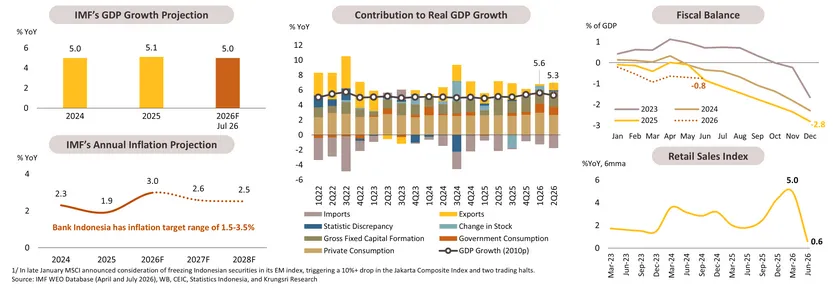
The IMF maintained Indonesia's 2026 GDP growth forecast at 5.0%, backed by fiscal stimulus and private consumption, with strong 1H26 growth fueled by a sharp surge in government consumption (+18.6% YoY). Inflation is projected to edge up to 3.0% in 2026, driven by cost-push spillovers from higher global fuel prices. The government’s fuel price freeze caps consumer pass-through, though a prolonged conflict could reignite oil prices and inflationary pressure in 2H26.
Bank Indonesia (BI) reversed its easing stance, hiking the policy rate by a cumulative 100 bps to 5.75% from May onward, as expanding subsidy burdens and deteriorating government credibility triggered sovereign rating outlook downgrades and capital outflows1/, driving the rupiah to a historic low past USD/IDR 18,000 in early June. Resignation of BI Governor Warjiyo, long viewed as a steady hand on stability, in late July further eroded market confidence in central bank independence, dimming prospects for a rupiah recovery.
The outlook for domestic consumption has become more mixed. While household consumption in the GDP accounts remained resilient, high-frequency indicators tell a softer story, with retail sales losing momentum markedly in 2Q26 amid higher policy rates, currency depreciation, and elevated inflation, suggesting household spending may gradually weaken in the coming quarters as fiscal support fades.

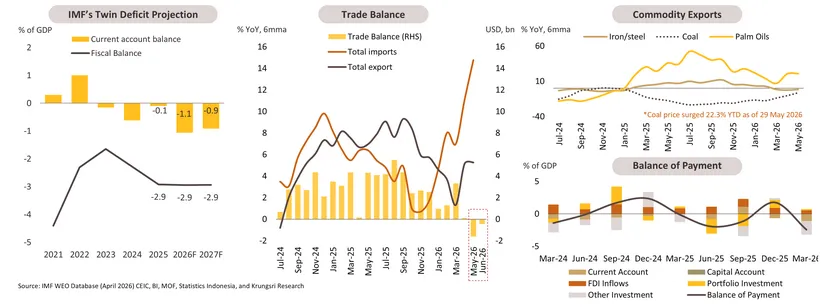
Indonesia faces renewed twin-deficit pressure, raising external financing needs and amplifying the rupiah's sensitivity to capital flows. On the fiscal front, the government projects the fiscal deficit to widen to 2.9% of GDP in 2026, nearing the 3.0% legal ceiling. Besides limited room to absorb further shocks, government spending remains weighted toward low-multiplier income support rather than productive investment, limiting its ability to sustain household consumption. The current account deficit widened in 1Q26 amid weaker commodity exports, while resilient imports of intermediate and capital goods, followed by higher oil import costs in 2Q, pushed up the import bill. With commodity exports remaining under pressure and oil prices staying elevated, the goods surplus is expected to narrow.
The launch of the Danantara sovereign wealth fund—tasked with optimizing SOE assets and overseeing strategic commodity sectors—was a key factor behind the deterioration in investor confidence in mid-2026, given its unclear mandate and governance. If concerns over greater state control are not addressed, they could weaken investor confidence and deter FDI inflows. Operational risks from centralized commodity oversight could also weigh on export performance.

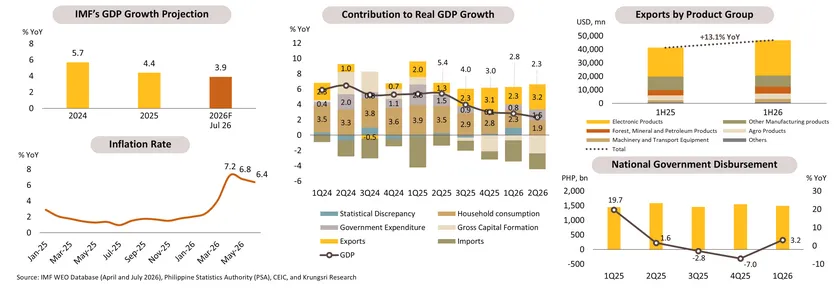
The IMF lowered its 2026 growth forecast for the Philippines to 3.9% in July 2026, down from 5.6% in January. Coupled with 1H26 GDP growth of just 2.6% YoY, this slowdown reflects the drag from anti-corruption measures that have delayed public spending and weighed on private investment, which has been contracting since 3Q25. Meanwhile, consumption — the country's main growth driver (over 70% of GDP) has also come under pressure, as weakness in private investment has spilled over into private demand, compounded by rising inflation since March 2026 and softer remittance inflows.
In contrast, exports remain a key growth driver in 1H26, increasing by 13.1% YoY. Electronic products gained the largest share of export value with 20.7% YoY growth, benefiting from global technology industry expansion. Despite the imposition of an additional 12.5% Section 301 tariff on Philippine exports, technology exports remain exempt — which accounts for more than 50% of total exports, thereby mitigating the impact on overall export momentum.
Despite a gradual recovery in public spending, which grew by 3.2% YoY in 1Q26 due to higher transfers to local government projects, the crowding-in effect on private investment has remained limited. Nevertheless, should the government sustain this spending momentum, the positive spillover is likely to materialize.

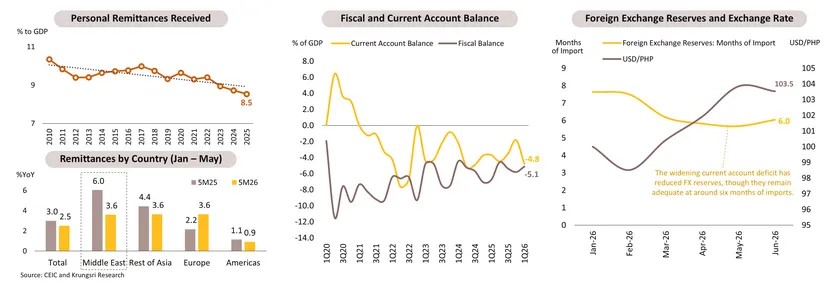
Overseas remittances, equivalent to 8.5% of GDP in 2025, have shown a gradual downtrend in recent years. Remittances still grew by 2.5% YoY in 5M26, although inflows from the Middle East slowed the most following the conflict. Growth in inflows from the Americas remained subdued, which is concerning given that the U.S. is the Philippines' largest source of remittances (around 40% in 2025). If this persists, it could reduce support for household consumption.
Twin deficits persist, with higher oil prices worsening both the current account and fiscal balance. The current account deficit widened to 4.8% of GDP in 1Q26. Meanwhile, government spending growth, particularly on targeted fuel subsidies, pushed the fiscal deficit to 5.1% of GDP in 1Q26 and close to the full-year target of 5.4% of GDP. Limited fiscal space constrains the government's ability to cushion future shocks and raises the risk of delayed fiscal consolidation.
The policy rate was raised by 50 bps to 4.75% in April-June 26 to contain second-round inflation effects and FX pressures, as the peso depreciated by 3.5% (Jan–Jun 2026) amid deteriorating terms of trade and a stronger USD. The tightening has increased financial costs and weighed on domestic activity. Further, climate-related risks could worsen the trade balance, particularly through higher rice imports, adding cost-push inflationary pressure and keeping interest rates high for longer.