
Monthly Economic Bulletin (February 2026)

Monthly Economic Bulletin (February 2026)

18 February 2026

Global: Fragmented tailwinds amid a challenging backdrop

Monthly Economic Bulletin
 

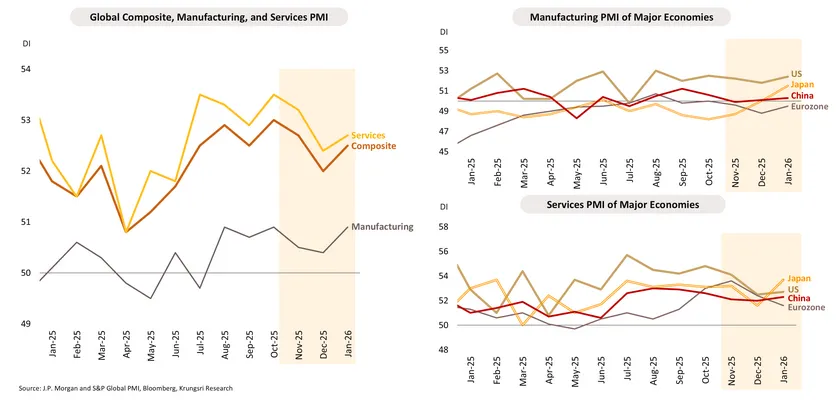
Global economic activity improves modestly from a 6-month low; services remain in expansion across most regions, while manufacturing shows patchy growth


Monthly Economic Bulletin
 

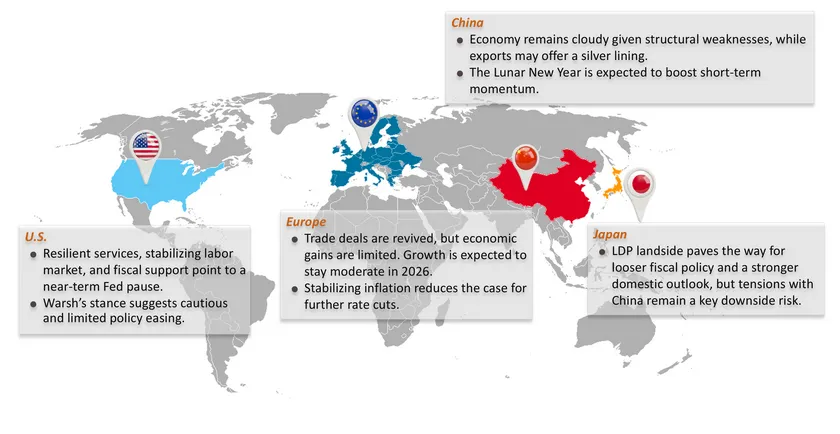
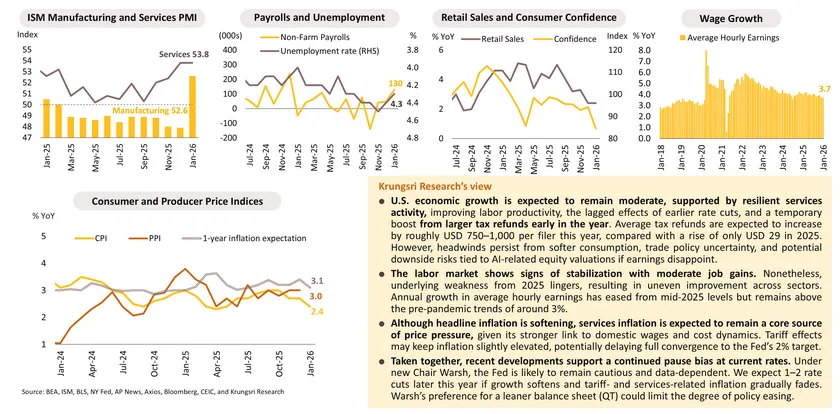
U.S.: Resilient services, stabilizing labor market, and fiscal support point to a near-term Fed pause; Warsh’s stance suggests cautious and limited policy easing


Monthly Economic Bulletin  

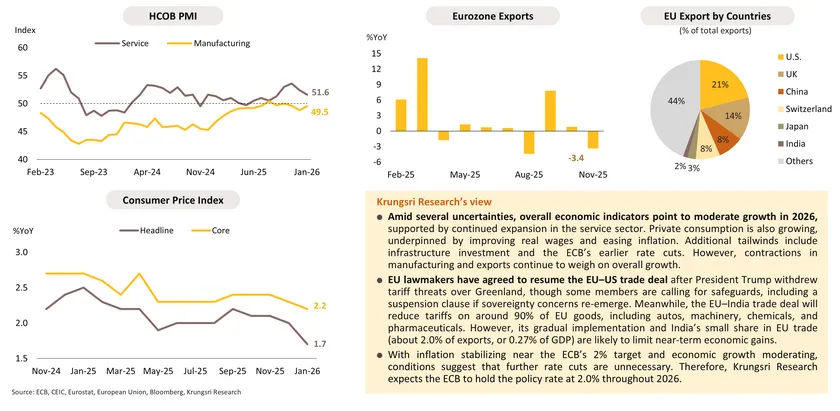
Eurozone: Trade deals are revived, but economic gains are still limited; growth is expected to stay moderate in 2026; stabilizing inflation reduces the case for further rate cuts


Monthly Economic Bulletin  
 

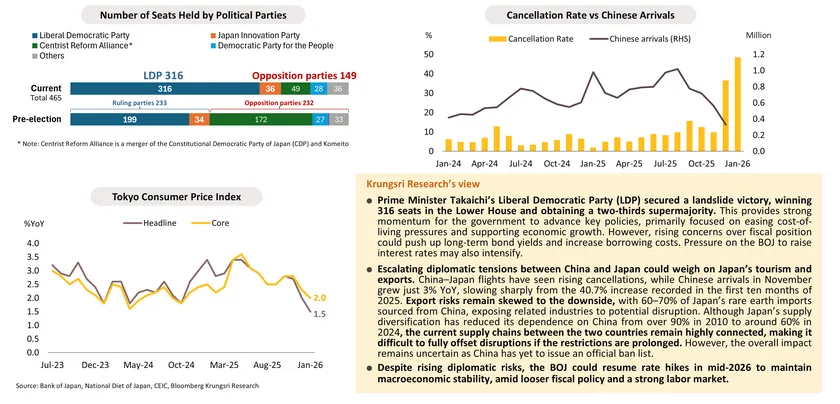
Japan: LDP landside paves the way for looser fiscal policy and a stronger domestic outlook, but tensions with China remain a key downside risk


Monthly Economic Bulletin  
 

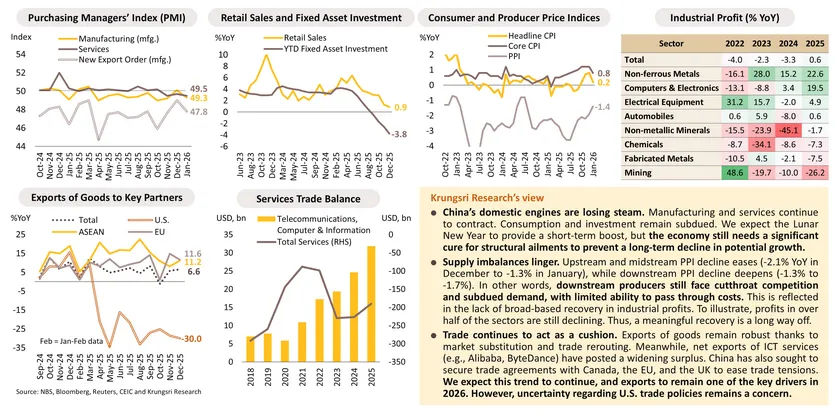
China: Economy remains cloudy given structural weaknesses, while exports may offer a silver lining; the Lunar New Year is expected to boost short-term momentum


Monthly Economic Bulletin  


Thailand: Uneven tailwinds amid emerging hopes for a more stable government and persistent structural pressures

 
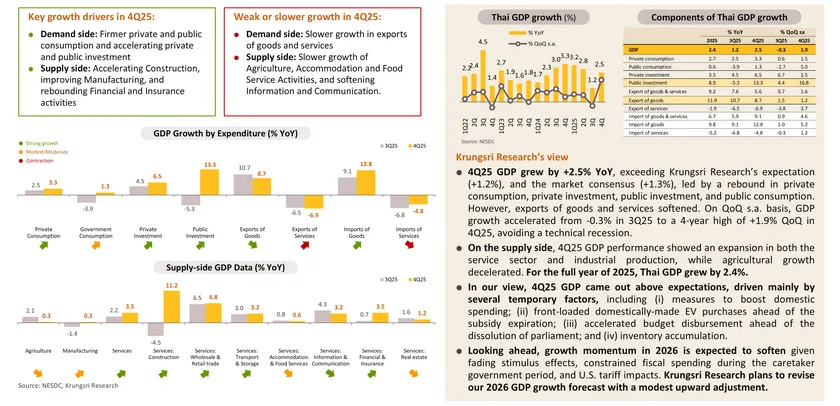
  • 4Q25 GDP growth recorded a significant upside surprise, expanding by +2.5% YoY and +1.9% QoQ s.a. Private consumption, private investment, and government spending are key drivers. At the same time, exports of goods and services experienced a moderation in growth. 

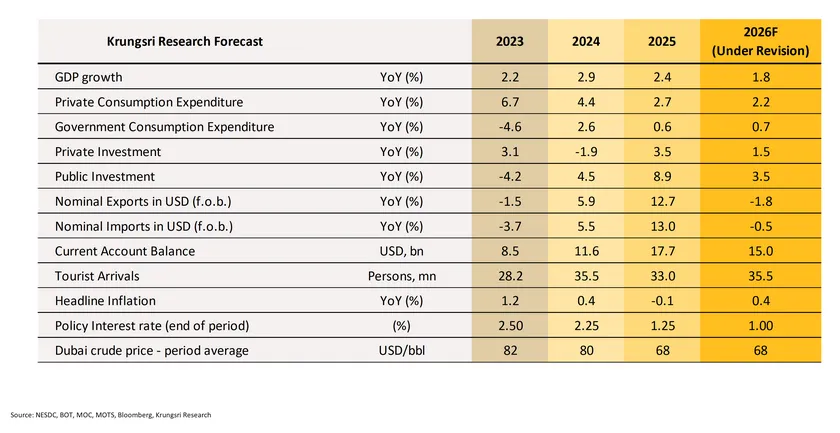
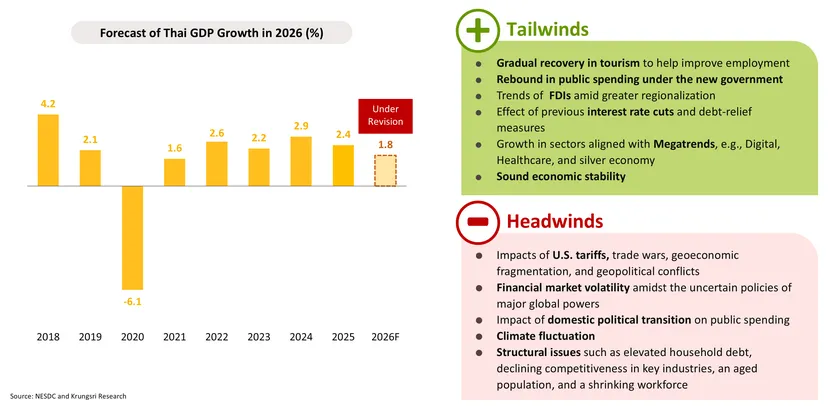
  • Our 2026 growth forecast of 1.8% is currently under revision, with a modest upward bias reflecting both technical and political factors. The new forecast will be announced on February 26.

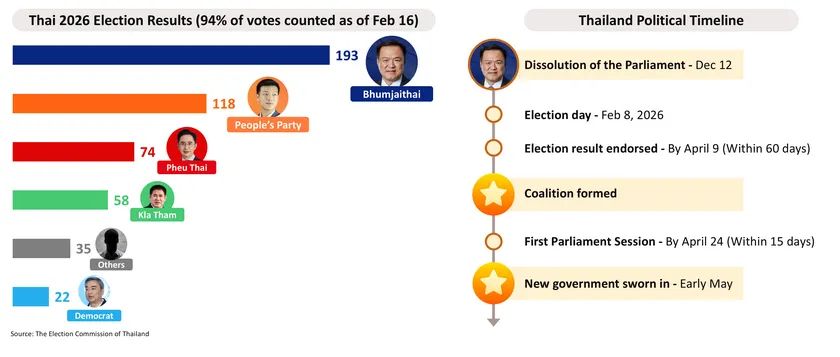
  • Thai Election: Results raise hopes for a more stable government and smoother policy execution under the Bhumjaithai-led bloc, lifting near-term economic sentiment.

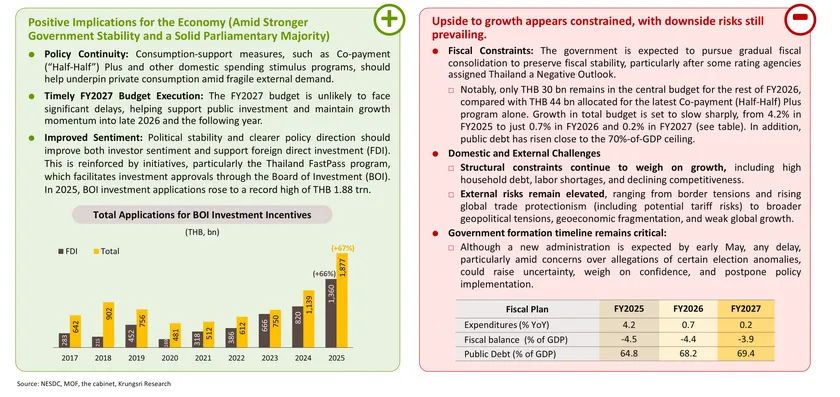
  • Politics and economic outlook: While political clarity could support near-term growth momentum, the upside appears constrained, and downside risks remain.

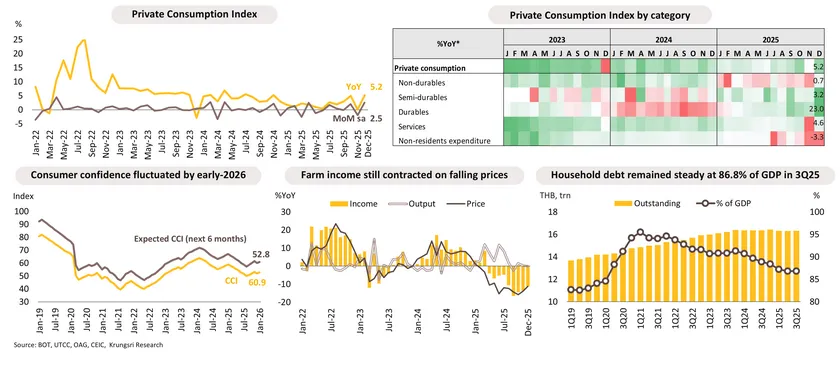
  • Private consumption rebounded modestly in late 2025 on tourism recovery, but momentum may weaken amid fading stimulus, weak income, and high household debt.

  • Private investment is picking up, while the realization of strong BOI applications hinges on greater political clarity.

  • Thai exports maintain momentum in late 2025, but U.S. tariffs, slowing global trade, and baht appreciation are likely to cloud the trade trajectory.

  • Tourism sees signs of improvement despite slow recovery.

  • MPC still has limited room for monetary easing amid downside risks to growth and subdued inflation. However, if fiscal stimulus gains traction, the easing cycle could end sooner than expected.


Krungsri Research Forecasts for 2026

Monthly Economic Bulletin  
 

4Q25 GDP growth recorded significant upside surprise, expanding by +2.5% YoY and +1.9% QoQ s.a., driven mainly by several temporary factor


Monthly Economic Bulletin  
 

Thailand’s 2026 economic growth likely to soften amid fading stimulus, constrained public spending and U.S. tariffs; our growth revision leans toward a modest upward bias

Monthly Economic Bulletin  

Thai Election: Results raise hopes for a more stable government and smoother policy execution under the Bhumjaithai-led bloc, lifting near-term economic sentiment


The Bhumjaithai Party emerged as the largest party in the House of Representatives, securing approximately 190–195 of the 500 seats. As the leading party in the government formation, Bhumjaithai is well positioned to anchor a new coalition. A coalition with the Pheu Thai Party (approximately 74 seats) could be sufficient to secure a parliamentary majority of at least 267 seats. Beyond this baseline majority, the coalition may seek to broaden its parliamentary base by incorporating the Klatham Party (approximately 58 seats) and/or smaller political parties, resulting in a coalition of more than 325 seats. Given the scale of the previous government bloc’s electoral performance, the government formation process is expected to proceed within a timeframe. However, concerns over allegations of certain election anomalies deserve close attention.

Monthly Economic Bulletin  
 

Politics and economic outlook: While political clarity could support near-term growth momentum, the upside appears constrained and downside risks remain


Monthly Economic Bulletin
 

Private consumption rebounded modestly in late 2025 on tourism recovery, but momentum may weaken amid fading stimulus, weak income, and high household debt


In Dec-25, the Private Consumption Index (PCI) turned to post a year-on-year expansion, reflecting a gradual recovery of durables and semi-durables, supported by short-term government measures such as the “Co-payment Plus” scheme, domestic tourism promotion, and EV subsidies. However, the growth momentum may weaken as these temporary support measures expire. In addition, weak income and structural constraints, particularly high household debt, continue to weigh on household spending going forward.

Monthly Economic Bulletin  
 

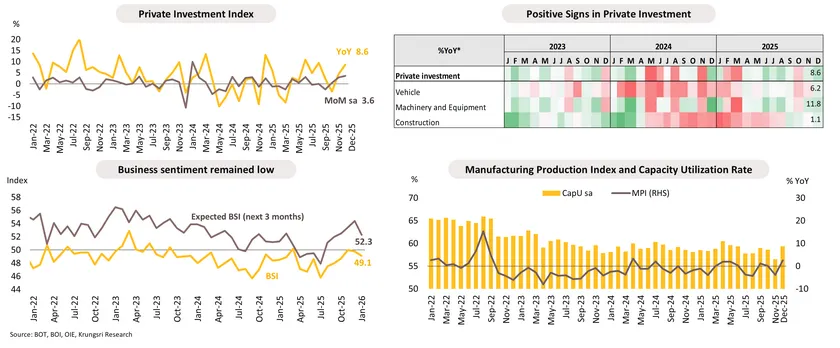
Private investment is picking up, while the realization of strong BOI applications hinges on greater political clarity


In Dec-25, the Private Investment Index (PII) expanded by 8.6% YoY and 3.6% MoM (seasonally adjusted), reflecting a gradual recovery, particularly in machinery and equipment investment, in line with higher manufacturing production and capacity utilization. Nevertheless, political uncertainty weighs on business sentiment. The near-term outlook remains pressured by weak domestic demand, global economic uncertainty, and U.S. trade tariffs. While investment momentum has improved, the realization of strong BOI applications will depend on greater political clarity.

Monthly Economic Bulletin  
 

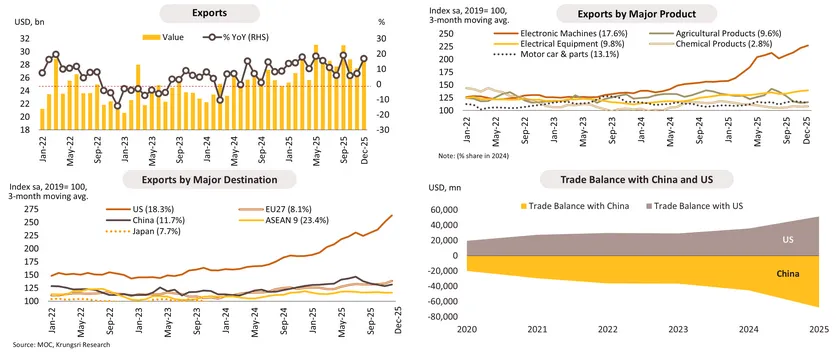
Thai exports maintain the growth momentum in late 2025, but U.S. tariffs, slowing global trade, and baht appreciation are likely to cloud the trade trajectory 


Exports expanded by 16.8% YoY in Dec-25, with continued growth in key products such as computers and parts, integrated circuits, and chemical products. Exports to all major markets – including the U.S., EU27, Japan, China, and ASEAN – also expanded. For the full year, exports grew by 12.9% YoY. Thailand recorded a trade surplus of USD 51.4 bn with the U.S., while its deficit with China widened to USD 67.9 bn, underscoring concerns over the influx of Chinese goods. Looking ahead, export growth is expected to slow down in 2026, reflecting the fading front-loading effect seen in 2025, the full-year impact of U.S. tariffs, and weak global trade conditions.

Monthly Economic Bulletin  
 

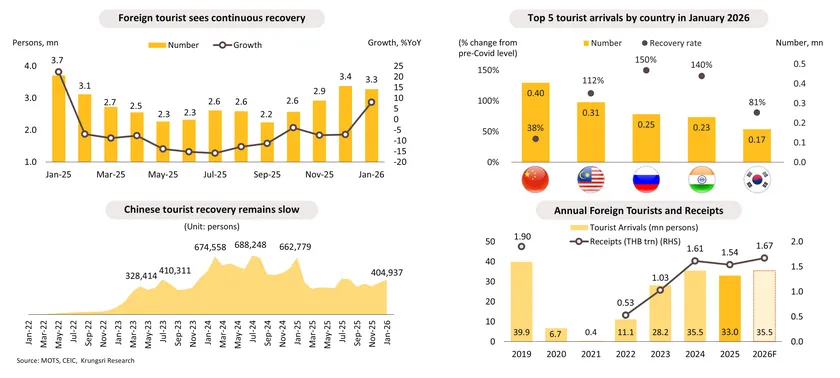
Tourism sees sign of improvement despite slow recovery


In Jan-26, Thailand welcomed 3.28 mn foreign visitors, slightly down from 3.37 mn in Dec-25. Chinese tourist arrivals continued to decline by -39% YoY, whereas tourist arrivals from India and Russia continued to expand by +24% and +7% YoY. However, the Chinese New Year festival is also expected to provide a seasonal boost to tourism in Feb-26. We maintain our full-year forecast of 35.5 mn foreign arrivals, generating tourism revenue of THB 1.67 trn. 

Monthly Economic Bulletin  
 

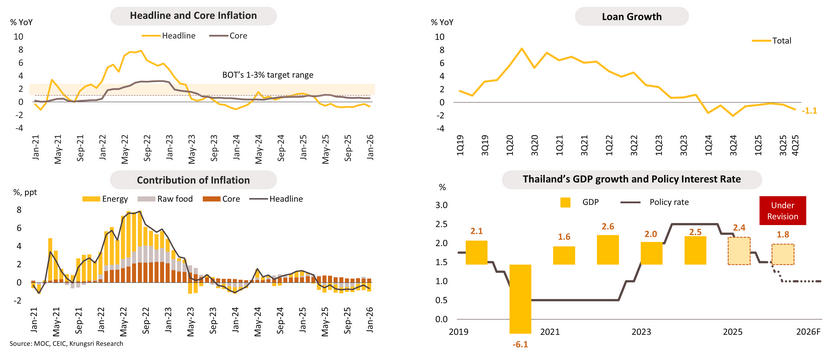
MPC still has room for monetary easing amid downside risks to growth and subdued inflation; however, if fiscal stimulus gains traction, the easing cycle could end sooner than expected


In Jan-26, headline inflation declined to -0.66%, falling further from -0.28% in Dec-25, and remaining well below the official target range of 1–3%. Subdued price pressures reflect low global oil prices and still-weak domestic demand. Amid downside risk to growth and subdued inflation, the Monetary Policy Committee (MPC) still has some room, albeit limited, for further monetary easing, However, the likelihood of rate cuts later this year—if they materialize at all—could edge lower if fiscal policy becomes more supportive from 2Q26 onward.

Monthly Economic Bulletin  

 
Back
Press keyword to search