
Global: Bracing for a volatile world
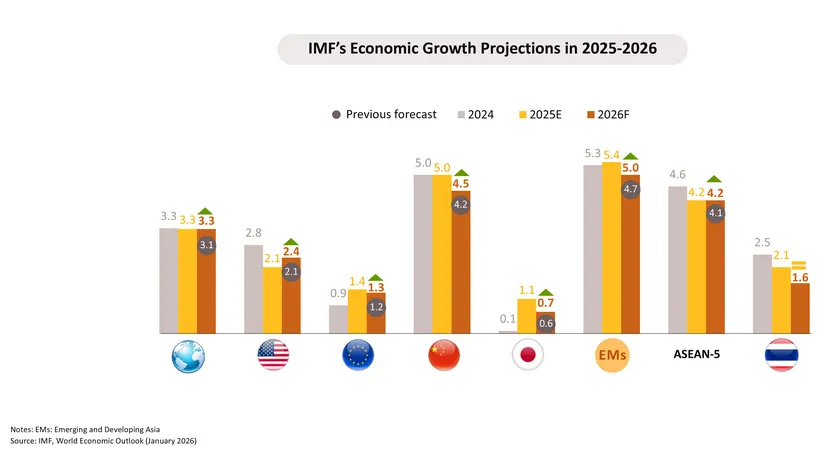
Global growth prospects: IMF sees uneven growth momentum despite policy support, with downside risks from trade protectionism, AI bubble, and geopolitical tensions
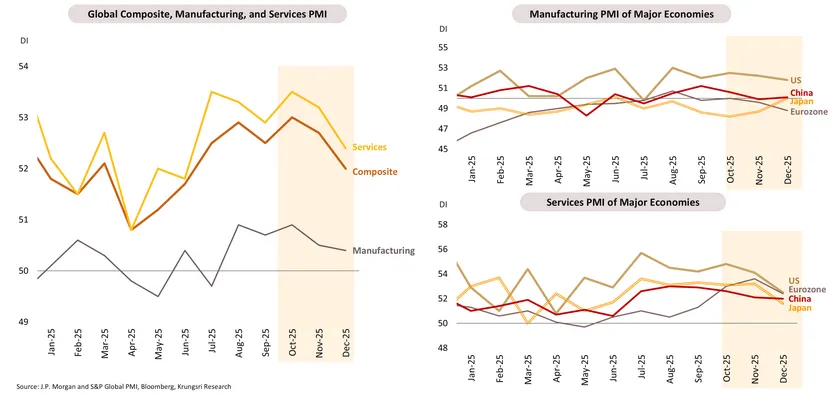
Global growth slowed to its weakest pace in six months at the end of 2025; softening services momentum, manufacturing weakness, and tariff headwinds pose downside risks
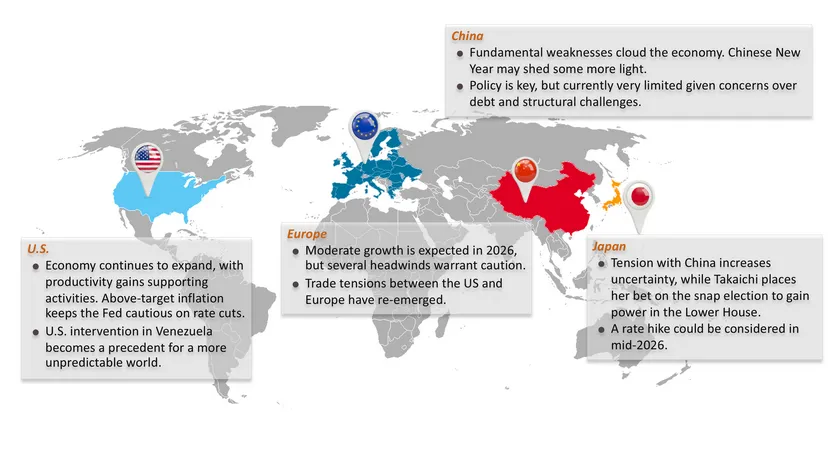
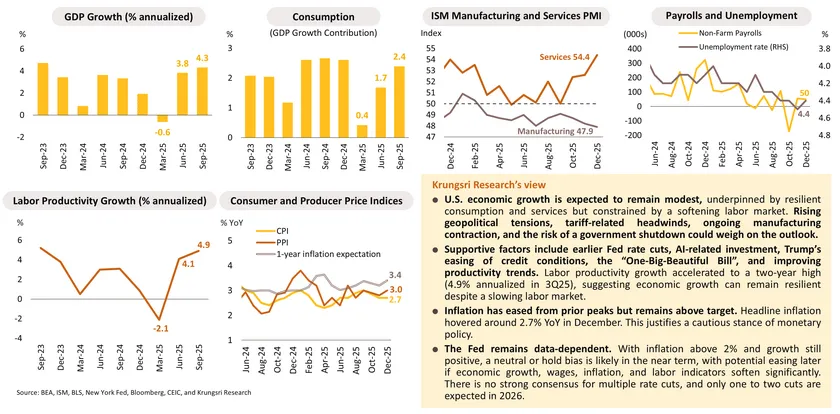
U.S.: Economy continues to expand despite slowing labor market, with productivity gains supporting activities, while above-target inflation keeps the Fed cautious on rate cuts
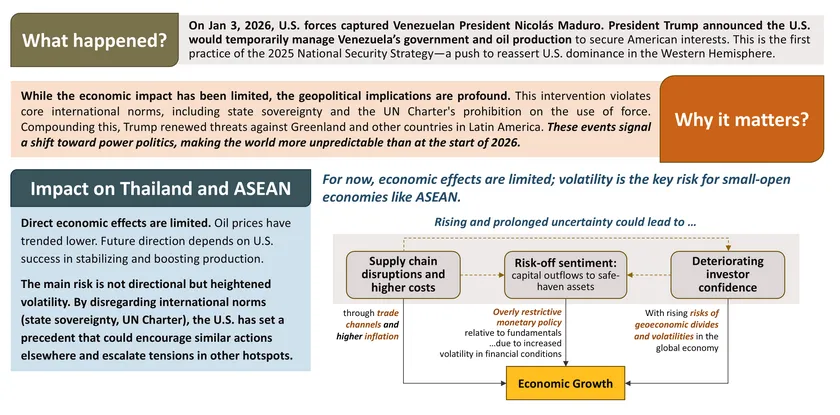
U.S. intervention in Venezuela: precedent for a more unpredictable world
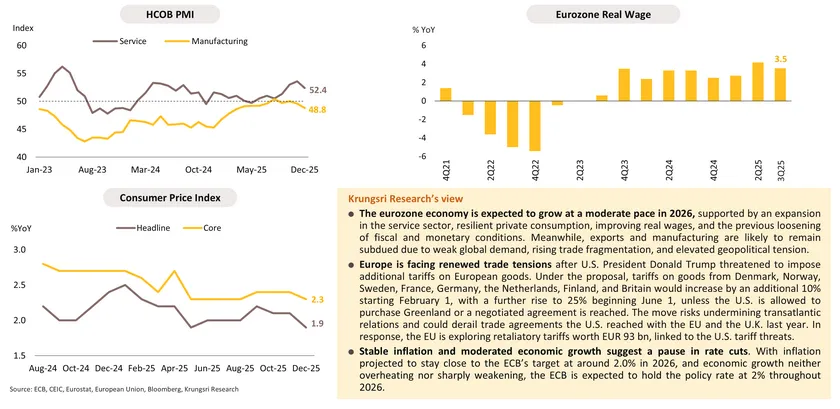
Eurozone: Moderate growth is expected in 2026 but several headwinds warrant caution; trade tensions between the US and Europe have re-emerged
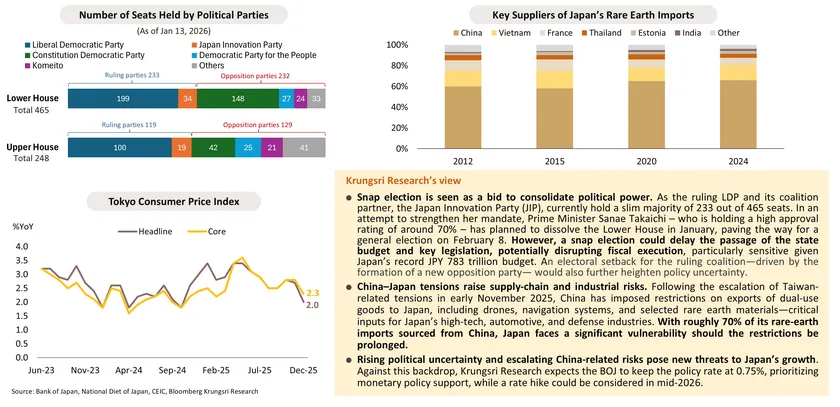
Japan: Tension with China increases uncertainty, while Takaichi places her bet on the snap election to gain power in the Lower House
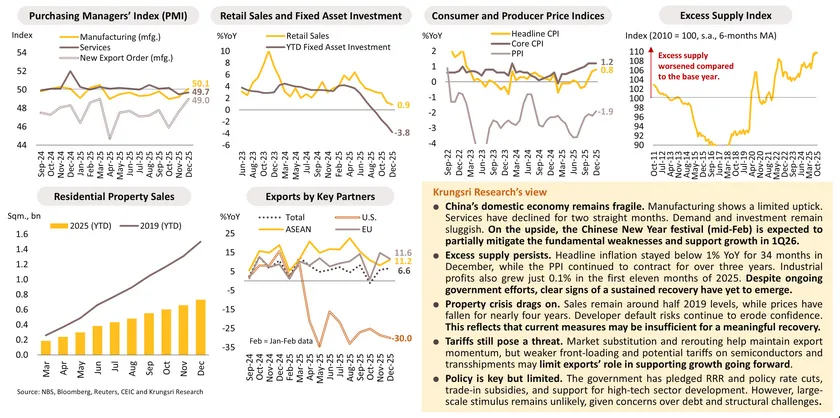
China: Fundamental weaknesses cloud economy; Chinese New Year may shed some more light, but stimulus measures needed to sustain momentum
Thailand: Economy in limbo
-
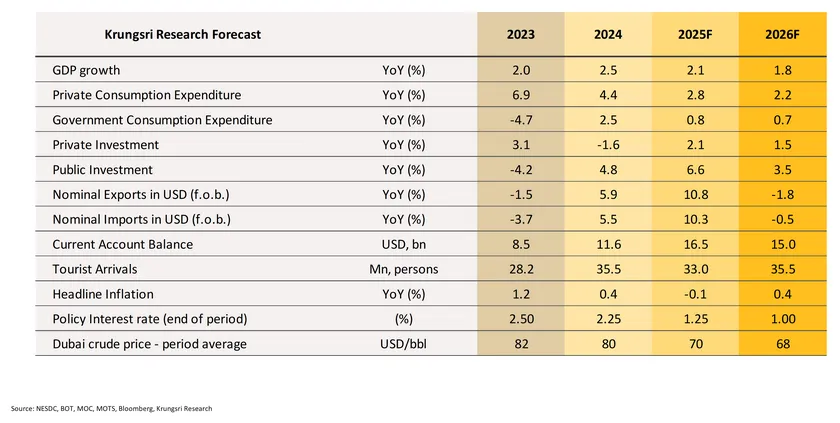
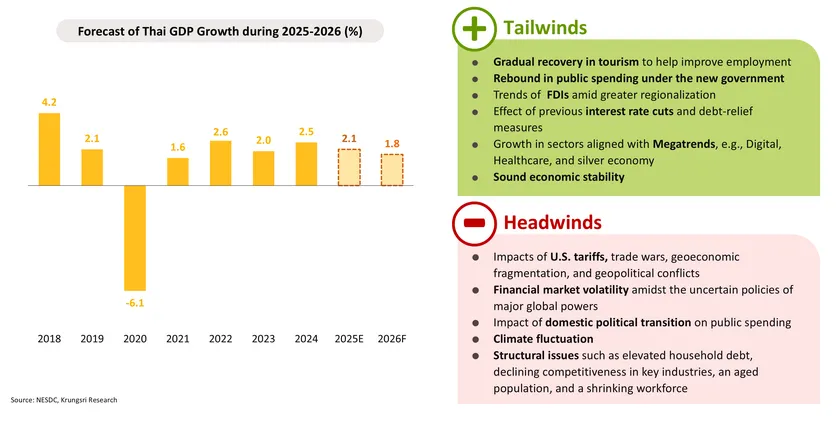
Thailand’s 2026 economic growth likely to moderate, facing tariff pressure and political uncertainty.
-
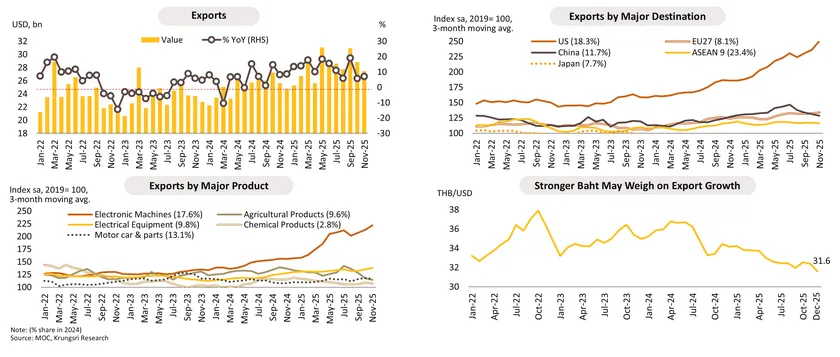
Thai exports to contract in 2026 as U.S. tariffs bite, global trade slows, and the Baht appreciates.
-
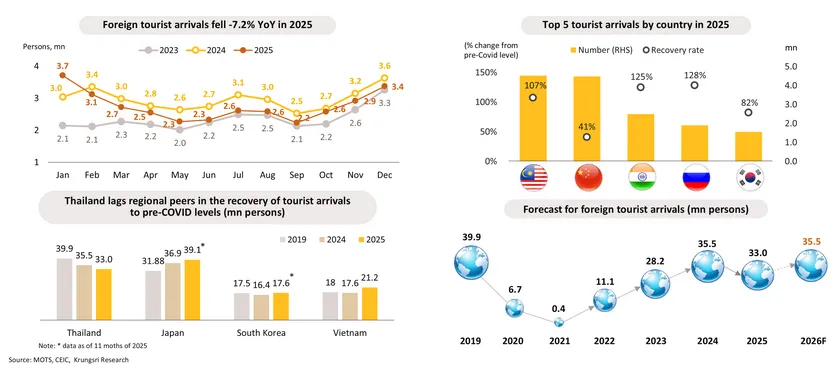
Tourism to play a larger role in driving economic growth in 2026, with arrivals expected to rebound to 35.5 million, though the recovery remains well below pre-COVID levels.
-
Private consumption to slow amid waning stimulus effects and structural constraints.
-
Private investment to maintain momentum in 2026, supported by FDI and supply chain relocation.
-
Public spending accelerated in early FY2026, but fiscal momentum faces uncertainty ahead.
-
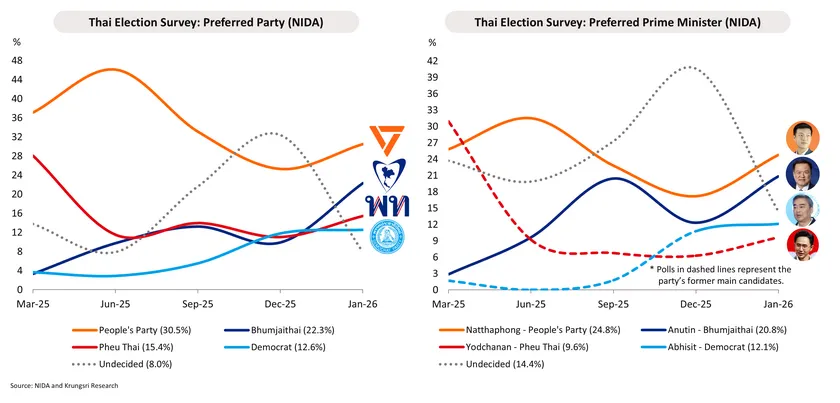
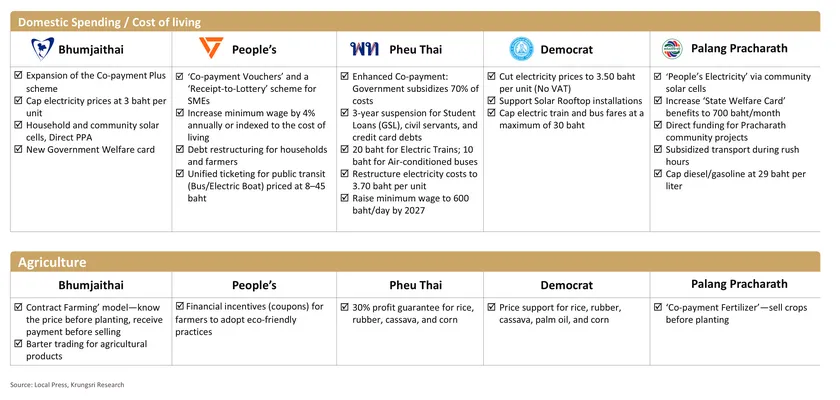
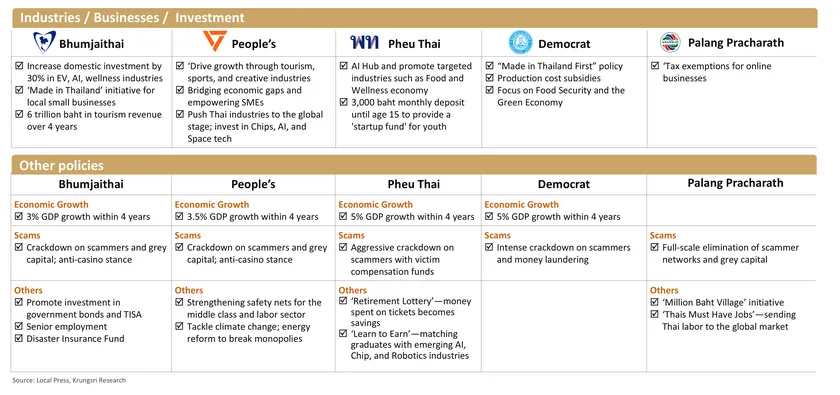
Thai Election: Undecided voters significantly drop, but votes spread, making it difficult for People’s Party to form a new coalition with a comfortable margin, despite holding the lead. Ahead of the 2026 election, most political parties are focusing on policies to support domestic spending (e.g., Co-payment, living cost subsidies, and debt moratorium), including agriculture. Anti-scam policy is another focus. Policies to promote investment and long-term economic development are somewhat mentioned but still lack concrete measures.
-
MPC expected to cut policy rate to 1.0% by 1H26 amid fragile recovery and low inflation.
Krungsri Research Forecasts for 2026
Thailand’s 2026 economic growth likely to moderate, facing tariff pressure and political uncertainty
Thai exports to contract in 2026 as U.S. tariffs bite, global trade slows and the Baht appreciates
In 2026, Thai exports will face full-year impacts from U.S. tariff hikes, including 19% U.S. reciprocal tariffs, effective from August 2025, and additional product-specific duties. The effective tariff rate has increased to 21%, compared to only 0.7% in 2024. The temporary export boost in 2025 from front-loading demand will fade, while there is an additional risk of tariff extension to technology products, a key Thai export. The WTO projects global trade volume growth to slow sharply to 0.5% in 2026 from 2.4% in 2025, reflecting weaker global demand. As a result,
Thai exports are projected to contract by -1.8% in 2026.
Tourism to play a larger role in driving economic growth in 2026, with arrivals expected to reach 35.5 million, though the recovery remains well below pre-COVID levels
In 2026, foreign tourist arrivals are projected to rebound to 35.5 million, supported by additional flights and new routes from China and India. However, the recovery is expected to remain gradual—particularly in the Chinese market, amid safety concerns and intensifying competition—keeping total arrivals below the pre-COVID level of 39.9 million in 2019.
Private consumption to slow amid waning stimulus effects and structural constraints
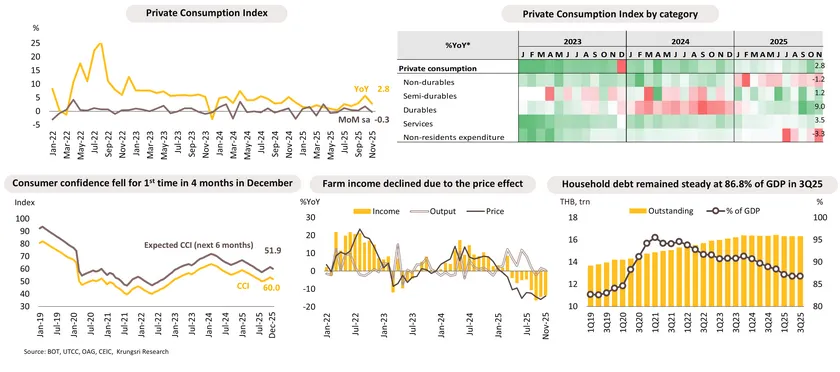
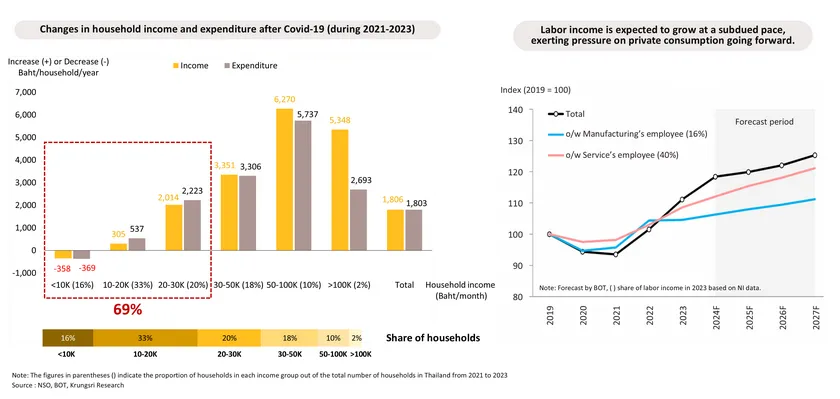
In 2026, private consumption growth is expected to slow to 2.2% from an estimated 2.8% in 2025, reflecting still-fragile purchasing power constrained by structural factors. These include persistently high household debt, a weak recovery in incomes, and weak agricultural earnings. At the same time, the supportive effects from earlier short-term economic stimulus measures are expected to fade, limiting the pace of private consumption growth going forward.
Weak income growth leaves Thai households with little room to save or spend, particularly those earning below 30,000 baht per month
Private investment to maintain momentum in 2026, supported by FDI and supply chain relocation
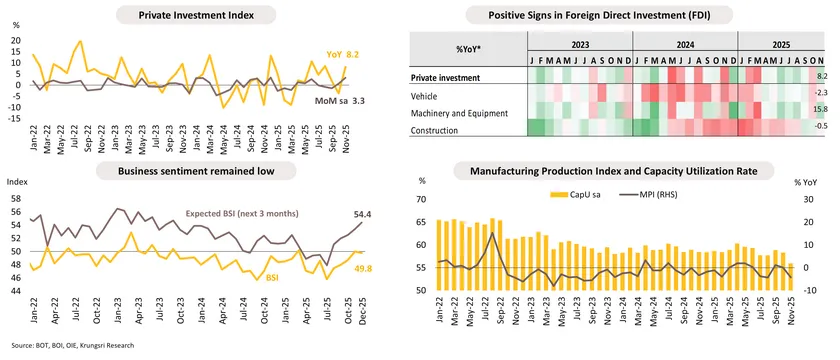
Private investment in 2026 is expected to continue growing, albeit at a slower rate. Key supporting factors include (i) rising investment value of BOI-promoted projects and continued inflows of foreign direct investment (FDI), particularly in targeted sectors such as digital industries, electric vehicles, and renewable energy; (ii) investment facilitation through the BOI’s Thailand FastPass mechanism; and (iii) the ongoing relocation of production bases from China to ASEAN.
Public spending accelerated in early FY2026, but fiscal momentum faces uncertainty ahead
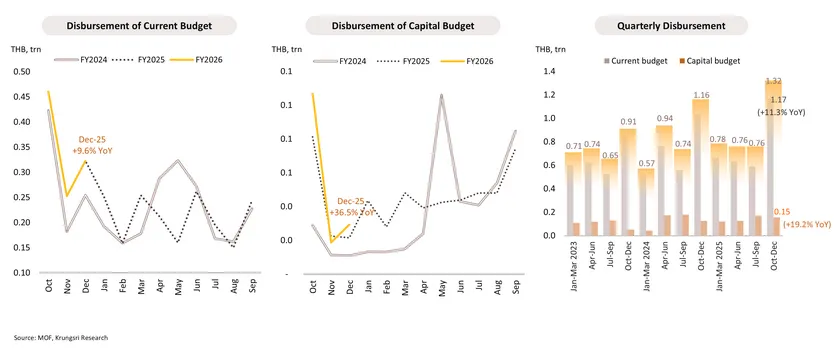
In the first quarter of FY2026 (October–December 2025), the disbursement of the Current Budget increased by 11.3% YoY, while that of the Capital Budget rose by 19.2%, reflecting the government’s efforts to accelerate public spending to support the economy.
However, the sustainability of budget disbursements going forward and the budget preparation process for FY2027 remain uncertain due to limitations during the caretaking government period. This could weigh on fiscal momentum in the period ahead.
Thai Election: Undecided voters significantly drop but votes spread, making it difficult for People’s Party to form new coalition with comfortable margin, despite holding the lead
For policy direction, most political parties are focusing on policies to support domestic spending (e.g., Co-payment, living cost subsidies, and debt moratorium), including agriculture
Anti-scam policy is another focus; policies to promote investment and long-term economic development are mentioned but lack concrete measures
MPC expected to cut policy rate to 1.0% by 1H26 amid fragile recovery and low inflation
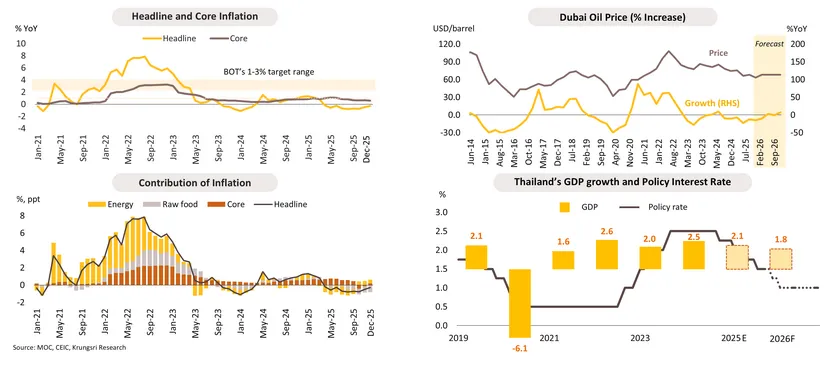
In 2026, headline inflation is expected to turn positive from the second quarter onward but remain below the official target range of 1–3%, averaging around 0.4% for the year. This follows 2025, when the average headline inflation fell into negative territory for the first time in five years, at -0.12%. The subdued inflation outlook reflects limited price pressures amid global oil prices averaging close to last year’s levels, ongoing energy subsidies, and still-weak domestic demand.
Against this backdrop, the Monetary Policy Committee (MPC) is expected to cut the policy rate by a further 25 bps to 1.0% by the first half of 2026 to help ease financial conditions and support the economic recovery.