
Monthly Economic Bulletin - Special Edition (December 2025)

Monthly Economic Bulletin - Special Edition (December 2025)

18 December 2025

2025 Recap: Growth weighed down by structural problems and several headwinds including earthquake, U.S. tariff hikes, domestic political uncertainty and border tension

 
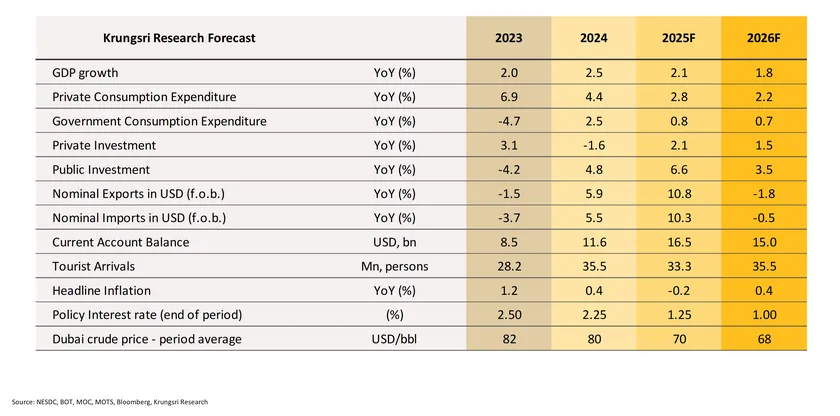
  • We estimate the Thai economy would expand by 2.1% in 2025, slowing from 2.5% in 2024. Growth was pressured by a struggling recovery in the tourism sector, weaker domestic spending, and subdued business investment amid concerns over several headwinds, including an earthquake in March, U.S. tariff hikes from April, Thailand-Cambodia border tensions, rising domestic political uncertainty, and severe flooding in Hat Yai city. However, export growth is performing well, aided by front-loading of orders ahead of tariff implementation.

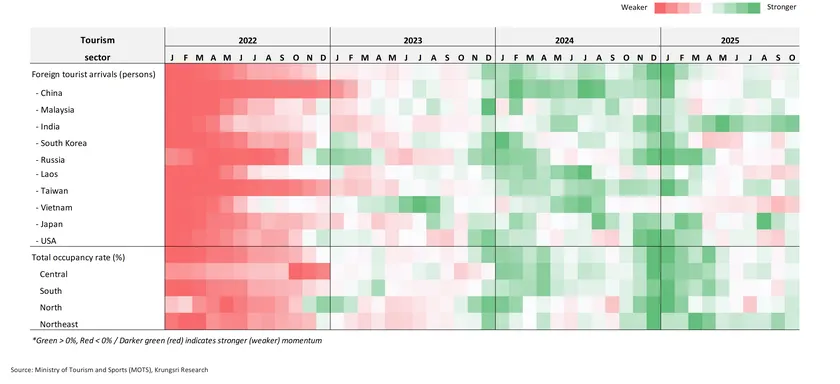
  • The tourism recovery loses momentum. Foreign tourist arrivals have marked the first annual decline since the post-pandemic recovery, hit by (i) concerns about safety and scams in Thailand, which led to a sharp decline in Chinese arrivals; (ii) the March 28 earthquake in Bangkok; and (iii) stronger regional competition. As a result, tourist arrivals are projected to fall towards 33.3 million in 2025, down from 35.5 million in 2024.

  • Private consumption is expected to grow by 2.8% in 2025, slowing from 4.4% in 2024, despite support from short-term government measures such as the THB 10,000 cash handout program, cost-of-living relief for low-income households, the “Co-payment Plus” scheme, and domestic tourism promotion. Additionally, the impact of declining agricultural incomes and structural constraints resulting from high household debt still limits growth.

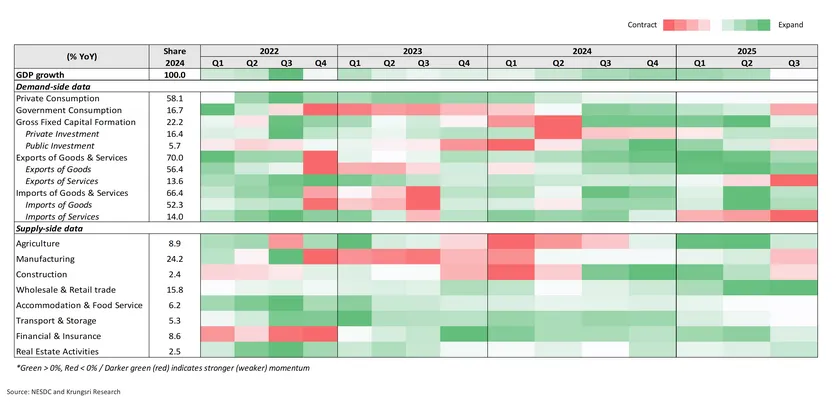
  • Public spending provided only modest support to the economy in 2025. Public consumption and public investment contracted sharply in 3Q25 amid rising geopolitical tensions following the leadership change in August. Despite support from additional stimulus measures in 4Q25, the House dissolution in December heightened concerns over delays in public spending.

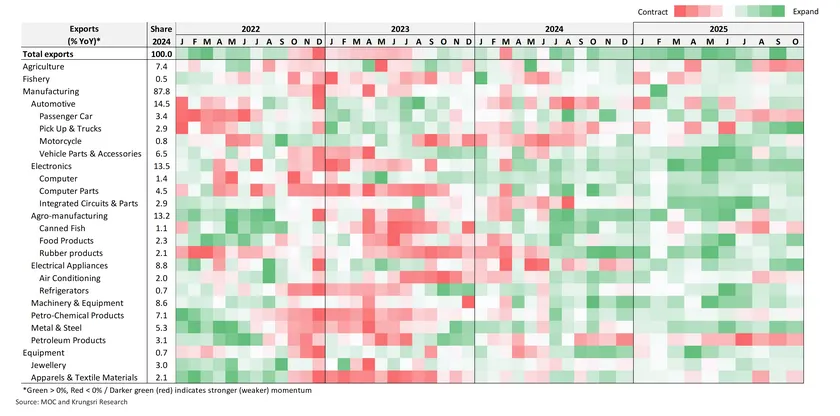
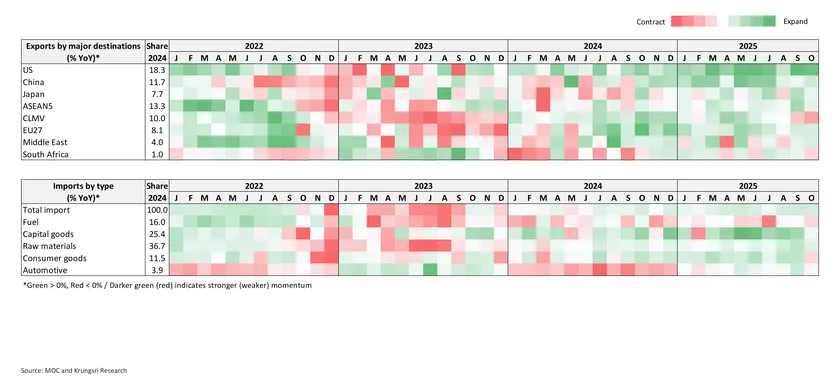
  • Export growth is expected to accelerate to +10.8% in 2025, from +5.9% in 2024. However, the expansion was not broad-based, being concentrated on technology and electronics products - driven by ongoing trends in digital transformation, AI, and semiconductors. In addition, front-loaded effects ahead of tariff implementation helped to boost demand for several products. 

  • Private investment is projected to grow modestly at 2.1% in 2025, recovering from -1.6% growth in 2024. Although there are partial signs of recovery from the low-base effect, growth remains suppressed by concerns over domestic political uncertainty, the impact of U.S. trade tariffs, persistently low-capacity utilization, and a slow recovery in the tourism sector.

  • The Monetary Policy Committee (MPC) cut the policy interest rate by a total of 100 basis points in 2025 to 1.25%, aimed at supporting the economic recovery, easing debt burdens for vulnerable groups, and enhancing the effectiveness of complementary financial measures and government policies. Meanwhile, the inflation rate is projected to remain negative at -0.2% in 2025, compared to 0.4% in 2024.


2026 outlook: In the shadow of transition surrounded by intensifying  trade tension, structural challenges, and political uncertainty

 
  • Thailand’s economy is expected to face another challenging year in 2026, estimated at 1.8%, pressured by a slowing global economy, escalating trade protectionism among major economies, domestic structural vulnerabilities, and heightened political uncertainty ahead of the general election. These factors suggest that 2026 will be a year of economic stabilization rather than accelerated growth.

  • Exports will face full-year impacts from U.S. tariff hikes in 2026. The temporary boost in 2025 from front-loading will fade, while Thai exports will be hit by a 19% U.S. import tariffs and additional product-specific duties. There is also a risk of tariffs extension to technology products, a key Thai export. Meanwhile, the WTO projects global trade volume growth to slow sharply to 0.5% in 2026 from 2.4% in 2025, reflecting weaker global demand. Thus, exports are projected to contract by -1.8% in 2026.

  • Tourism will regain a role of key growth support, with international tourist arrivals expected to reach 35.5 million in 2026, supported by more winter flights and new routes from China and India. However, recovery is slow—especially from China, due to safety concerns and rising competition—keeping arrivals below the pre-COVID peak of 40 million in 2019.

  • Public spending is likely to slow due to tight fiscal space and political uncertainty. The FY2026 budget allocates slightly lower current and capital expenditures, while a caretaker government may face limits in project approvals and disbursement acceleration.

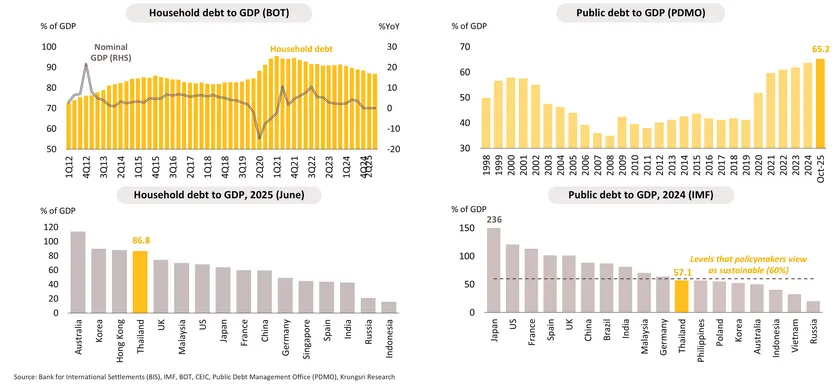
  • Private consumption is expected to lose momentum, slowing to 2.2%—constrained by household debt of above 80% of GDP, sluggish income recovery, weak agricultural income, and potential employment impacts from export weakness. Meanwhile, positive impacts from previous short-term stimulus schemes—Digital Wallet, Co-payment plus programs, tourism tax incentives—have faded, leaving households reliant on slow-growing regular income.

  • Private investment should expand gradually, estimated at 1.5%—supported by rising BOI-approved projects, continued FDI inflows (especially in digital, EV, and renewable energy), and streamlined procedures through the BOI’s Thailand FastPass mechanism. Ongoing supply-chain shifts from China to ASEAN may also benefit Thailand.

  • Krungsri Research expects the MPC to cut policy rate to 1.0% by 1H26, to ease financial strain and nurture economic recovery. Headline inflation is projected to remain low at 0.4% in 2026 (vs. –0.2% in 2025), due to stable global oil prices, continued energy cost-relief measures, and weak domestic demand. 

  • Risks & Challenges: (i) Intensifying global trade tensions, uncertain U.S. economic policy, and geopolitical risks; (ii) A possible “Twin Influx”—surges of Chinese imports and U.S. goods under trade agreement—pressuring Thai producers; (iii) Climate volatility affecting farm incomes; (iv) Structural issues such as high household debt and declining competitiveness in some industries; and (v) policy uncertainty and political risk in Thailand.


Krungsri Research Forecasts for 2025-2026

 
Economic Bulletin
 

Thai economy slowed down in 2025 despite robust exports; recovery path in 2026 looks dim, given structural weaknesses, political uncertainty, and rising trade protectionism

 
Economic Bulletin
 

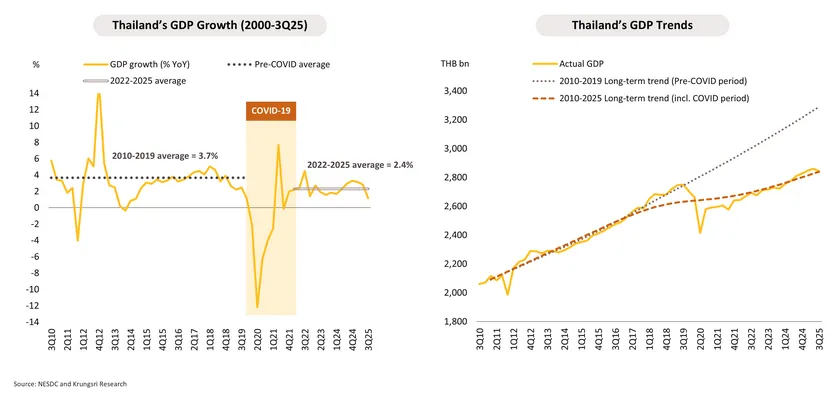
Thailand’s economic growth remains far below pre-COVID average and shows no signs of returning to the pre-pandemic trend or even narrowing the deviation

 
Economic Bulletin


Tourism sector was losing momentum in 2025 due to safety concerns, the March earthquake, and rising competition. It will likely regain a role of key growth support in 2026

 
Economic Bulletin
 

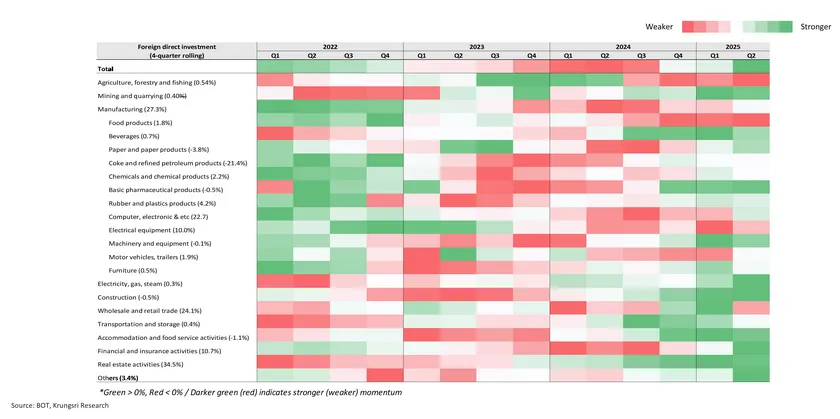
FDI remains strong in digital industries, EVs, and renewable energy, while rising BOI-approved projects and the Thailand FastPass mechanism should provide additional support in 2026

Economic Bulletin


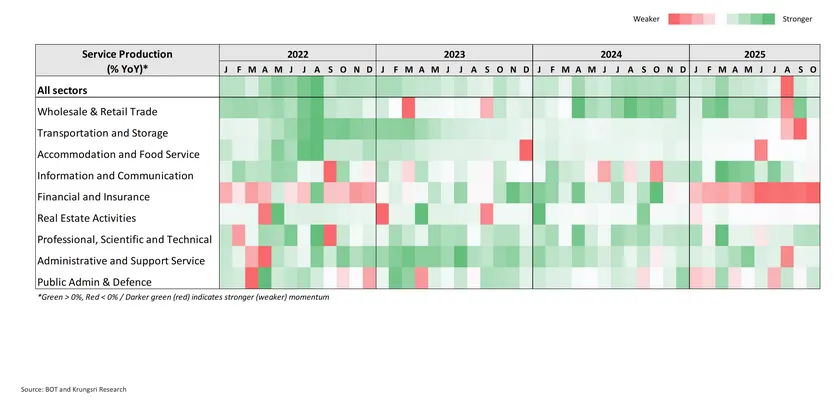
Service sectors continued to grow but at a slower pace in 2025; tourism and related industries could gradually improve in 2026

 
Economic Bulletin
 

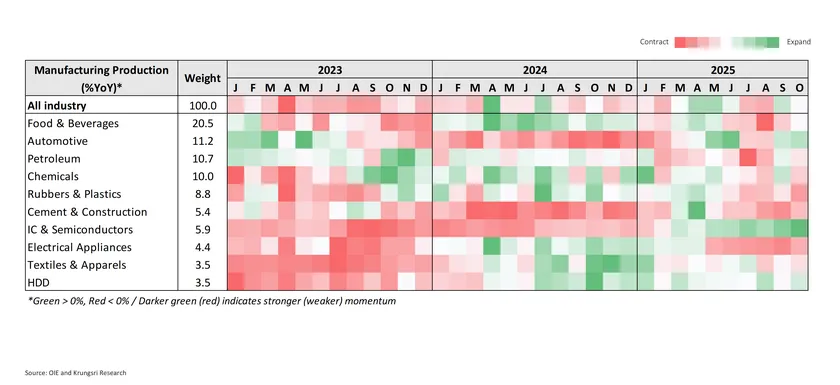
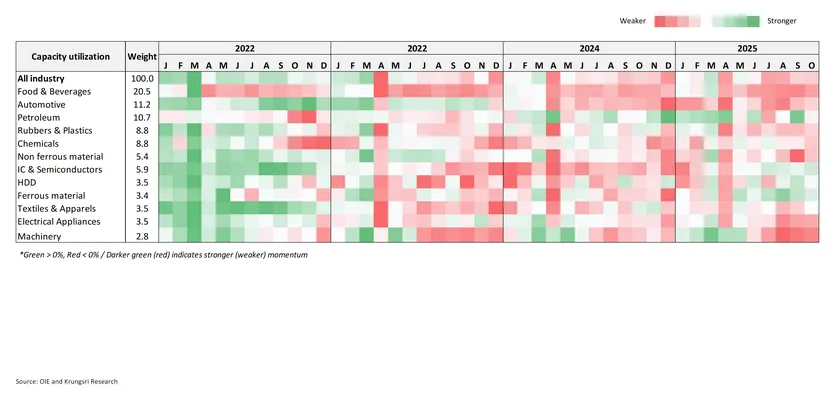
Capacity utilization rates remained low in several industries, dragged down by U.S. tariffs as well as structural problems and in line with weak manufacturing production

 
Economic Bulletin
 

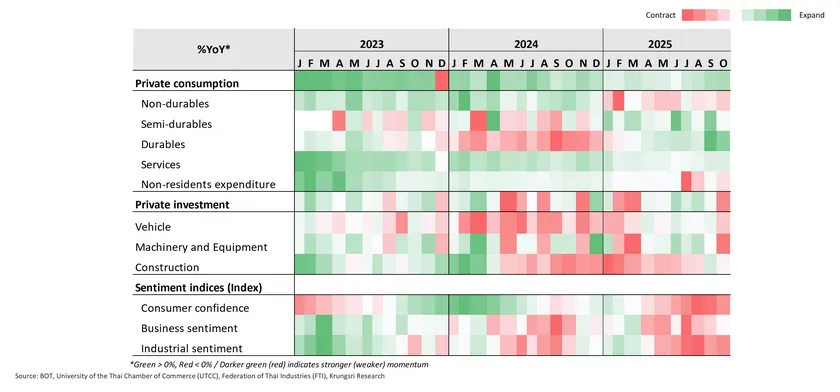
Domestic economy: Weak recovery amid still-low confidence; Private consumption driven by the service sectors, but spending on non-durable goods contracted; Private investment has been sluggish due to structural issues and domestic political uncertainty

 
Economic Bulletin
 

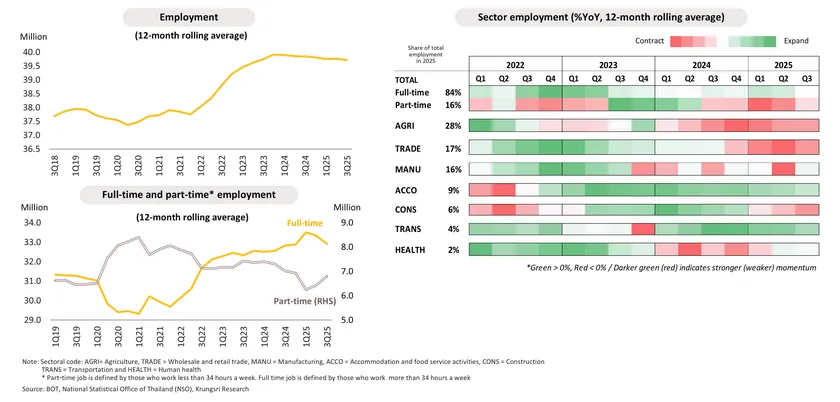
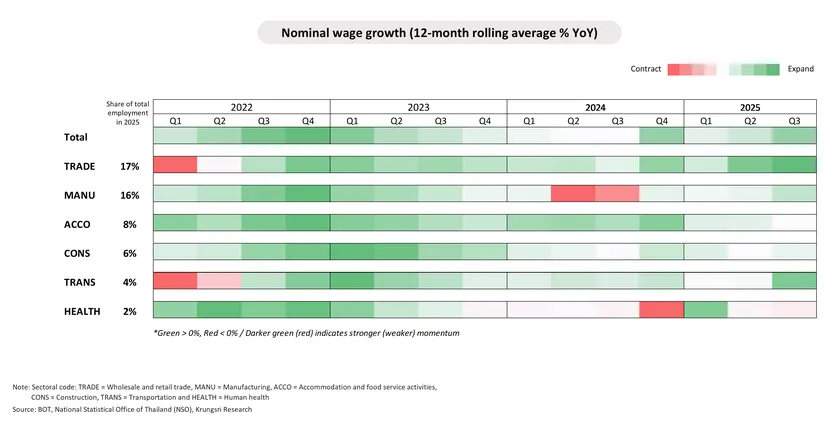
Overall employment conditions are weakening across sectors. Part-time employment falls below pre-pandemic level

 
Economic Bulletin
 

Non-farm income remains positive, but momentum is weaker in the accommodation and food service sectors

 
Economic Bulletin
 

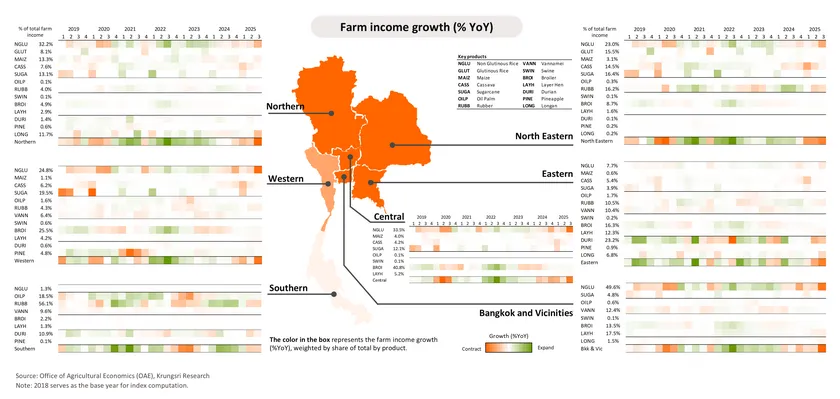
Farm income may expand moderately in 2026, given (i) higher output driven by favorable reservoir water levels and (ii) a modest rebound in prices after a sharp contraction in 2025 

 
Economic Bulletin
 

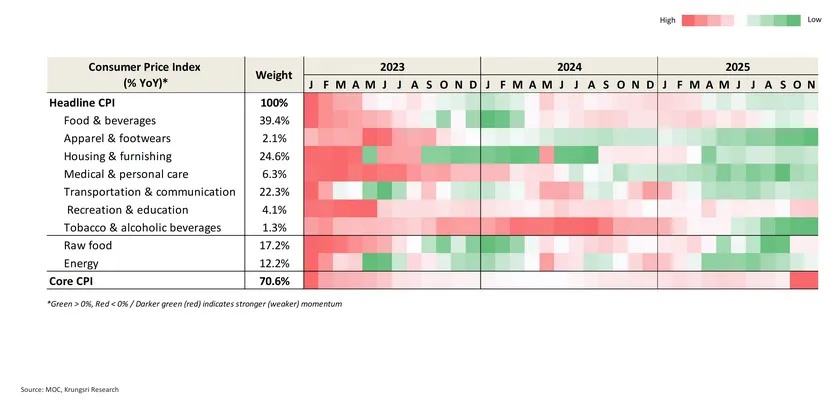
Inflation should post negative in 2025 at -0.2%; projected to return to positive territory by 2Q26 but remain below the BOT’s target of 1-3%

 
Economic Bulletin
 

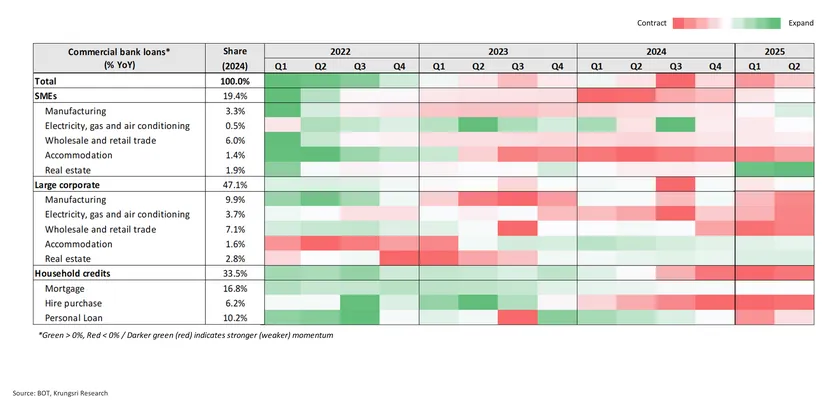
Bank lending still contracted amid slower economic growth, high debt burden at SMEs and households, as well as structural issues and lower competitiveness in certain businesses

 
Economic Bulletin


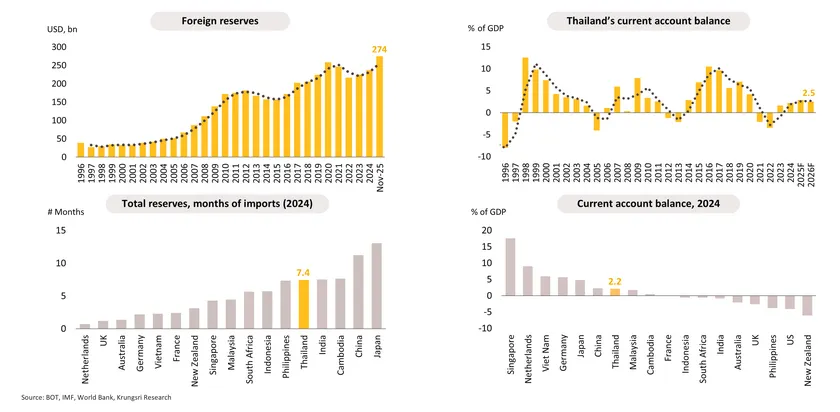
External stability remains sound with high foreign reserves. The stalled recovery in the tourism sector weighed on the current account surplus in 2025

 
Economic Bulletin


Debt levels remain high: Limited fiscal space and political uncertainty might slow public spending in 2026, while the “You Fight We Help” program should help to ease household debt burden

 
Economic Outlook


Back
Press keyword to search