
Climate Change Management
Climate change and environmental degradation have been crucial issues of the global community as they directly impact developments of economies, businesses, ecosystems, biodiversity, and the life of all human, while being a problem addressed by the United Nations through its sustainable development goals.
Krungsri is well aware that our business operations and economic activities could impact the environment and climate change, directly or indirectly. We, as a responsible financial institution that takes into account social and environmental footprints, place our emphasis on partnerships with the public and private sectors, as well as the civil society, in coping with the climate issues by inclusively managing the climate change in alignment with the Bank’s business operations. Measures and solutions to mitigate greenhouse gas emissions caused by the Bank’s operations toward zero percent, thereby reducing potential risks posed by and impact of climate change on our operations and customers.
Management approaches
- Declare Krungsri Net Zero Vision in conformity with the United Nations Sustainable Development Goal 13: Climate Action, low-carbon transitions in alignment with the Paris Agreement and Nationally Determined Contribution (NDCs), and support MUFG’s Carbon Neutrality Declaration.
- Join force with other members of the Thai Bankers’ Association (TBA) to launch “ESG Declaration”, serving as a framework and operating guideline for climate-related financial disclosures.
- Internalize Environmental and Climate Change Aspects into Financial Institution Business in alignment of the Bank of Thailand’s Standard Practice, as well as Industry Handbook initiated and developed by member banks of the Thai Bankers’ Association (TBA) in collective efforts to enhance commercial banks’ environmental and climate risk management standards and to support customers’ transitions in a concrete manner.
- Adjust investment strategies and loan portfolios in line with the “Responsible Lending”, which aligns with Krungsri’s Policy for Credit Risk Management and Policy for Sustainability Lending. This includes increasing the proportion of green loans across various business sectors, while reducing the risk of lending to businesses with high environmental impacts or greenhouse gas emissions.
- Improve risk management processes by integrating ESG criteria into risk assessments and evaluating the impact of climate change on the Bank’s loan portfolio and investments.
- Develop financial products that promote environmental sustainability, such as loans for environmentally friendly businesses, financing for business transformation towards sustainability, issuance of green debentures/bonds, and ESG-related funds.
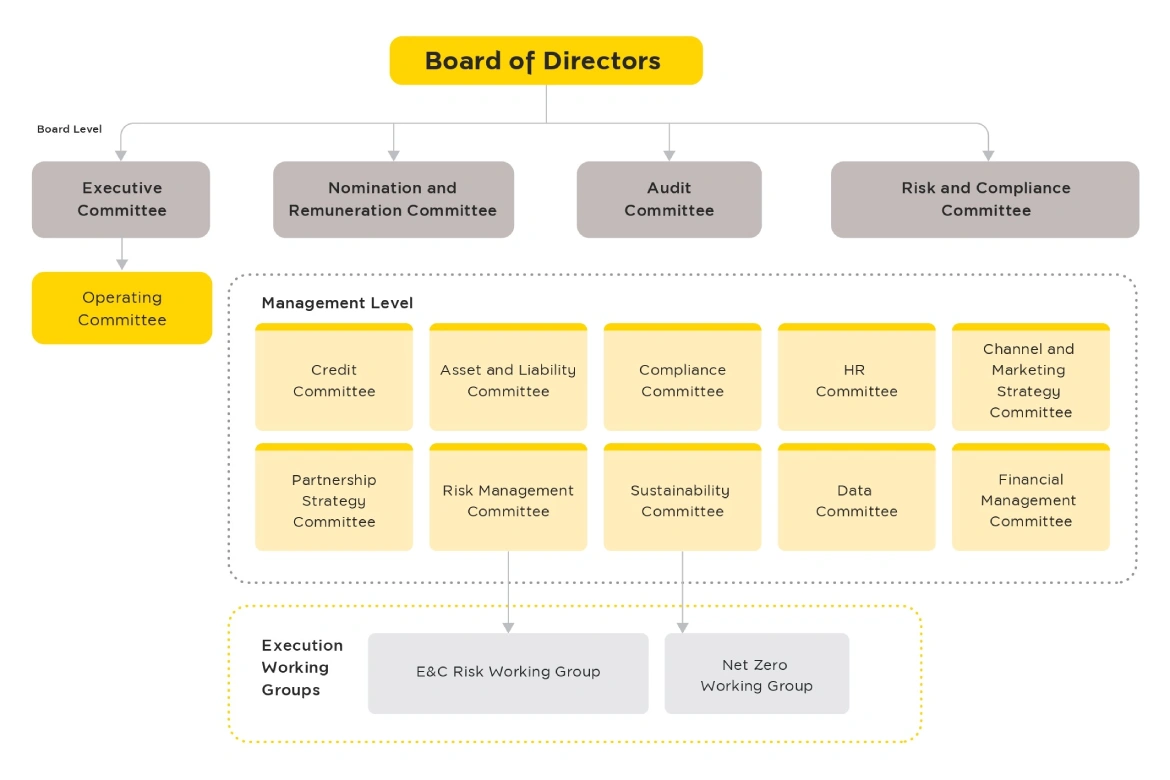
- Adjust organization-wide structures and work processes to support environmental and climate change risk management. Under the supervision of the Executive Committee and the Board of Directors, the Sustainability Committee initiated the “IECC” (Internalizing Environmental and Climate Change Aspects into Financial Institution Business Program) to conduct analyses, research, and provide recommendations in collaboration with environmental and climate change experts.
- Develop knowledge and provide training for the Board of Directors, executives, and employees on environmental and climate change risk management by establishing learning plans aligned with the roles, duties, and responsibilities of each department.
- Develop Transition Plans for environmental and climate risk management, particularly high-emissions businesses in which the Bank has high exposure. Related targets and initiatives are set in alignment with Krungsri’s business strategies in achieving the low-carbon transition and decarbonization of our financial services to achieve the Net Zero target by 2050.
- Support the transitions of customers, the business sector, and the economy of the country toward emissions mitigation and environmental sustainability in a concrete manner, through our advisory service in raising awareness as well as sustainable financial products and services to ensure sustainability of the environment and cope with climate change
- Conduct a Carbon Footprint for Organization (CFO) to assess the amount of greenhouse gas emissions from Krungsri Group's business operations and analyze significant sources of greenhouse gas emissions. This effort is to stipulate the practices to effectively reduce the organization's greenhouse gas emissions—including preparation of various measures to achieve Krungsri Carbon Neutrality Vision. In this regard, the Bank assessed the carbon footprint for the organization according to the criteria stipulated by the Thailand Greenhouse Gas Management Organization (Public Organization) and the ISO 14064-1 standard. These are international standards and requirements for organizations in measuring and reporting the greenhouse gas emissions with an aim to uplift our certification standard of greenhouse gas emissions to the international level. Krungsri has been verified by BSI Group (Thailand) Co., Ltd.
- Promote workflows and operations that help reduce emissions. Examples include digitalization that reduces the use of resources and environmental footprints, the design of KSPO that meet the Leadership in Energy and Environmental Design (LEED) standards of the U.S. Green Building Council (USBC) with the Gold Level of certification granted.
- Become a member of various organizations to support greenhouse gas emission mitigation in line with Thailand’s Nationally Determined Contribution (NDC), and the Paris Agreement, under United Nations Framework Convention on Climate Change (UNFCCC), in conformity with the United Nations Sustainable Development Goal 13: Climate Action. In this connection, Krungsri becomes members of various networks as follows:
- The Alliance for Green Commercial Banks (The Alliance)
- Partnership for Carbon Accounting Financials (PCAF)
- Thailand Carbon Neutral Network (TCNN)
- Thai Renewable Energy (RE100) Association
- Carbon Markets Club
- Thailand Climate Business Network (ThaiCBN)
Environmental and Climate Change Risk Governance Structure
Krungsri has established a governance structure and management system for environmental and climate change risks, which are considered urgent and important issues that the Bank must address by systematically assessing both opportunities and risks in operational and decision-making processes. This approach supports the transition of the economic system toward environmental sustainability—while elevating environmental, social, and governance (ESG) operational standards to the international level, in line with the Bank's commitment to “Banking with Purpose” paradigm.