
Monthly Economic Bulletin (October 2026)

Monthly Economic Bulletin (October 2026)

19 October 2026

Global Economy: Carrying the weight of uncertainty in a high-pressure environment

Monthly Economic Bulletin

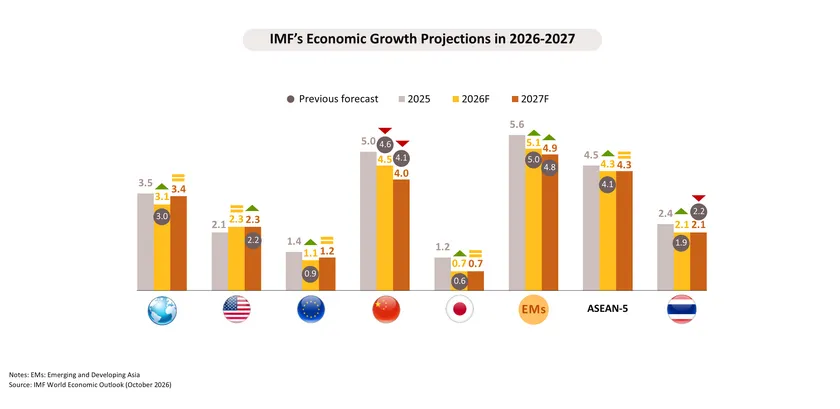
IMF sees global economy remains resilient, supported by AI investment, but risks skewed to the downside especially from geopolitical tensions and a potential AI market correction

Monthly Economic Bulletin
 

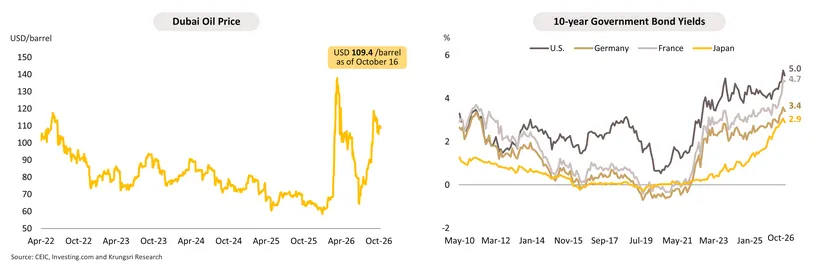
Geopolitical risks continue to keep oil prices elevated, fueling inflationary pressures, and increasing fiscal burdens across economies.

 
  • In mid October, crude oil prices remain elevated above USD 100 per barrel, nearing a six-month high. Preliminary data from Kpler, a provider of global trade and vessel-tracking data, show that crude oil exports from the Arabian Gulf recovered to 18.5 million barrels per day as of October 1, exceeding the pre-conflict level of 18 million barrels per day. Also, the G7’s release of a combined 100 million barrels from strategic oil reserves over four months is expected to help alleviate near-term supply disruptions. However, ongoing conflict and attacks on Middle Eastern shipping, alongside energy production remaining below pre-war levels, are expected to keep upward pressure on crude oil prices and inflation.

  • Persistent fiscal stimulus, inflation concerns, and AI-related financing demand have pushed up long-term bond yields, particularly in countries with high public debt and persistent deficits, such as the U.S., Japan, and some countries in the Eurozone. U.S. public debt has reached a record USD 40 trillion (around 125% of GDP), while debt exceeds 100% of GDP in France, Italy, and Belgium and 200% in Japan, the highest public debt among G7 economies. 

  • Higher bond yields will raise financing costs and increase financial market volatility, undermining private-sector confidence and wealth. This could, in turn, dampen business investment and household spending. In addition, rising government interest expenses may further weaken already-fragile fiscal positions and reduce policy space. Together, these developments could pose headwinds to economic growth in the period ahead.
     

Monthly Economic Bulletin  
 

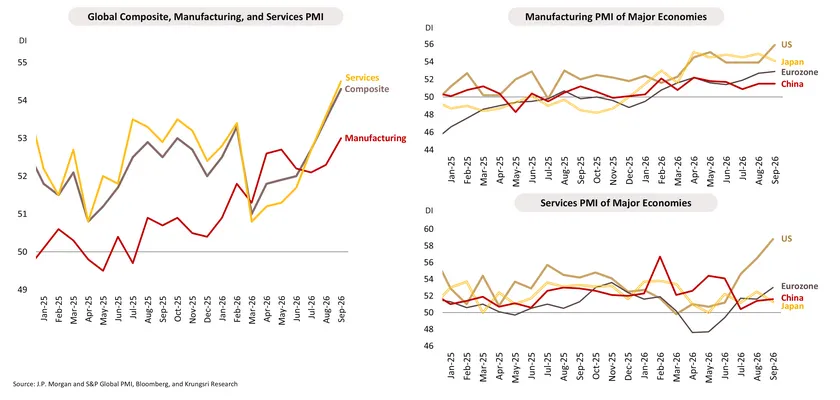
Global activity remains resilient, but geopolitical risks, inflationary pressures, and tighter financial conditions cloud the outlook.


Monthly Economic Bulletin  
 

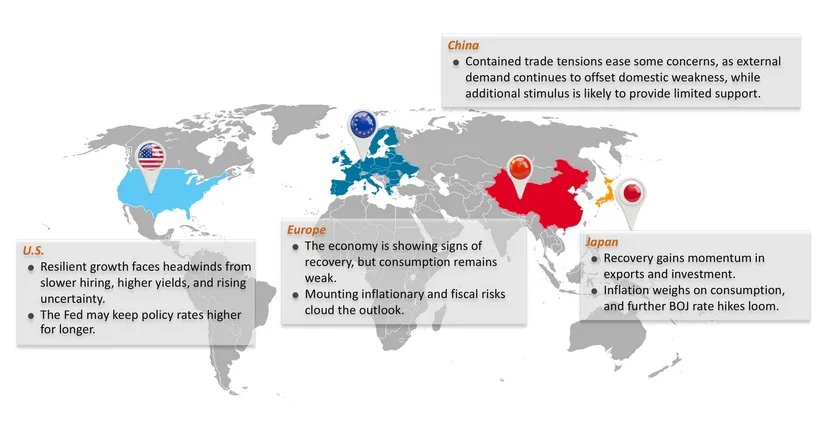
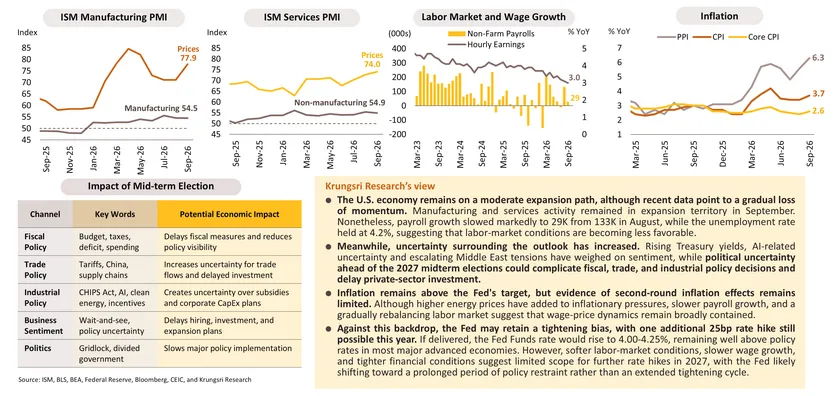
U.S.: Resilient growth faces headwinds from slower hiring, higher yields, and rising uncertainty; the Fed may keep rates higher for longer.


Monthly Economic Bulletin  
 

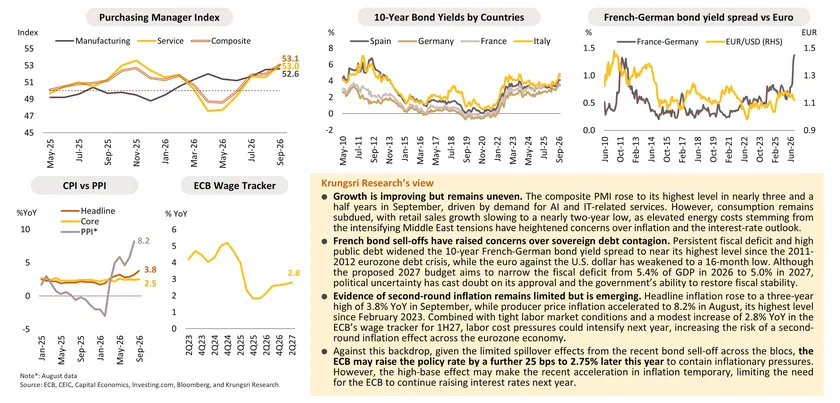
Eurozone: The economy is showing signs of recovery, but consumption remains weak; mounting inflationary and fiscal risks cloud the outlook.


Monthly Economic Bulletin  
 

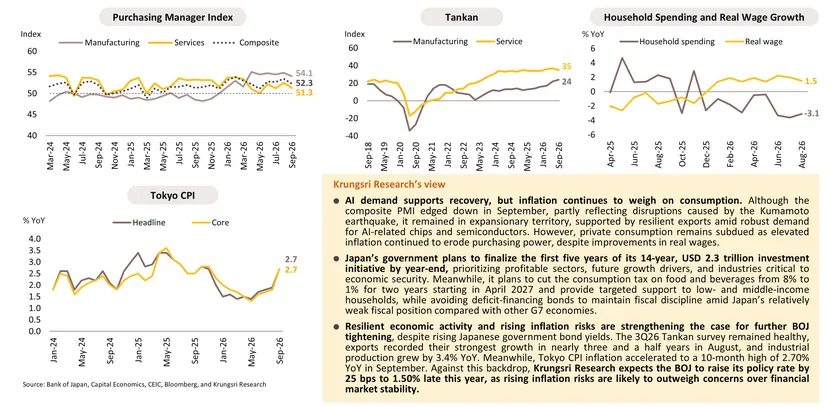
Japan: Recovery gains momentum on exports and investment; inflation weighs on consumption and further BOJ rate hikes loom. 


Monthly Economic Bulletin  
 

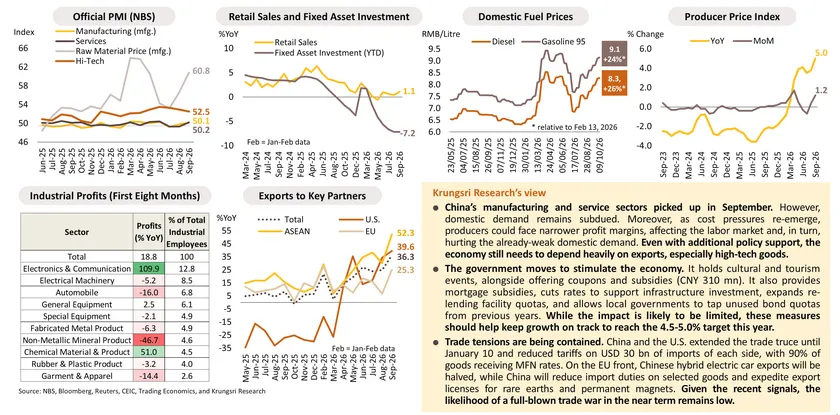
China: Contained trade tensions ease some concerns, as external demand continues to offset domestic weakness, while additional stimulus is likely to provide limited support.


Monthly Economic Bulletin  
 

Thailand: Improving growth momentum faced headwinds from floods and external uncertainty, while manufacturing data overhaul revealed a stronger underlying economy.

 
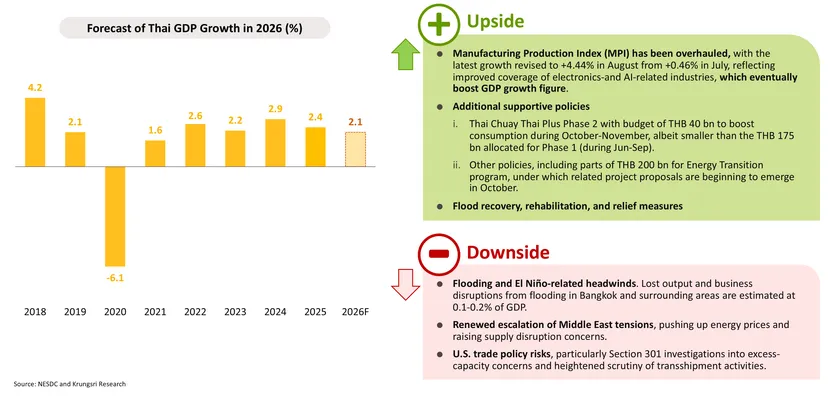
  • GDP growth figure could be driven by both supportive policies and technical adjustments, though weather-related disruptions and external risks may weigh on the outlook.

  • The manufacturing sector appeared stronger than the previous series indicated, reflecting improved coverage of electronics- and AI-related industries, which ultimately boost economic growth number. Meanwhile, supportive policies include measures to stimulate private consumption and to relieve flood impacts. 

  • For key economic drivers, private investment strengthened, as reflected in rising FDI accumulation, led by electrical equipment, alongside strong BOI applications in AI and digital industries.

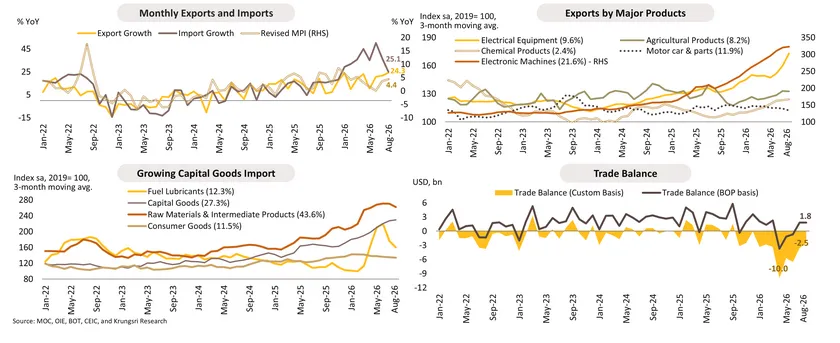
  • Thai exports gained momentum while import growth moderated, narrowing the trade deficit, though gains remained concentrated in technology-related products.

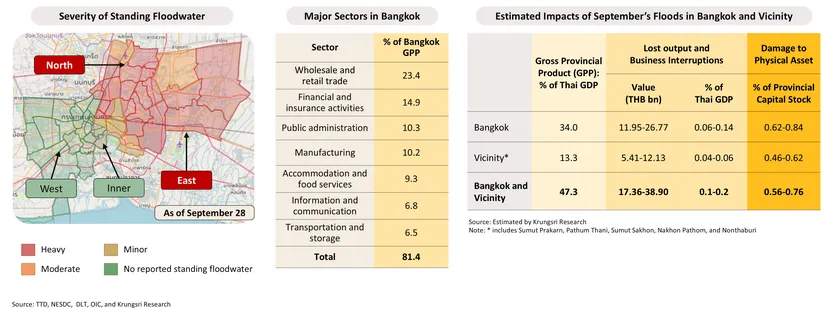
  • However, Bangkok faced its most severe flooding since 2011. The economic impact is expected to be around 0.1-0.2% of GDP, while asset damage could be significantly larger. 

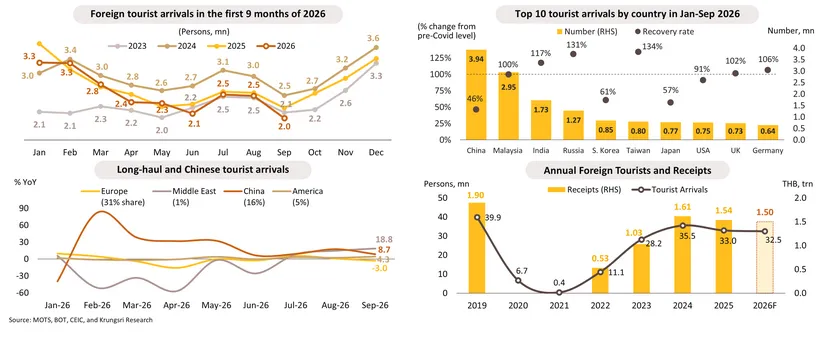
  • Tourist arrivals also fell amid September flooding. Arrivals from East Asia partially recovered, while long-haul markets remained subdued due to high airfares and safety concerns.

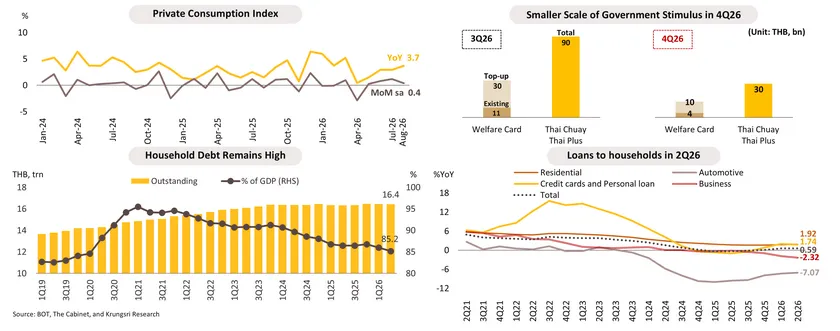
  • Private consumption may be subdued from smaller stimulus, elevated household debt, and limited financial buffers, despite flood-related reconstruction spending.

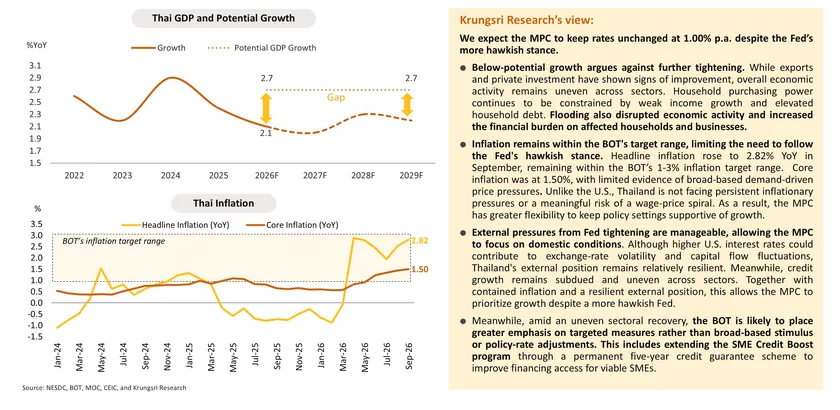
  • Regarding the policy rate outlook, despite a more hawkish Fed, below-potential growth is expected to keep the Thai MPC on hold.


GDP growth figure could be driven by both technical adjustments and supportive policies, although weather-related disruptions and external risks may weigh on the outlook.


Monthly Economic Bulletin  
 

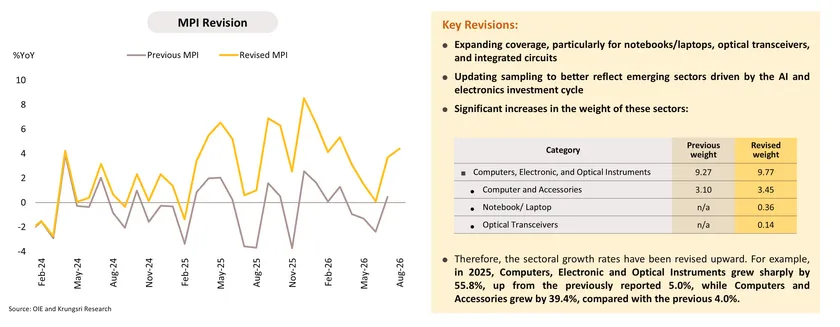
Manufacturing sector appears stronger than indicated by the previous series, reflecting improved coverage of AI- and electronics-related industries, which eventually boost growth


The Ministry of Industry has recently overhauled the Manufacturing Production Index (MPI), a key indicator of economic activity, by expanding product coverage and updating sampling methods to better reflect Thailand's evolving industrial structure. The revision incorporates products such as notebooks/laptops and optical transceivers (which have never been previously included), and Uninterruptible Power Supply (UPS) units, while adding new factory samples in integrated circuits and other electronic components. As a result, reported manufacturing production has been significantly stronger under the revised methodology since 2Q25. The revised series appears more consistent with trends in exports, capital goods imports, and the growing importance of AI- and electronics-related industries. Given that the manufacturing sector accounts for 25-30% of Thailand's GDP, this revision could have important implications for assessing economic momentum. 


Monthly Economic Bulletin  
 

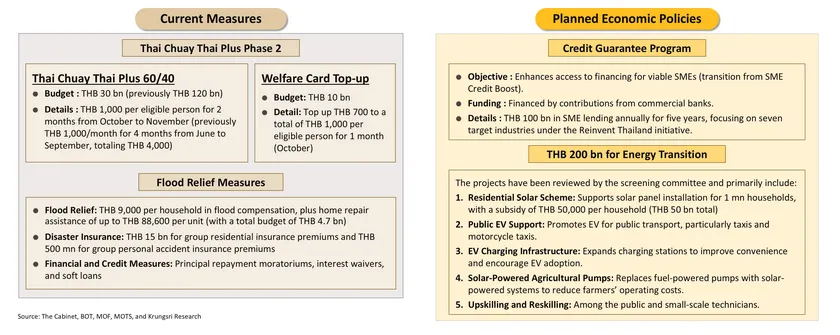
Supportive policies include measures to stimulate private consumption, credit guarantee program, and investment in the energy transition.


Toward the end of 2026 and into early 2027, several supportive policy measures are expected to provide further support to the economy. As Middle East tensions persist, the second phase of the Thai Chuay Thai Plus scheme is being rolled out during October–November, although the total subsidy is substantially smaller than in the first phase. Flood relief measures are also being implemented through direct cash assistance, disaster insurance, and financial support. Meanwhile, the SME Credit Boost initiative will transition into a longer-term credit guarantee scheme to further improve SME access to financing. Over the medium term, the energy transition initiative is gaining traction, with organizations beginning to submit project proposals, although careful project screening will be essential to ensure project viability and effective resource allocation.


Monthly Economic Bulletin  
 

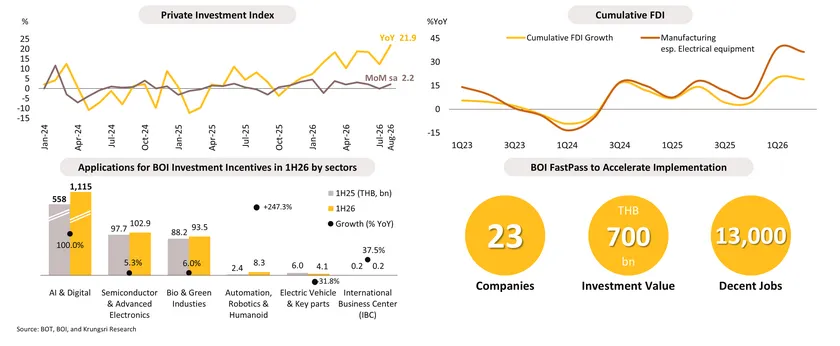
Private investment strengthens, as reflected in rising FDI accumulation, led by electrical equipment, alongside strong BOI applications in AI and digital industries.


Private investment momentum is expected to be a key growth driver, with growth of the Private Investment Index (PII) accelerating to 21.9% YoY in August. Rising cumulative FDI, particularly in manufacturing, points to stronger investment in electronic equipment. At the same time, BOI applications are particularly strong in AI and digital industries. Moreover, the THB 200 billion energy transition program and non-budgetary measures, including the Thailand FastPass initiative and BOI-to-IPO program, are expected to further support investment going forward.


Monthly Economic Bulletin  

Thai exports gained momentum while import growth moderated, narrowing the trade deficit, though gains remained concentrated in technology-related products.


Exports are expected to remain a key growth driver alongside investment. In August, exports grew by 24.3% YoY, accelerating from 21.6% in July, led by electronics and electrical equipment. On the other hand, import growth moderated in August. Capital goods imports continued to expand, while growth of energy imports eased from its recent peak despite ongoing tensions in the Middle East. As a result, the trade deficit (Customs basis) narrowed to its lowest level so far this year, while the BOP-basis trade balance returned to surplus after adjustments, suggesting a more favorable contribution from net exports to GDP growth. Going forward, persistent Middle East tensions, U.S. tariff uncertainty, and weak external demand could weigh on export growth.


Monthly Economic Bulletin  

Bangkok faces its most severe flooding since 2011; the economic impact is expected at around 0.1-0.2% of GDP, while asset damage could be significantly larger. 


During September 25-26, widespread rainfall across Bangkok and surrounding provinces led to flooding in many parts of the capital, particularly in eastern and northern Bangkok. While floodwaters receded relatively quickly in some areas, others remained inundated for longer periods; however, flood conditions have since largely normalized. These floods have primarily affected Bangkok, where economic activity is largely concentrated in services, led by wholesale and retail trade. We estimate that lost output and business interruptions from the floods in Bangkok and the vicinity could amount to THB 17.3-38.9 bn, or 0.1-0.2% of GDP. However, damage to physical assets is expected to be substantially larger at an estimated 0.56-0.76% of provincial capital stock. If additional heavy rainfall occurs or flooding spreads to other key business areas, the economic impact could be larger than currently estimated. 


Monthly Economic Bulletin  

Tourist arrivals fell amid September flooding. Arrivals from East Asia partially recovered, while long-haul markets remained subdued due to high airfares and safety concerns.


In the first nine months of 2026, foreign tourist arrivals totaled 23.2 million. In September, arrivals declined to 2.0 million from 2.5 million in August, contracting -10.5% YoY, partly due to flooding in central and eastern Thailand. Arrivals from the Middle East remained above pre-conflict levels. Chinese arrivals continued to recover but remained at only around 46% of pre-pandemic levels, broadly in line with arrivals from South Korea and Japan. High airfares and travel safety concerns continue to weigh on long-haul markets, particularly Europe and the U.S. Looking ahead, tourism warrants close monitoring as increasingly volatile weather conditions and the prolonged conflict in the Middle East could disrupt transportation and tourism activity.


Monthly Economic Bulletin  


Private consumption may be subdued from smaller stimulus, still-high household debt, and limited financial buffers, despite flood-related reconstruction spending.


Although fiscal support and flood rehabilitation efforts could provide some support to private consumption, momentum is likely to soften as (i) the latest stimulus package is significantly smaller than the previous phase and (ii) underlying fundamentals remain weak, reflecting subdued income growth and elevated household debt. In August, growth in the Private Consumption Index (PCI) increased to 3.7% YoY in August from 3.0% in July, buoyed by stimulus measures. While the household debt-to-GDP ratio has declined to 85.2% of GDP in 2Q26 from 86.0% in 1Q26, debt remains elevated above the pre-pandemic level, constraining household finances. Also, business and auto loans to households continued to contract. Going forward, fading stimulus support, elevated household debt, weak purchasing power, and the financial burden of flood-related damages are likely to weigh on private consumption.


Monthly Economic Bulletin  
 

Policy rate outlook: Despite a more hawkish Fed, below-potential growth is expected to keep the Thai MPC on hold.

Monthly Economic Bulletin  
Back
Press keyword to search