
Monthly Economic Bulletin (August 2026)

Monthly Economic Bulletin (August 2026)

18 August 2026

Global: The conflict playbook - escalation, de-escalation, negotiation, and economic risks


Monthly Economic Bulletin
 

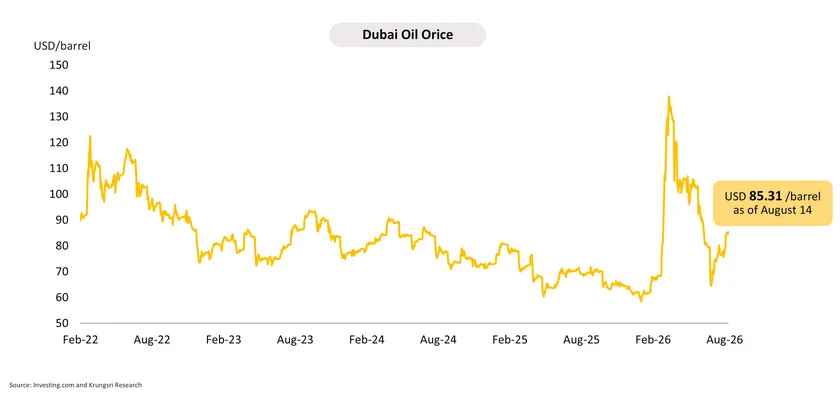
Prolonged U.S.-Iran tension and the Strait of Hormuz closure may keep energy prices elevated, amid growing concerns over further supply disruption.


Monthly Economic Bulletin
 

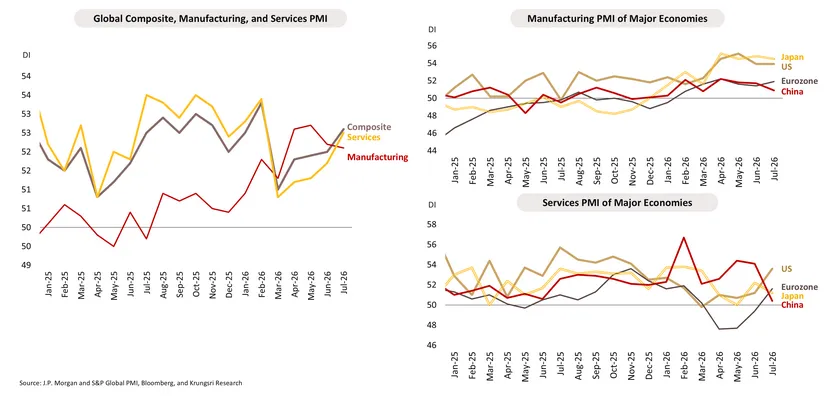
Global manufacturing reached its weakest pace since March amid fading inventory support, while a rebound in services activity may reflect temporary FIFA-related spending.


Monthly Economic Bulletin  
 

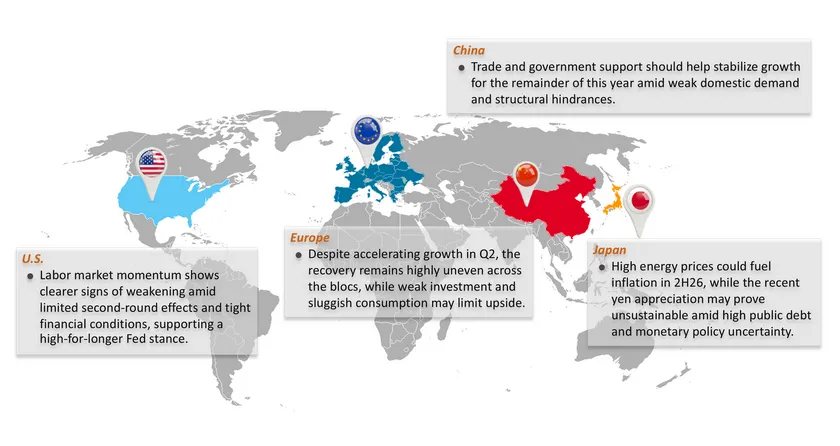
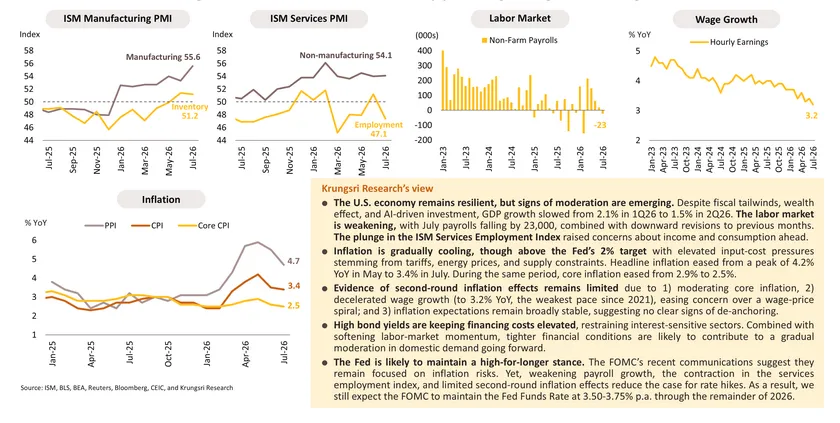
U.S.: Labor market momentum shows clearer signs of weakening amid limited second-round effects and tight financial conditions, supporting a high-for-longer Fed stance.


Monthly Economic Bulletin  
 

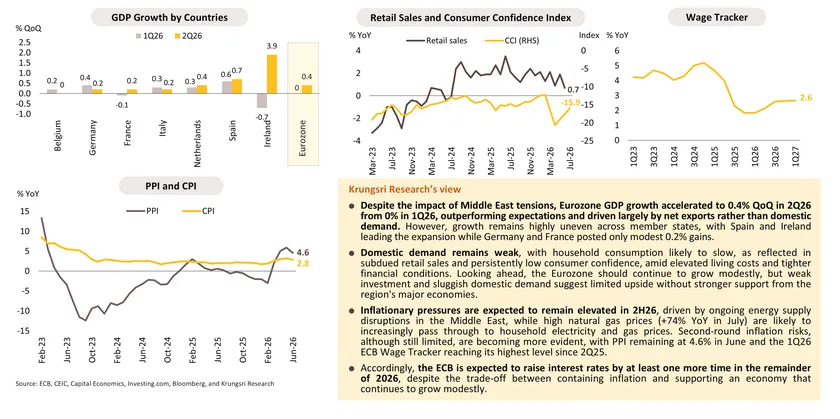
Eurozone: Despite accelerating growth in Q2, the recovery remains highly uneven across the blocs, while weak investment and sluggish consumption may limit upside.


Monthly Economic Bulletin  
 

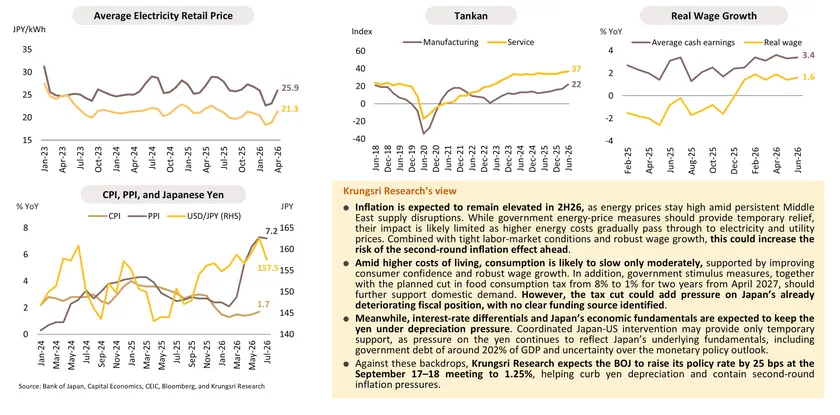
Japan: High energy prices could fuel inflation in 2H26, while the recent yen appreciation may prove unsustainable amid high public debt and monetary policy uncertainty.


Monthly Economic Bulletin  
 

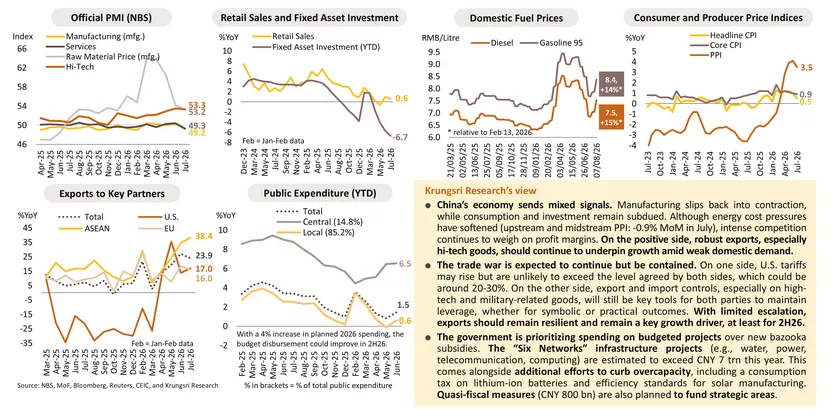
China: Trade and government support should help stabilize growth for the remainder of this year amid weak domestic demand and structural hindrances.


Monthly Economic Bulletin  

Thailand: Economic momentum and policy support improve growth prospects but  recurring external risks cloud the growth outlook.

 
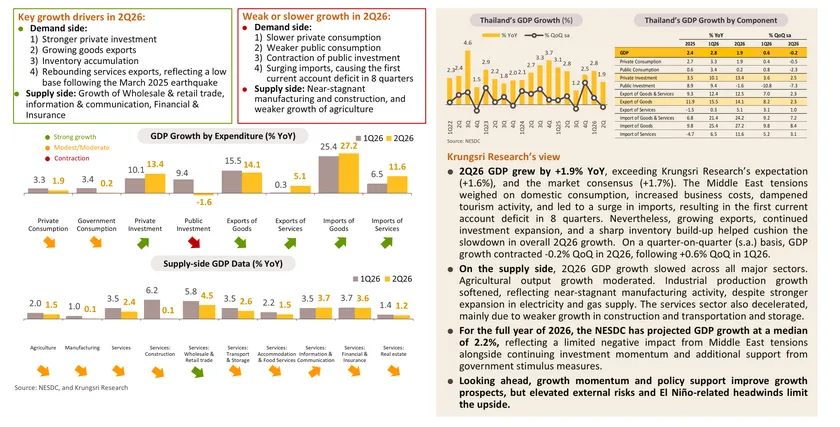
  • 2Q26 GDP growth decelerated to 1.9% YoY, weighed by Middle East tensions, but growth exceeded expectations, driven by investment, exports, and inventory accumulation.

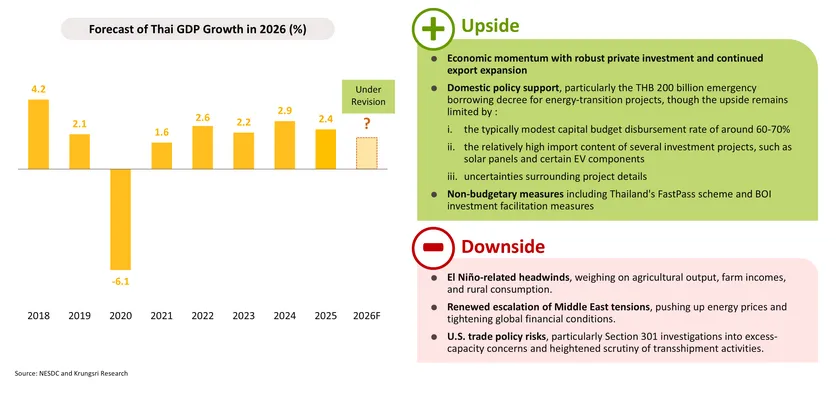
  • The overall 2026 outlook has improved on stronger momentum and policy support, which could lead to an upward revision of our forecast, though external risks and weather-related headwinds remain.

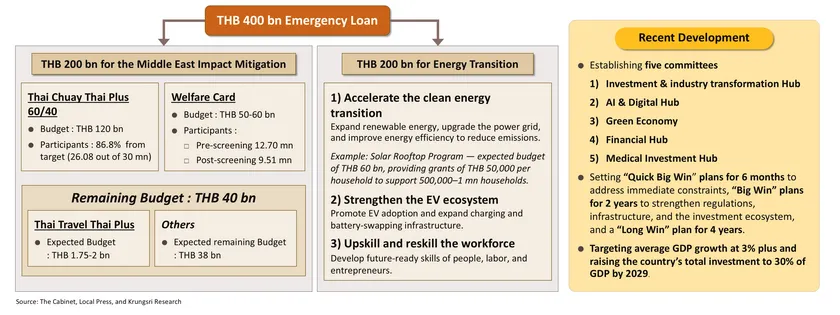
  • Medium- to long-term policy support remains available, but uncertainty persists over implementation details. 

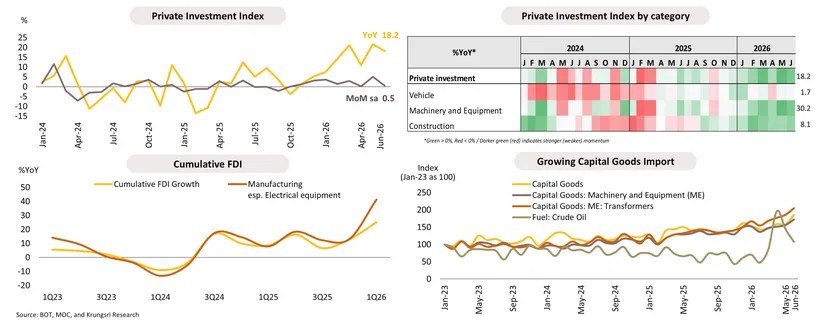
  • Private Investment remained robust, supported by machinery and equipment spending, FDI, and the electronics upcycle.

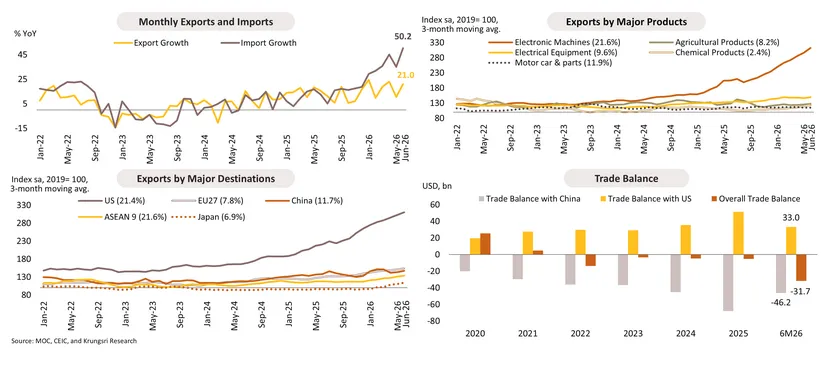
  • Thai exports, despite high growth, remained uneven and continued to lag import growth. A 12.5% Section 301 forced-labor tariff replaces Section 122, with potential Section 301 tariffs on the excess-capacity issue posing further downside risks to Thai exports. Thailand and ASEAN may face broadly similar tariffs to the previous reciprocal tariffs. Thailand’s Tier-2 classification in the U.S. “The Great Transshipment Scam” report could amplify risks beyond ongoing Section 301 investigations.

  • Tourism shows signs of recovery despite high aviation costs and safety concerns, with stronger Middle Eastern arrivals.

  • Private consumption strengthens on temporary stimulus support, but the outlook remains uncertain amid high living costs, weak income growth, and elevated household debt. In particular, the lower-income group has flat real earnings and fragile jobs. 

  • Inflation remains elevated amid Middle East tensions and still-high oil prices. Gradually rising core inflation warrants monitoring for cost pass-through to consumer prices.

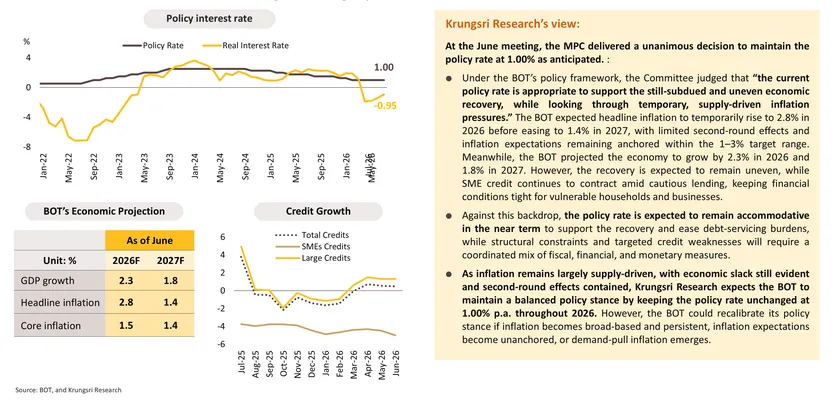
  • The BOT’s policy stance remains focused on domestic conditions, with no immediate need to follow other central banks’ tightening cycles.


2Q26 GDP growth decelerated to 1.9% YoY, weighed by the Middle East tension, but growth exceeded expectations driven by investment, exports and inventory accumulation.


Monthly Economic Bulletin  
 

Overall 2026 outlook has improved on stronger momentum and policy support, which could lead to an upward revision of our forecast, though external risks and weather-related headwinds remain.


Monthly Economic Bulletin  


Medium- to long-term policy support remains available but uncertainty persists over implementation details.


Economic momentum faces uncertainty ahead. First, the boost from stimulus measures may fade in 4Q26. Although the Thai Travel Thai Plus scheme could support spending, its THB 1.75–2.0 billion budget is substantially smaller than the THB 120 billion Thai Chuay Thai Plus. Second, medium- to long-term policy support remains available, but greater clarity is needed, particularly regarding the THB 200 billion energy transition investment program, including initiatives such as rooftop solar. These measures and other long-term policies could provide additional support to both consumption and investment. The government has recently set targets for average GDP growth of 3% or more and investment to reach 30% of GDP by 2029. However, their economic impact will depend on implementation details, the pace of disbursement (with capital expenditure typically disbursed at only around 60–70%), and particularly the large import content of the potential investment projects, which could accelerate imports and widen the country’s trade deficit.

Monthly Economic Bulletin  
 

Private Investment remained robust, supported by machinery and equipment spending, FDI, and the electronics upcycle.


The Private Investment Index (PII) continued to post double-digit growth of 18.2% YoY in June, down from 21.7% in May, supported by investment in machinery and equipment. For 1H26, PII grew by 15.5%. This was consistent with improving investment among export-oriented businesses, benefiting from the electronics upcycle and data center investment, alongside accelerating cumulative FDI, particularly in manufacturing. Data center projects face stricter screening to ensure domestic value creation and to better manage resource use, which may slow investment in the near term but support more sustainable growth over the medium to long term. Meanwhile, accelerating capital goods imports, particularly machinery and equipment, provide a positive signal for medium-term investment momentum.


Monthly Economic Bulletin  
 

Thai exports, despite high growth, remained uneven and continued to lag import growth.


Exports rose 21.0% YoY in June (+17.6% in 1H26), led by electronics and electrical equipment, while imports continued to outpace exports, increasing 50.2%.  Export growth was driven primarily by electronics and electrical equipment, with shipments expanding across all major markets, including the U.S., ASEAN, China, the EU27, and Japan. However, following the expiry of the Section 122 tariff on July 24, 2026, Thailand faces a 12.5% Section 301 tariff related to forced-labor concerns, alongside ongoing investigations into excess production capacity, increasing downside risks to exports. Although the AI boom and the electronics upcycle should continue to support exports, tariff uncertainty, lingering Middle East tensions, and weak external demand are expected to weigh on export growth going forward.


Monthly Economic Bulletin  
  

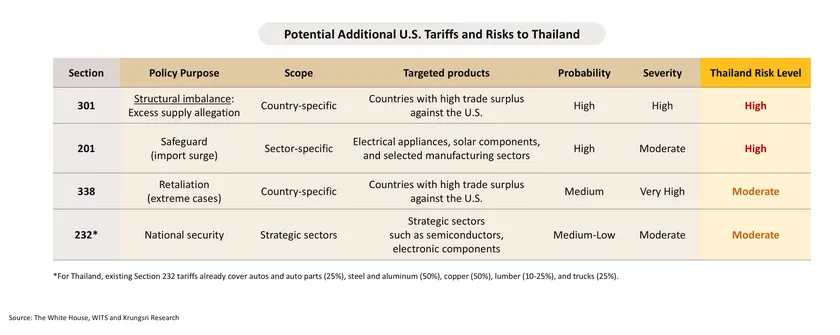
U.S. tariffs: A 12.5% Section 301 forced-labor tariff replaces Section 122, with potential Section 301 tariffs on excess capacity posing further downside risks to Thai exports.

 
  • Following the ruling against the IEEPA (Reciprocal Tariffs) in February and the expiration of Section 122 (10% broad-based tariffs) in July, other tariffs such as Section 232 (product-specific) and Section 301 tariffs remain in place for Thailand. 

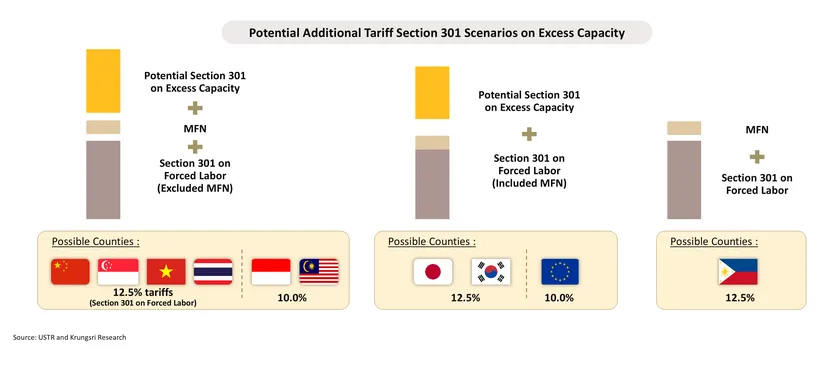
  • Thailand became subject to a 12.5% Section 301 tariff related to forced-labor import concerns when the Section 122 tariff expired, applied on top of the Most-Favored-Nation (MFN) tariff rate, with certain exemptions such as food, fuels, and fertilizers. In addition, ongoing Section 301 investigations into excess production capacity could lead to further tariff increases, posing downside risks to Thai exports, manufacturing, and supply chains. Taken together, these measures could raise Thailand’s effective tariff burden to a level broadly comparable to the previous reciprocal tariff. Meanwhile, transshipment-related tariffs remain another ongoing risk for Thailand.

Monthly Economic Bulletin  
 

Thailand and ASEAN may face broadly similar tariffs to the previous reciprocal tariffs

 
  • For the Section 301 risks, a 12.5% forced-labor-import tariff has been applied on top of the MFN rate since July 24, 2026, with exemptions for certain products such as food, fuels, and fertilizers. Separately, the excess-capacity investigation targets structural overcapacity and manufacturing overproduction across 16 major economies, including Singapore, Thailand, and China. Potentially affected Thai sectors include rubber products (6.3% of U.S. exports), machinery (5.7%), and motor vehicles and auto parts (2.6%).

  • Apart from Thailand, several ASEAN economies—including Singapore, Vietnam, Indonesia, and Malaysia—are also subject to excess-capacity investigations. Across ASEAN, Section 301 measures could have uneven impacts, with Thailand, Vietnam, and Singapore potentially facing the highest tariff rates, followed by Indonesia, Malaysia, and the Philippines.


Monthly Economic Bulletin  
  

“The Great Transshipment Scam”: Greater classification and tier-based targeting could heighten downside risks beyond Section 301 trade investigations.

 
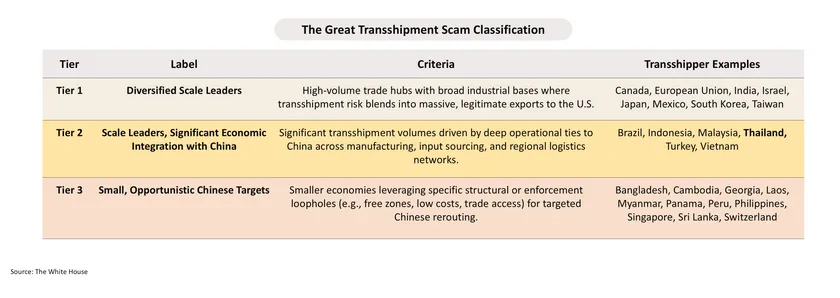
  • The White House released a report titled “The Great Transshipment Scam,” alleging that China is using a “shadow trade network” across third countries to circumvent U.S. tariffs. These networks reportedly involve final-stage manufacturing, logistics platforms, processing routes, free-trade zones, and re-export hubs, allowing China-linked goods to enter the U.S. market under a new declared country of origin, rather than being directly identified as Chinese-origin products.

  • Countries are classified into three tiers based on their transshipment risk and integration with Chinese supply chains: Tier 1 comprises economies with strong industrial bases, diversified trade, and robust customs controls, including the EU, India, Japan, South Korea, and Taiwan; Tier 2 includes major transit and manufacturing hubs deeply integrated with China, with greater potential for trade rerouting, including Indonesia, Malaysia, Vietnam, and Thailand; and Tier 3 covers smaller economies with weaker customs enforcement and hence may be more susceptible to be used as transshipment hubs, e.g., Cambodia and the Philippines.

  • Nevertheless, the report identifies targeted high-risk sectors, including Thai exports of key manufactured products such as thermostats (HS 903210), which are concentrated in Ayutthaya–Samut Prakan, an “Ugly Sister City” counterpart to Minneapolis–St. Paul in the U.S.

Monthly Economic Bulletin  


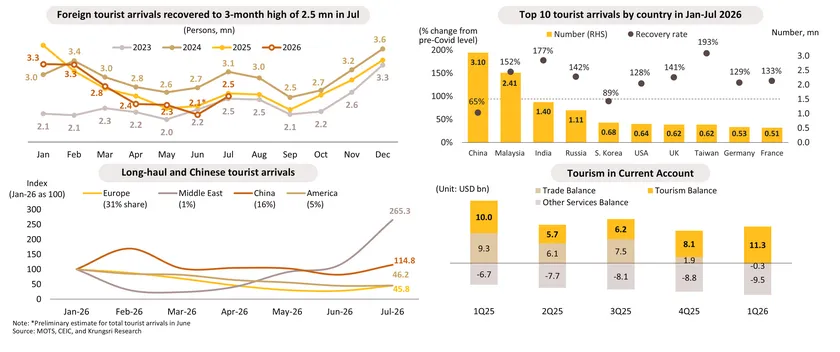
Tourism shows signs of recovery despite high aviation costs and safety concerns, with stronger Middle Eastern arrivals.


In July 2026, Thailand recorded 2.54 million foreign arrivals, up from 2.14 million in June. For 1H26, foreign arrivals totaled 16.2 million. Although most markets have broadly recovered, Chinese and South Korean arrivals in the first seven months remained below pre-COVID levels. Despite high airfares and travel safety concerns, Middle Eastern arrivals strengthened significantly, while Chinese arrivals surpassed pre-conflict levels. Long-haul markets, particularly Europe, also show early signs of recovery. Tourism remains a key contributor to the country’s current account balance, with the tourism surplus offsetting deficits in other services accounts.

Monthly Economic Bulletin  
 

Private consumption strengthens on temporary stimulus support, but the outlook remains uncertain amid high living costs, weak income growth, and elevated household debt.


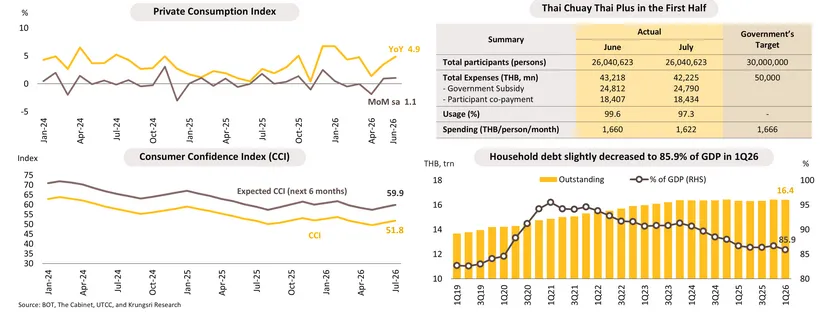
Household spending continued to recover, with the Private Consumption Index (PCI) rising 4.9% YoY in June from 3.5% in May, driven mainly by stronger consumer goods sales following the launch of stimulus measures, including Thai Chuay Thai Plus and the State Welfare Card program, starting from June to September. For 1H26, PCI rose by 4.2%. The Consumer Confidence Index (CCI) gradually improved to 51.8, supported by the stimulus measures and lower global oil prices. Meanwhile, household debt edged down to 85.9% of GDP in 1Q26 from 86.7% in 4Q25, but still above the pre-pandemic level of 82.7%. Looking ahead, existing stimulus measures should support consumption through 3Q26, but payback effects may follow, while the 4Q26 stimulus remains uncertain. Thereafter, high living costs, weak income growth, and elevated household debt are likely to constrain household spending.

Monthly Economic Bulletin  
 

Stagnant income: Lower-income group has flat real earnings and fragile jobs. 

 
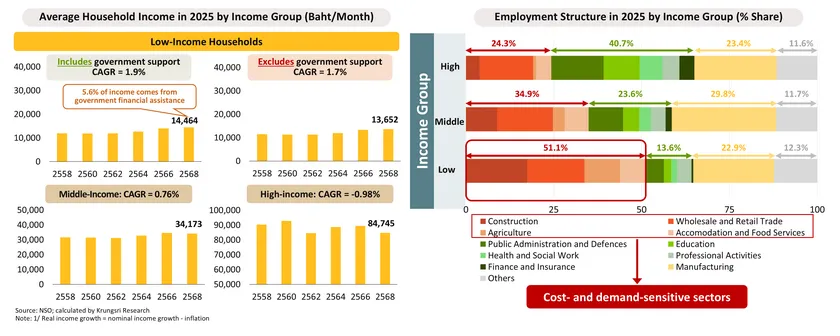
  • Over the past decade, real income growth1/ has eroded across almost all income groups, weakening purchasing power. Even though low-income households recorded the fastest nominal income growth at 1.9%, reliance on government financial assistance rose substantially. Excluding this unsustainable support, nominal income growth would drop to 1.7%, slightly higher than average inflation (1.0%), implying weak real income growth. Moreover, as low-income households face higher inflationary pressures from shocks, their actual real income growth will be even lower.

  • Furthermore, as more than half of workers in low-income households are employed in cost- and demand-sensitive sectors, such as construction, domestic trade, agriculture, and accommodation and food services, this leaves them highly vulnerable. In contrast, 40.7% of high-income earners are mainly engaged in more stable jobs, including public administration, education, health, professional services, and finance. 


Monthly Economic Bulletin  
 

Inflation remains elevated amid Middle East tensions and still-high oil prices; gradually rising core inflation warrants monitoring for cost pass-through to consumer prices.


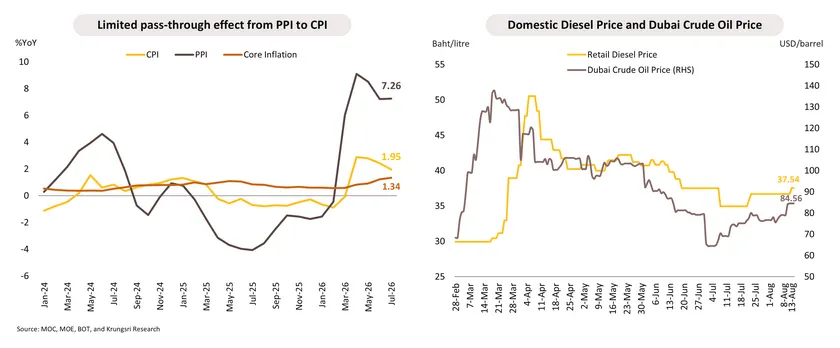
In July 2026, headline inflation eased to 1.95% YoY from 2.42% in June, mainly due to lower energy prices following the decline in global crude oil prices, as well as lower fresh food prices, particularly meat amid higher supply, and vegetables due to a high base effect. Looking ahead, supply constraints, high commodity prices, and impacts of El Niño risks could push inflation up from 3Q26 onward. The wide gap between PPI and consumer inflation suggests potential cost pass-through, while rising core inflation warrants monitoring amid weak domestic demand. 

Monthly Economic Bulletin  
 

BOT’s policy stance remains focused on domestic conditions, with no immediate need to follow other central banks’ tightening cycles.


Monthly Economic Bulletin  


Back
Press keyword to search