
Monthly Economic Bulletin (July 2026)

Monthly Economic Bulletin (July 2026)

17 July 2026

Global: The illusion of a geopolitical deal gives way to growth and inflation risks

Monthly Economic Bulletin


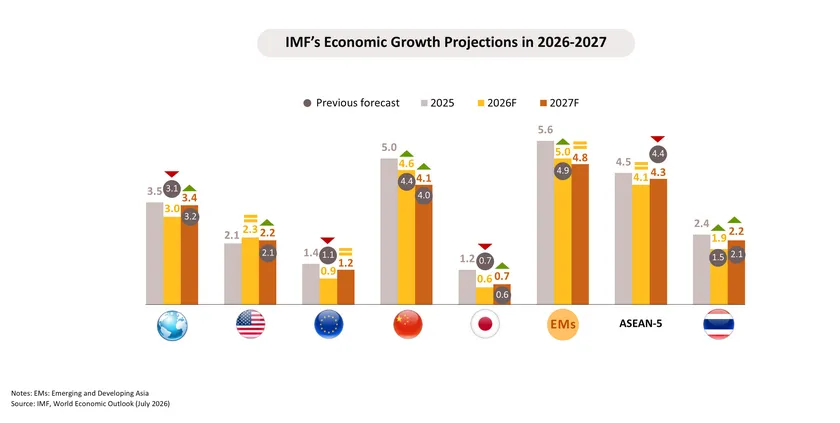
Global outlook: The IMF sees global growth slowing as war-driven shocks continue to exert pressure, while robust AI demand help lift the outlook for certain economies.

Monthly Economic Bulletin


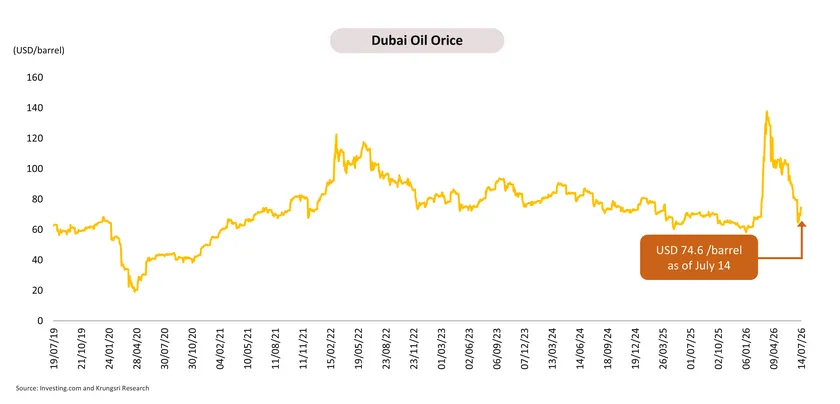
Dubai oil price rebounded amid heightened uncertainty over energy flows following escalating U.S.-Iran attacks in the Strait of Hormuz.

Monthly Economic Bulletin  
 

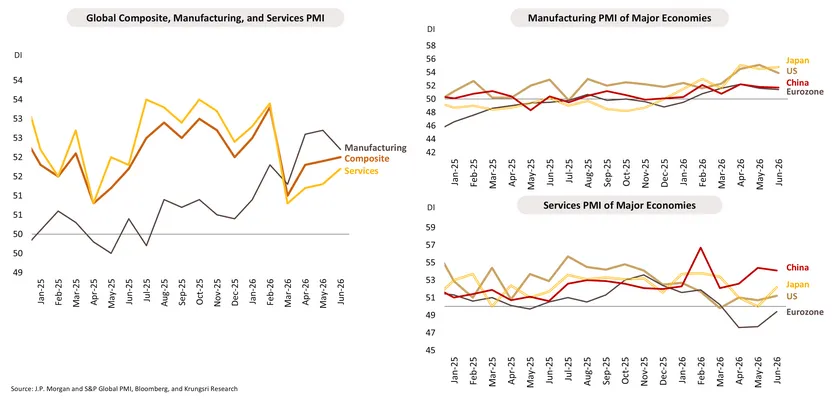
Global manufacturing is losing momentum, while services remain below pre-conflict levels; weak labor markets and sluggish global trade continue to constrain the outlook.


Monthly Economic Bulletin  
 

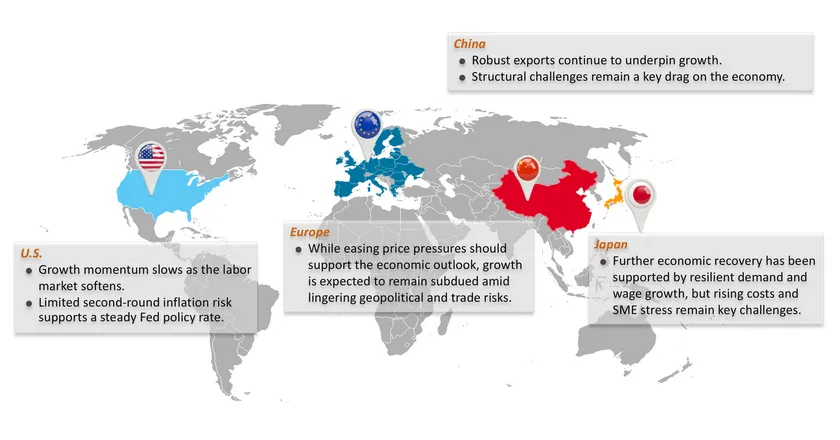
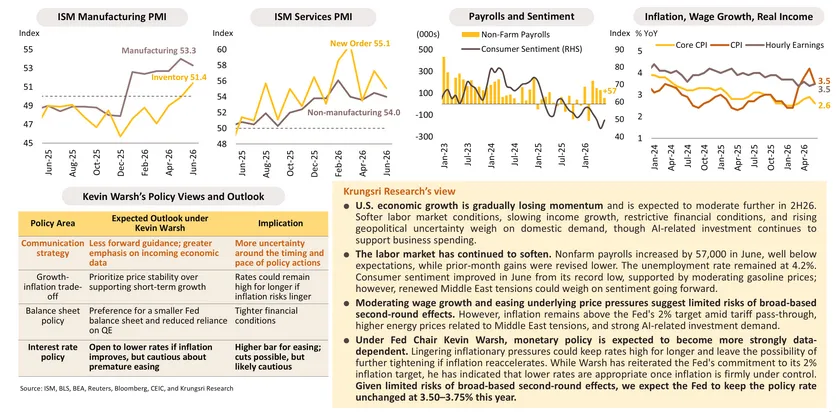
U.S.: Growth momentum slows as labor market softens; limited second-round inflation risk supports a steady Fed policy rate


Monthly Economic Bulletin  
 

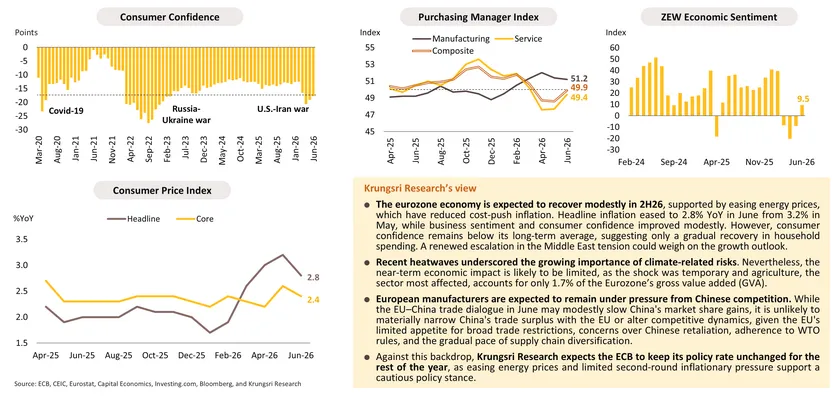
Eurozone: While easing price pressures should support the economic outlook, growth is expected to remain subdued amid lingering geopolitical and trade risks. 


Monthly Economic Bulletin  
 

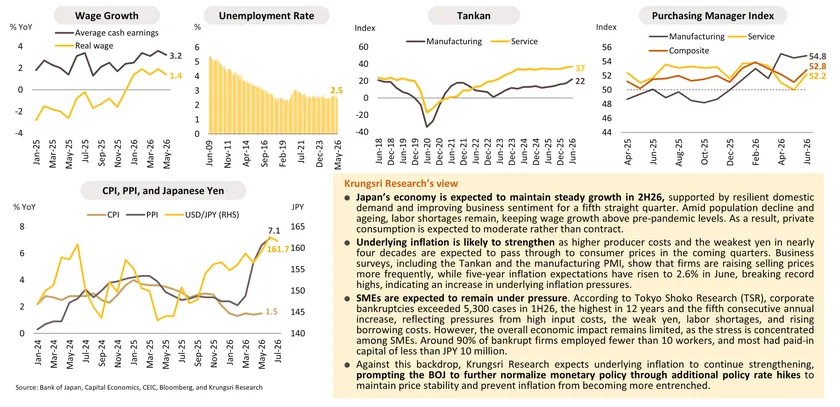
Japan: Further economic recovery has been supported by resilient demand and wage growth, but rising costs and SME stress remain key challenges.


Monthly Economic Bulletin  
 

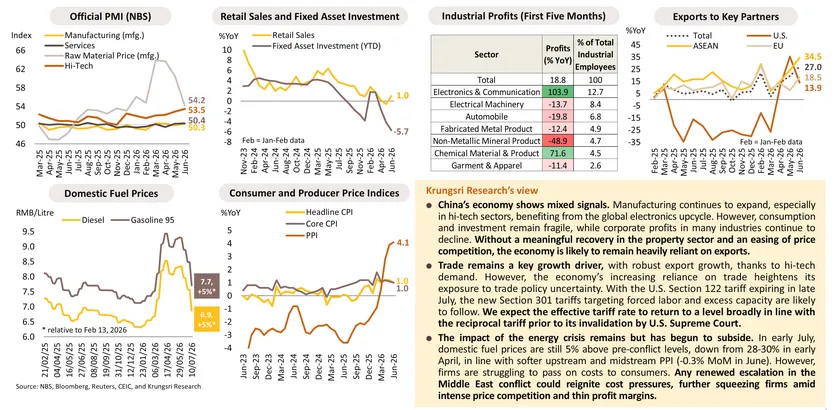
China: Robust exports continue to underpin growth, while structural challenges remain a key drag on the economy.


Monthly Economic Bulletin  
 

Thailand: Signs of a new investment cycle emerge as lower-income households face stagflation risks.

 
  • Private consumption receives temporary support from stimulus measure while high living costs, weak income growth, and elevated household debt continue to constrain spending.

  • Stagflation risks arise from the combination of higher inflation and stagnant income growth. While overall risks appear limited, they could vary across income groups. Stagflation risks loom for lower-income households though debt-free groups keep consumption contained. 

  • Tourism remains a key driver of Thailand’s current account, although the recovery is softening amid weak long-haul demand despite improving arrivals from the Middle East.

  • Thai exports has slowed relative to import growth with uneven export performance, while tariff risks cloud the export outlook in 2H26.

  • Investment momentum is strengthening, supported by robust FDI, policy continuity, and AI industries, potentially marking the start of Thailand’s new investment cycle.

  • Public spending improved in the first seven months of FY2026, but limited fiscal space constrains further stimulus.

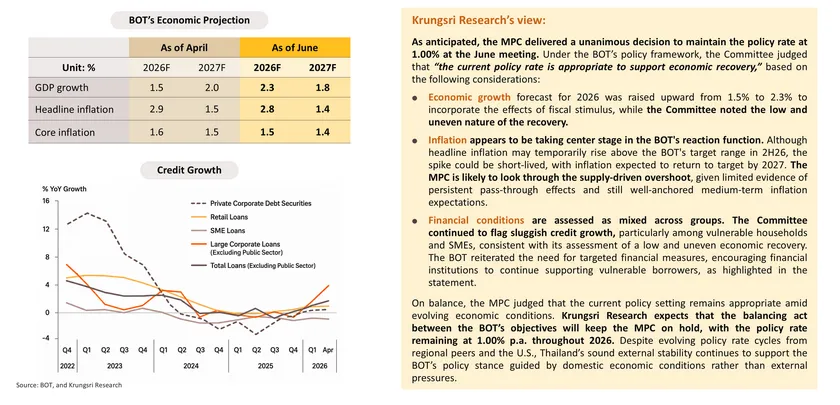
  • Despite evolving global rate cycles, the BOT’s policy trajectory remains guided by domestic conditions. We expect no change in the policy rate through 2026. 


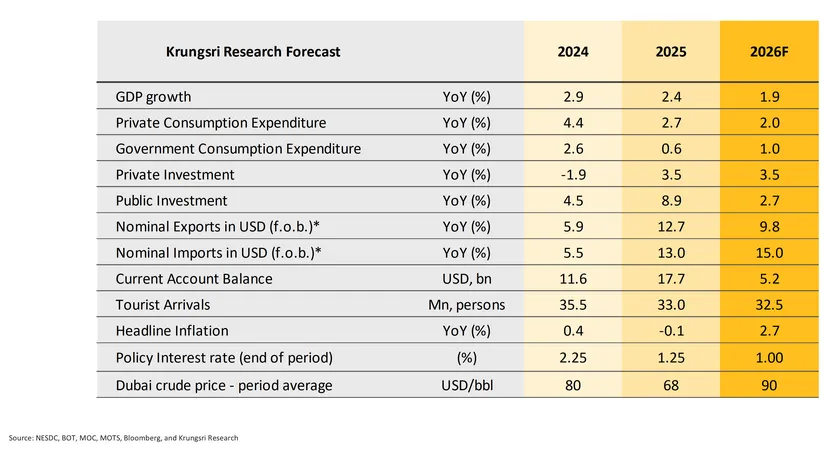
Krungsri Research Forecasts for 2026

Monthly Economic Bulletin  
 

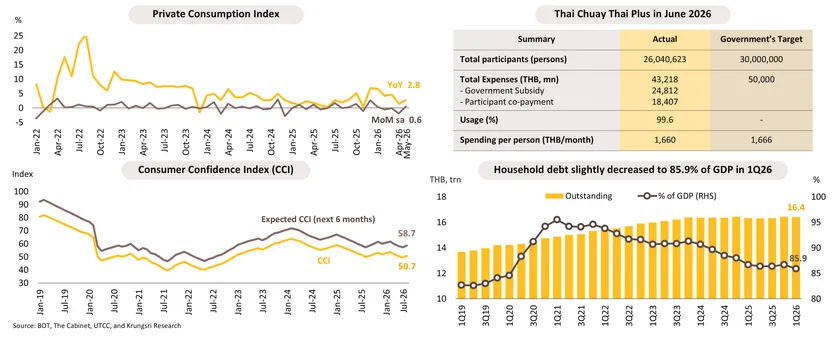
Private consumption receives temporary support from stimulus measure, while high living costs, weak income growth, and elevated household debt continue to constrain spending.


Household spending rebounded in the short term, with the Private Consumption Index (PCI) rising 2.8% YoY in May from 1.4% in April, driven mainly by stronger purchases of passenger vehicles, particularly EV demand amid concerns over high fuel prices. Consumer Confidence Index (CCI) also improved to 50.7 in July, supported by the Thai Chuay Thai Plus scheme and easing external pressures. However, household debt in 1Q26 remained elevated at 85.9% of GDP, though moderating from 86.7% in 4Q25, still above the pre-pandemic level of 82.7%. Looking ahead, government stimulus is expected to provide only temporary support to consumption through September. Thereafter, high living costs, weak income growth, elevated household debt, and post-stimulus payback effects are likely to weigh on household spending.


Monthly Economic Bulletin  
 

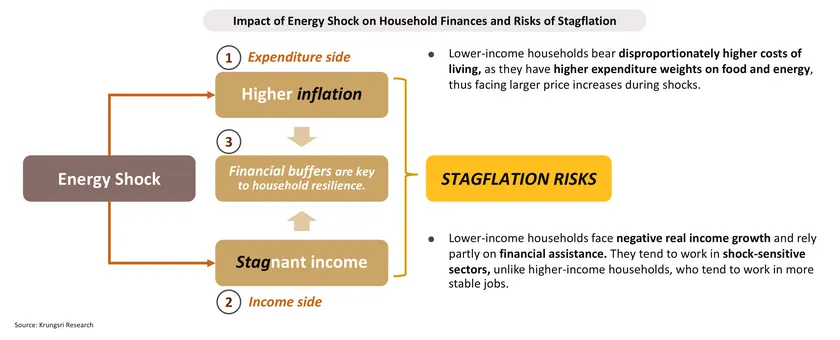
Stagflation risks arise from the combination of higher inflation and stagnant income growth; while overall risks appear limited, they could vary across income groups.


Since the Middle East conflict escalated in late February, global energy prices have increased substantially, potentially posing “stagflation” risks to already fragile economies. For Thailand, such risks to the overall economy appear limited, as the economy is still able to expand and an upward trend of inflationary pressure is limited by subdued domestic demand. However, at the household level, the stagflation risks might be unevenly distributed across income groups. Thus, we examine the impact of the energy shock across income levels on (i) household expenditure (spending category) and (ii) household income (real income growth and occupation). Household financial buffers are also considered to reflect household’s capacity to absorb shocks, which will be assessed through excess income (defined as monthly income minus expenditure) and debt burdens.

Monthly Economic Bulletin  
 

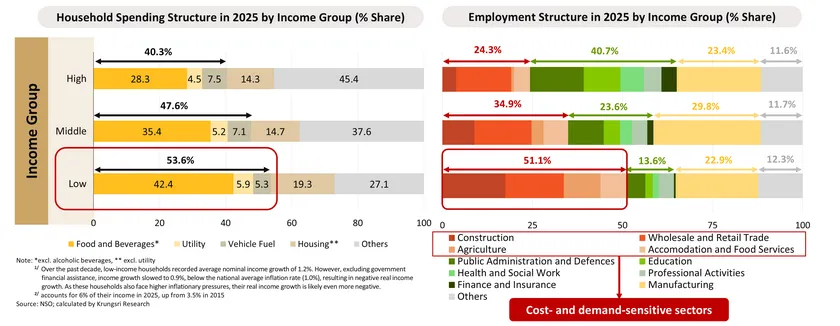
Income and expenditure: Lower-income groups are more exposed to the energy shock due to higher food and energy spending, stagnant income growth, and vulnerable jobs. 


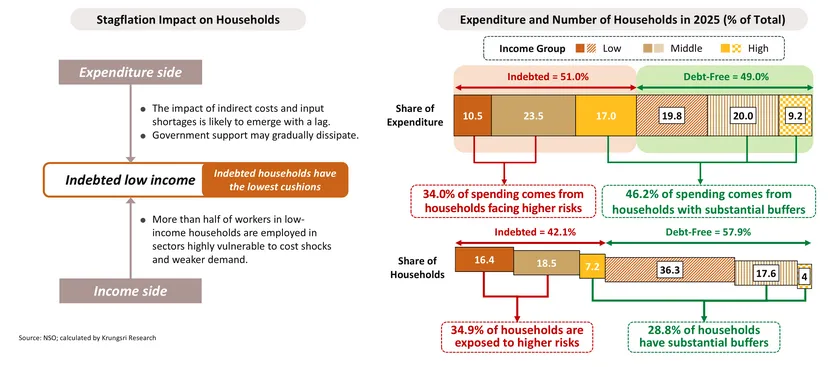
Given the current household spending structure, the direct and immediate impact of the energy shock would weigh more on higher-income households, particularly through vehicle fuel expenses. However, over time, the indirect impact from higher input costs, combined with the phasing out of price controls and subsidies, is likely to spill over into the prices of other items, especially food. In the subsequent phase, lower-income households would face a more severe impact as food and energy take a larger portion of the consumption basket. Apart from struggles on the expenditure side, low-income households also face eroding purchasing power1/, rely on government financial assistance to some extent2/,  and are mainly engaged in highly sensitive sectors such as construction, domestic trade, agriculture, and accommodation and food services. This is in stark contrast to high-income households, whose members are mainly concentrated in more stable sectors, including public administration, education, health, professional services, and finance.

Monthly Economic Bulletin  


Financial buffers: Lower-income households have very limited buffers to absorb shocks and adjust consumption, thus prone to repeating a debt cycle.


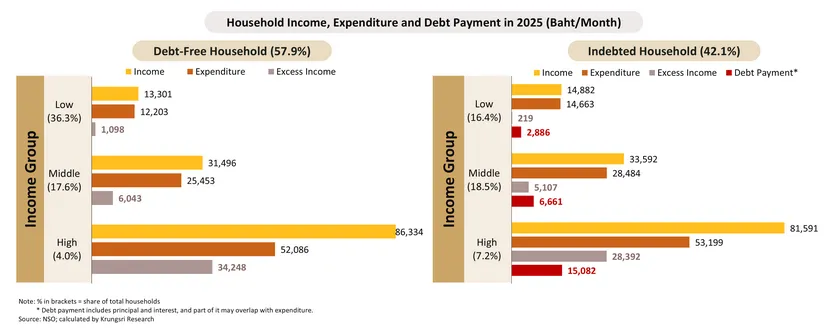
Financial buffers, measured by excess income or the difference between income and expenditure, enable households to cushion the impact of shocks for a certain period of time. Such capacities, however, differ across income groups and debt obligations. Irrespective of debt burdens, lower-income households hold very limited buffers to absorb price volatility and income shocks. For indebted households, the financial buffers are even lower, especially among low- and middle-income groups. At the same time, lower-income households possess limited capacity to adjust consumption in response to shocks, as their expenditures are concentrated largely on essential items such as food and energy. They may consequently be compelled to sell assets, draw down savings, or take on additional loans, thereby reinforcing a persistent debt cycle.

Monthly Economic Bulletin  
 

Stagflation risks loom for lower incomes, while debt-free groups keep consumption contained 


Taken together, lower-income households are being squeezed by insufficient income growth (“stagnant”) and expenditure pressures (“inflation”). In other words, they are more exposed to “stagflation” risks, with limited financial buffers to absorb shocks and a tendency to repeat the debt cycle. This, in turn, exerts additional pressure on aggregate consumption, given that indebted low- and middle-income households account for 34.0% of total household spending and 34.9% of total households. On the brighter side, debt-free middle- to high-income households still take a sizable 29.2% of total spending. If indebted high-income households are included, such a share would increase to 46.2%. In conclusion, while higher-income spending helps support aggregate consumption during stagflation, it masks the severity of the impact on lower-income households.

Monthly Economic Bulletin  


Tourism remains a key driver of Thailand’s current account, although the recovery is softening amid weak long-haul demand despite improving arrivals from the Middle East.


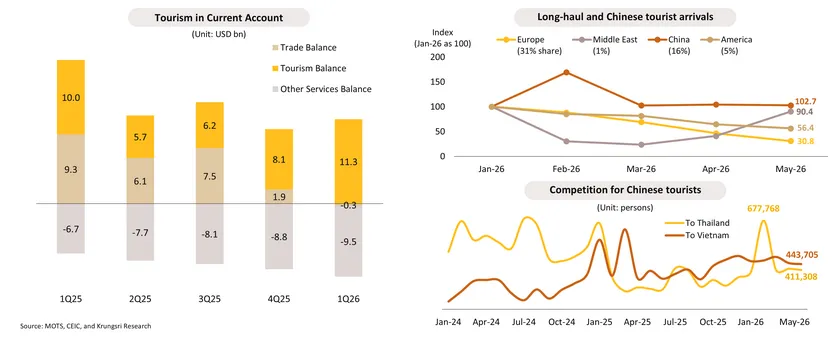
Tourism remains a key driver of Thailand’s current account, with the tourism surplus offsetting deficits in other services. In May 2026, Thailand welcomed 2.34 mn foreign visitors, slightly down from 2.36 mn in April. While arrivals from most markets have largely recovered, Chinese tourist arrivals in the first five months of this year remained at less than half of their pre-COVID levels. Arrivals from the Middle East recovered to the pre-conflict level, but long-haul tourists, particularly from Europe and the U.S., would still be weighed by elevated aviation costs and concerns over transit disruptions and travel safety. Moreover, Thailand faces increasing competition from Vietnam in attracting Chinese tourists. Therefore, Krungsri Research expected 32.5 mn foreign tourist arrivals in 2026, as the recovery has begun to moderate. 

Monthly Economic Bulletin
 

Thai exports has slowed relative to import growth with uneven export performance, while tariff risks cloud the export outlook in 2H26.


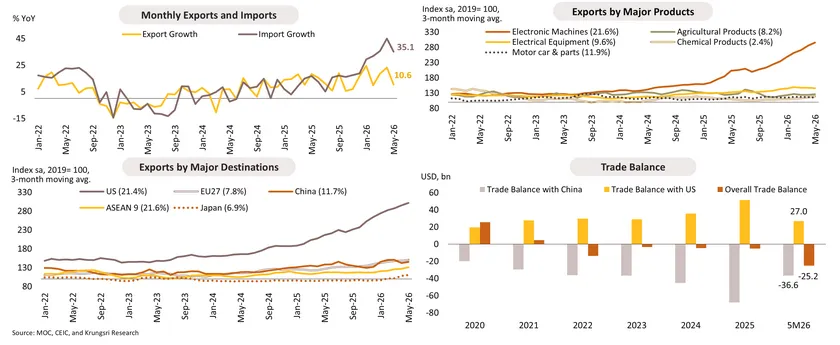
Exports grew 10.6% YoY in May, while imports, despite moderating slightly to 35.1%, continued to outpace exports. Export growth was driven primarily by electronics and electrical equipment, with shipments expanding across all major markets, including the U.S., ASEAN, China, the EU27, and Japan. Although AI boom, electronics upcycle, and front-loading ahead of U.S. tariff measures continues to support exports, the upside is likely to be temporary amid the ongoing Section 301 investigations on the forced-labor merchandise imports and the excess production capacity, alongside lingering Middle East tensions, and subdued external demand. Consequently, export growth is expected to weaken over the remainder of the year.

Monthly Economic Bulletin  


Strengthening investment momentum supported by FDI, and the policy continuity, potentially marking the start of Thailand’s new investment cycle.


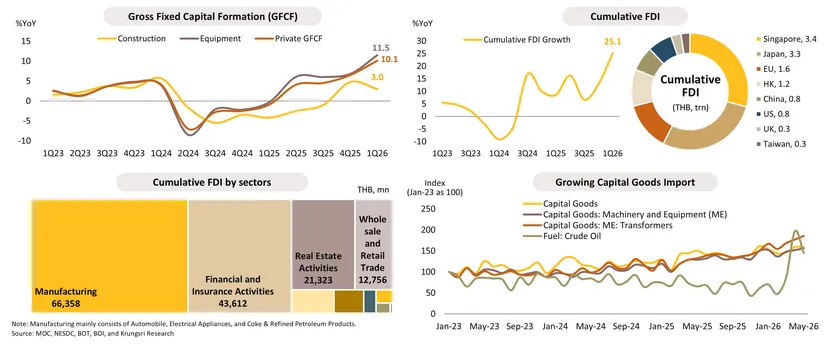
Private sector gross fixed capital formation (GFCF), particularly in machinery and equipment, has expanded at a stronger pace, especially after the election and the signs of policy continuity. Foreign direct investment (FDI) has remained robust, with cumulative investment applications exceeding THB 3.0 trillion, while net FDI inflows in 1Q26 were concentrated in the manufacturing and finance & insurance sectors. Meanwhile, accelerating capital goods imports, especially machinery and equipment, point to improving investment momentum. Overall, rising private investment, foreign investment, and capital goods imports suggest that a new investment cycle may be emerging.

Monthly Economic Bulletin  
 

Investment promotion applications continued to strengthen, driven by digital infrastructure and electronics. 


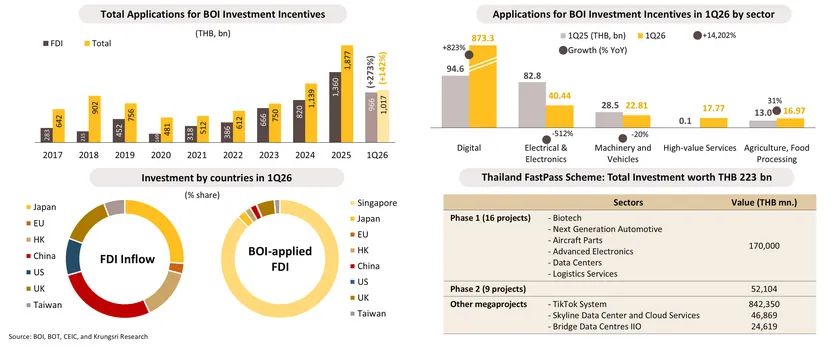
BOI investment applications reached THB 1.02 trillion in 1Q26, surging 142.4% YoY, driven primarily by data centers and cloud services. Applications for BOI investment incentives by foreign investors rose to THB 966 billion (+273% YoY), led by Singapore, the U.K., and Japan. Besides, the government has declared 2026 the Year of Investment, led by the Thailand FastPass initiative, which has attracted over THB 223 billion in projects, alongside nearly THB 1 trillion in other promoted investments in line with digital infrastructure and electronics trend.

Monthly Economic Bulletin
 

Private Investment has been volatile amid concerns over prolonged Middle East tensions, but the medium-term outlook shows signs of recovery.


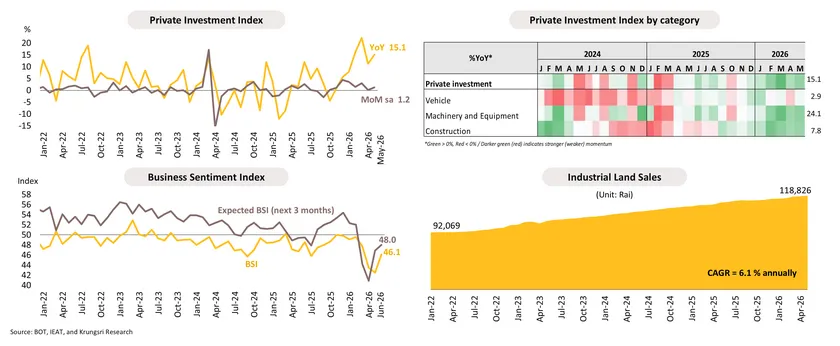
Business investment continued to strengthen, with the Private Investment Index (PII) accelerating to 15.1% YoY in May from 11.3% in April, reflecting growth across vehicles, machinery & equipment, and construction. Forward-looking indicators also improved, with the expected Business Sentiment Index (BSI) rising to 48.0 and the BSI rebounding to 46.1 in June. Looking ahead, leading alternative indicators such as industrial land sales point to the possible emergence of a new investment cycle. However, investment growth is likely to remain somewhat constrained by weak domestic demand, geopolitical uncertainties, and risks associated with U.S. tariff policy.

Monthly Economic Bulletin  
 

Public spending improved in the first seven months of FY2026, but limited fiscal space constrains further stimulus.


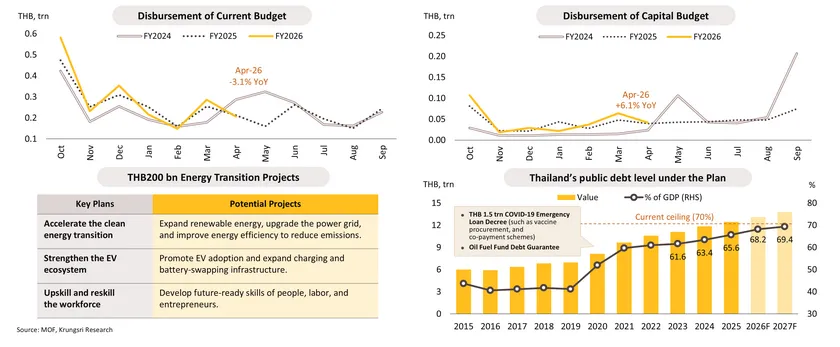
In the first seven months of FY2026 (October 2025–April 2026), current and capital budget disbursements increased by 5.8% and 12.4% YoY, respectively, reflecting accelerated public spending and continued policy implementation. Besides, the FY2027 budget is under usual preparation despite the election period early this year. The Constitutional Court’s approval of the THB 400 billion emergency decree supports the government’s THB 200 billion energy transition program, though its effectiveness and economic impact warrant monitoring. Meanwhile, public debt is approaching the statutory ceiling, leaving limited fiscal space for additional stimulus.

Monthly Economic Bulletin  
 

Despite evolving global rate cycles, the BOT’s policy trajectory remains guided by domestic conditions; we expect no change in the policy rate through 2026.


Monthly Economic Bulletin  

 
Back
Press keyword to search