
Monthly Economic Bulletin (May 2026)

Monthly Economic Bulletin (May 2026)

19 May 2026

Global: Hope Above, Strain Beneath—Sentiment Improves, but Growth Softens and Inflation Pressures Build


Monthly Economic Bulletin
 

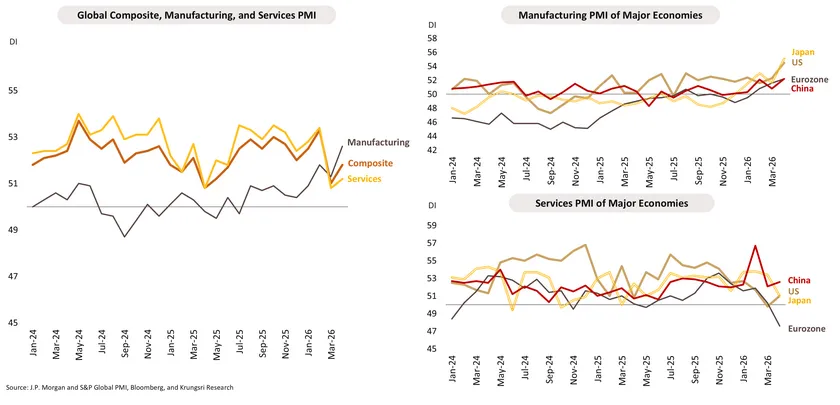
Global: Activity rebounds, but supply strains worsen across most economies, with input costs and delivery delays nearing their highest levels since the Russia-Ukraine war.


Monthly Economic Bulletin


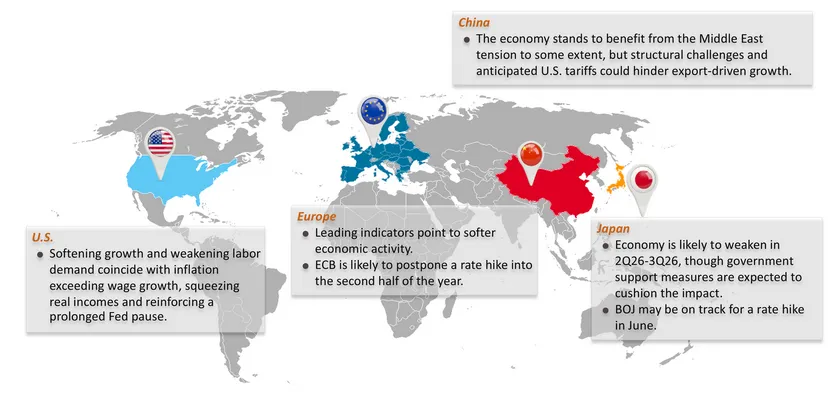
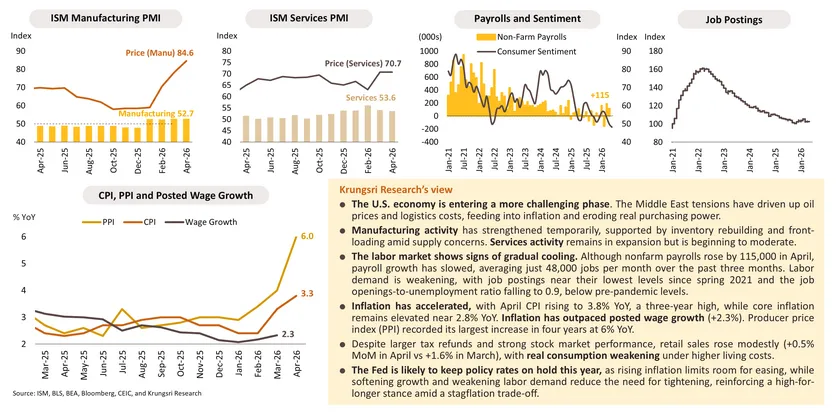
U.S.: Softening growth and weakening labor demand coincide with inflation exceeding wage growth, squeezing real incomes and reinforcing a prolonged Fed pause.


Monthly Economic Bulletin  


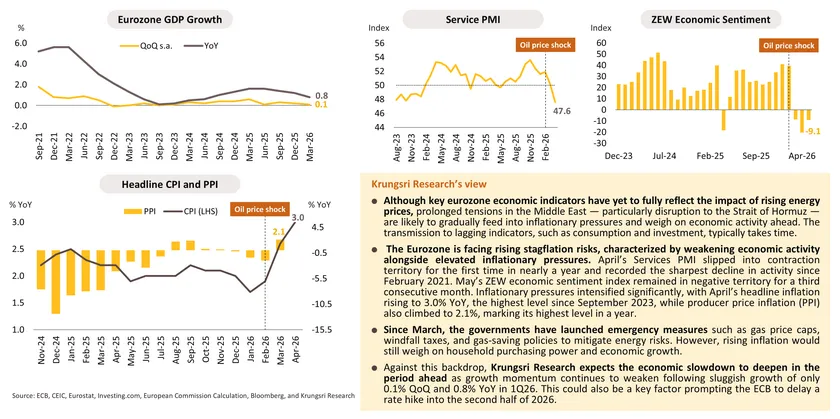
Eurozone leading indicators point to softer economic activity; ECB is likely to postpone a rate hike into the second half of the year.


Monthly Economic Bulletin  


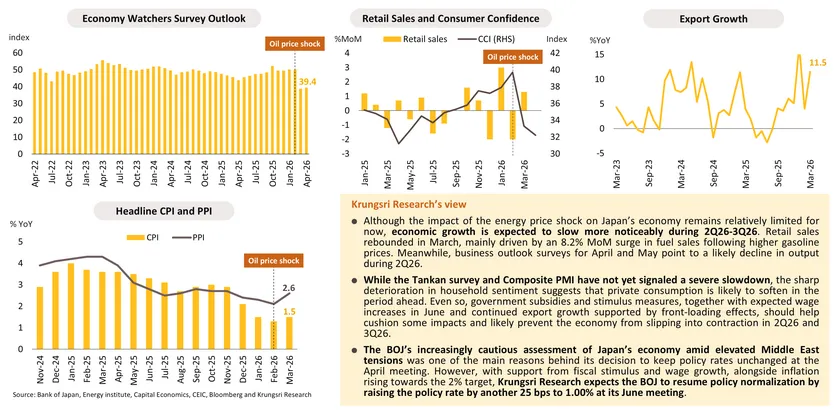
Japan’s economy is likely to weaken in 2Q26-3Q26, though government support measures are expected to cushion the impact; BOJ may be on track for a rate hike in June.


Monthly Economic Bulletin  


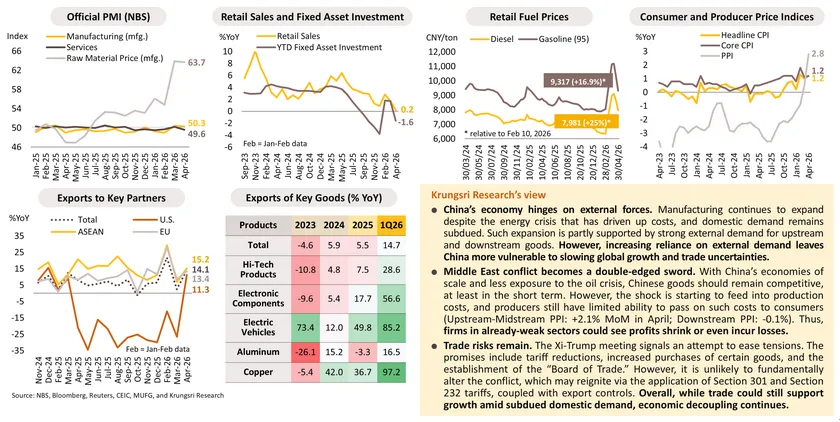
China: The economy stands to benefit from the Middle East tension to some extent, but structural challenges and anticipated U.S. tariffs could hinder export-driven growth.


Monthly Economic Bulletin  


Thailand: Supportive policy emerges but growth weighed down by external strains and fragile confidence.

 
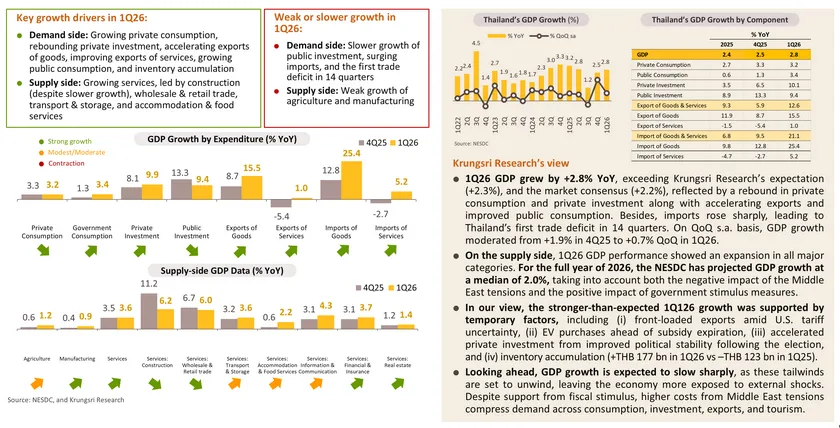
  • 1Q26 GDP growth surprised on the upside at 2.8% YoY and +0.7% QoQ s.a., supported by temporary factors.

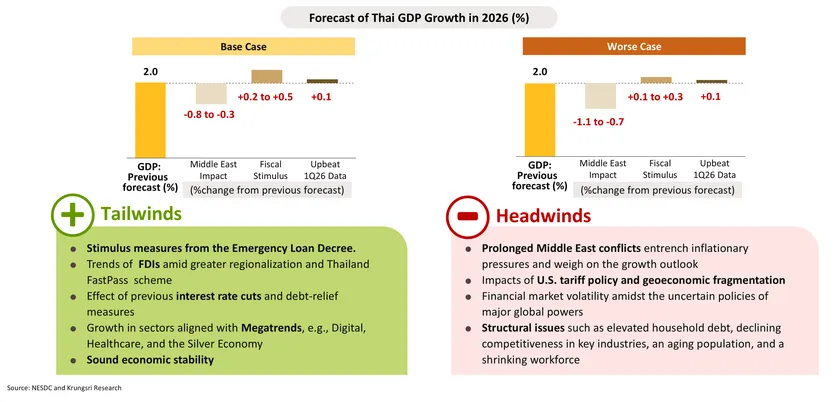
  • For Thailand’s 2026 economic outlook, Middle East Tensions weigh on growth, even as fiscal stimulus and stronger 1Q momentum offer support.

  • The government introduces THB 400 bn Emergency Loan Decree to ease impacts of high energy costs through co-payment schemes and Thailand’s transition plan toward greater energy resilience.

  • Moody’s has upgraded Thailand’s rating outlook to ‘stable’, reflecting easing U.S. tariff risks, recovery in investment momentum, and improved political stability.

  • Private consumption is showing signs of moderation. Private Investment is beginning to moderate with deteriorating sentiment amid concerns over prolonged Middle East tensions.

  • Tourism is softening amid higher aviation costs, transit disruption, and safety concerns.

  • Thai exports remain volatile amid front-loading ahead of tariff uncertainty; imports continue to surge.

  • Inflation is rising. Supply constraints and higher energy costs transmitted to producer prices more visibly than consumer prices.

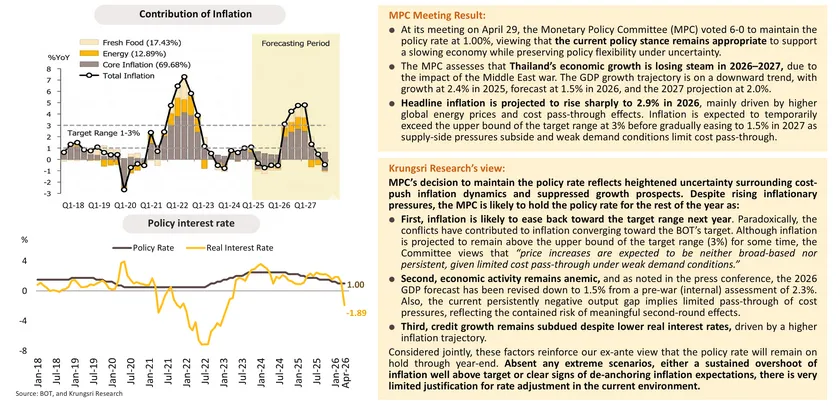
  • MPC holds rate at 1%, viewing policy adjustment as a risk to growth–inflation dynamics. Krungsri research maintains the view that the policy rate will remain on hold throughout 2026. 


1Q26 GDP growth surprised on the upside at 2.8% YoY and +0.7% QoQ s.a., supported by temporary factors; momentum may soften ahead


Monthly Economic Bulletin  


Thailand’s 2026 economic outlook: Middle East Tensions weigh on growth, even as fiscal stimulus and stronger 1Q momentum offer support.


Monthly Economic Bulletin  


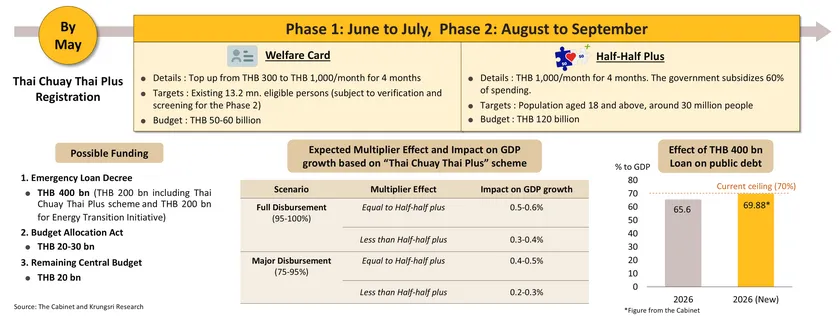
THB 400 bn Emergency Loan Decree aims to ease impacts of high energy costs through co-payment schemes and Thailand’s transition plan toward greater energy resilience.
 

  • The proposed THB 200 bn immediate relief, including the “Thai Chuay Thai Plus” scheme, aims to support domestic demand and sustain purchasing power amid high energy costs and weaker sentiment. While the package could provide a short-term boost to GDP growth, it may raise fiscal risks, push public debt closer to the statutory ceiling, and lead to a payback effect after the end of the stimulus.

  • The remaining THB 200 bn budget is expected to support Thailand’s energy transition through renewable energy, EVs, charging infrastructure, and carbon-credit initiatives, although implementation details remain unclear. The measure may also face legal challenges over the necessity of issuing it under an emergency loan decree, following an opposition party’s petition to the Constitutional Court, leaving uncertainty remaining.


Monthly Economic Bulletin  


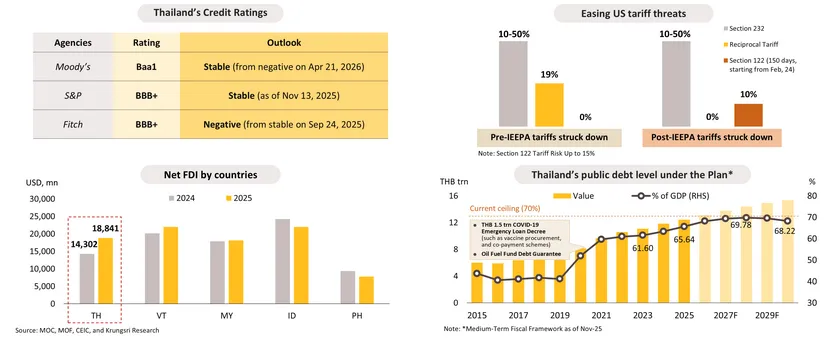
Thailand’s rating outlook improves, reflecting easing U.S. tariff risks, recovery in investment momentum, and improved political stability from a sizeable parliamentary majority.


Moody’s has upgraded Thailand’s rating outlook to ‘stable’ from ‘negative’ while maintaining the rating at Baa1. This revision reflects (i) easing downside risks from U.S. tariffs, with rates now broadly aligned with regional peers, supported by 17.6% YoY export growth in 1Q26 and 12.9% in 2025; (ii) recovered investment momentum, with Thailand recording the highest FDI growth (+31.7%) among ASEAN-5 in 2025; and (iii) improved political stability supported by a sizeable parliamentary majority, enhancing prospects for reform implementation, economic growth, and gradual fiscal improvement. According to the latest fiscal plan, the public debt level will be gradually consolidated over the medium term.

Monthly Economic Bulletin  


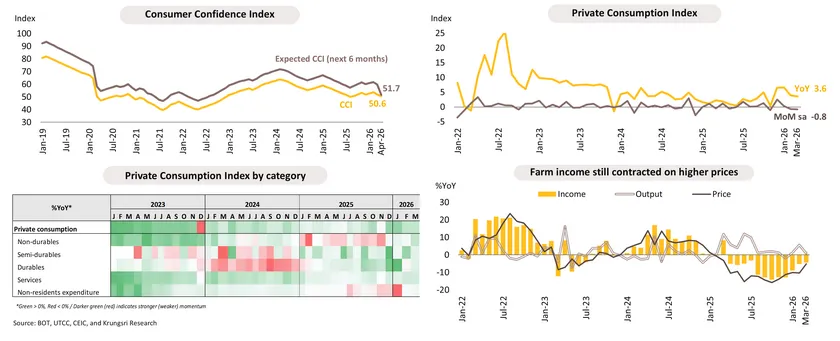
Private consumption is showing signs of moderation as deteriorating sentiment, declining purchasing power, and weak farm income weigh on the outlook.


In April 2026, the Consumer Confidence Index (CCI) continued to decline from 51.8 in March to 50.6, the lowest level in seven months, signaling rising concerns over the Middle East Tension. Alongside, the Private Consumption Index (PCI) slowed to 3.6% YoY in March from 3.9% in February, due to a decline in semi-durable goods purchases and services, particularly hotels and restaurants, following the tourism slowdown. Despite higher agricultural prices, farm income remained negative, amid falling output. Going forward, fiscal stimulus measures may support domestic spending during June to September, but higher living costs, weak income growth, and elevated household debt are expected to constrain domestic consumption.

Monthly Economic Bulletin   


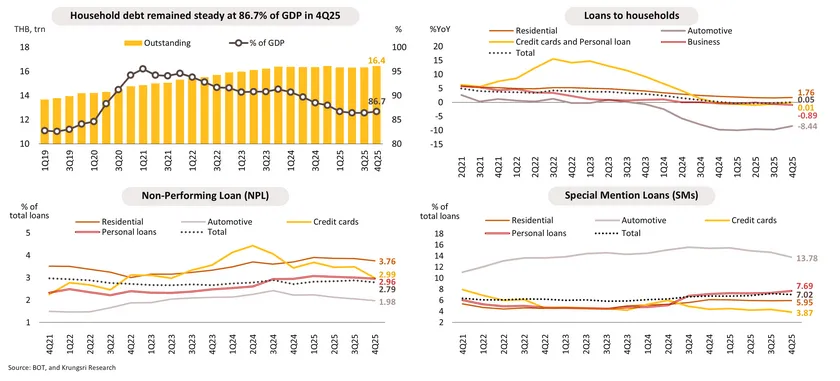
Household debt was steady at 86.7% of GDP in 4Q25, still above pre-pandemic level.


Household debt-to-GDP ratio remained high at 86.7%, still higher than pre-Covid level of 82.7%. Asset quality weakened slightly, with NPLs edging up to 2.79% of total loans in 4Q25 from 2.71% at end-2024. Residential NPLs increased modestly, while credit-card and auto loan NPLs remain vulnerable to future deterioration. Meanwhile, Stage-2 loans stayed elevated at 7.02% of total loans.

Monthly Economic Bulletin   
  

Private Investment is beginning to moderate with deteriorating sentiment amid concerns over prolonged Middle East tensions though medium-term outlook remains encouraging.


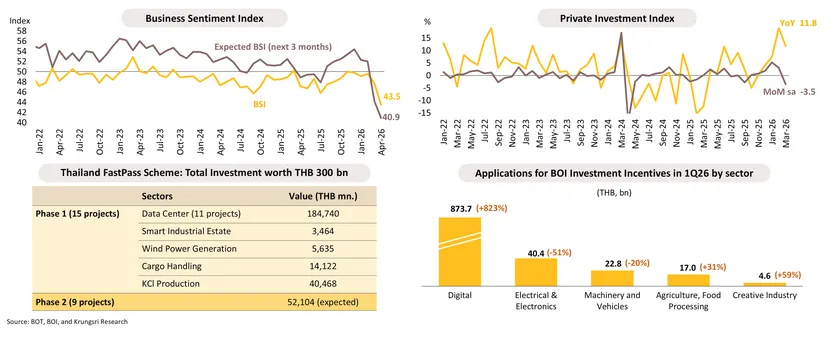
The forward-looking indicators have also weakened, with the expected BSI falling to a more-than-five-year low of 43.5 in April, reflecting concerns over escalating and prolonged Middle East tensions. The Private Investment Index (PII) also grew more slowly by 11.8% YoY in March, compared to 15.5% in February. However, investment promotion applications submitted to the BOI reached THB 1.02 tn in 1Q26, expanding 142.4% YoY, driven mainly by investments in data centers and cloud services. Thailand FastPass Phase 1 secured over THB 240 bn in investments, with Phase 2 expected to add THB 52 bn. Thus, while medium-term investment outlook may see supportive factors in certain sectors, private investment in the near future is likely to face headwinds from soft domestic demand, escalating geopolitical risks, and uncertainty surrounding U.S. tariff policies.

Monthly Economic Bulletin   


Tourism is softening amid higher aviation costs, transit disruption, and safety concerns, while a recovery in Chinese tourist arrivals remains slow.


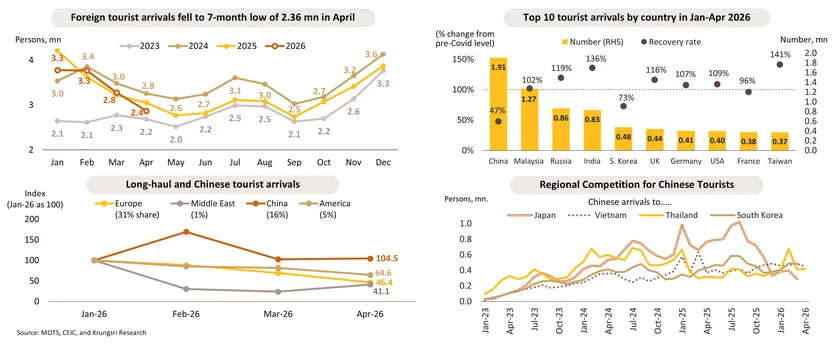
In April 2026, Thailand welcomed 2.36 mn foreign visitors, down from 2.77 mn in March. While arrivals from most markets have largely recovered already, Chinese tourist arrivals in the first four months of this year remained well below the pre-COVID levels. For long-haul tourism, Middle East tensions and concerns over transit disruptions and travel safety are weighing, particularly on Middle East, European, and American tourists, while Chinese arrivals remained above pre-war levels. However, Thailand faces intensifying competition from regional peers in attracting Chinese tourists, despite the emerging opportunities.

Monthly Economic Bulletin   
  

Thai exports remain volatile amid front-loading ahead of tariff uncertainty; imports continue to surge, and prolonged Middle East tensions could weigh on trade ahead.


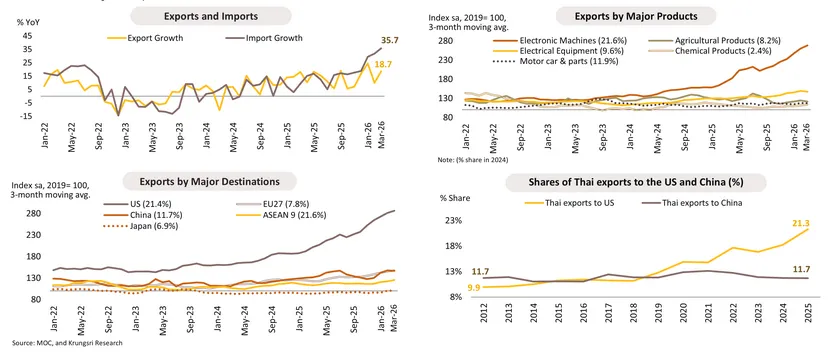
Exports expanded by 18.7% YoY in March, while imports also grew sharply by 35.7%. The export growth was driven by key products such as electronic machines and electrical equipment. Exports to all major markets – including the U.S., EU27, Japan, China, and ASEAN – also expanded. Although the invalidation of the U.S. IEEPA tariffs may temporarily support exports through front-loading demand, the upside is likely to be short-lived amid prolonged Middle East tensions and lingering tariff risks, particularly ongoing Section 301 and 232 investigations by the U.S.

Monthly Economic Bulletin   
  

Inflation is rising on Middle East tensions and reduced subsidies; supply constraints and higher energy costs are transmitting to PPI more visibly than CPI.


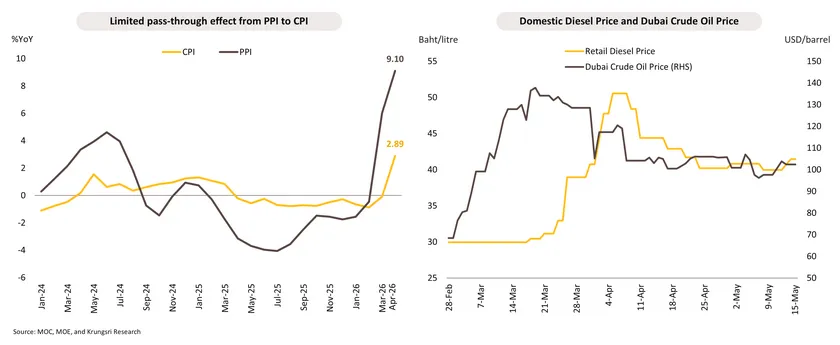
In April 2026, headline inflation accelerated to 2.89% following the reduction of government subsidies, driven mainly by higher public transportation fares and prepared food prices as businesses passed rising costs on to consumers. Nevertheless, the sharper increase in PPI relative to CPI suggests a limited effect of cost pass-through. Domestic diesel prices also moved broadly in line with Dubai crude oil prices, indicating a reduced—though still elevated—government burden in subsidizing retail fuel prices. Going forward, supply shortages, higher electricity charges, and potential increases in key commodity prices are likely to raise inflation to above the BOT’s target range from 2Q26 onward.


Monthly Economic Bulletin   
 

MPC holds rate at 1%, viewing policy adjustment as a risk to growth–inflation dynamics; we maintain our view that the policy rate will remain on hold throughout 2026. 


Monthly Economic Bulletin

 
Back
Press keyword to search