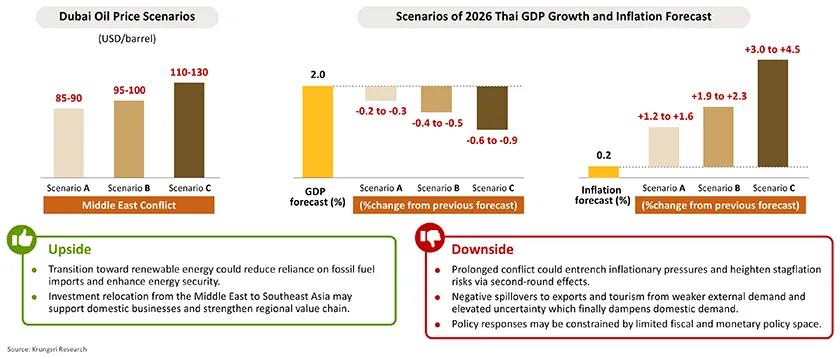



The ongoing Middle East conflict poses meaningful downside risks to Thailand’s economic outlook. Although Thailand shows relatively less vulnerability than most peers, it still faces notable risks, as the impact of the geopolitical shock could be prolonged amid limited policy space.
Private consumption is set to soften further, as weaker sentiment, fading demand, higher living costs, and structural constraints weigh on the outlook.
Private Investment momentum is likely to weaken, as deteriorating sentiment and rising external risks may offset earlier strength in capital spending.
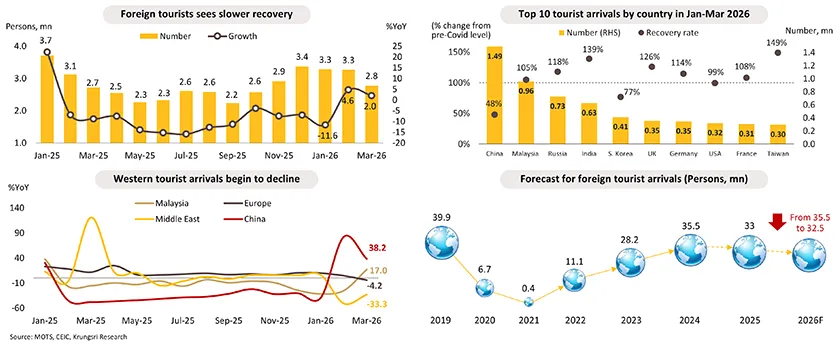
Tourism is feeling the impact of Middle East tensions through higher aviation costs, transit disruption, and safety concerns, prompting a downward revision of foreign tourist forecasts.
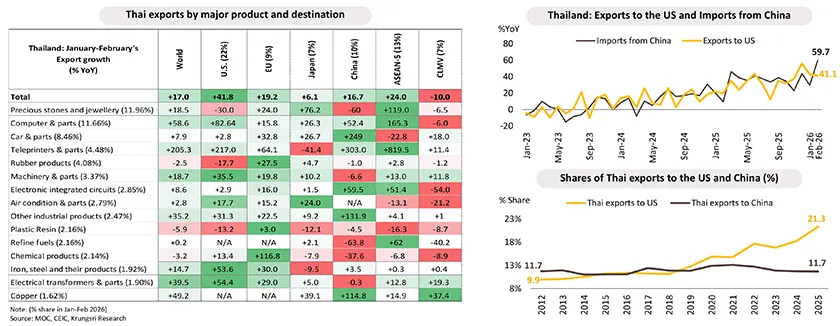
Thai exports are fluctuating amid front-loading ahead of uncertain U.S. tariff policy, while the Middle East tensions could dampen growth in the future.
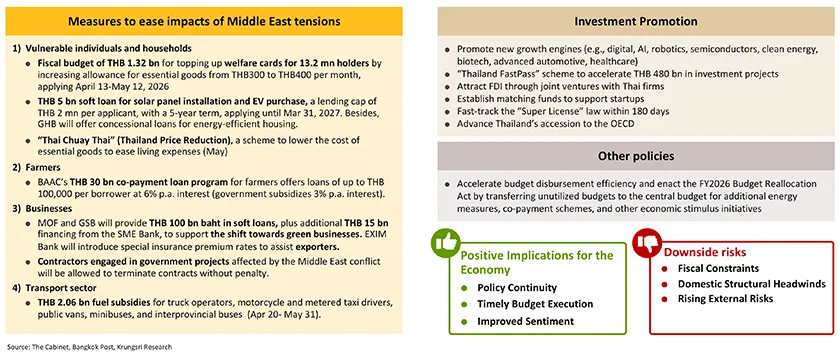
The new government’s immediate measures aim to cushion the impact of Middle East tensions via cost-of-living relief and targeted fiscal support, though upside remains constrained.
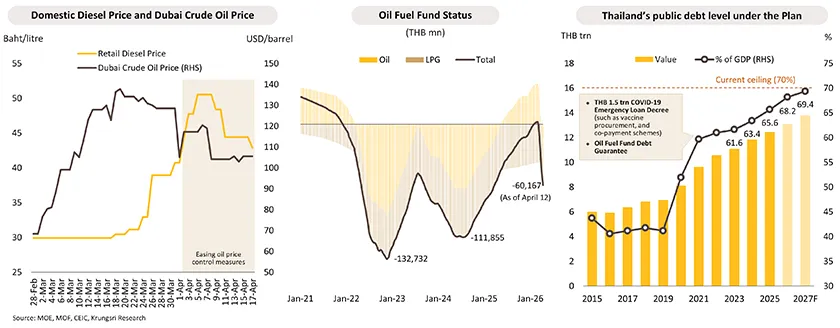
Fiscal pressures are mounting amid Middle East tensions and constrained policy space. Expanded subsidies increase burdens and further limit the ability to support the economy.
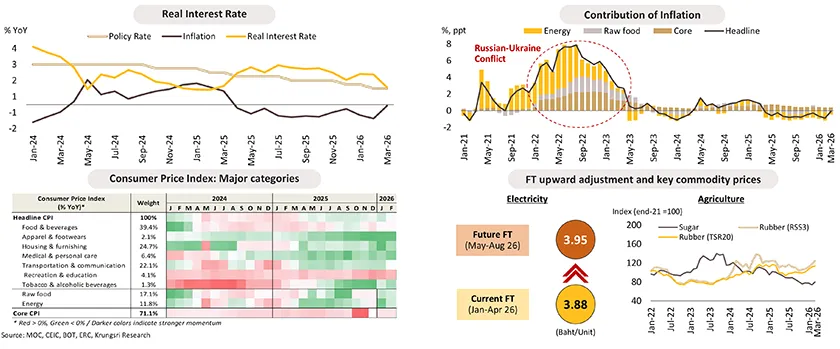
Inflation is rising due to the Middle East tensions and reduced subsidies. Policy interest rate is likely to remain on hold, with limited room to cut and no need to hike amid weak economic growth.
The impact on the Thai economy depends on the intensity and duration of the Middle East tensions. Given the current situation, the primary effect is from the supply side due to the sudden increase in oil prices and higher production costs. If tensions in the Middle East persist, the impact through demand-side channels and financial markets would intensify—affecting trade, tourism, and investment, and ultimately shaping monetary policy and the broader economic outlook.

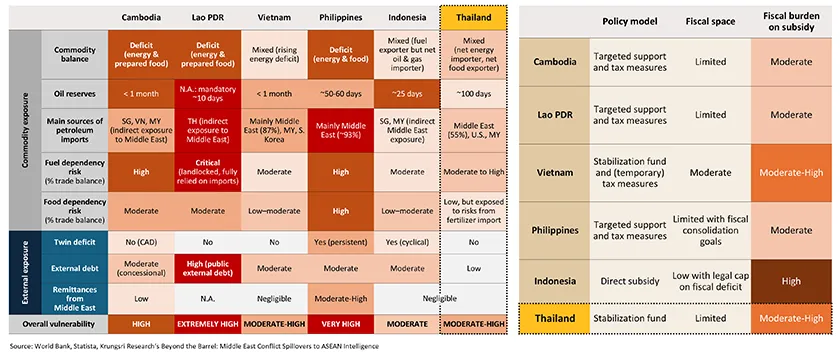
Considering vulnerabilities related to import dependence and external stability, the Philippines, Lao PDR, and Cambodia are among the most exposed economies, while Thailand, Indonesia, and Vietnam face relatively lower. ASEAN economies, including Thailand, should accelerate the diversification of energy import sources and design targeted, time-bound support measures to contain long-term fiscal burdens while preserving fiscal space.

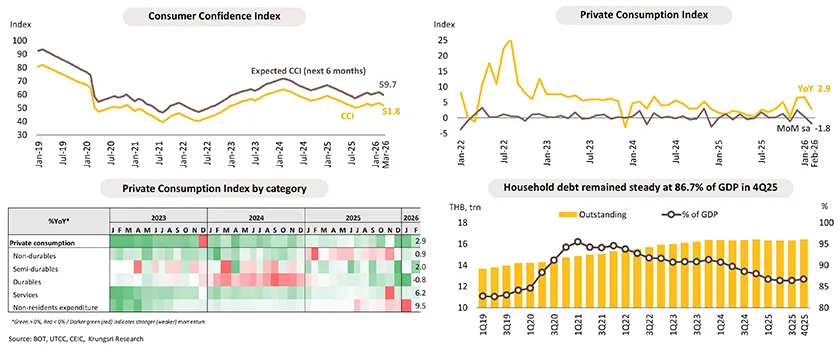
In Mar-26, the Consumer Confidence Index (CCI) fell from 53.7 in Feb to 51.8, the lowest level in six months, signaling rising concerns over the Middle East Tension. Even before the war in Iran, the Private Consumption Index (PCI) slowed to 2.9% YoY in Feb, mainly due to a decline in durable goods purchases, particularly EV, following front-loaded demand in the previous period. Consumption of services and non-durables also softened, in line with weaker tourist receipts and subdued demand. Looking ahead, higher energy prices and cost of living, together with structural constraints such as weak income growth and elevated household debt, are likely to further weigh on domestic consumption.

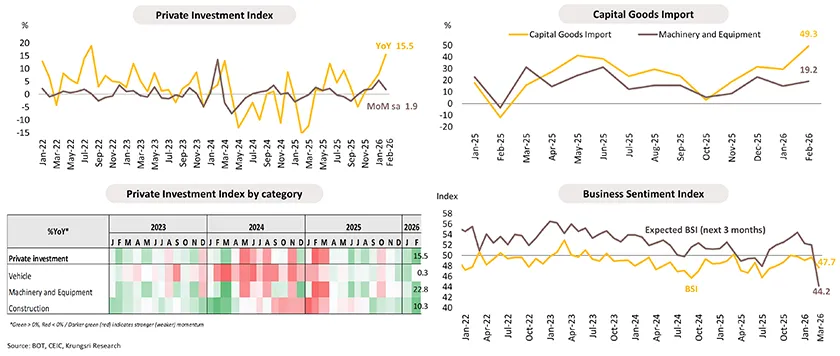
Although the Private Investment Index (PII) surged by 15.5% YoY in Feb-26, supported by strong capital goods imports, forward-looking indicators have weakened. In Mar, the Business Sentiment Index (BSI) declined from 49.6 in Feb to 47.7, while the expected BSI dropped sharply from 52.0 to a sixth-year low of 44.2, reflecting concerns over escalating and prolonged Middle East tensions. Going forward, private investment is expected to be pressured by weak domestic demand, rising geopolitical risks, and uncertainty over U.S. tariff policy.

In Mar-26, Thailand welcomed 2.78 mn foreign visitors, down from 3.26 mn in Feb. As a result, total foreign arrivals in 1Q26 reached 9.32 mn, down from 9.55 mn in 1Q25. While arrivals from most markets have largely recovered to pre-COVID levels, Chinese tourist arrivals in Mar remained well below those levels and declined from the previous month. Escalating tensions in the Middle East, coupled with concerns over transit disruptions and travel safety, are weighing on Western tourist arrivals and slowing growth in other markets. As a result, Krungsri Research has revised down our foreign tourist forecast this year to 32.5 mn from 35.5 mn previously.

In the first two months of 2026, Thai exports grew by 17.0% YoY (based on MOC data), led by Industrial products, which expanded by 21.3% (including precious stones and jewelry, computers & parts, and electrical appliances). However, exports of agro-industrial products decreased by -5.0% (such as sugar, and canned & processed seafood), while agricultural exports also declined by -2.7% (including rubber, rice, and tapioca products). Although the invalidation of the U.S. IEEPA tariffs may provide a temporary boost to exports through front-loading effects, such gains are likely to be short-lived and limited given lingering tariff risks, particularly from ongoing investigations under Section 301. Meanwhile, Thai exports to the U.S. have increased sharply (+41.1% YoY in Feb), coinciding with a notable acceleration in imports from China (+59.7% in the same period). In addition, exports could come under pressure in the period ahead as Middle East tensions lead to higher production costs, raw material shortages, and transportation disruptions.

In the near term, the new government’s immediate measures have been introduced to ease impacts of ongoing Middle East tensions, including (i) fiscal budget support worth THB 3.38 bn (0.02% of GDP) , (ii) soft loans of THB 150 bn (0.78% of GDP), and (iii) other targeted measures. The government is also seeking to create additional fiscal space by reallocating unutilized budgets. However, the overall upside remains constrained by limited fiscal space, persistent structural headwinds, and rising external risks.

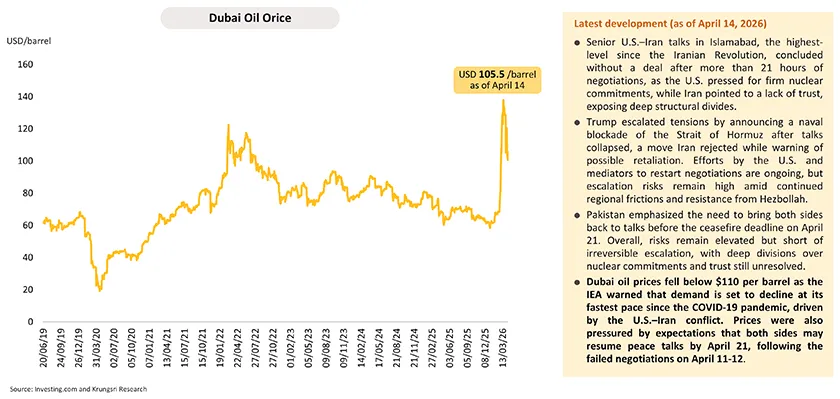
Amid the escalation of geopolitical tensions and uncertainty surrounding the Strait of Hormuz, impacts on the Thai economy are beginning to emerge, as reflected in a sharp increase in retail fuel prices. Even though the pass-through from global oil prices, particularly Dubai crude, has been partially delayed by government price controls, the subsequent rise in retail fuel prices and emerging supply shortages in several key products are likely to intensify inflationary pressures, which would erode purchasing power in the periods ahead. Meanwhile, the Oil Fuel Fund’s position has deteriorated significantly given the recent subsidy measures. Further expansion of such subsidies and other support measures could increase fiscal burdens on an already constrained fiscal position, potentially pushing public debt closer to the statutory ceiling.

Real interest rates – policy rate adjusted for headline inflation – are showing early signs of moderation, indicating some easing in monetary conditions. In Mar-26 headline inflation began to rise, driven mainly by rising energy prices, although the increase was limited by government subsidies. Energy remains the primary contributor, while other components have yet to exhibit broad-based price pressures. Looking ahead, supply shortages in some products, higher electricity charges, and potential increases in key commodity prices are likely to add to inflation pressure. While rising inflation may constrain further monetary policy easing, a rate hike is not warranted given weak domestic demand and a negative output gap, especially as inflation pressures remain largely supply-driven.