
Monthly Economic Bulletin (September 2026)

Monthly Economic Bulletin (September 2026)

17 กันยายน 2569

Global: Striving to maintain growth momentum amid multiple headwinds

Monthly Economic Bulletin
 

Global economy and financial markets confront a twin shock from escalating geopolitical tensions and surging bond yields.

 
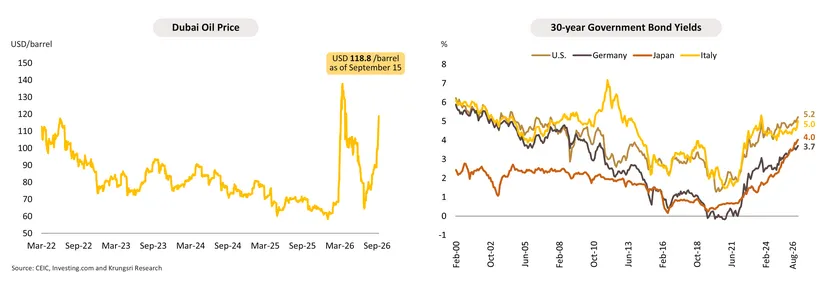
  • Crude oil prices have surged above USD 100 per barrel to a 3-month high during mid-September, as key energy transportation routes in the Middle East face mounting risks. These include the temporary closure of Saudi Arabia’s East-West Pipeline, which accounts for around 4% of global oil supply, and the Houthi forces’ expanding control over several strategically important areas along the Red Sea coast. Prolonged disruptions could further tighten global oil supply and keep energy prices elevated for an extended period.
  • Rising inflation risks from a potentially prolonged Middle East conflict, alongside growing expectations of higher policy rates, AI businesses’ fundraising, and fiscal challenges in several countries, have triggered a global sell-off in bond markets and driven a sharp rise in government bond yields. The sharpest increases in yields have been seen in the US, Germany, Italy, and Japan, with 30-year yields reaching their highest levels in decades. 
  • Higher bond yields will raise financing costs and increase financial market volatility, undermining private-sector confidence and wealth. This could, in turn, dampen business investment and household spending. In addition, rising government interest expenses may further weaken already-fragile fiscal positions and reduce policy space. Together, these developments could pose headwinds to economic growth in the period ahead.

Monthly Economic Bulletin


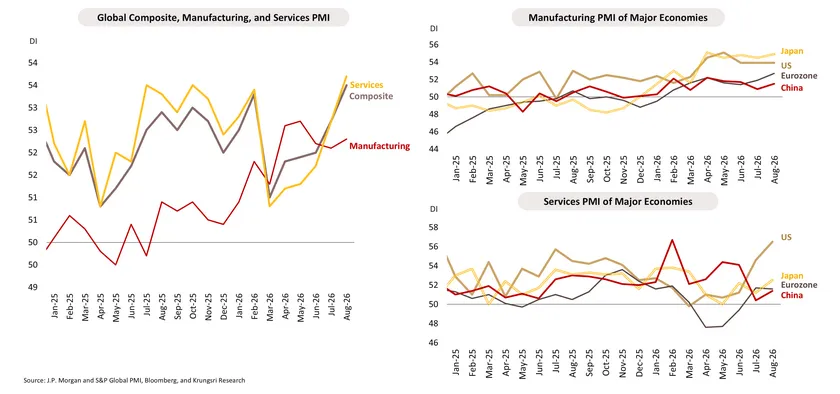
Global activity: Growth remains driven by services, while rising geopolitical tensions, tariff uncertainty, and tighter financial conditions weigh on prospects


Monthly Economic Bulletin  
 

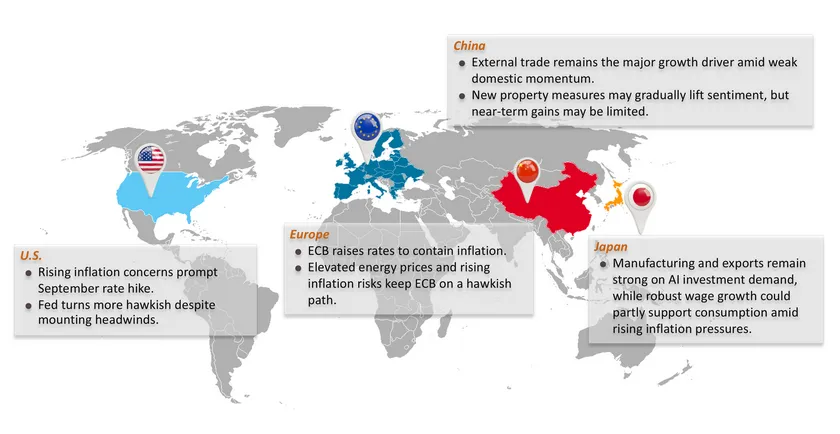
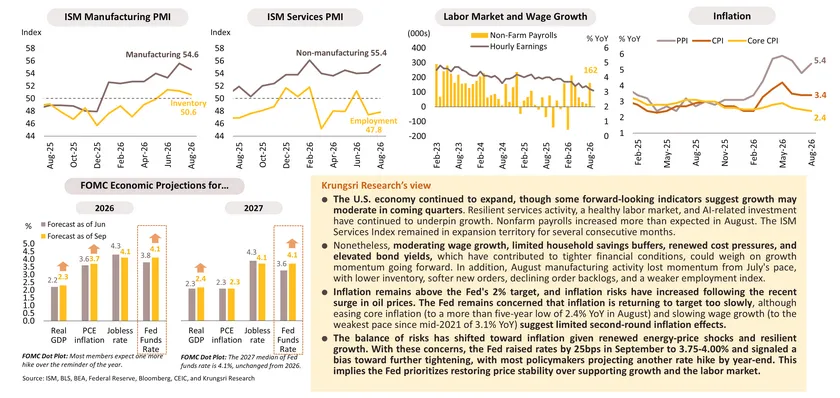
U.S.: Rising inflation concerns prompt September rate hike; Fed turns more hawkish despite mounting headwinds


Monthly Economic Bulletin
 

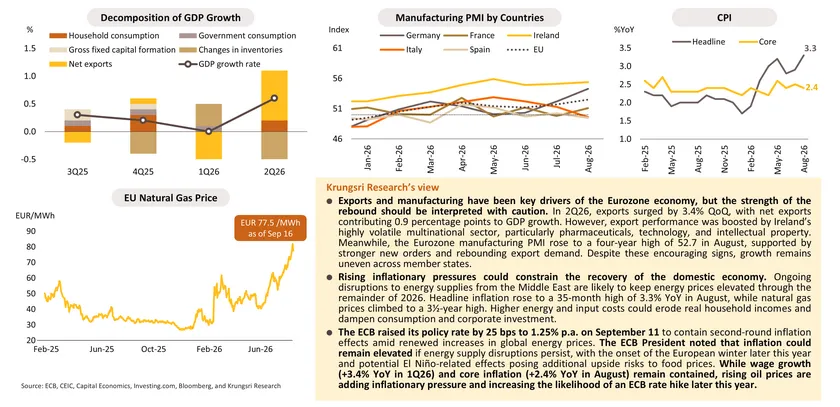
Eurozone: ECB raises rates to contain inflation; elevated energy prices and rising inflation risks keep ECB on a hawkish path.


Monthly Economic Bulletin  
 

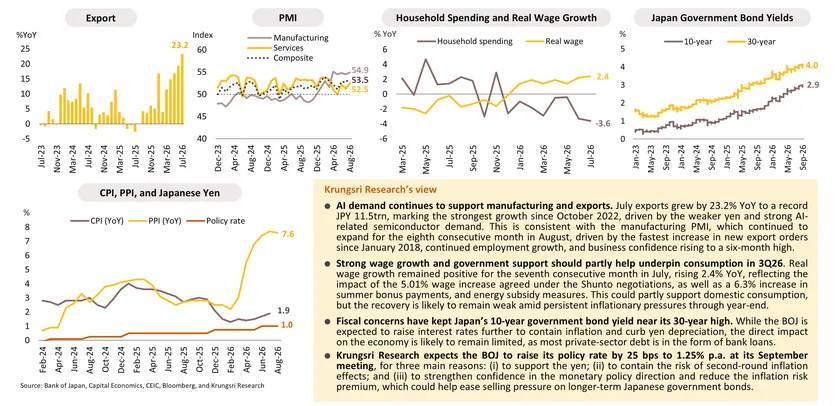
Japan: Manufacturing and exports remain strong on AI investment demand, while robust wage growth could partly support consumption amid rising inflation pressures.


Monthly Economic Bulletin  
 

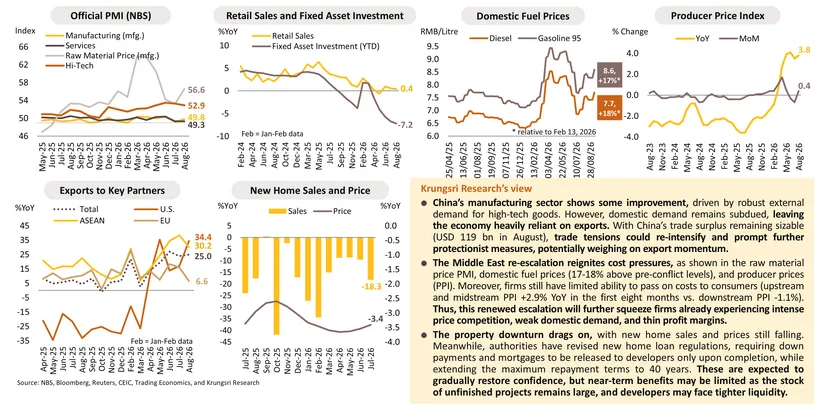
China: External trade remains the major growth driver amid weak domestic momentum; new property measures may gradually lift sentiment, but near-term gains may be limited.


Monthly Economic Bulletin  
 

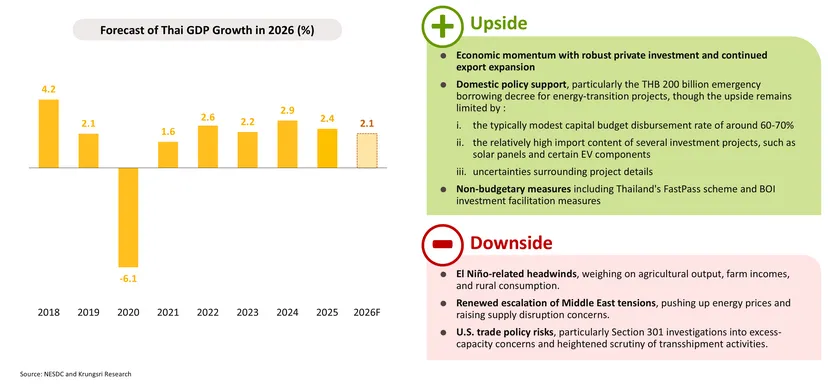
Thailand’s economic outlook is improving, driven by investment momentum and export growth. External headwinds and El Niño pose downside risks.

 
  • 2026 growth outlook has been revised up to 2.1% from 1.9% in the previous forecast, driven by stronger momentum and greater policy continuity, but external headwinds—including renewed Middle East tensions and U.S. tariff uncertainty—along with domestic constraints such as weakening consumption after stimulus measures expire and El Niño risks remain.

  • Regarding economic momentum, private investment outlook is bolstered by BOI-approved projects and rising cumulative FDI, with capital goods imports signaling machinery and equipment investment.

  • Thai export growth may gain further support from the electronics upcycle and AI-driven investment, although growth remains uneven. U.S. tariffs pose downside risks, as Section 301 measures could raise tariffs on Thai goods toward previous reciprocal tariff levels, while the “Great Transshipment Scam” report adds uncertainty over potential additional tariffs on Thailand.

  • Tourism remains a key growth driver. Chinese arrivals improve slightly while long-haul recovery warrants monitoring amid high aviation costs and safety concerns.

  • Stimulus measures are providing a temporary boost to private consumption, but momentum may fade in 4Q26 amid weak incomes and thin financial buffers.

  • El Niño could weigh on growth outlook through lower agricultural output and supply-chain disruptions.

  • Inflation may temporarily exceed the target range in 4Q26. Elevated oil prices and pass-through risks warrant monitoring amid renewed Middle East tensions.

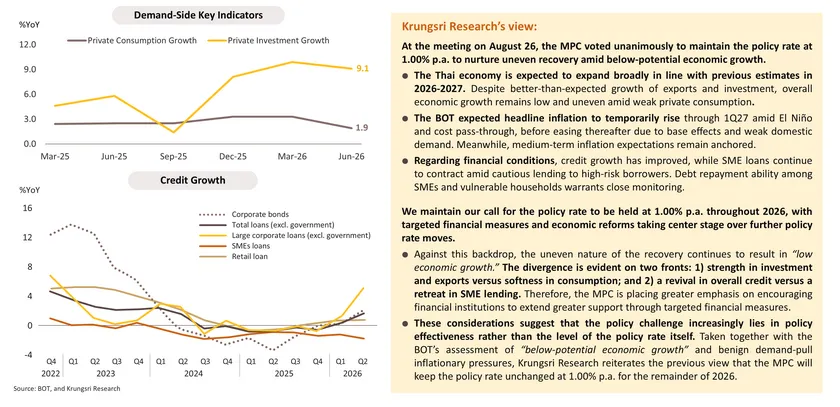
  • MPC voted unanimously to maintain the policy rate at the August meeting. Targeted financial measures and economic reforms are taking center stage over further policy rate moves.


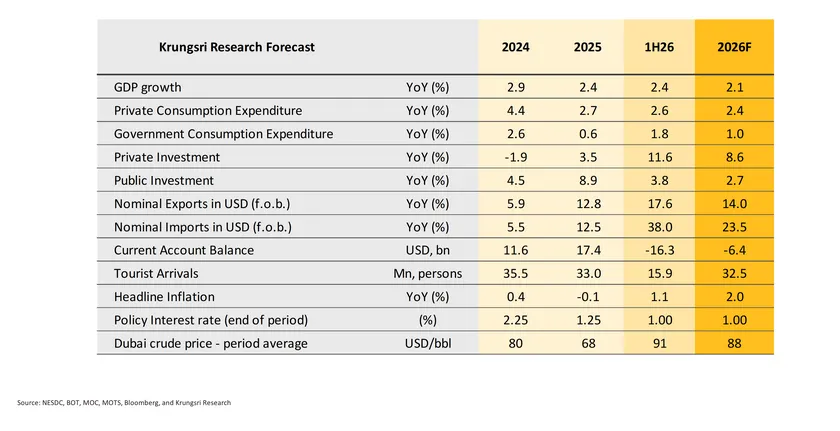
2026 growth outlook has been raised to 2.1% from 1.9% in the previous forecast, driven by stronger momentum and greater policy continuity, but external headwinds remain.


Monthly Economic Bulletin  
 

Krungsri Research Forecasts for 2026


Monthly Economic Bulletin  

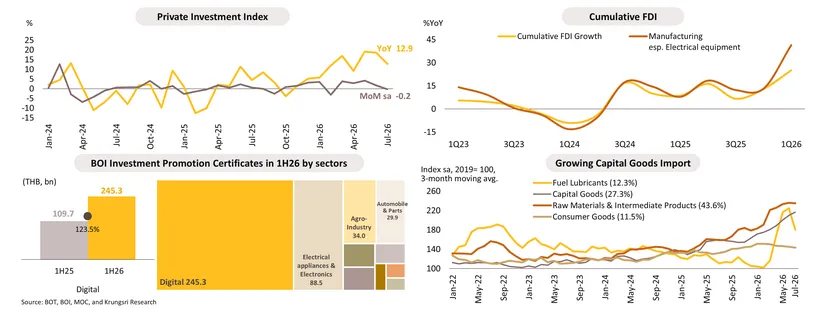
Private Investment outlook is bolstered by BOI-approved projects and rising cumulative FDI, with capital goods imports signaling machinery and equipment investment.


Private investment momentum is expected to be a key growth driver. The Private Investment Index (PII) grew 12.9% YoY in July. Rising cumulative FDI, particularly in manufacturing, is consistent with stronger investment by export-oriented businesses benefiting from the electronics upcycle and data center investment. BOI investment applications continued to surge, with issued investment promotion certificates helping accelerate project realization. Meanwhile, capital goods imports, especially machinery and equipment, continue to signal medium-term investment momentum. Although stricter screening of data center projects to enhance domestic value creation and manage resource use may weigh on near-term investment, it should promote more sustainable growth over the medium to long term. The government is also prioritizing strategic sectors, with short- to long-term plans to increase the total investment to 30% of GDP within three years.


Monthly Economic Bulletin  
 

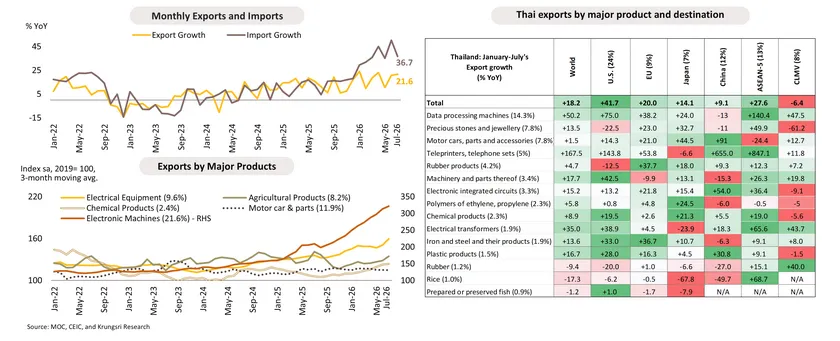
Thai export growth may benefit from the electronics upcycle and AI-driven investment, although growth remains uneven.


Exports were a key growth driver in 1H26 and are projected to continue expanding in 2H26. In July, exports grew by 21.6% YoY vs. 19.3% in June, led by electronics and electrical equipment. For the first seven months, data processing machines recorded strong export growth to the U.S. and ASEAN-5, while motor cars & parts exports to China also expanded strongly. Meanwhile, agro-industrial exports posted a contraction (-3.5% YoY), and agricultural exports declined (-2.5%). Looking ahead, lingering Middle East tensions and weak external demand could further weigh on Thailand’s export growth.


Monthly Economic Bulletin  
 

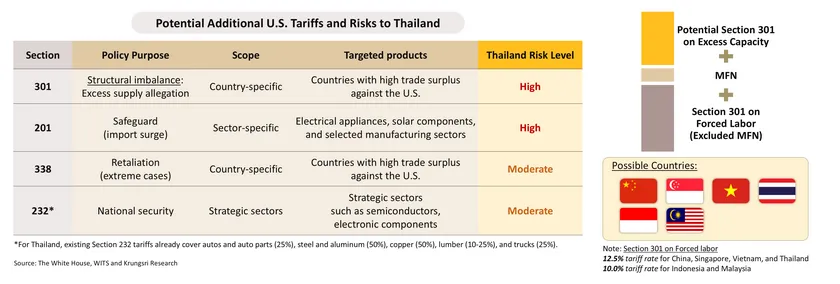
U.S. tariffs pose downside risks, as Section 301 measures could raise tariffs on Thai goods toward previous reciprocal tariff level, while the “Great Transshipment Scam” report adds uncertainty over potential additional tariffs on Thailand.

 
  • Thailand became subject to a 12.5% Section 301 tariff related to forced-labor import concerns when the Section 122 tariff expired, applied on top of the Most-Favored-Nation (MFN) tariff rate, with certain exemptions such as food, fuels, and fertilizers. In addition, ongoing Section 301 investigations into excess production capacity could lead to further tariff increases, posing downside risks to Thai exports, manufacturing, and supply chains. Taken together, these measures could raise Thailand’s effective tariff burden to a level broadly comparable to the previous reciprocal tariff. Across ASEAN, Section 301 measures could have uneven impacts, with Thailand, Vietnam, and Singapore potentially facing the highest tariff rates, followed by Indonesia, Malaysia, and the Philippines.

  • Transshipment-related tariffs remain another ongoing risk. Thailand’s Tier-2 classification in the U.S. “The Great Transshipment Scam” report could amplify risks beyond ongoing Section 301 investigations. Tier 2 includes major transit and manufacturing hubs deeply integrated with China, with greater potential for trade rerouting, including Indonesia, Malaysia, Vietnam, and Thailand.


Monthly Economic Bulletin  
 

Tourism remains a key growth driver. Chinese arrivals improve slightly while long-haul recovery warrants monitoring amid high aviation costs and safety concerns.


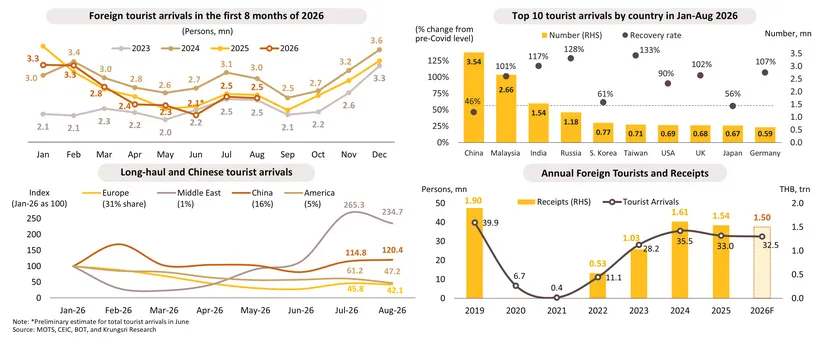
In the first seven months of the year, foreign tourist arrivals totaled 21.2 million, broadly on track to reach our full-year forecast of 32.5 million. In August 2026, arrivals held steady at 2.5 million. Arrivals from the Middle East have surpassed pre-conflict levels, and Chinese arrivals have continued to recover. However, Chinese arrivals remain below pre-COVID levels, weighing on the overall tourism recovery. High airfares and travel safety concerns continue to affect long-haul markets, particularly Europe and the U.S. Looking ahead, the tourism sector continues to be an important growth driver, although its contribution to growth depends on the pace of recovery during the rest of this year.


Monthly Economic Bulletin  
 

Private consumption: Gains from government support are likely to be short-lived; momentum may fade in 4Q26 due to weak incomes and thin financial buffers.


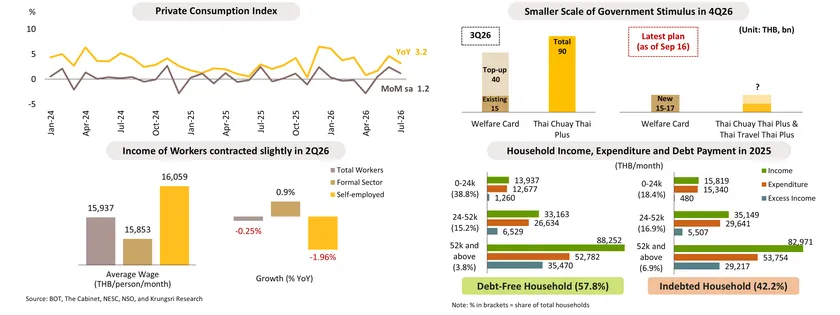
Private consumption is receiving a temporary boost from stimulus measures, but momentum is likely to moderate as these supports fade. Further support will depend on the details of the Thai Chuay Thai Plus scheme in 4Q26 and the potential rollout of Thai Travel Thai Plus next year. With around THB 40bn in budget left, compared with THB 120bn already disbursed, fiscal support for consumption is likely to be more limited. Meanwhile, the growth of Private Consumption Index (PCI) slowed to 3.2% YoY in July from 4.6% in June. Overall income contracted slightly by -0.3% in 2Q26, with self-employed income declining by -2.0%. Financially constrained households (0-24k monthly income) also have limited financial buffers, with only THB 1,260 per month for debt-free households and THB 480 per month for indebted households, leaving them highly vulnerable to future shocks. Therefore, fading stimulus, sluggish income growth, and elevated household debt are likely to weigh on consumption going forward.


Monthly Economic Bulletin  
 

El Niño could weigh on growth through lower agricultural output and supply-chain disruptions.


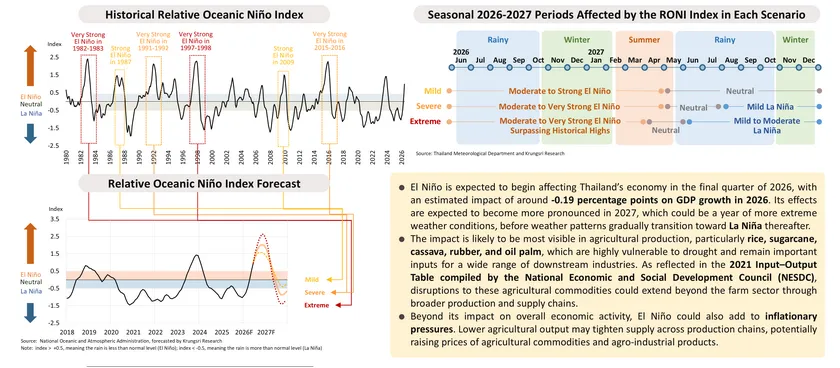
El Niño is expected to affect Thailand from late 2026, with more severe impacts in 2027. It could weigh on GDP through lower agricultural output and supply-chain disruptions, while also adding to inflationary pressures by tightening agricultural and agro-industrial supply.


Monthly Economic Bulletin  
 

Inflation may temporarily exceed the target range in 4Q26; Elevated oil prices and pass-through risks warrant monitoring amid renewed Middle East tensions.


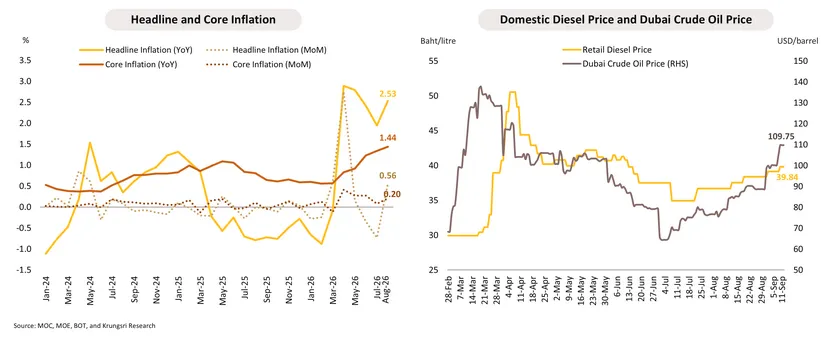
Headline inflation warrants monitoring as global oil prices continue to pose upside risks. In August 2026, headline inflation rebounded to 2.53% YoY from 1.95% in July, driven by higher energy prices amid heightened Middle East tensions. Meanwhile, core inflation continued to rise to 1.44% YoY, although the month-on-month increase was less pronounced than at the onset of the conflict. Further increases in core inflation could be constrained by a potential loss of consumption momentum following fading gains from stimulus measures. Going forward, supply constraints, elevated commodity prices, and El Niño risks could push inflation higher in 4Q26, depending on the conflict’s trajectory. 


Monthly Economic Bulletin  
 

MPC voted unanimously to maintain the policy rate; targeted financial measures and economic reforms taking center stage over further policy rate moves.


Monthly Economic Bulletin  
ประกาศวันที่ :17 กันยายน 2569
ย้อนกลับ
พิมพ์สิ่งที่ต้องการค้นหา