
Monthly Economic Bulletin (June 2026)

Monthly Economic Bulletin (June 2026)

17 มิถุนายน 2569

Global: Mounting Pressure from Middle East Tensions, with Looming Tariff Risks Complicating the Outlook


Monthly Economic Bulletin
 

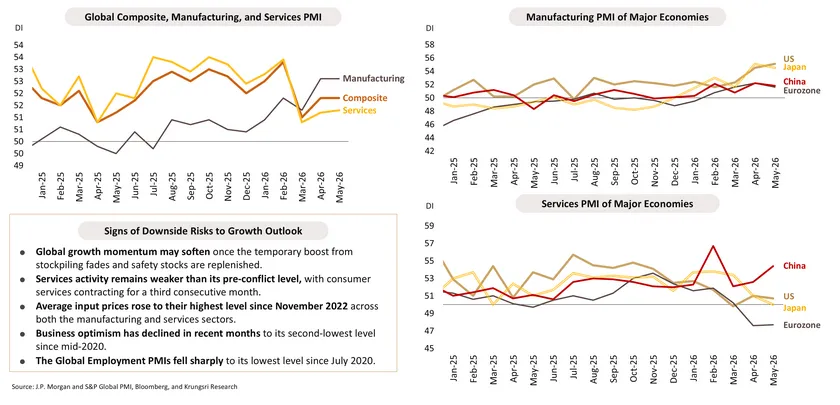
Global growth driven by inventory building ahead of potential supply disruptions; Middle East tensions weaken sentiment and raise risk of slower growth and higher inflation


Monthly Economic Bulletin
 

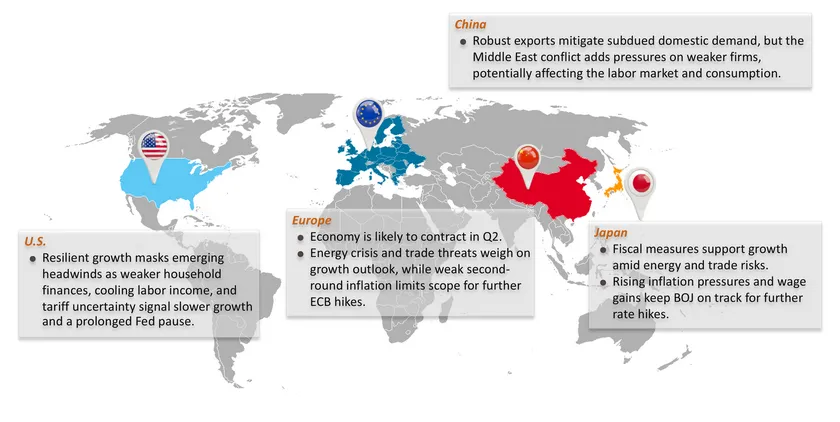
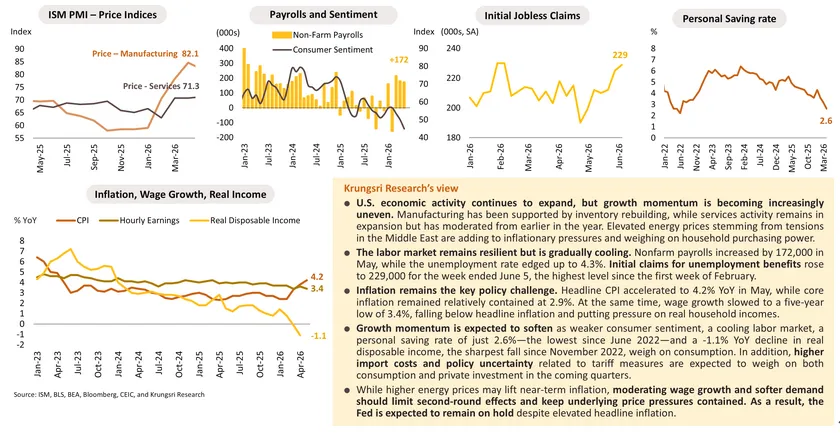
U.S.: Resilient growth masks emerging headwinds as weaker household finances, cooling labor income, and tariff uncertainty signal slower growth and a prolonged Fed pause.


Monthly Economic Bulletin  
 

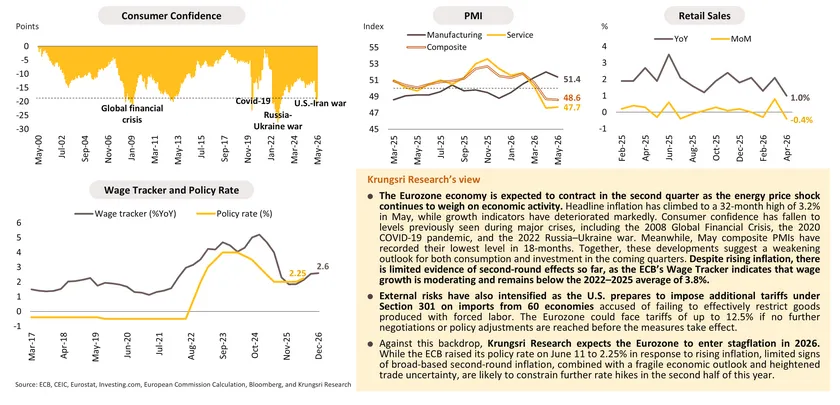
Eurozone: Economy is likely to contract in Q2; energy crisis and trade threats weigh on growth outlook, while weak second-round inflation limits scope for further ECB hikes.


Monthly Economic Bulletin  
 

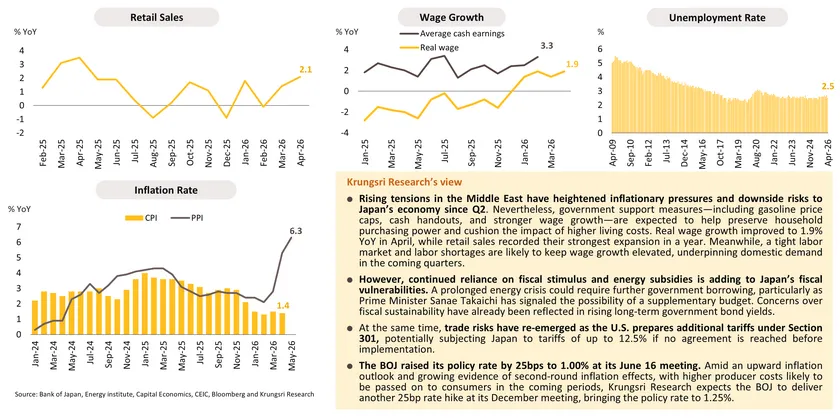
Japan: Fiscal measures support growth amid energy and trade risks; rising inflation pressures and wage gains keep BOJ on track for further rate hikes.


Monthly Economic Bulletin  
 

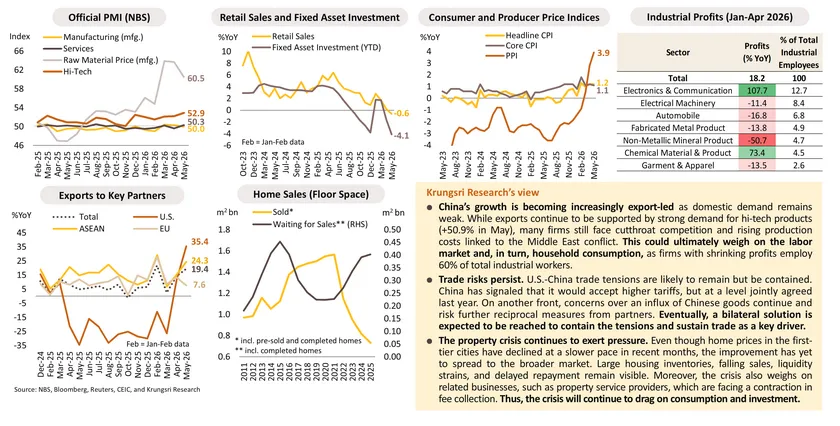
China: Robust exports mitigate subdued domestic demand, but the Middle East conflict adds pressures on weaker firms, potentially affecting the labor market and consumption


Monthly Economic Bulletin  
 

Thailand: Despite stimulus measures supporting growth, Middle East tensions, intensifying tariff risks, and domestic constraints continue to weigh on the economic outlook.

 
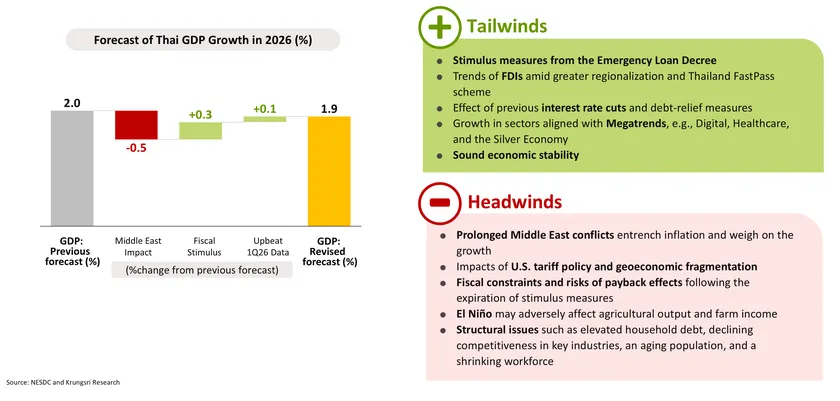
  • For Thailand’s 2026 economic outlook, Krungsri Research expects GDP growth to slow to 1.9% from 2.4% in 2025. Prolonged tensions in the Middle East are expected to weigh on growth, although fiscal stimulus measures and stronger 1Q momentum offer some support.

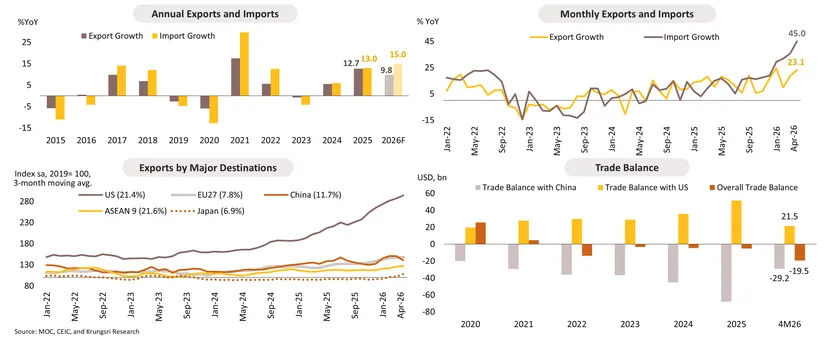
  • Thai exports continue to rise amid front-loading ahead of tariff uncertainty, while surging imports result in a trade deficit. Rising tariff risks may weigh on exports in the periods ahead.

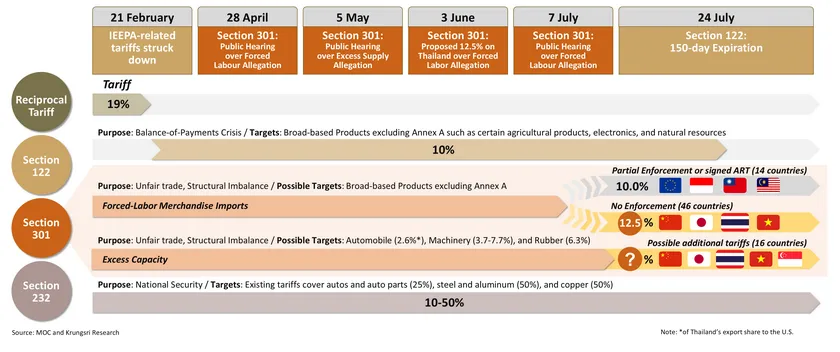
  • U.S. trade policy uncertainty is likely to become a greater headwind in 2H26. Although the temporary 10% Section 122 tariff is scheduled to expire on July 24, Thailand remains exposed to the risk of additional tariffs from Section 301 investigations targeting forced labor concerns and excess production capacity, which could weigh on exports and domestic production.

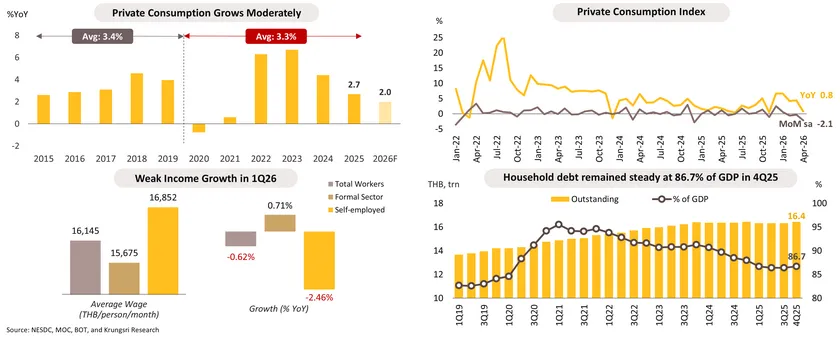
  • Private consumption is temporarily supported by stimulus measures, but higher living costs, weak income growth, and high household debt continue to weigh on spending.

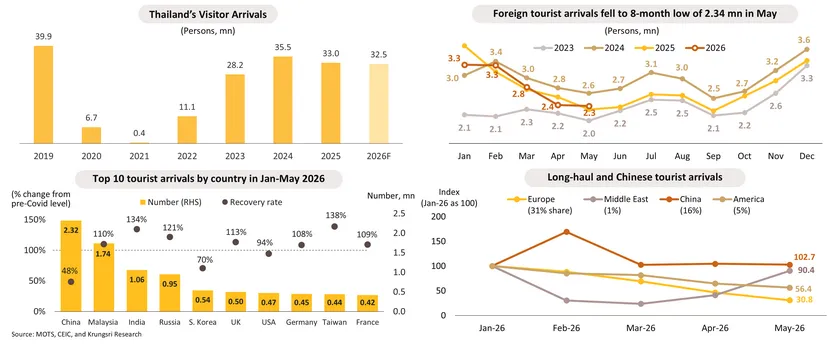
  • Tourism softens amid high aviation costs and safety concerns, particularly among long-haul tourists, despite improving arrivals from the Middle East.

  • Private Investment is moderating amid concerns over prolonged Middle East tensions, although the medium-term outlook shows signs of recovery. Investment and FDI promotion applications continued to gain momentum, supported by strong investor interest in digital and electronics projects.

  • Inflation remains elevated, driven by the impact of Middle East tensions, although limited second-round effects suggest the spike may be temporary.

  • The MPC is likely to keep the policy rate on hold amid a negative output gap, supply-driven inflation, and limited second-round effects.


Thailand’s 2026 economic outlook: Middle East tensions weigh on growth, even as fiscal stimulus and stronger 1Q momentum offer some support.


Monthly Economic Bulletin  
 

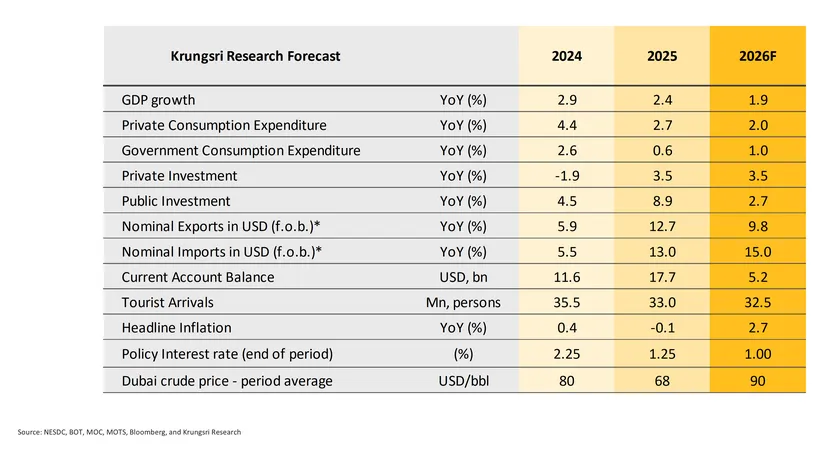
Krungsri Research Forecasts for 2026


Monthly Economic Bulletin  
 

Thai exports continue to rise amid front-loading ahead of tariff uncertainty, while surging imports result in a trade deficit. Rising tariff risks may weigh on exports in 2H26.


Exports expanded by 23.1% YoY in April, while imports surged by 45.0%. Export growth was driven by key products such as electronic machinery and electrical equipment. Exports to key major markets – including the U.S., EU27, Japan, and ASEAN – also expanded. Although the invalidation of the U.S. IEEPA tariffs may temporarily support exports through the front-loading effect, the upside is likely to be short-lived with the ongoing Section 301 investigation alongside prolonged Middle East tensions and weak global demand. As a result, Thailand faces higher risks of slower exports and a weaker trade surplus this year.

Monthly Economic Bulletin  
 

U.S. Trade Policy Uncertainty: Beyond forced-labor import-related Section 301 risks, Thailand also faces excess capacity investigations as the temporary Section 122 measure nears expiry.


While the temporary Section 122 measure (imposing 10% tariff) expires on July 24, Thailand continues to face risks from potential U.S. tariff measures, including a proposed 12.5% Section 301 tariff linked to forced labor concerns over goods imported. Indonesia, Malaysia, and Taiwan are subject to 10% tariffs due to some forced labor import prohibition or signed Agreement on Reciprocal Trade (ART). Furthermore, the additional Section 301 investigations into excess production capacity could leave Thailand facing higher tariffs, weighing on exports, manufacturing activity, and supply chains.

Monthly Economic Bulletin  
 

Private consumption temporarily supported by stimulus measures, but higher living costs, weak income growth, and high household debt continue to weigh on spending.

 
Broadly, private consumption continues to show weak momentum. In the short term, the Private Consumption Index (PCI) slowed to 0.8% YoY in April from 4.4% in March, mainly due to weaker spending on non-durable goods following earlier front-loaded fuel purchases. Meanwhile, average wages of Thai workers fell by -0.6% YoY in 1Q26, with wages among self-employed workers declining sharply by -2.5%. Looking ahead, the Thai Chuay Thai Plus measures may provide temporary support to domestic spending during Jun–Sep, but higher living costs, weak income growth, elevated household debt, and potential payback effects after the stimulus expires are expected to constrain consumption.

Monthly Economic Bulletin  
 

Tourism softens amid high aviation costs and safety concerns, particularly among long-haul tourists, despite improving arrivals from the Middle East.


Krungsri Research expected a 2026 forecast of 32.5 mn foreign tourist arrivals, as the trend has begun to moderate. In May 2026, Thailand welcomed 2.34 mn foreign visitors, slightly down from 2.36 mn in April. While arrivals from most markets have largely recovered already, Chinese tourist arrivals in the first five months of this year remained at less than half of the pre-COVID levels. Arrivals from the Middle East recovered to the pre-conflict level, but long-haul arrivals, particularly from Europe and the U.S., would still be weighed by elevated aviation costs and concerns over transit disruptions and travel safety.  

Monthly Economic Bulletin  
 

Private Investment is moderating amid concerns over prolonged Middle East tensions, although the medium-term outlook shows signs of recovery.


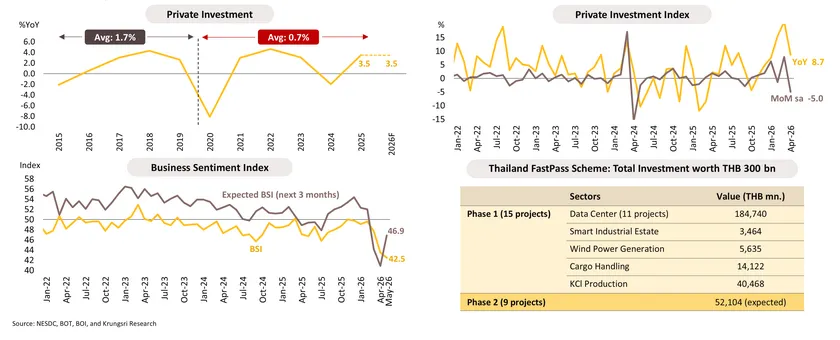
Although the Private Investment Index (PII) grew at a slower pace by 8.7% YoY in April, compared with 20.8% in March, forward-looking indicators have begun to improve, with the expected BSI rebounding strongly to 46.9 in May, reflecting businesses’ gradual adjustment to higher costs and positive sentiment amid policy continuity and improving political stability. In addition, Thailand FastPass Phase 1 secured over THB 240 bn in investment value, while Phase 2 is expected to attract another THB 52 bn, providing medium-term support for investment. Nevertheless, the investment growth could be limited by headwinds from soft domestic demand, escalating geopolitical tensions, and uncertain U.S. tariff policies.

Monthly Economic Bulletin  
 

Investment and FDI promotion applications continued to gain momentum, supported by strong investor interest in digital and electronics projects.


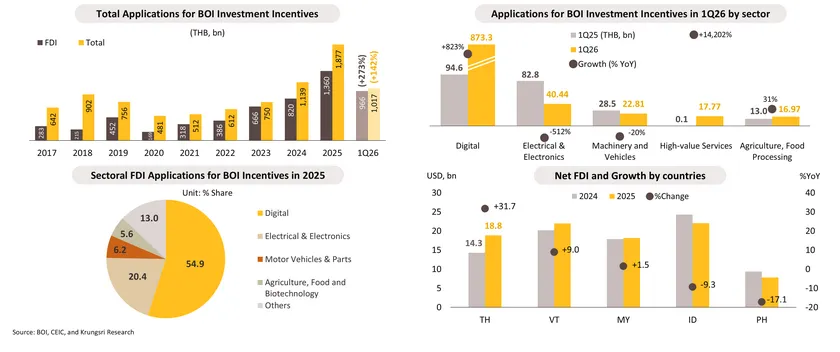
BOI investment applications reached THB 1.02 trn in 1Q26, surging 142.4% YoY, driven mainly by data centers and cloud services. FDI applications for BOI incentives rose to THB 966 bn (+273%), led by Singapore, the U.K., and Japan. Although the investment value of BOI-approved projects fell by -43% to THB 330 bn amid the election period, promoted certificates—which are more closely linked to actual investment—rose strongly by 62% to THB 383 bn. Together with the Thailand FastPass scheme, these developments signal a promising medium-term outlook for domestic investment, supported by the digital and electronics upcycle and the China+1 trend.

Monthly Economic Bulletin  

Inflation remains elevated, driven by the impact of Middle East tensions, although limited second-round effects suggest the spike may be temporary.


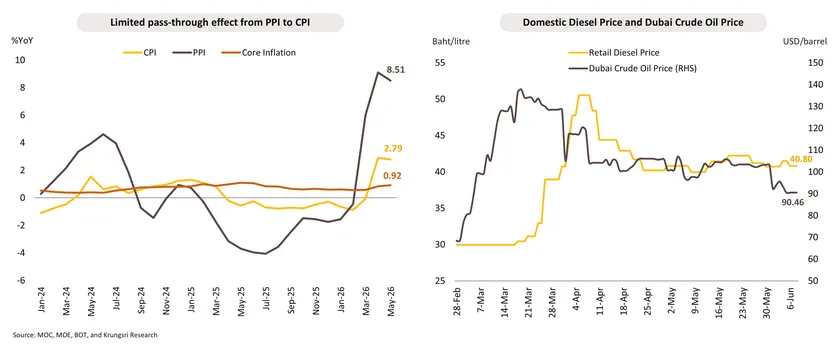
In May 2026, headline inflation eased slightly to 2.79% from a record-high 2.89% in April, driven mainly by domestic fuel prices in line with global oil prices, alongside food and public transport costs. Looking ahead, supply shortages, higher electricity charges, rising commodity prices, and government stimulus measures could temporarily push inflation above the BOT’s target range from 2Q26 onward. However, the sharper rise in PPI relative to CPI suggests limited cost pass-through to consumers, while stable core inflation signals limited second-round effects. 

Monthly Economic Bulletin  

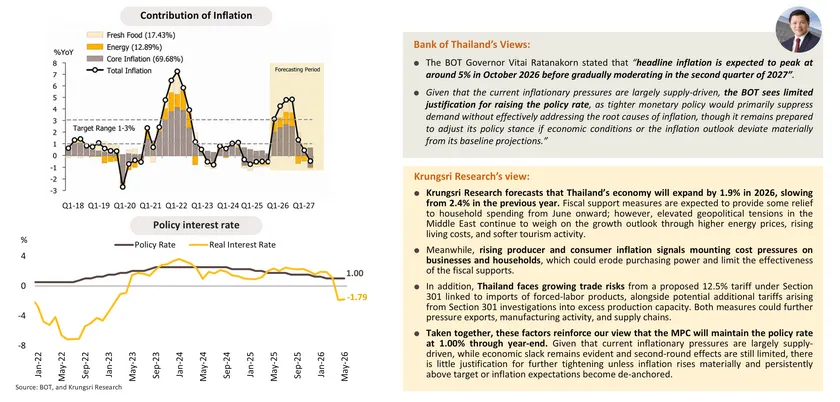
MPC is likely to keep the policy rate on hold amid a negative output gap, supply-driven inflation, and limited second-round effects.


Monthly Economic Bulletin  


ประกาศวันที่ :17 มิถุนายน 2569
ย้อนกลับ
พิมพ์สิ่งที่ต้องการค้นหา