Introduction
Today, the world is undergoing structural shifts across multiple dimensions simultaneously, from the fragmentation of the global economy and the emergence of a new world order to changes in society and people's mindsets, technological advances, and environmental challenges. Together, these forces represent major “megatrends” that will shape the future direction of economies and businesses. At the same time, they can create new opportunities for organizations that are able to recognize emerging signals of change and adapt their strategies in a timely manner.
As uncertainty increasingly becomes the norm, competitive advantage may no longer belong solely to large organizations or those with early access to technology. Instead, organizations that are agile and able to adapt quickly, while developing strategies and products that respond to the evolving needs of modern consumers, will be better positioned to compete. Commercial banks will also play an important role in supporting this transition by developing financial products, services, and solutions aligned with these megatrends, enabling businesses and individuals to navigate change, pursue growth, and move confidently and sustainably into the future.
Understanding Megatrends: Key Forces Shaping the Future
What Are Megatrends?
Megatrends are large-scale structural shifts that unfold gradually over time and have far-reaching, long-term impacts on economies, societies, technology, and the environment worldwide.1/ These shifts influence people's behavior, reshaping both lifestyles and ways of working, while also significantly transforming industry structures, supply chains, and business practices. Businesses therefore need to understand the direction of global megatrends in order to adapt, identify new revenue opportunities, and prepare for potential risks arising from a changing business environment.
A Closer Look at Three Megatrends Reshaping the World
While megatrends encompass changes across a wide range of dimensions, this article focuses on three key megatrends that will play an important role in shaping the future direction of the economy and business sector:
Megatrend 1: A New World Order Amid Growing Global Fragmentation
Today, the world is facing heightened volatility from multiple overlapping challenges. The COVID-19 pandemic disrupted supply chains across numerous industries, exposing vulnerabilities in global production systems that rely heavily on a single production base or market, particularly China. Meanwhile,
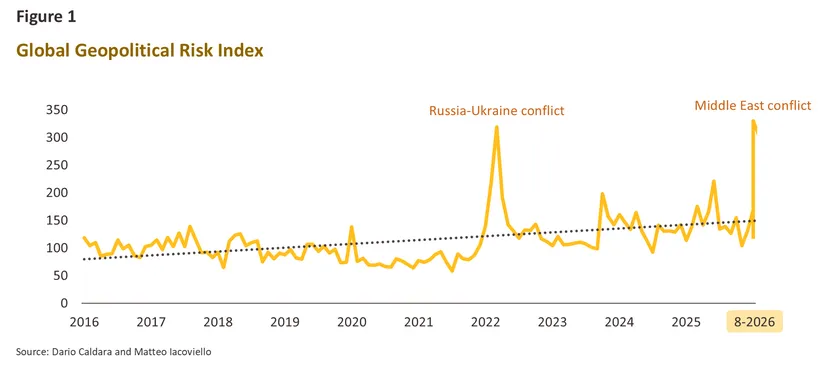
geopolitical conflicts in various regions have periodically intensified, leading to economic sanctions against certain countries (such as Russia) and putting pressure on key production inputs, including oil and natural gas. This is reflected in the Global Geopolitical Risk Index (GPR Index),
2/ which has remained on an upward trend, particularly since 2022
3/ (Figure 1). In addition,
the trade war has remained a major issue on the global economic agenda following the US imposition of reciprocal tariffs in 2025, which affected more than 180 countries and territories worldwide, although the tariffs were subsequently struck down by the courts.
4/ These developments are becoming part of the longer-term global landscape and are contributing to the emergence of a new world order, particularly in international trade.
These dynamics are driving the world towards an increasingly multipolar order, prompting countries to strengthen supply chain resilience and contributing to a rebalancing of the global trade order between the traditional economic powers led by the United States and emerging economies led by China. PwC5/ projects that by 2050, the E7 economies, i.e., China, India, Brazil, Russia, Indonesia, Mexico, and Türkiye, will account for 50% of global GDP. As a result, the existing trade order is likely to weaken, while the world that once prospered under globalization, characterized by trade liberalization, geographically dispersed supply chains, and a strong emphasis on maximizing production efficiency at the lowest possible cost, is shifting towards a landscape of increasingly fragmented supply chains, known as “the great decoupling.” At the same time, stronger protectionist trade measures are prompting manufacturers to relocate more production to their home countries or allied economies. This shift is likely to raise production costs and have significant implications for the direction of global trade in the years ahead.
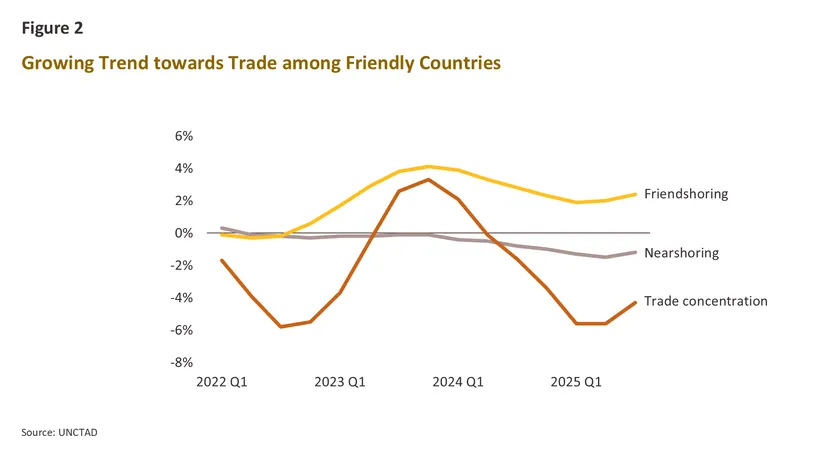
These developments are prompting multinational companies to accelerate strategic adjustments, placing greater emphasis on supply chain flexibility, security, and resilience by seeking new locations for their operations. Key strategies include (1) gradually relocating production to allied countries (friendshoring) or closer to end markets (nearshoring) to diversify sources of raw materials and goods (supply diversification) and reduce reliance on a limited number of production hubs. This is particularly important for strategic manufacturing industries that require highly resilient supply chains, such as semiconductors and electronics, as well as the automotive industry (Figure 2). (2) Companies are also placing greater emphasis on building regional trade and investment networks (regionalization) to establish new partnerships with economically stable markets. McKinsey6/ notes that the number of regional and bilateral trade agreements has increased by nearly one-third since 2017, reflecting a growing focus on intraregional trade to mitigate the impact of tighter tariff measures and expand access to new markets. (3) Companies are also taking advantage of trade and investment incentives that encourage them to relocate investment and production back to their home countries (reshoring). At the same time, several economies in Asia and Latin America (including Vietnam, Mexico, Indonesia, and India) have benefited by becoming key destinations for multinational investment and production relocation, as well as from increased orders, supported by the China+1 strategy, friendshoring, and nearshoring trends described above.
Megatrend 2: Shifts in Society and People’s Mindsets (New Societal Mindset)
Global structural changes extend beyond the economy to encompass shifts in people’s mindsets, values, and expectations about how they live. These shifts are giving rise to a new societal mindset that places greater emphasis on resilience, well-being, and a good quality of life over the long term. One key driver is the transition towards an ageing society. The United Nations (UN) projects that by 2050, the global population aged 65 and above will reach 1.6 billion, equivalent to one in six people worldwide. In some countries, including Japan, South Korea, and Italy, older people will account for more than one-third of the total population, compared with around one-quarter today.
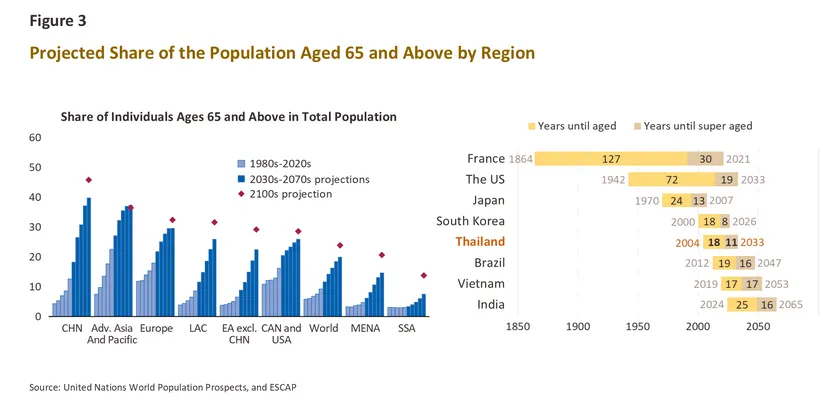
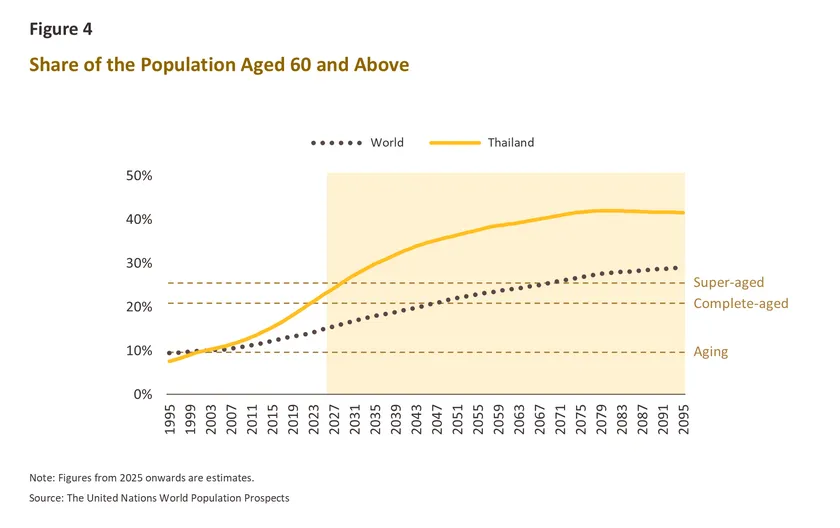
For Thailand, it took less than 20 years to transition from an ageing society to a “complete-aged society” in 2023, when the share of people aged 60 and above exceeded 20% of the total population. Thailand is expected to take only another 10 years to become a “super-aged society” by 2033, when people aged 60 and above will account for more than 25% of the total population. This would be well above the global average of 16.1% (Figure 4). Thailand’s transition is also expected to be faster than that of any other country except South Korea, which is projected to take no more than eight years. In contrast, the number of births in Thailand has continued to decline. According to World Bank data,7/ Thailand’s fertility rate stood at an average of 1.2 births per woman in 2024, below the global average of 2.2 births per woman.
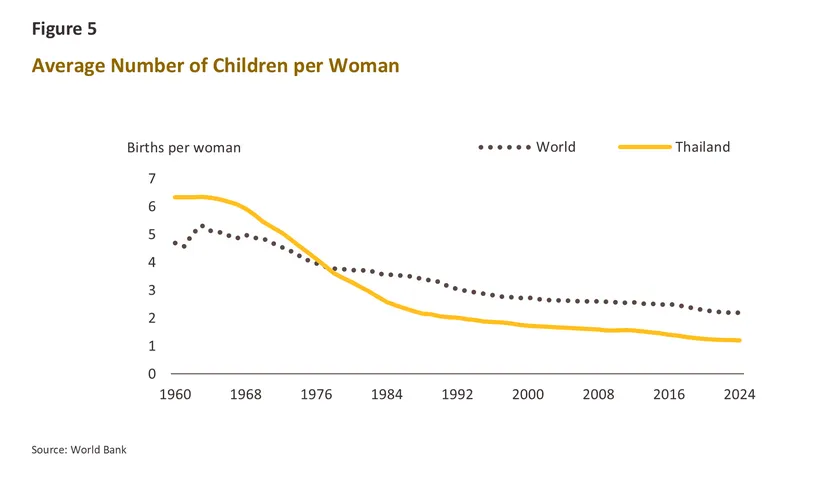
The transition towards a fully aged society, alongside the growing share of Gen Y and Gen Z in the workforce, is driving changes across multiple dimensions.
The first dimension is a shift towards a more balanced lifestyle. The 2025 Workmonitor survey8/ found that workers worldwide placed greater importance on work-life balance (83%) than on pay (82%) for the first time in the survey’s 22-year history. Gen Z and Gen Y, in particular, prioritize quality of life, workplace flexibility, and alignment between their jobs and personal values. In addition, 83% of respondents want their workplace to provide a sense of community and belonging, while 55% would be willing to leave their jobs if they felt they did not belong. This reflects how a balanced lifestyle has become an important consideration for businesses, encompassing employees, organizational culture, and products and services that respond to these changing ways of life.
The second dimension is a shift towards more mindful and purposeful spending, with consumers placing greater emphasis on value for money, quality, and health, while becoming more deliberate in their spending decisions. According to The 1 Insight (December 2025),9/ Thai consumers are increasingly becoming mindful spenders, with a stronger focus on (i) value-oriented spending. Gen Y and Gen Z tend to prioritize niche brands and products that reflect their identity, while families with children view certain spending as an investment, such as skills development courses and educational toys. Gen X and Baby Boomers, meanwhile, tend to spend on preventive health to support longevity, including vitamins and dietary supplements, fitness, and wellness spas. Another key priority is (ii) health & wellness-driven choices, as consumers across all age groups are placing greater importance on “health.” This is reflected in significant growth in purchases of healthy food and beverages, vitamins and dietary supplements, fitness products, and beauty and wellness products.
The third dimension is the growing importance of living a healthy and fulfilling life for longer, which has become a key goal for people worldwide. The wellness economy, which supports holistic health and a balanced lifestyle, is expected to grow rapidly, with its global market value projected to reach USD 9.8 trillion by 2029, up from USD 6.8 trillion in 2024, representing average annual growth of 7.6%.10/ In addition, longevity is gaining momentum as people increasingly focus on maintaining both physical and mental well-being and extending their healthy lifespan (health span). This includes proactive healthcare, such as annual health check-ups with more in-depth assessments of genetics, hormones, and antioxidants to support personalized healthcare, alongside purposeful living, such as pursuing hobbies, to improve overall quality of life over the long term and maintain independence into old age. Market Research Future11/ projects that the global longevity economy12/ will reach USD 66.4 billion by 2035, up from USD 32.2 billion in 2025. In Thailand, research by the College of Management Mahidol University (CMMU)13/ found that people across all generations are placing greater importance on health. Gen Z is the most open to adopting and experimenting with new health-related products and services, while Gen Y places the greatest emphasis on disease prevention, and Gen X shows the strongest interest in longevity services and the highest willingness to spend.
Megatrend 3: Technology and the Environment: Opportunities Accompanied by Risks (New Enablers and Risks)
Rapid technological advances, particularly in artificial intelligence (AI), together with climate change and its impacts on the global environment, represent both enablers and risks. These forces will shape the future direction of businesses as well as how people and society adapt in the years ahead, as follows:
- Technology Reshaping Business: Opportunities Accompanied by Challenges
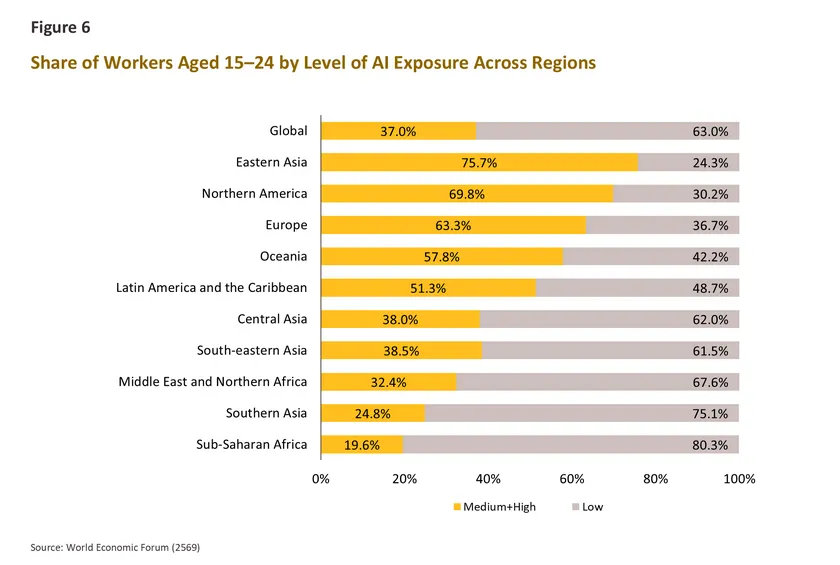
Advances in artificial intelligence (AI) and automation are key forces reshaping businesses, transforming workforce structures while simultaneously improving operational efficiency. A 2026 World Economic Forum report indicates that work is likely to shift from primarily relying on human labor towards greater collaboration between people, AI, and automation.14/ Technology will increasingly take on tasks that require speed, accuracy, and the processing of large volumes of data, while humans will play a greater role in tasks requiring judgment and accountability, particularly in setting strategic goals, managing unexpected situations, and overseeing automated systems. From a workforce perspective,15/ entry-level workers face a higher risk of automation replacing tasks such as data processing, document summarization, and work involving repetitive or clearly defined processes. The report finds that 37% of young workers worldwide are at risk of being displaced by AI, with the highest risk in East Asia (75%), followed by North America (69%) and Europe (63%) (Figure 6). The occupations most likely to be affected include those in financial services, information and communications, and education, while workers in agriculture, construction, and restaurants are expected to face less disruption because these jobs require physical skills and human interaction. However, the WEF notes that replacing human labor with technology could affect the development of mid- and senior-level talent, creating a long-term strategic risk that may be overlooked.
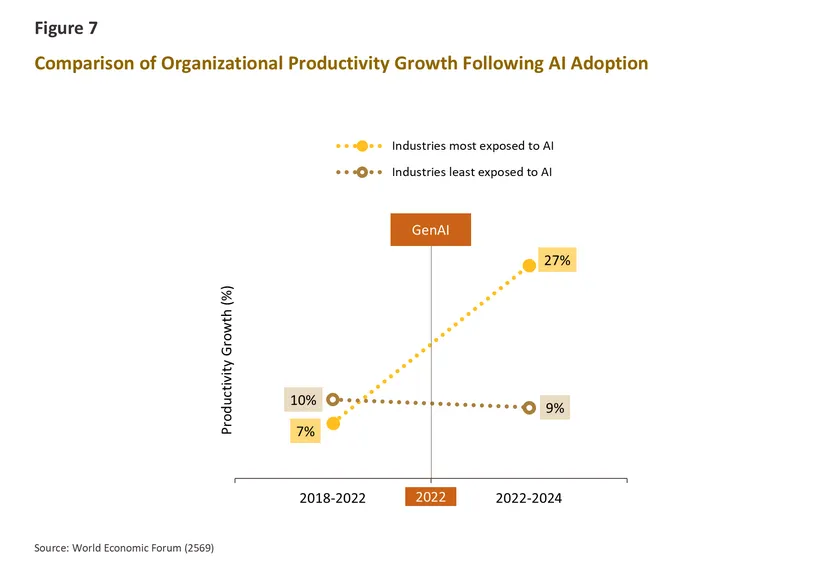
The adoption of technology can also help improve organizational productivity. However, the pace of productivity gains varies across organizations. This divergence has become particularly evident since 2022, when AI began to be widely adopted. Organizations with high levels of AI adoption have experienced faster productivity growth, while productivity among those with low AI adoption has remained largely unchanged. This indicates that technology can provide a significant productivity advantage. Organizations that are slower to adapt are therefore likely to have lower productivity than those that adapt more quickly, which could ultimately affect their competitiveness over the medium to long term (Figure 7).
However, technological advances may also bring growing cybersecurity risks. The Global Cybersecurity Outlook 2026 found that cyber-enabled fraud has become the top concern among senior executives, overtaking ransomware, which ranked first in 2025. This is followed by AI-related vulnerabilities and the exploitation of software vulnerabilities. Cyber-enabled fraud is estimated to cost the global economy around USD 1.1 trillion annually, equivalent to approximately 3% of global GDP, while one in three organizations still lacks a process for assessing AI security before deployment. This highlights that organizations seeking to use technology to strengthen their competitive advantage should invest in governance and security at the same time, ensuring that technology is adopted appropriately, carefully, and to its fullest potential.
- Environmental Change Reshaping the World: A Crisis Accompanied by Opportunities
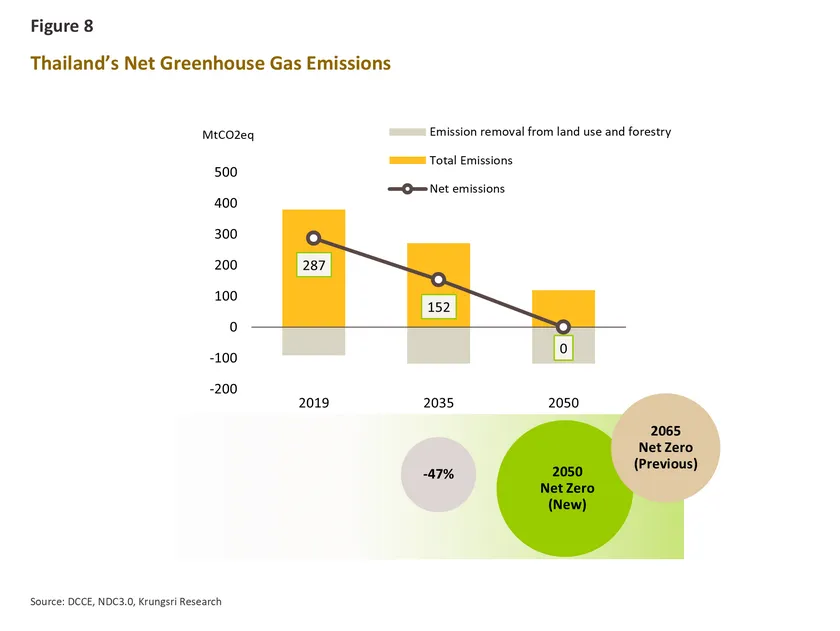
Climate change is creating growing challenges for businesses worldwide, which face physical risks from increasingly severe natural disasters, such as major floods and droughts, that can directly disrupt supply chains, as well as transition risks arising from increasingly stringent environmental regulations. In Thailand, efforts to accelerate the response to climate change are gaining momentum. In 2025, the Thai government brought forward its target for achieving net-zero greenhouse gas emissions to 2050 (Net Zero 2050), 15 years earlier than originally planned, to align with global trends.16/ As a result, Thai businesses need to accelerate efforts to reduce greenhouse gas emissions from their production processes and adopt more environmentally friendly business practices. However, the transition to a green economy (green transition) requires substantial investment, which is likely to increase business operating costs.
However, beyond these risks, accelerating efforts to address climate change can also create new business opportunities related to sustainability. These include clean energy businesses, technologies that help reduce greenhouse gas emissions, and ESG advisory services, as well as opportunities in the financial sector. Commercial banks, in particular, play an important role in supporting the business sector’s transition by developing green financial products, such as green loans and green bonds.
Amid rapid technological advances and intensifying environmental challenges, organizations that can adapt quickly; for example, by building supply chains that are more resilient to natural disasters or aligning their business strategies with the transition towards a low-carbon economy, will be better positioned to capture new business opportunities. In particular, they may gain greater access to sustainable finance, which can broaden their financing options, strengthen their competitiveness in global markets, and support a sustainable transition into the emerging business landscape.
Krungsri Research View: Implications for Businesses
Implications for Businesses Adapting to the New World Order
The McKinsey Global Survey conducted in November 2025
17/ identified geopolitical instability as a key risk to business growth, ranking above economic volatility and technological change. As global supply chains are rerouted, a new world order is emerging. Businesses therefore need to consider a range of geopolitical scenarios in an increasingly multipolar world to identify opportunities and build competitive advantages that can support sustainable growth. Key areas of supply chain management that businesses should prioritize include:
- Diversifying Risk Across Regional Partner Networks
Businesses need to rethink their approach to supply chain risk management, shifting away from a traditional focus on cost reduction through inventory management or reliance on a small number of major suppliers towards building more flexible supply chains by diversifying sources of raw materials and suppliers across regional partner countries. This can help reduce the risk of supply chain disruptions and maintain production continuity. Countries likely to benefit from this trend include
Vietnam, which offers competitive labor costs and has FTAs with many countries;
Thailand and Malaysia, which have strong capabilities in electronics, automotive, and advanced components;
Indonesia, which has critical minerals for the battery and EV industries;
Mexico, which serves as a manufacturing base close to the US market; and
India, which has a large domestic market and policies supporting local manufacturing. Companies adopting this approach include Apple and Samsung, which have diversified their production bases from China to India and Vietnam, while Intel has expanded its semiconductor manufacturing operations in Vietnam and Malaysia.
- Seeking New Production Bases in Politically Neutral Countries
Relocating production to countries that remain neutral amid geopolitical tensions between major powers is creating opportunities for ASEAN, which offers a range of structural advantages. These include large economies that can serve as both consumer markets and sources of labor, supported by a regional population with an average age of just 31 years, as well as abundant natural resources. Most ASEAN countries also offer government investment incentives and are strategically located close to major production hubs such as China, while remaining within easy reach of key consumer markets across Asia.
18/ These advantages can help reduce risks arising from the fragmentation of the global economy. For example, Google has shifted some Pixel production from China to Vietnam, while Foxconn has expanded investment in India and Vietnam to diversify production away from China.
Implications for Businesses Adapting to Changes in Society and People’s Mindsets
This new societal mindset will drive demand for new and increasingly sophisticated categories of products and services, particularly those related to holistic health and well-being. These range from healthy food and beverages and self-care consumer products to real-time health monitoring technologies, medical services, and financial management services. Businesses therefore need to rethink their product development strategies and move beyond traditional approaches, as follows:
- Developing Products and Services That Create Value for Consumers
Consumers are increasingly choosing products and services based on the “value” they provide in meeting different needs, rather than on functionality alone. They are also willing to pay more for products and services that enhance their experiences or improve their quality of life. For example, consumers may buy running shoes to support a healthier lifestyle or use home cleaning services to free up more time for rest or activities they enjoy. Businesses should therefore shift their strategies away from competing primarily on product features towards developing offerings that deliver greater value in terms of quality, value for money, and user experience. This can help differentiate them from competitors, increase customer satisfaction, and support sustainable business growth over the long term.
- Building Brands That Feel Reassuring and Approachable
At a time when consumers face growing stress and uncertainty,
peace of mind and trust are becoming increasingly important factors influencing purchasing decisions.19/ Brands that communicate openly and provide transparent information throughout the entire process, i.e., from the sourcing of raw materials and production processes to quality standards, pricing, and service terms, can convey a sense of honesty and sincerity to consumers. This can help differentiate their products from competitors and foster long-term customer loyalty (brand loyalty).
- Reaching Consumers in an Increasingly Technology-Driven Era
The way modern consumers purchase products and services is changing. Consumers are increasingly using AI to help search for and select products and services tailored to their individual needs. As a result, AI is becoming an intermediary that helps filter information and increasingly influences purchasing decisions. Businesses should therefore adapt their strategies by designing content across digital platforms in ways that align with how AI processes information, known as Generative Engine Optimization (GEO), to increase brand visibility and strengthen their competitive advantage.
20/ In health and quality of life, advances in AI, genomics, biotechnology, digital health, and wearable devices are enabling more personalized healthcare. This creates opportunities for businesses to develop tailored health products that meet the needs of consumers who increasingly prioritize well-being and quality of life.
Implications for Businesses Adapting to Technological and Environmental Change
Technological advances and growing environmental challenges are significantly reshaping business operations and the long-term competitive landscape. Businesses should accelerate their strategic adjustments to maintain competitiveness and prepare for the emerging business environment, as follows:
- AI Is Becoming Essential for Every Organization
Rapid advances in AI are accelerating adoption across businesses worldwide, making human-AI collaboration a new standard in the business world. Surveys by the Stanford AI Index
21/ and McKinsey
22/ in March 2025 found that the share of organizations using AI in at least one business function increased from 55% to 78–88% within one year. However, maximizing the benefits of AI requires organizations to develop workforce skills and redesign ways of working alongside AI adoption. In addition, the widespread use of AI within organizations is making AI governance and compliance policies increasingly important. Organizations need to establish clear AI governance frameworks to manage risks related to data, privacy, and cybersecurity. This will enable them to unlock the full potential of AI while maintaining trust and credibility in their business operations over the long term.
- Using AI and Automation in Supply Chain Management
Advanced technologies are playing an increasingly important role in supply chain management. Technologies such as blockchain, artificial intelligence (AI), and automation can help businesses forecast demand, manage inventory, and conduct real-time quality inspections, thereby improving production efficiency. They can also identify potential risks across the supply chain, enabling businesses to respond to uncertainty in a timely manner. In addition, these technologies are important tools in the transition towards more environmentally friendly and sustainable production processes. McKinsey
23/ finds that AI can improve demand forecasting accuracy by 20–50%, reduce inventory costs by 10–15%, and cut stockouts by up to 30%.
24/ This highlights the important role of technology in strengthening the long-term competitiveness of businesses.
- Prioritizing Measures to Address Climate Change
Extreme climate events are becoming more severe and frequent, including heatwaves, heavy rainfall, floods, and severe droughts. These events expose businesses to supply chain disruptions, higher production costs, and interruptions to business operations.
Climate risk management should therefore become an integral part of long-term corporate strategy, ranging from diversifying raw material sources towards lower-risk areas and spreading production across multiple locations to investing in infrastructure that can withstand extreme weather events, such as flood protection systems, backup power systems, and water management systems. These measures can help minimize losses from unexpected events and maintain business continuity.
- Environmental Regulations Will Become Key Compliance Requirements
Environmental requirements are increasingly being elevated into standards and regulations that businesses must comply with, including sustainability disclosures, greenhouse gas emissions reporting, and limits on carbon emissions from production processes. Environmental considerations will increasingly affect access to consumer markets and financing, as well as the ability to maintain relationships with business partners.
Businesses therefore need to develop systems for collecting and disclosing environmental data in line with internationally recognized sustainability standards in order to maintain their competitiveness.
In the future, the competitive advantage of businesses, including commercial banks, may no longer be determined by organizational size or the number of branches, but by their ability to adapt to change faster than their competitors. This also includes the ability to develop products and services that meet customers’ emerging needs and respond promptly to the evolving global landscape. However, the most important priority for businesses will remain building “confidence and trust” among customers, which forms a fundamental foundation for almost every type of business, including banking.
References
Thai
SD Thailand. (2025). “The 1 Insight เผยผู้บริโภคไทยเปลี่ยนพฤติกรรม หันมาเลือกซื้ออย่างมีสติ” Retrieved September 3, 2026, from The 1 Insight เผยผู้บริโภคไทยเปลี่ยนพฤติกรรม หันมาเลือกซื้ออย่างมีสติ - Mindful Consumption Trend ชู “คุณค่าที่ได้รับ” และ “สุขภาพ” เป็นตัวขับเคลื่อนหลัก | SD Thailand
Talk About Market. (2025). “CMMU เปิดอินไซต์ Longevity Economy ชี้ “ชีวิตยืนยาว – สุขภาพดี” มาตรฐานใหม่ของ ความลักชูรี่” Retrieved September 4, 2026, from CMMU เปิดอินไซต์ Longevity Economy ชี้ “ชีวิตยืนยาว - สุขภาพดี” มาตรฐานใหม่ของ “ความลักชูรี่” - Talk About Market
English
Caldara, D. & Iacoviello, M. (2026). “Geopolitical Risk (GPR) Index” Retrieved September 1, 2026, from Geopolitical Risk (GPR) Index
Global Wellness Institute. (2025). “2025 Global Wellness Economy Monitor” Retrieved September 3, 2026, from 2025 Global Wellness Economy Monitor - Global Wellness Institute
IEEPA Tariff Recovery. (2026). “IEEPA Reciprocal Tariffs: Which Countries Were Affected and What's Refundable” Retrieved October 5, 2026, from IEEPA Reciprocal Tariffs: Which Countries Were Affected and What's Refundable | IEEPA Tariff Recovery
Krungsri Research. (2025). “ASEAN’s Investment Appeals under Trump 2.0: Resilient or Vulnerable?” Retrieved September 9, 2026, from ASEAN’s Investment Appeals under Trump 2.0: Resilient or Vulnerable?
Leenoi, P. (2025). “Decoding the Thailand Taxonomy: How Classification Drives Sustainable Business” Retrieved September 11, 2026, from Decoding the Thailand Taxonomy
Leenoi, P. (2026). “Net Zero 2050: Turning Thailand’s Ambition into Action” Retrieved September 7, 2026, from Net Zero 2050: Turning Thailand’s Ambition into Action
Market Research Future. (2026). “Longevity Market (2026 - 2035)” Retrieved September 4, 2026, from Longevity Market Type, Size, Growth & Global Trends 2035
McKinsey & Company. (2022). “AI-driven operations forecasting in data-light environments” Retrieved September 10, 2026, from Stronger forecasting in operations management—even with weak data | McKinsey
McKinsey & Company. (2025). “Beyond the headlines: How trade agreements are reshaping business” Retrieved September 2, 2026, from How trade agreements are reshaping global business landscape | McKinsey
McKinsey & Company. (2025). “Leading amid geopolitical upheaval: Five imperatives for today’s CEOs” Retrieved September 8, 2026, from Five imperatives for CEOs amid geopolitical uncertainty | McKinsey
Menke, B. (2025). “Megatrends-At A Glace” Retrieved September 1, 2026, from Megatrends ⇒ Understanding Future Changes | 4strat
Mingsakul, P. (2026). “Agentic Commerce: When AI Shops on Our Behalf” Retrieved September 9, 2026, from Agentic Commerce: When AI Shops on Our Behalf
PwC. (2026). “The long view: How will the global economic order change by 2050?” Retrieved September 2, 2026, from World in 2050: How will the global economic order change by 2050? : PwC Greece
Singla, A. & Sukharevsky, A. et. al. (2025). “The state of AI: How organizations are rewiring to capture value” Retrieved September 10, 2026, from the-state-of-ai-how-organizations-are-rewiring-to-capture-value_final.pdf
Slesarenko, A. (2025). “AI Agents in Supply Chain Management: Automating Inventory and Demand Forecasting” Retrieved September 11, 2026, from AI Agents in Supply Chain: Inventory and Forecasting Automation
Stanford University. (2025). “The 2025 AI Index Report” Retrieved September 10, 2026, from The 2025 AI Index Report | Stanford HAI
Workmonitor. (2026). “The great workforce adaptation” Retrieved September 3, 2026, from Discover Randstad's Workmonitor 2026: Insights into the Future of Work
World Bank. (2026). “Fertility rate, total (births per woman) – Thailand” Retrieved September 2, 2026, from Fertility rate, total (births per woman) - Thailand | Data
World Economic Forum. (2026). “Artificial Intelligence and the Future of Entry-Level Work: A Framework for Safeguarding and Reinventing Early Career Pathways” Retrieved September 4, 2026, from World Economic Forum
World Economic Forum. (2026). “Human Machine Collaboration in Industrial Operations: Activation Playbook” Retrieved September 4, 2026, from World Economic Forum
1/ Source: Megatrends: Understanding Future Changes | 4strat
2/ The Global Geopolitical Risk Index measures the level of geopolitical risk worldwide based on the number of articles published in leading newspapers each month that refer to geopolitical tensions, such as wars, terrorism, and international conflicts.
3/ Source: Geopolitical Risk (GPR) Index | Matteoiacoviello
4/ Source: IEEPA Reciprocal Tariffs: Which Countries Were Affected and What's Refundable | IEEPA Tariff Recovery
5/ Source: World in 2050: How will the global economic order change by 2050? | PwC
6/ Source: How trade agreements are reshaping global business landscape | McKinsey & Company
7/ Source: Fertility rate, total (births per woman) – Thailand | World Bank
8/ Source: Discover Randstad's Workmonitor 2026: Insights into the Future of Work | Randstad
9/ Source: The 1 Insight Reveals a Shift in Thai Consumer Behavior toward Mindful Spending – Mindful Consumption Trend Driven by “Value” and “Health” | SD Thailand
10/ Source: 2025 Global Wellness Economy Monitor | Global Wellness Institute
11/ Source: Longevity market (2026-2035) | Market Research Future
12/ The Longevity Economy refers to an economic system driven by longer lifespans and the pursuit of a better quality of life, creating demand for products, services, and innovations that support health, well-being, and financial security throughout the life course.
13/ Source: CMMU Reveals Insights into the Longevity Economy, Highlighting “Longer Life and Better Health” as the New Standard of “Luxury” | Talk About Market
14/ Source: Human Machine Collaboration in Industrial Operations: Activation Playbook | World Economic Forum
15/ Source: Artificial Intelligence and the Future of Entry-Level Work: A Framework for Safeguarding and Reinventing Early Career Pathways | World Economic Forum
16/ More details can be found at Net Zero 2050: Turning Thailand’s Ambition into Action | Krungsri Research
17/ Source: Five imperatives for CEOs amid geopolitical uncertainty | McKinsey & Company
18/ More details can be found at ASEAN’s Investment Appeals under Trump 2.0: Resilient or Vulnerable? | Krungsri Research
19/ Source: Global Consumer Trends 2026 | Euromonitor International
20/ Source: Agentic Commerce: When AI Shops on Our Behalf | Krungsri Research
21/ Source: The 2025 AI Index Report | Stanford
22/ Source: the-state-of-ai-how-organizations-are-rewiring-to-capture-value_final.pdf | McKinsey & Company
23/ Source: Stronger forecasting in operations management—even with weak data | McKinsey & Company
24/ Source: AI Agents in Supply Chain: Inventory and Forecasting Automation | OneReach.ai