Introduction
Energy Storage Systems (ESS) represent a cornerstone technology for balancing electricity supply and demand. These systems can be categorized into five primary types based on their operational mechanisms: Chemical (converting electricity into clean fuels), Mechanical (utilizing kinetic or potential energy), Electrical (direct charge storage), Thermal (accumulation of heat or cold), and Electrochemical (batteries)—the latter of which currently plays the most prominent role in the industry.
The global ESS market is expanding steadily, driven by accelerating electricity demand and the rising penetration of renewable energy. Lithium-ion batteries remain the dominant technology due to rapidly declining costs. However, Long-Duration Energy Storage (LDES) technologies, such as Flow Batteries and Thermal Energy Storage, are gaining strategic importance to support discharge durations exceeding 8 hours.
In Thailand, the ESS market is poised for exponential growth in alignment with the draft Power Development Plan (PDP), particularly through solar-plus-storage projects incentivized by Partial-firm PPA contracts. Krungsri Research identifies significant challenges ahead, specifically the substantial investment required for Grid Modernization and the development of regulatory frameworks. Key milestones, such as the implementation of the Third-Party Access (TPA) Code, will be crucial for unlocking liberalized electricity trading and steering the nation toward its Net Zero emissions target.
Introduction to Energy Storage Systems
What is an Energy Storage System?
An Energy Storage System (ESS) is a pivotal technology for managing the equilibrium between energy supply and demand through a mechanism known as time-shifting. The system functions by capturing surplus energy during periods of low demand (off-peak/surplus) and discharging it back into the grid during peak demand intervals. This process not only mitigates power system fluctuations but also enhances the overall flexibility and security of the electrical grid. Ultimately, ESS ensures that energy resources are utilized at their maximum efficiency around the clock.
Types Energy Storage System
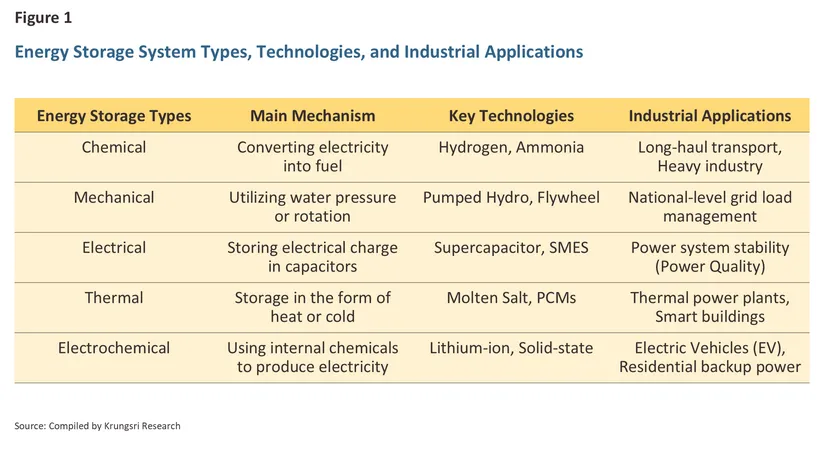
At present, energy storage technologies can be categorized into five primary types based on their operational mechanisms and technical properties:
-
Chemical Energy Storage: This technology involves converting electrical energy or other energy forms into chemical bond energy through electrolysis to produce clean fuels, such as Green Hydrogen or Ammonia1/. Its defining strength lies in its capacity for long-duration storage and its transportability, making it ideal for heavy transport sectors and hard-to-abate industries.
-
Mechanical Energy Storage: This category stores energy in the form of potential or kinetic energy. A key example is Pumped Hydro Storage (PHS)2/, which holds the largest share of global energy storage capacity due to its immense storage volume. It also includes Flywheel systems, which utilize high-speed rotation to provide near-instantaneous grid balancing between power supply and demand.
-
Electrical Energy Storage: This involves storing electrical charges directly within electric or magnetic fields without relying on chemical reactions. Examples include Supercapacitors, which are characterized by their ability to charge and discharge rapidly within seconds. These are particularly suited for voltage regulation, maintaining grid stability, and protecting industrial equipment from power surges.
-
Thermal Energy Storage: This technology stores energy in the form of temperature, whether as heat or cold. It utilizes materials with high thermal heat capacity, such as Molten Salt or Phase Change Materials (PCMs). Common applications include storing surplus heat from concentrated solar power plants for nighttime electricity generation and storing cooling energy to manage large-scale air conditioning systems during peak demand periods.
-
Electrochemical Energy Storage: This stores electrical energy through chemical reactions within batteries, most notably Lithium-ion technology. As the leading technology for electric vehicles (EVs) and residential storage, it is favored for its high energy density and precise response. Its compact siz e relative to other technologies makes it highly convenient for installation in both vehicles and residential buildings.
The Evolving Roles of Energy Storage Systems: Present and Future
Beyond enhancing the stability and security of the traditional grid, the primary roles of energy storage systems, both currently and in the future, are focused on three emerging dimensions:
-
Renewable Energy Stability: Energy storage is at the heart of managing the intermittency of solar and wind power. It serves to transform volatile energy sources into a dispatchable and continuous supply by capturing surplus energy during peak production periods and discharging it back into the grid when natural resources are limited, such as at night or during periods of low wind. Acting as a large-scale energy reserve, it not only minimizes the wastage of clean energy but also serves as a critical engine for scaling up the share of renewable energy in alignment with the nation’s sustainable Net Zero Emissions targets.
-
Enhancing Distributed Energy Resources (DER): The power system structure is transitioning from a traditional centralized model, where users are passive consumers, toward a decentralized network driven by prosumers who can produce and manage their own energy. Amidst surging electricity demand from the electrification of the automotive and industrial sectors—which poses challenges to timely grid expansion and requires massive investment—energy storage has emerged as a key solution for building flexibility. By orchestrating real-time energy from prosumers' solar panels and batteries to support the grid during peak demand, energy storage systems mitigate pressure on main transmission lines and reduces the need for costly reserve power plants, ensuring the existing grid operates at maximum efficiency and sustainability.
-
Driving the EV Ecosystem: Energy storage systems are a vital mechanism for supporting the increased electricity demand arising from the expansion of electric vehicles. This includes the development of Vehicle-to-Grid (V2G) technology, which will further enhance grid flexibility and create additional revenue streams for vehicle owners in the future.
The Current Situation
Overall Industry Growth
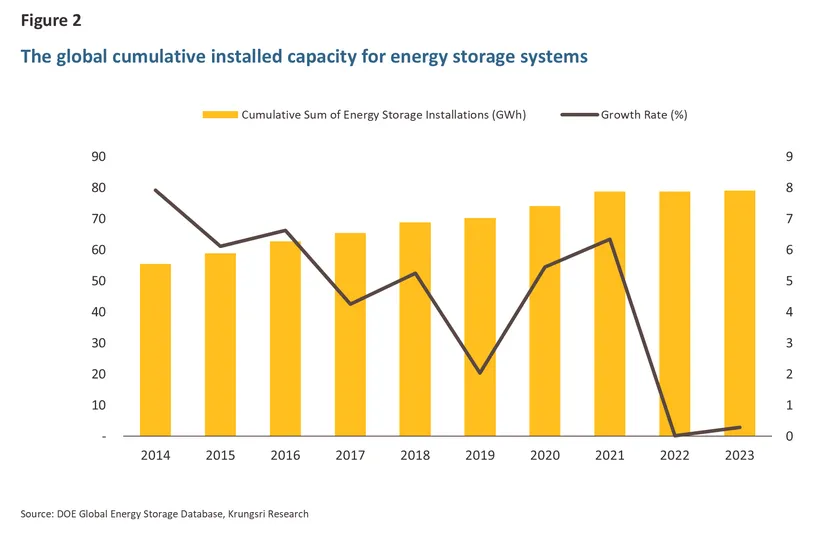
During the 2014-2023 period, the global cumulative installed capacity for energy storage systems expanded at a compound annual growth rate (CAGR) of approximately 4.0%. This growth was driven by four key supporting factors:
- Accelerating Global Electricity Demand (Global Electrification Trend): Global electricity demand in 2024 is projected to accelerate by 4.3%, significantly higher than the average growth rate of 2.7% observed during 2010-2023. The primary drivers include (1) residential electricity demand, which is expected to expand more than fourfold from the 2024 base—stimulated by heatwaves in China and India increasing cooling needs, alongside the rapid expansion of data centers to support AI technology—and (2) demand from modern industrial sectors, particularly within clean energy supply chains such as solar panel, battery, and electric vehicle (EV) manufacturing. In this context, energy storage systems have become a crucial component in load management, optimizing efficiency to balance and support the rapid surge in electricity consumption across all sectors.
- Higher Renewable Energy Penetration: The share of global electricity generation from renewable sources has expanded significantly, rising from around 10% in the past to 32.1% in 2024, with solar energy being a major contributor. However, the primary limitation of renewable energy is its high intermittency, which directly impacts grid stability. Consequently, energy storage systems have become indispensable infrastructure, ensuring a steady and continuous supply of renewable power while minimizing the wastage of surplus clean energy.
- Rising Demand for Grid Resilience and Ancillary Services: Energy storage systems are increasingly utilized as backup power to mitigate power outages and blackouts, which are becoming more severe. Data from the EIA indicates that the average duration of power outages in the US increased from 3.5 hours in 2013 to over 7 hours in 2021. As grid volatility rises, energy storage plays a vital role in frequency regulation to maintain stability and prevent minor disruptions from escalating into large-scale grid collapses.
- Growing Popularity of Distributed Energy Resources (DER): Distributed generation and off-grid systems are growing in line with the trend toward decentralization. These systems are installed near the point of consumption and rely primarily on renewable energy. Energy storage acts as the heart of these systems, transforming volatile energy sources into reliable power supplies, especially in areas where main transmission infrastructure is unreachable. This is reflected in the cumulative global capacity of off-grid solar photovoltaic (PV) storage systems, which grew at an average rate of 16.5% between 2015 and 2024.
Technological Dimension Analysis
When analyzing the technology mix, Pumped Hydro Storage (PHS) remains the most stable and mature technology in the market. It dominates the industry with a cumulative installed capacity of over 777.1 GWh, accounting for approximately 91% of total global energy storage capacity in 2023. However, its growth has been modest, averaging only 0.4% annually since 2014.
In contrast, Electrochemical Energy Storage, particularly the battery segment, has emerged as the fastest-growing technology over the past decade. While its current cumulative capacity stands at 15.7 GWh, it has achieved a remarkable CAGR of 22.7%, rising from just 2.5 GWh in 2014.
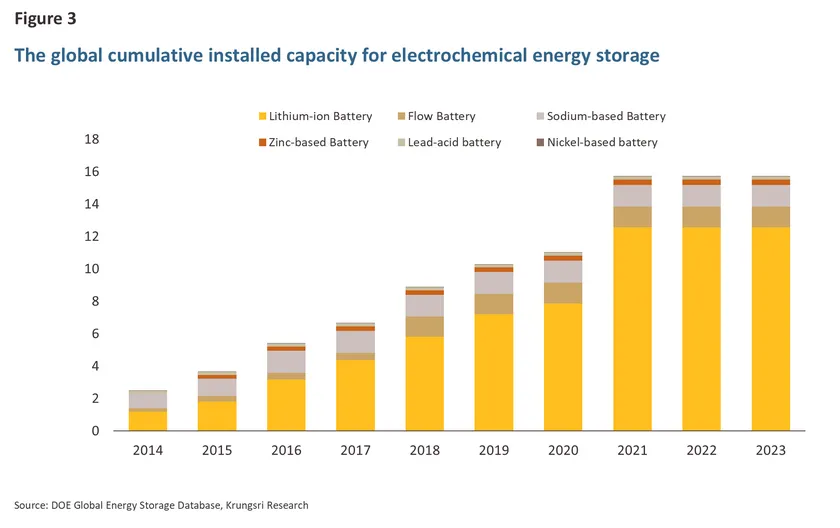
Lithium-ion batteries have become the primary technology within the electrochemical group, representing over 80% of its cumulative capacity. This surge is driven by the continuous decline in the costs of Lithium-ion battery cells and packs over the last ten years. Prices plummeted from USD 475/kWh in 2015 to USD 108/kWh in 2025, representing an average annual decline of -13.8%. This price reduction is largely attributed to significant global overcapacity; in 2024, global production capacity reached 2,600 GWh, more than double the actual demand of 950 GWh. Furthermore, rapid leaps in technical efficiency—specifically the ability to extend discharge durations from 4 hours to 6-8 hours—have enhanced Lithium-ion’s competitiveness against other Long-Duration Energy Storage (LDES) systems. Consequently, demand for Lithium-ion batteries has seen significant expansion across all sectors.
Industry Outlook
Bloomberg NEF forecasts that the global cumulative installed capacity of energy storage systems will surge to 7.3 TWh by 2035—an eightfold increase compared to 2025 levels, representing a robust CAGR of approximately 23%. Over the next decade, Lithium-ion batteries will remain the primary engine of the industry, serving both the electric vehicle (EV) sector and stationary storage markets. This dominance is underpinned by economies of scale, which continue to drive down battery costs.
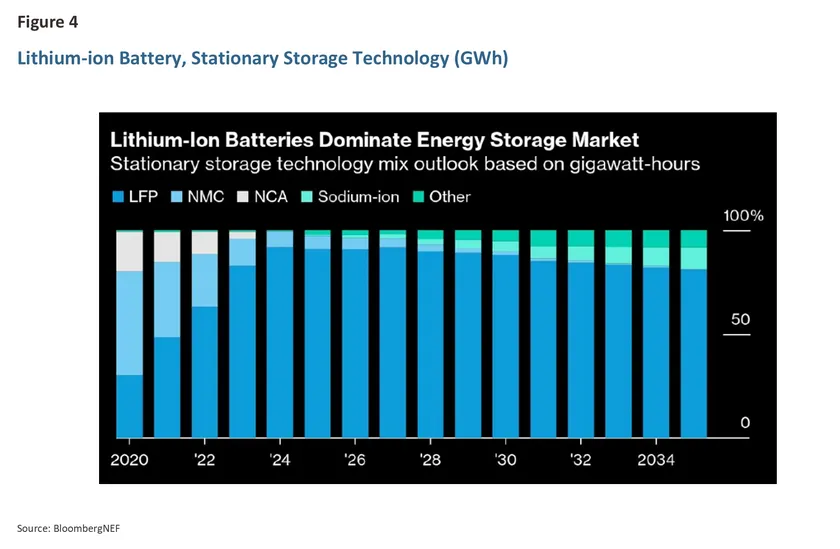
However, Lithium-ion technology faces a significant technical constraint: its discharge duration is typically limited to less than 8 hours. This limitation may prove insufficient for maintaining grid stability as the penetration of renewable energy surpasses the 40-50% threshold. Consequently, Long-Duration Energy Storage (LDES) technologies are emerging as a vital complement, capable of storing surplus solar and wind energy for durations ranging from 8 to over 24 hours. LDES solutions help reduce reliance on natural gas power plants and, unlike conventional batteries, often do not depend on rare earth elements. Key technologies to watch include Flow Batteries, which utilize liquid chemical electrolytes ideal for utility-scale projects, and Thermal Energy Storage, such as Heat Bricks, which can accumulate high-grade heat for heavy industrial applications. These innovations are becoming the heartbeat of future clean energy grids.
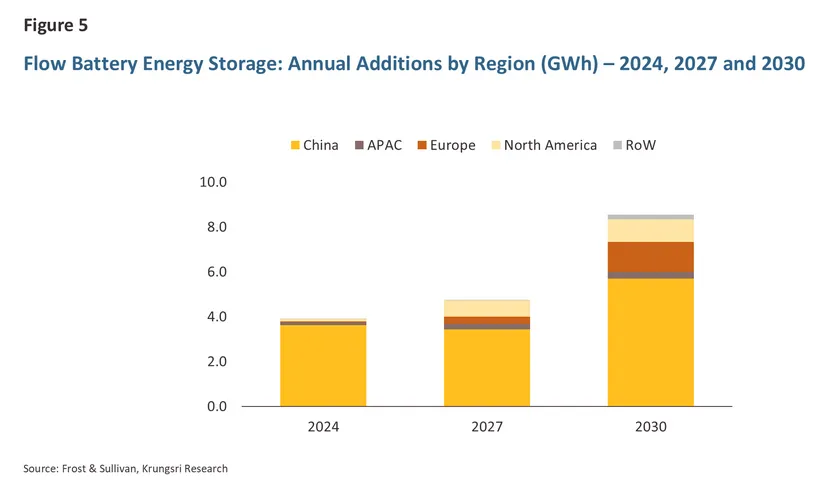
Currently, North America and Europe lead in policy support for LDES. Notably, the US has allocated USD 325 million to accelerate LDES development, aiming for a 90% cost reduction by 2030. Meanwhile, China is ramping up investment in flow battery projects for energy security. Other regions are also gaining momentum through funding from global energy giants like Saudi Aramco and Shell, signaling strong confidence in the commercial viability of long-duration storage technologies.
The Energy Storage Technology Market in Thailand
Energy storage technologies in Thailand are poised for exponential growth, aligned with the acceleration of renewable energy targets under the draft Power Development Plan (PDP). The plan aims for clean energy to constitute 51% of the total power generation mix by 2037, with a strategic focus on increasing solar capacity to cover 70% of all renewable sources. Recently, investment has primarily concentrated on Battery Energy Storage Systems (BESS). This is reflected in the 2022 renewable energy auction results, where 24 solar-plus-storage projects were approved, totaling a combined capacity of 994 MWh. Meanwhile, other technologies, such as Pumped Hydro Storage (PHS), are regaining strategic importance; the Ministry of Energy and the Electricity Generating Authority of Thailand (EGAT) are considering an installation target as high as 10 GWh to support the expansion of over 2.7 GWh in Floating Solar projects by 2030, ensuring maximum stability for the Thai power grid.
The rapid growth of BESS is primarily driven by declining technology costs coupled with extended discharge durations, which have overcome historical cost-efficiency barriers. Furthermore, government policies have provided a conducive environment through Partial-firm PPA contract structures. These contracts require an Availability Guarantee, meaning the state compensates developers for ensuring electricity is strictly available during specified periods, such as evening hours when solar generation ceases. This condition necessitates the installation of batteries in solar projects (Solar-plus-storage) to discharge energy as mandated by the EGAT. For investors, this structure transforms volatile revenue into stable cash flow, distinguishing it from Non-firm PPA standalone projects, which face higher risks of curtailment.
Consequently, Thailand is seeing a steady stream of investments in utility-scale BESS projects, particularly to meet the 24/7 clean energy demands of sectors like data centers. Additionally, new industrial innovations, such as thermal energy storage, are emerging—notably the collaboration between the SCG Group and Rondo Energy to produce heat batteries for industrial energy transitions. However, expansion in the residential sector still faces hurdles due to the use of a Net Billing system instead of Net Metering. This results in a less attractive return on investment for customer-owned storage compared to international markets.
Krungsri Research View
Despite the high growth potential of Battery Energy Storage Systems (BESS), significant challenges remain. These include the massive investment required for Grid Modernization and delays in establishing relevant regulatory frameworks. Although the government has begun driving policies such as Direct PPAs, Utility Green Tariffs (UGT), and Renewable Energy Certificates (REC), there is still a lack of pricing mechanisms that facilitate profitability through energy arbitrage or other ancillary services. However, a critical turning point to monitor is the development of the Third-Party Access (TPA) Code by the Energy Regulatory Commission (ERC). Once officially implemented, this code will unlock liberalized electricity trading between producers and consumers. This shift will enable project developers to access new income streams through Revenue Stacking and serve as a vital mechanism in concretely driving Thailand toward its Net Zero Emissions target.
References
An EMIS Insights Thematic Report (2025) Southeast Asia Gears Up for Energy Storage Growth. Retrieved January 22, 2026 from EMIS Next Market Intelligence & Strategic Planning
An EMIS Insights Industry Report (2025) Thailand Renewable Energy Sector Report2025-2026. Retrieved January 19, 2026 from EMIS Next Market Intelligence & Strategic Planning
BloombergNEF (2025, December 9) Lithium-ion battery pack prices fall to $108 per kilowatt-hour, despite rising metal prices: BloombergNEF. Retrieved January 25, 2026 from https://about.bnef.com/insights/clean-transport/lithium-ion-battery-pack-prices-fall-to-108-per-kilowatt-hour-despite-rising-metal-prices-bloombergnef/
BloombergNEF (2026, January 7) Global energy storage boom: Three things to know. Retrieved January 25, 2026 from https://about.bnef.com/blog/global-energy-storage-boom-three-things-to-know/
BloombergNEF (2025, June 18) Global energy storage growth upheld by new markets. Retrieved January 25, 2026 from https://about.bnef.com/insights/clean-energy/global-energy-storage-growth-upheld-by-new-markets/
Frost & Sullivan (2025) Top 10 Growth Opportunities for Energy Storage, 2025: The Decade of Energy Storage Continues with Strong Growth Forecast. Retrieved December 12, 2025 from EMIS Next Market Intelligence & Strategic Planning
IEA (2022) Unlocking the Potential of Distributed Energy Resources: Power System Opportunities and Best Practices. Retrieved February 15, 2026 from https://www.iea.org/reports/unlocking-the-potential-of-distributed-energy-resources
IEA (2025) Renewable 2025: Analysis and Forecasts to 2030. Retrieved February 25, 2026 from https://www.iea.org/reports/renewables-2025
IRENA (2025) Off-grid renewable energy statistics 2025, International Renewable Energy Agency, Abu Dhabi. Retrieved February 10, 2026 from https://www.irena.org/Publications/2025/Dec/Off-grid-Renewable-Energy-Statistics-2025
IRENA (2017) Electricity Storage and Renewables: Costs and Markets to 2030, International Renewable Energy Agency, Abu Dhabi. Retrieved November 2, 2025 from https://www.irena.org/Publications/2025/Dec/Off-grid-Renewable-Energy-Statistics-2025
The Standard Team (2568, 6 มิถุนายน) รู้จัก “BESS”: Power Bank ของระบบไฟฟ้าไทย ช่วยให้ไฟไม่ดับในยุคพลังงานใหม่ เสริมความมั่นคงระบบพลังงานไทย. The Standard. Retrieved January 25, 2026 from https://thestandard.co/bess-thailand-power-bank-energy-stability/
วิจัยกรุงศรี (2567) แนวโน้มธุรกิจ/อุตสาหกรรม ปี 2568-2570: อุตสาหกรรมผลิตไฟฟ้า. Retrieved January 25, 2026 https://www.krungsri.com/getmedia/8029e33f-4b28-43ad-8046-de5c74a65635/IO_Power_Generation_241224_TH_EX.pdf.aspx
1/ Chemical energy is stored within these substances. When they undergo chemical reactions, such as combustion or use within a fuel cell, the stored energy is released in the form of thermal or electrical energy for further applications.
2/ Pumped Hydro Storage (PHS) utilizes surplus electricity from the generation process to pump water into an upper reservoir, storing it as potential energy. When electricity demand increases, the water is released to a lower reservoir through a turbine, driving a generator to produce electricity and supply it back to the grid.