Introduction
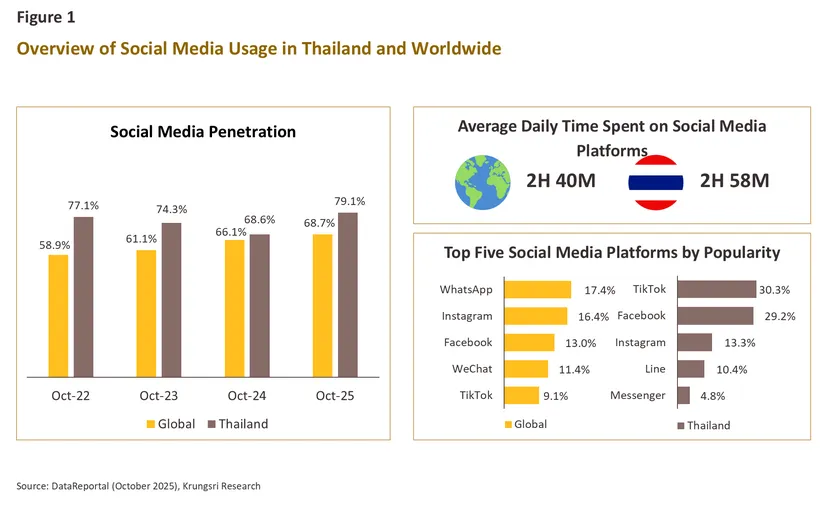
In today's digital era, artificial intelligence (AI) and online platforms have become deeply integrated into everyday life, enabling people to stay connected and access information anytime, anywhere with just a few taps. As a result, our daily routines have become more intertwined with the digital world than ever before. Social media platforms such as Facebook, Instagram, and TikTok, together with messaging applications including WhatsApp and LINE, have become an integral part of modern life. These platforms allow users to follow consumer trends, build social and professional networks, acquire knowledge, discover new ideas and inspiration, and share opinions and perspectives with others. According to DataReportal, global social media penetration1/ reached 68.7% in 2025, up from 66.1% in 2024, while average daily social media usage stood at 2 hours and 40 minutes.2/ In Thailand, social media adoption was even higher at 79.1%, exceeding the global average, with Thai users spending nearly three hours per day on social media platforms.3/ (Figure 1)
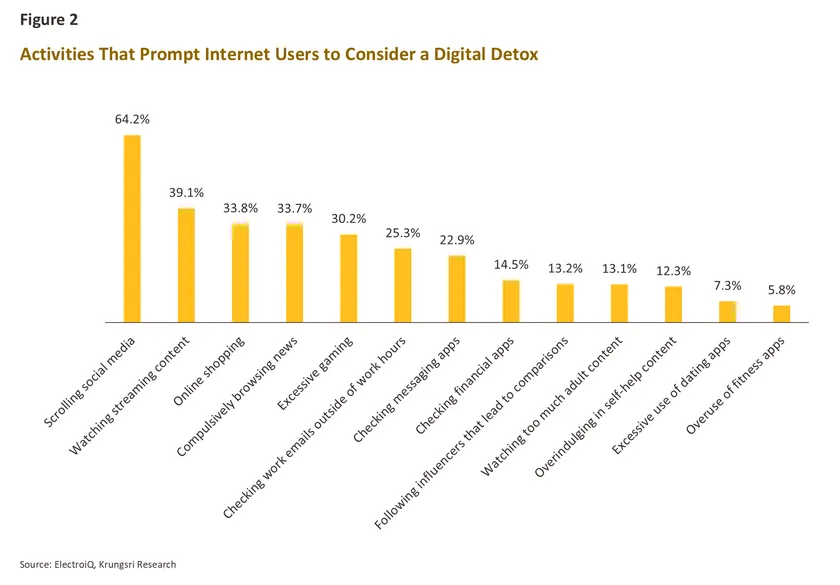
Against this backdrop, digital detox—the intentional practice of taking a break from social media and digital devices—has emerged as a growing wellness trend, particularly among working professionals and younger generations who spend much of their lives online. Prolonged and continuous engagement with digital platforms has contributed to digital fatigue,4/ increased stress levels, and reduced attention spans, while the boundary between online identities and real-life experiences has become increasingly blurred. At the same time, the growing prevalence of cyberbullying and online scams has further encouraged many people, particularly younger users, to temporarily disconnect from technology. According to the 2025 Global Digital Detox Survey,5/ which surveyed 15,000 respondents across 24 countries, 63% of participants planned to take a break from the digital world—more than double the 31% reported in 2020. Meanwhile, Google Trends data indicate that searches for the term "digital detox" in early 2026 were nearly three times higher than during the same period in 2025, suggesting growing interest in reducing online engagement and spending more time on real-world relationships and offline activities. This emerging behavioral shift presents both challenges and opportunities for commercial banks as they continue their transition towards a fully digital financial ecosystem. On one hand, reduced time spent online could translate into lower digital transaction volumes and potentially affect fee-based income from digital banking channels. On the other hand, the trend also creates new opportunities for banks to develop products and services that align with consumers' growing emphasis on digital well-being and healthier technology use.
How Social Media Platforms Are Designed to Maximize User Engagement
Excessive social media use is not solely the result of individual behavior. It is also driven by the behavioral and psychological design of social media platforms, which are engineered to encourage users to return more frequently and remain engaged for longer periods. Key design mechanisms include the following:
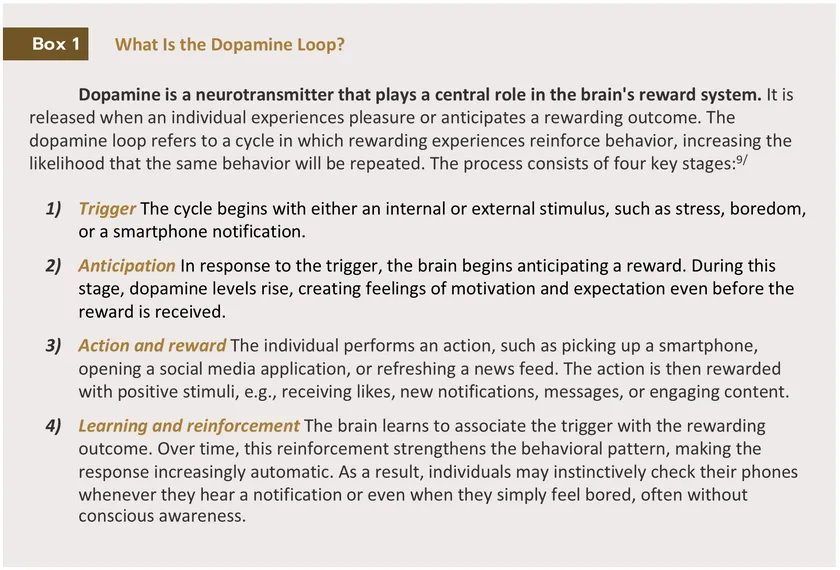
1. Variable Reinforcement Schedules: Rewarding Users Unpredictably One of the most powerful engagement mechanisms employed by social media platforms is the use of variable reinforcement schedules. On the home feed, users are presented with content tailored to their interests, while the pull-to-refresh feature continuously delivers new and unpredictable content each time the screen is refreshed. This mechanism closely resembles pulling the lever of a slot machine.
6/,7/ During the anticipation of an uncertain reward, the brain releases elevated levels of dopamine—a neurotransmitter associated with pleasure, motivation, and reward processing.
8/ The resulting feelings of excitement, anticipation, and satisfaction encourage users to continue scrolling in search of the next rewarding piece of content. Over time, this repetitive cycle can reinforce habitual behavior, creating what is commonly referred to as the dopamine loop.
2. Infinite Scroll: Removing Natural Stopping Points Most social media platforms are designed with infinite scrolling, allowing new content to load automatically as users scroll down their feeds without requiring them to navigate to another page or switch to a different platform. This design minimizes friction in content consumption, creating a seamless and uninterrupted browsing experience. Unlike traditional web pages that require pagination, infinite scrolling provides few natural cues for users to pause and decide whether to stop. As a result, many users continue consuming content almost automatically, often spending significantly more time on the platform than originally intended.10/
3. Notification Design: Capturing Attention Through Visual Cues Social media platforms also employ carefully designed notification systems to encourage users to return to the platform. Notifications are typically displayed prominently on application icons or home screens using red notification badges, making them highly visible and difficult to ignore. From a psychological perspective, red is strongly associated with urgency and importance, while the circular badge is a simple visual form that the human brain can process rapidly. Together, these design elements effectively draw users' attention to unread messages or pending activities, prompting them to reopen the application almost instinctively.11/
4. Algorithms That Personalize and Reinforce User Preferences Recommendation algorithms serve as the core engine behind content curation on social media platforms. They continuously collect and analyze users' behavioral data, including viewing duration, likes, comments, shares, and other forms of engagement, to predict individual preferences and recommend increasingly relevant content. While this personalized approach enables users to discover content aligned with their interests more efficiently, it also increases repeated exposure to information that reinforces their existing beliefs, preferences, and viewpoints. Over time, this can lead to the formation of an echo chamber—an environment in which individuals are predominantly exposed to similar opinions while encountering fewer alternative perspectives or conflicting information. Such environments may limit critical thinking, reduce exposure to diverse viewpoints, and reinforce existing biases.
What Is Digital Detox, and Why Does It Matter in the Digital Age?
Digital detox refers to the intentional practice of refraining from using digital devices, such as smartphones, computers, and tablets, for a period of time, or simply taking a temporary "screen break." The objective is to give both the mind and body an opportunity to recover from constant exposure to digital information and stimuli, helping restore attention, improve well-being, and achieve a healthier balance between online and offline life. The need for digital detox has become increasingly relevant as excessive social media use, particularly prolonged scrolling through news feeds and short-form content, often comes with hidden costs, including stress, anxiety, and poor sleep quality. These warning signs suggest that users may benefit from setting healthier boundaries around their digital consumption. Taking regular breaks from digital media
12/ can help mitigate its adverse effects on overall quality of life in several key areas.
1. Mental Well-being: Excessive social media use has been associated with a higher risk of depression and other mental health issues. A 2025 study published by JMIR Publications found that retired older adults who spent more than six hours per day on social media were approximately 1.5 times
13/ more likely to experience depressive symptoms than those who used social media for one hour or less per day. Heavy social media use may also contribute to emerging forms of psychological stress, including Fear of Missing Out (FOMO)—the anxiety of missing important news, events, or social interactions—and nomophobia,
14/ the fear or discomfort associated with being without one's mobile phone.
2. Sleep Quality: The blue light emitted by electronic screens stimulates the brain and suppresses the production of melatonin, the hormone responsible for regulating the body's sleep-wake cycle. As a result, users may find it more difficult to fall asleep, experience delayed sleep onset, and suffer from poorer sleep quality. Research indicates that each additional hour of screen time before bedtime is associated with a 59% increase in the risk of insomnia, while average sleep duration declines by approximately 24 minutes.
15/ These effects can significantly impair physical recovery and overall well-being.
3. Physical Health: Extended screen use may increase the risk of digital eye strain, a condition commonly characterized by eye fatigue, blurred vision, eye irritation, headaches, and pain in the neck and shoulders. Prolonged focus on digital screens also reduces the frequency of blinking—from the normal rate of approximately 15–20 blinks per minute—causing the eyes to lose moisture more quickly. This can increase tear film instability and make users more susceptible to eye irritation and dry eye syndrome.
16/
4. Attention and Cognitive Performance: Continuous exposure to short-form digital content can reduce attention span, as the brain becomes accustomed to rapidly changing streams of information. Consequently, users may find it increasingly difficult to concentrate on complex tasks that require sustained focus. Frequent switching between different types of content also affects information processing and memory. A 2025 study published by Scientific Research found that individuals who spent less than two hours per day on social media, primarily for work or educational purposes, demonstrated stronger attention and memory performance than those who spent more than four hours per day on entertainment-focused platforms such as TikTok and Snapchat.
17/
5. Interpersonal Relationships: Using a smartphone during face-to-face conversations—a behavior commonly known as phubbing (phone snubbing)—can undermine the quality of interpersonal interactions and relationships.18/ When individuals divide their attention between their conversation partner and their mobile device, others may feel ignored or undervalued. Such behavior also violates fundamental social expectations that conversation partners should remain attentive and actively engaged during interpersonal communication.
Digital detox can be practiced in a variety of ways by adopting healthier digital habits. Common approaches include limiting screen time to no more than one hour per day,
19/ avoiding the use of electronic devices during the hour before bedtime,
20/ scheduling screen-free periods throughout the day, blocking unnecessary notifications and distractions, enabling grayscale mode to reduce the visual appeal of smartphone interfaces, and using AI-powered digital well-being tools that remind users to disconnect. Wearable devices can also help by monitoring stress levels and prompting users to take breaks when needed. These strategies are often complemented by offline activities that promote relaxation and well-being, such as reading, exercising, or learning new skills.
Adopting these behavioral changes can significantly improve the quality of life for individuals experiencing digital fatigue. Reducing prolonged exposure to digital stimuli allows the brain to enter a more relaxed state, contributing to better mental well-being and improved sleep quality. Lower levels of stimulation also help reduce the release of cortisol—the body's primary stress hormone—thereby supporting more effective physical and psychological recovery.
Ultimately, digital detox does not imply rejecting or abandoning technology altogether. Rather, it is about establishing a healthy balance between online and offline life, enabling individuals to benefit from digital technologies while minimizing their long-term impact on physical and mental health.
Advancing Digital Detox: From Social Awareness to Public Policy
The concept of digital detox is gaining momentum across multiple sectors of society. This growing interest is reflected in the emergence of digital well-being applications that help users manage screen time and reduce excessive device use. At the same time, leading organizations have begun introducing innovative products, campaigns, and initiatives that encourage healthier digital habits. Some notable examples include:
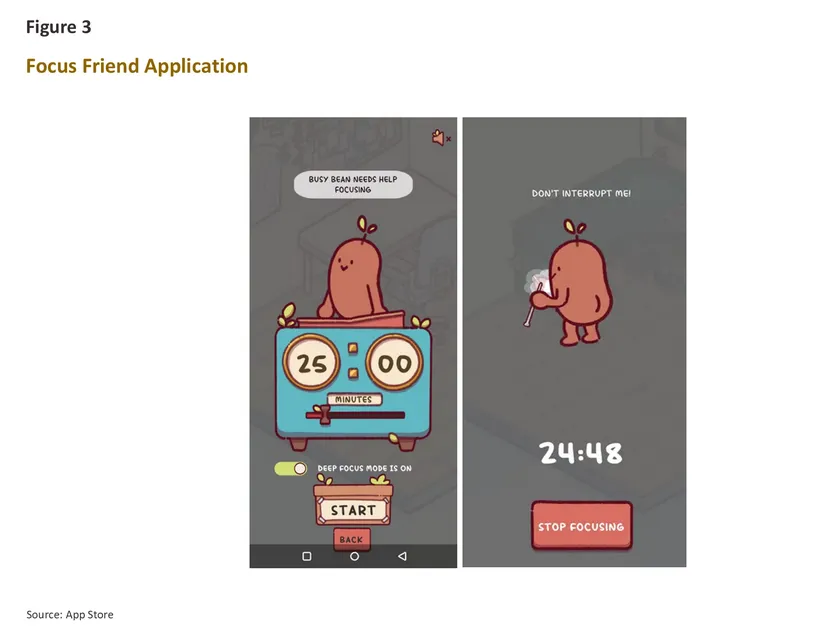
- Focus Friend: Focus Friend is a digital well-being application designed to improve concentration and reduce smartphone distractions.21/ Developed by American content creator Hack Green and launched in August 2025, the application encourages users to temporarily disconnect from social media and devote their attention to activities requiring sustained focus. The app incorporates gamification through a virtual character named “Bean”, a bean-shaped companion that spends the designated focus period knitting socks and scarves while the user's distracting applications remain temporarily blocked. The knitted items can later be exchanged for in-game rewards. However, if users exit the session early to access another application, Bean immediately stops knitting, causing the mission to fail. This design leverages users' sense of responsibility toward the virtual character and their desire to complete tasks and earn rewards, thereby strengthening self-control and improving sustained attention.
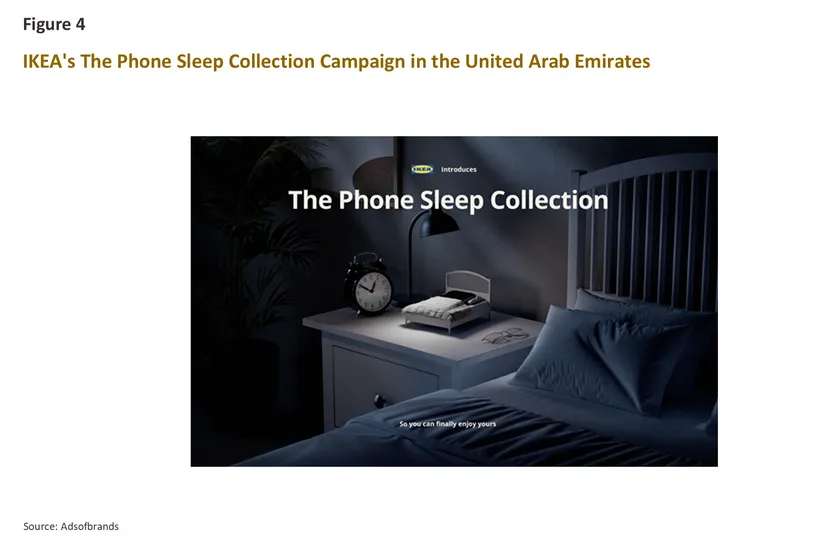
- The Phone Sleep Collection: The Phone Sleep Collection is a campaign launched by IKEA,22/ the Swedish furniture and home furnishings retailer, in October 2025 in the United Arab Emirates. Designed to promote healthy sleep habits and reduce smartphone use before bedtime, the campaign offers customers purchasing IKEA sleep products a miniature bed for their smartphones. The accessory is equipped with Near Field Communication (NFC) technology and connects to the IKEA mobile application to monitor users' bedtime phone usage. Customers who meet predefined sleep targets, for example, sleeping at least seven hours per night for seven consecutive nights, receive exclusive discounts on future IKEA purchases. The campaign applies a reward-based behavioral incentive to encourage better sleep hygiene by reducing digital distractions before bedtime.
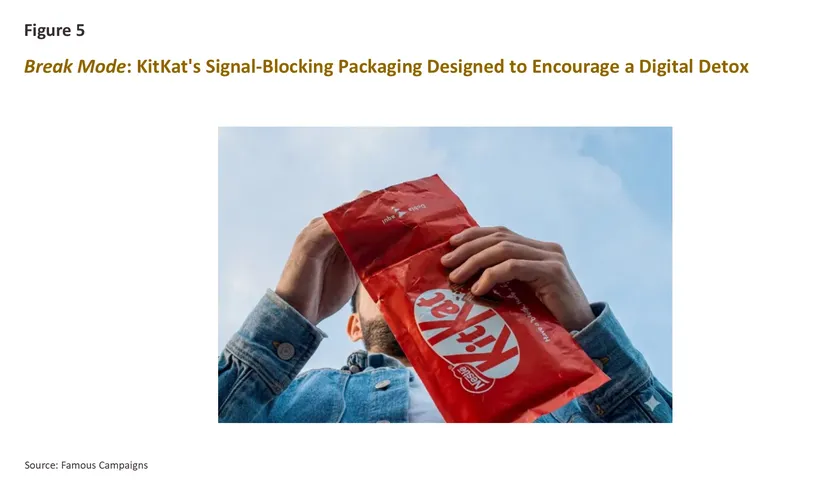
- Break Mode: Break Mode is a marketing campaign23/ developed by KitKat Panama, in collaboration with Ogilvy Colombia, and launched in April 2026 in Panama. The campaign introduced a specially designed KitKat package lined with signal-blocking materials that prevent smartphones placed inside from connecting to mobile networks, Wi-Fi, Bluetooth, and GPS. As a result, users temporarily stop receiving notifications and lose access to online services, encouraging them to disconnect from the digital world and focus on the present moment. The packaging is designed to be reusable for up to one year and can be disassembled for recycling at the end of its lifespan. Although the product was not commercially available, it was distributed as part of promotional activities at universities, concerts, trade fairs, and other public events.
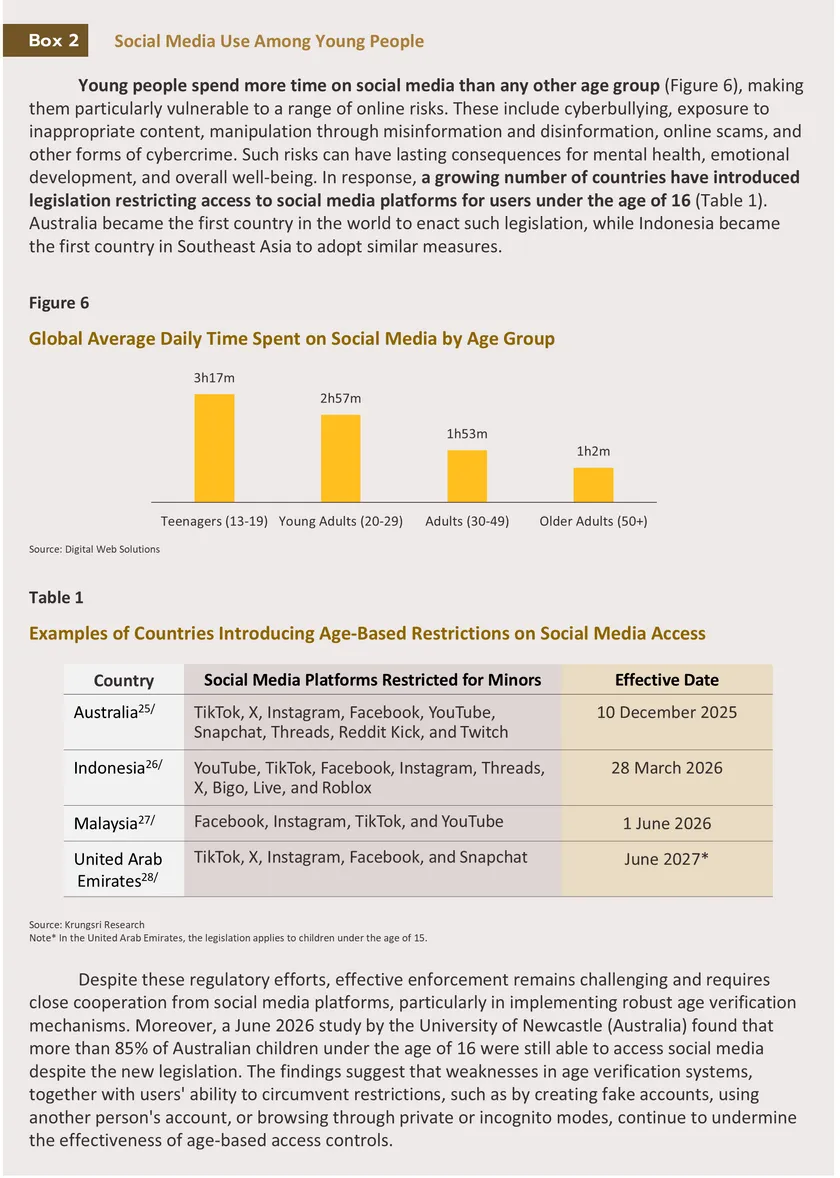
Beyond the private sector, governments are also placing greater emphasis on promoting healthier digital habits, particularly among children and adolescents. For example, South Korea enacted legislation in March 2026 prohibiting students from bringing smartphones and other digital devices into classrooms. Poland is scheduled to introduce restrictions on smartphone use in primary schools beginning 1 September 2026. Across Europe, several countries including the United Kingdom, Norway, France, Spain, and Denmark are considering or advancing similar legislation to regulate smartphone use in educational settings.
In Thailand, public authorities have likewise begun addressing the issue. In May 2026,24/ the Bangkok Metropolitan Administration (BMA) launched the "Phone Off, Learning On" initiative across 437 schools under its jurisdiction. Under the program, primary and secondary school students are required to deposit their smartphones and other digital devices with teachers or at designated collection points before classes begin and may retrieve them only after the school day ends. Furthermore, the private sector has also started incorporating digital well-being into workplace practices. Some organizations now encourage employees to periodically disconnect from digital devices by introducing initiatives such as "No Phone Hour" during lunch breaks or organizing technology-free team-building activities. These measures aim to improve employee well-being, strengthen interpersonal relationships, and foster a healthier balance between work, technology, and everyday life.
The Implications of Digital Detox for Digital Banking
The growing digital detox movement is encouraging many consumers to adopt healthier digital habits by reducing the amount of time they spend online and engaging with digital platforms more intentionally. This trend is particularly evident among Generation Z and Millennials, who are generally more inclined than Generation X and Baby Boomers
29/ to reduce their daily screen time. For commercial banks, this behavioral shift presents both challenges and opportunities. As banking services increasingly rely on digital channels, including mobile banking applications, real-time account notifications, and personalized product recommendations, many customer engagement strategies have traditionally focused on encouraging users to open banking applications more frequently. However, as consumers seek to minimize unnecessary screen time, banks may need to rethink how they deliver digital experiences. Rather than maximizing customer engagement through longer app sessions,
financial institutions may need to prioritize efficient, intuitive, and low-friction experiences that enable customers to complete financial tasks quickly while accessing only the information that is most relevant to them. Several leading banks have already begun adapting their digital strategies accordingly.
-
Monzo, a UK-based digital bank, allows customers to customize the types of notifications they receive, including updates on new features, promotional offers,30/ marketing communications,31/ and other banking-related information. Users can easily modify these preferences at any time, helping reduce notification fatigue and minimize unnecessary interruptions. This customer-centric approach gives users greater control over how they interact with the bank's digital platform.
-
Banco Bibao Vizcaya Argentaria (BBVA) of Spain and United Overseas Bank (UOB) of Singapore have incorporated artificial intelligence (AI) into their personal financial management services. BBVA uses AI to automatically categorize transactions into spending, income, savings, and investment activities, reducing the need for customers to organize their financial information manually. Meanwhile, UOB's Smart Insights32/ feature analyses customers' financial data and spending behavior to provide personalized insights. Both banks also generate alerts when unusual spending patterns or significant changes in account activity are detected, ensuring customers receive only the financial information that requires their attention rather than encouraging prolonged engagement with the banking application.
In Thailand, many commercial banks have likewise begun redesigning their mobile banking applications to better align with consumers' evolving digital habits. For example, the Krungsri application enables users to personalize the home screen by arranging frequently used menus, displaying only selected accounts or financial information, and hiding features that are rarely used. This customization simplifies navigation, allows users to access essential information more quickly, and helps reduce both information overload and cognitive overload resulting from excessive or unnecessary content.
As consumers place increasing importance on digital well-being and seek to spend less time on digital platforms, commercial banks may need to further evolve their digital strategies. Rather than measuring success primarily through app engagement or session duration, banks should focus on designing frictionless financial experiences that enable customers to complete transactions and obtain essential information as efficiently as possible with minimal screen time. In this evolving landscape,
the institutions that succeed will likely be those that design digital services with a deep understanding of customers' changing expectations. By delivering experiences that are simple, personalized, and respectful of users' time and attention,
banks can foster higher customer satisfaction, strengthen long-term relationships, and build more sustainable customer loyalty.
Krungsri Research’s View
Krungsri Research expects the pursuit of a healthier balance between online and offline life to become an increasingly important behavioral trend in the years ahead. As more consumers recognize the adverse effects of prolonged digital engagement,
many are shifting towards a mindset that embraces selective disconnection—choosing not to follow every update or participate in every online conversation.
This reflects the growing concept of Joy of Missing Out (JOMO), which encourages individuals to focus on what truly matters to them rather than feeling compelled to remain constantly connected. As a result, consumers are likely to spend less time on social media
33/ and devote more time to meaningful offline activities. The private sector has already begun responding to this trend. Many organizations are introducing initiatives such as nature-based retreats, digital wellness programs, and offline workshops that encourage employees to step away from screens, improve productivity, and reduce the risk of workplace burnout.
The rise of digital detox has implications that extend well beyond individual lifestyle choices. It also presents a strategic challenge for commercial banks as consumer expectations around digital services continue to evolve. Customers who actively practice digital detox are more likely to reduce their time on social media, disable non-essential notifications, and access mobile applications only when necessary. This behavioral shift may also lead to fewer interactions with mobile banking applications, reducing the frequency of digital transactions and limiting opportunities for banks to engage customers or promote additional financial products and services through digital channels.
To remain competitive, commercial banks will need to move beyond strategies designed simply to increase digital engagement. Instead, they should focus on delivering high-quality, customer-centric financial experiences that maximize value while minimizing the time customers need to spend on digital platforms. This may include presenting only the most relevant financial information, offering personalized notifications, developing intuitive dashboards that provide a comprehensive view of customers' financial positions at a glance, and leveraging artificial intelligence (AI) to summarize financial information and recommend appropriate actions. Banks may also expand into products and services that support broader lifestyle needs, such as travel, preventive healthcare, and holistic wellness, while building on their core strengths in trust, financial expertise, and professional wealth management.
Looking ahead, the banks that are most successful in winning customers' trust may not be those that maximize screen time or app engagement. Rather, they will be those that enable customers to manage their finances quickly, effortlessly, and with confidence, reducing the cognitive burden of financial decision-making and allowing people to spend more time enjoying life beyond the screen.
References
Thai
Post Today. (2026). “ชัชชาติสั่งเก็บมือถือ 437 รร.กทม. ดีเดย์ 18 พ.ค. 69 เน้นเรียนรู้” Retrieved June 17, 2026, from https://www.posttoday.com/smart-city/739366
English
Abeele, M. (2024). “Co-present mobile phone use as an expectancy violation: revisiting ‘phubbing’ in two lab-based experiments” Retrieved June 12, 2026, from https://www.tandfonline.com/doi/full/10.1080/15534510.2024.2419622#abstract
Baker McKenzie. (2026). “United Arab Emirates: Legislation Issued Banning Under-15s from Social Media” Retrieved June 18, 2026, from https://www.bakermckenzie.com/en/insight/publications/2026/07/united-arab-emirates-legislation-issued-banning-under-15s-from-social-media
Bhalla, P. (2025). “Digital Detox Statistics And Facts (2025) : Screen Time, Smartphone Addiction, and Mental Health Trends” Retrieved June 11, 2026, from https://electroiq.com/stats/digital-detox-statistics/
CNA. (2026). “Indonesia starts implementing social media restrictions for children under 16” Retrieved June 17, 2026, from https://www.channelnewsasia.com/asia/indonesia-starts-social-media-ban-children-youtube-tiktok-facebook-instagram-6022636
Davis, C. G., & Goldfield, G. S. (2025). “Limiting social media use decreases depression, anxiety, and fear of missing out in youth with emotional distress: A randomized controlled trial.” Retrieved June 15, 2026, from https://psycnet.apa.org/doiLanding?doi=10.1037%2Fppm0000536
Design Middle East. (2025). “IKEA UAE Launches ‘Phone Sleep’ Collection” Retrieved June 16, 2026, from https://design-middleeast.com/ikea-uae-launches-phone-sleep-collection/
Fox, E. (2025). “Scrolling instead of working? YouTuber Hank Green's new app wants to help” Retrieved June 16, 2026, from https://www.nbcnews.com/tech/tech-news/hank-green-focus-friend-app-rcna225967
Guarnotta, E. (2023). “Social Media Addiction: Could Your Scrolling Habits Be a Problem?” Retrieved June 12, 2026, from https://www.goodrx.com/well-being/behavioral-addiction/addicted-to-social-media
Herring, J. (2026). “KitKat creates a wrapper that blocks phone signals” Retrieved June 16, 2026, from https://www.famouscampaigns.com/2026/05/kitkat-creates-a-wrapper-that-blocks-phone-signals/
Hjetland, G. et. al. (2025). “How and when screens are used: comparing different screen activities and sleep in Norwegian university students” Retrieved June 12, 2026, from https://www.frontiersin.org/journals/psychiatry/articles/10.3389/fpsyt.2025.1548273/full
Huang, J. & Ge, Z. et. al. (2025). “Associations Between Social Media Use and Anxiety and Depression Among Older Adults : Cross-Sectional Study” Retrieved June 12, 2026, from https://aging.jmir.org/2025/1/e71712/authors
Kantar, A. et. al. (2025). “Joy of Missing Out (JOMO) and Its Role in Reducing Social Media Addiction: The Serial Mediating Role of Loneliness and Psychological Distress” Retrieved June 19, 2026, from https://journals.sagepub.com/doi/10.1177/00332941251378710
Kepios. (2025). “Digital 2026: Thailand” Retrieved June 8, 2026, from https://datareportal.com/reports/digital-2026-thailand
Kepios. (2026). “Digital 2026 Global Overview Report” Retrieved June 8, 2026, from https://datareportal.com/
Medqor LLC. (2024), “Do Screen-Free Bedtimes Make a Difference in Toddler Sleep?” Retrieved June 15, 2026, from https://sleepreviewmag.com/sleep-health/demographics/age/screen-free-bedtimes-make-difference-toddler-sleep/
Monzo. (2026). “Managing your app notifications” Retrieved June 19, 2026, from https://monzo.com/ie/help/using-monzo/help-notifications
O’Connor, M. (2025). “New Data: Excessive Screen Time Sparks a Digital Detox Movement. How Brands and Advertisers Can Seize the Moment” Retrieved June 18, 2026, from https://nuvoodoo.com/2025/02/27/new-data-excessive-screen-time-sparks-a-digital-detox-movement-how-brands-and-advertisers-can-seize-the-moment/
Pires, C. (2026). “How Social Apps’ Infinite Scroll Design Is Rewiring User Behavior” Retrieved June 10, 2026, from https://visualmodo.com/how-social-apps-infinite-scroll-design-is-rewiring-user-behavior/
Poles, A. (2025). “Impact of Social Media Usage on Attention Spans” Retrieved June 12, 2026, from https://www.scirp.org/journal/paperinformation?paperid=143508
Pucker, A. et. al. (2024). “Digital Eye Strain: Updated Perspectives” Retrieved June 12, 2026, from https://www.tandfonline.com/doi/full/10.2147/OPTO.S412382#d1e202
Saif, S. (2025). “Red notification dot : The psychological manipulation to keep users engaged.” Retrieved June 11, 2026, from https://blog.saif71.com/red-notification-badge-ux/
SalamGuard. (2023). “The Dopamine Loop” Retrieved June 10, 2026, from https://salamguard.com/resources/science/dopamine-loop
Sharma, Y. & Pothen, S. (2025). “Social Media and the Dopamine System: A Behavioral Neuroscience Perspective on Reward, Attention, and Addiction” Retrieved June 9, 2026, from https://ijirt.org/publishedpaper/IJIRT185697_PAPER.pdf
Ta-sinuzzaman, M. (2025). “Reinforcement Schedule in the Digital Age” Retrieved June 9, 2026, from https://www.researchgate.net/publication/395115230_Reinforcement_Schedule_in_the_Digital_Age
The Straits Times. (2026). “Malaysia requires social media age checks barring under-16 accounts” Retrieved June 17, 2026, from https://www.straitstimes.com/asia/se-asia/malaysia-requires-social-media-age-checks-barring-under-16-accounts
Unicef Australia. (2026). “Social media ban” Retrieved June 17, 2026, from https://www.unicef.org.au/unicef-youth/staying-safe-online/social-media-ban-explainer
UnplugWell. (2025). “Key Findings From the 2025 Global Digital Detox Survey” Retrieved June 9, 2026, from https://unplugwell.com/global-digital-detox-survey-2025/
UOB. (2025). “Smart Insights” Retrieved June 19, 2026, from https://www.uob.co.th/personal-en/digital-banking/tmrw/features/smart-insights.page
1/ Social media penetration rate is measured as the proportion of active social media users relative to the total population.
2/ Source: Global Digital Insights | DataReportal
3/ Source: Digital 2026: Thailand – Global Digital Insights | DataReportal
4/ Digital fatigue is a condition of physical and psychological exhaustion caused by prolonged exposure to digital devices and online activities. Common symptoms include digital eye strain, sleep disturbances, reduced attention span, irritability, and increased anxiety.
5/ Source: Key Findings From the 2025 Global Digital Detox Survey | UnplugWell
6/ Source: Reinforcement Schedule in the Digital Age | ResearchGate
7/ Source: Social Media and the Dopamine System: A Behavioral Neuroscience Perspective on Reward, Attention, and Addiction | IJIRT
8/ Source: The Dopamine Loop | SalamGuard
9/ Source: Ibid.
10/ Source: How Social Apps’ Infinite Scroll Design Is Rewiring User Behavior | Visualmodo
11/ Source: Red notification dot : The psychological manipulation to keep users engaged. | https://blog.saif71.com/
12/ Source: Digital Detox Statistics And Facts (2025) : Screen Time, Smartphone Addiction, and Mental Health Trends | ElectroIQ
13/ Source: Associations Between Social Media Use and Anxiety and Depression Among Older Adults : Cross-Sectional Study | JMIR
14/ Source: Social Media Addiction: Could Your Scrolling Habits Be a Problem? | GoodRx
15/ Source: How and when screens are used: comparing different screen activities and sleep in Norwegian university students | Frontiers
16/ Source: Digital Eye Strain: Updated Perspectives | Taylor & Francis
17/ Source: Impact of Social Media Usage on Attention Spans | Scientific Research
18/ Source: Co-present mobile phone use as an expectancy violation: revisiting ‘phubbing’ in two lab-based experiments | Taylor & Francis
19/ Source: Limiting social media use decreases depression, anxiety, and fear of missing out in youth with emotional distress: A randomized controlled trial. | American Psychological Association
20/ Source: Do Screen-Free Bedtimes Make a Difference in Toddler Sleep? | Sleep Review
21/ Source: Scrolling instead of working? YouTuber Hank Green's new Focus Friend app wants to help | NBC News
22/ Source: IKEA UAE Launches 'Phone Sleep' Collection | Design Middle East
23/ Source: KitKat creates a wrapper that blocks phone signals | Famous Campaigns
24/ Source: "ชัชชาติ" สั่งเก็บมือถือ 437 รร.กทม. ดีเดย์ 18 พ.ค. 69 เน้นเรียนรู้ | Post Today
25/ Source: Social media ban in Australia | UNICEF
26/ Source: Indonesia starts implementing social media restrictions for children under 16 | Channel News Asia
27/ Source: Malaysia requires social media age checks barring under-16 accounts | The Straits Times
28/ Source: United Arab Emirates: Legislation Issued Banning Under-15s from Social Media | Baker McKenzie
29/ Source: New Data: Excessive Screen Time Sparks a Digital Detox Movement. How Brands and Advertisers Can Seize the Moment | NuVoodoo
30/ Source: Managing your app notifications | Monzo
31/ Source: Changing your marketing preferences | Monzo
32/ Source: UOB TMRW Smart Insights - Manage Money Easily | UOB Thailand
33/ Source: Joy of Missing Out (JOMO) and Its Role in Reducing Social Media Addiction: The Serial Mediating Role of Loneliness and Psychological Distress