Executive Summary
China has been investing more overseas in recent years, driven by domestic overcapacity, production diversification, and the China+1 strategy aimed at reducing exposure to trade war risks. Thailand has become one of China's key investment destinations, underpinned by its strategic location and regional connectivity. At the same time, China has emerged as one of Thailand's leading investors, both in terms of investment inflows and applications for investment promotion, with Chinese businesses concentrated in the Eastern Economic Corridor (EEC) and industrial estates—reflecting the pull of Thailand's infrastructure and investment incentives. Moreover, over the past two to three years, Chinese investment has increasingly extended across the supply chain. Downstream manufacturers in advanced-technology industries such as electric vehicles (EVs) and electronics entered first, subsequently attracting upstream parts and raw material producers as well as other supporting businesses from China, to build out a complete production ecosystem.
Going forward, Thailand's economy and industrial sector are likely to continue receiving investment from China amid ongoing geopolitical tensions. However, Thailand will need to manage several challenges, including maintaining balance amid competition between major powers, managing energy and environmental issues, and promoting the use of domestic raw materials and local value creation.
China's Outward Direct Investment Strategy
Why Is China Increasing Outbound Investment?
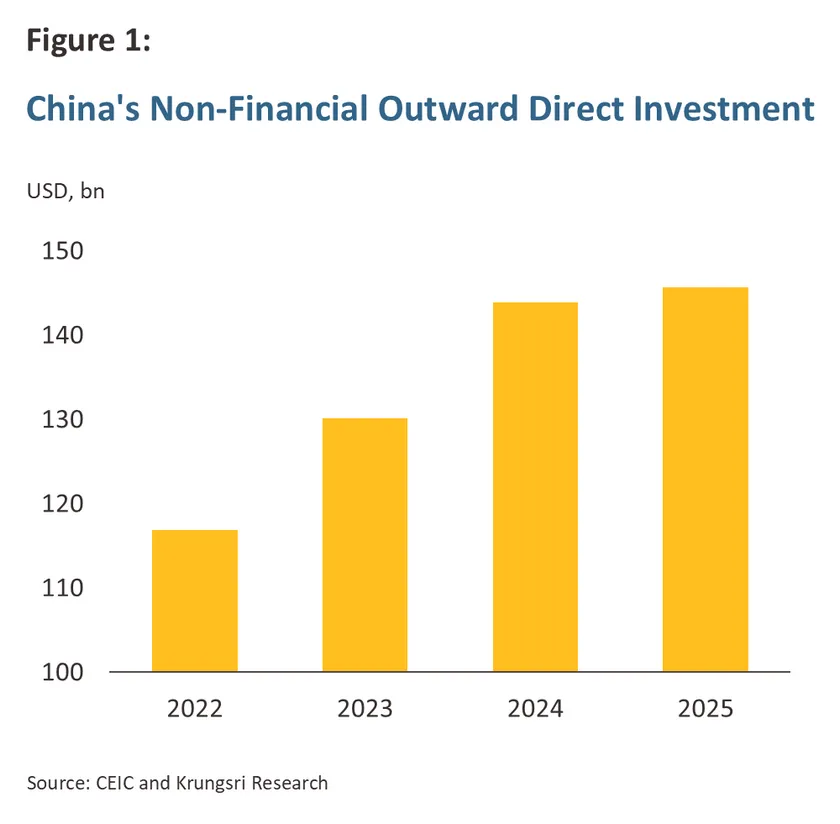
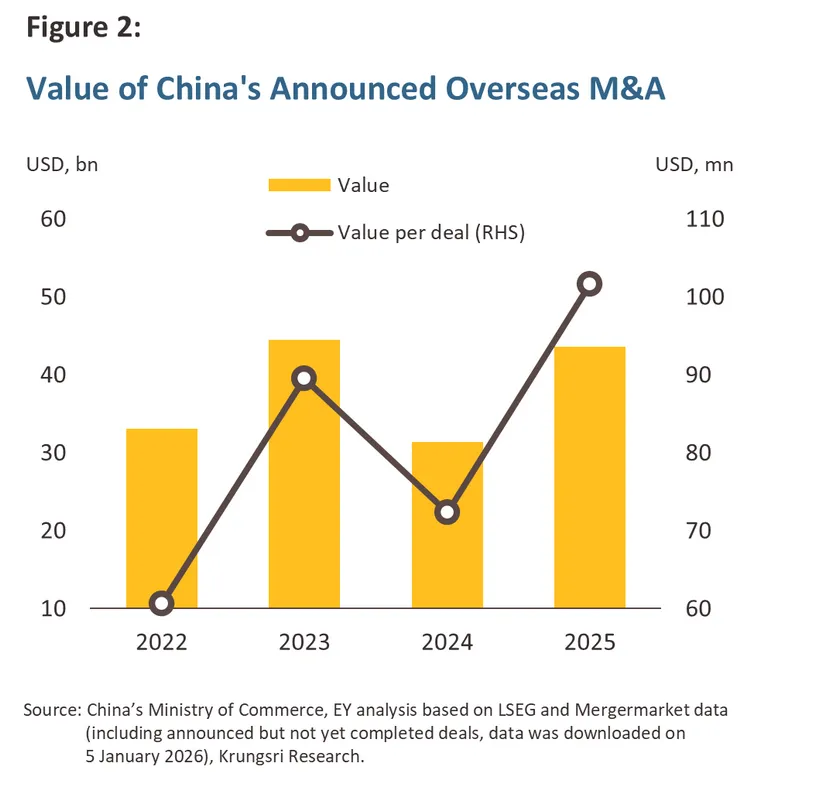
China's outward direct investment (ODI) has continued to expand. In 2025, ODI totaled USD 174.4 billion, up 7.1% from 2024. Non-financial ODI alone reached USD 145.7 billion, the highest level since 2022, with a compound annual growth rate (CAGR) of 7.6% over 2022–2025 (Figure 1). Over the same period, the value of China's announced overseas mergers and acquisitions (M&A) grew by an average of 9.6% per year, while the average value per deal rose by an average of 18.8% per year (Figure 2). These indicators collectively underscore China's intensifying drive to expand outbound investment.
Key factors driving China's rising outbound investment include:
-
Domestic overcapacity: Excess production has prompted Chinese manufacturers to look overseas for alternative markets, particularly in electric vehicles (EVs), batteries, and solar cells. Intense domestic price competition has also squeezed profit margins, prompting producers to look for new markets overseas.
-
US–China trade tensions: US tariff measures have made it harder for Chinese goods to compete on price and to access the US market, pushing Chinese companies to relocate production to third countries to mitigate the impact.
-
Tighter rules of origin1/: As the US steps up scrutiny of local content requirements to prevent transshipment, Chinese companies have needed to establish production bases in third countries to preserve trade tariff benefits.
-
The China+1 strategy2/: This has led companies to diversify production out of China into other countries, particularly in ASEAN, to reduce reliance on a single market and limit the impact of trade tensions.
These factors show that China is accelerating outbound investment both to absorb excess production capacity and to diversify production bases against trade war risks—while also reflecting a broader shift in China's global role. China, once seen primarily as a low-cost manufacturing base built on cheap raw materials and labor, is now emerging as a major investor shaping the direction of supply chains and investment landscapes across multiple regions.
Which Industries Are Attracting Chinese Outbound Investment?
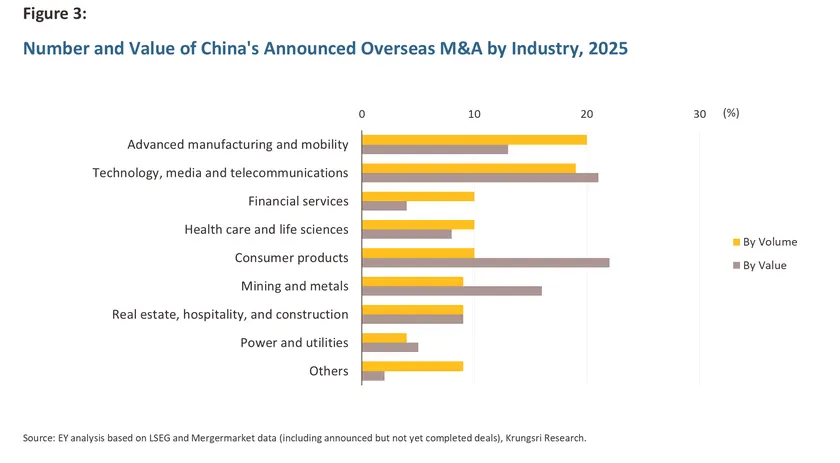
Looking at global outbound M&A activity by Chinese businesses in 2025,
by deal count, advanced manufacturing and mobility attracted the most Chinese M&A activity, accounting for around 20% of total deals, followed by technology, media and telecommunications (19%). By deal value, however,
consumer products led with a 22% share of total deal value, followed by technology, media and telecommunications (21%) and mining and metals (16%) (Figure 3).
China's investment is spread across multiple sectors, consistent with the EY China Overseas Investment Network (2026) report, which identifies the following key target industries:
-
Advanced manufacturing and clean energy: Major Chinese firms are accelerating investment in clean energy, EVs, and aerospace, focusing on establishing fully integrated production bases in destination markets—including investment in critical minerals to secure upstream supply chains for the battery and clean energy industries.
-
Technology: China is expanding its role in robotics, entering the era of commercial humanoid robot production, as well as in data centers to support the growth of artificial intelligence (AI).
-
Consumer products and health: Notable industries include food and beverage, art toys, gaming, entertainment, and digital-platform-mediated culture, along with healthcare, with a focus on expanding into emerging markets with favorable purchasing power and demographics.
-
Infrastructure: As developing countries accelerate upgrades to transport, energy, and digital infrastructure, Chinese companies are benefiting, taking on expanded roles across investment, construction, and operations in destination markets.
-
Financial services: Chinese banks are playing a growing role globally and within Belt and Road3/ markets, offering integrated and customized financial services, while Chinese fintech firms are expanding digital payment and cross-border payment services abroad, particularly in ASEAN.
In short, China is currently focusing investment on modern industries—particularly advanced manufacturing and technology—spanning both supply chains and industrial infrastructure.
Where Are Chinese Investors Going?
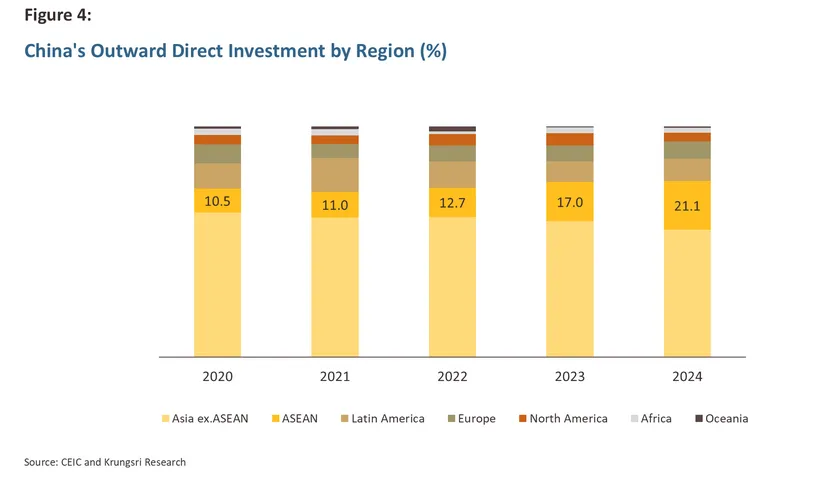
Most of China's investment flows to Asia, which accounted for over 76.3% of China's outward direct investment value in 2024, followed by Latin America (9.6%), Europe (7.7%), North America (3.7%), Africa (2.1%), and Oceania (0.7%) (Figure 4).
Within Asia, ASEAN stands out as a major and fast-growing destination for Chinese investment. In the same year, ASEAN accounted for over 21.1% of China's outward investment value, more than double its share in 2020. This reflects several of the region's strengths: a large working-age population, competitive labor costs, developing infrastructure, and regional free trade agreements such as RCEP
4/ and CAFTA 3.0
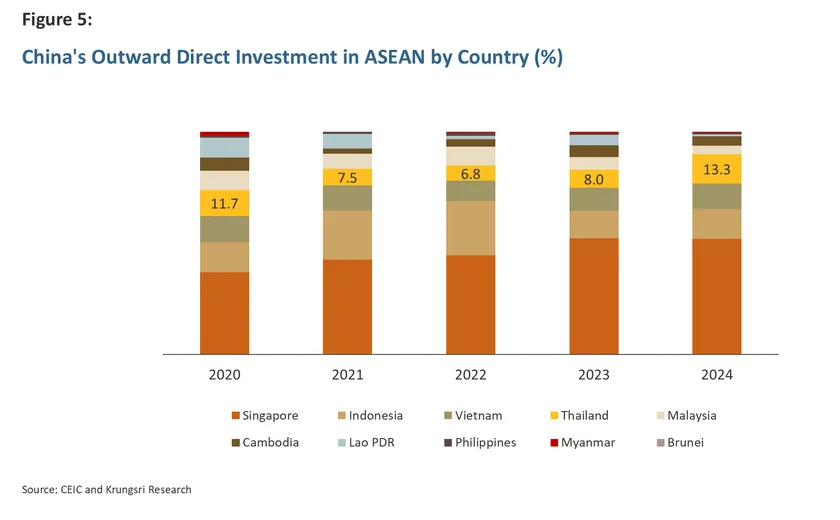
5/—all of which have encouraged Chinese firms to relocate production and link China's manufacturing base with ASEAN's, while also helping to mitigate the impact of US tariff measures. Singapore is the largest recipient of Chinese investment in ASEAN, accounting for 52.1% of China's investment value in the region, followed by Indonesia (13.4%), Thailand (13.3%), and Vietnam (11.4%) (Figure 5).
Thailand stands out as one of the fastest-growing destinations for Chinese investment: Chinese investment inflows expanded by an average of 24.7% per year over 2021–2024, the second-highest growth rate after Singapore. Key supporting factors include policies promoting new industries such as EVs, electronics, and data centers within the Eastern Economic Corridor (EEC), as well as Thailand's well-developed industrial ecosystem and infrastructure, which enhance the country's appeal to foreign investors, including those from China.
Direction of China's Investment and Production Relocation to Thailand
China's Investment Trends in Thailand
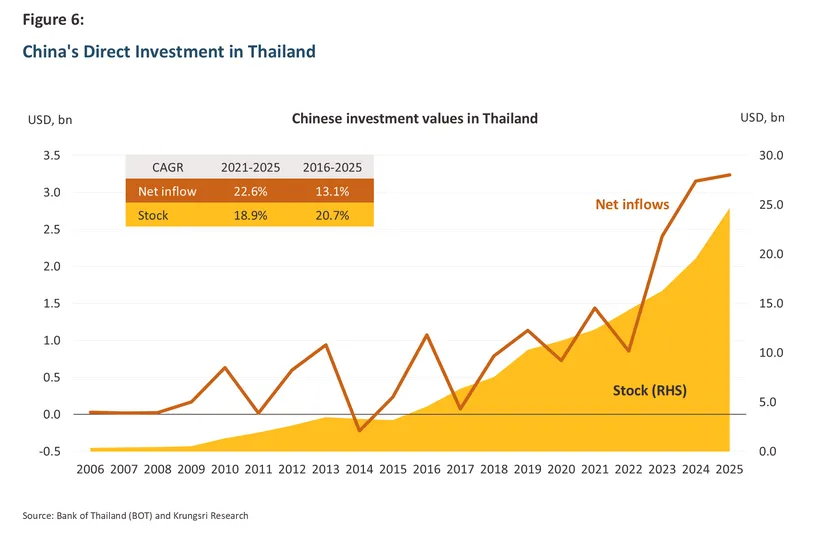
Chinese investors have continued to invest steadily in Thailand over the past two decades. In 2025, net foreign direct investment (FDI) inflows from China totaled USD 3.2 billion, bringing the outstanding investment stock from China to USD 24.7 billion—both record highs (Figure 6). Over the past five years (2021–2025), Chinese investment inflows grew by an average of 22.6% per year, while the outstanding investment stock increased by an average of 18.9% per year.
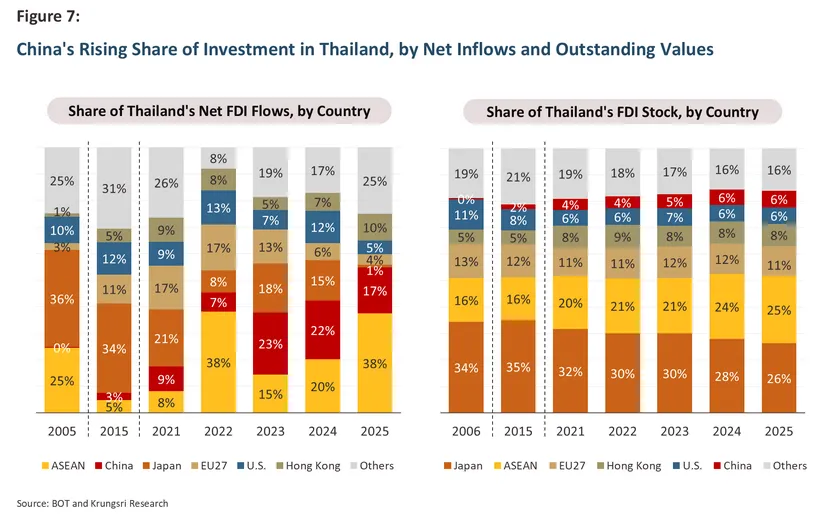
Compared with investment from other countries, China has emerged as one of Thailand's key investors. Over 2023–2024, China was the largest investor in Thailand, accounting for around 22–23% of total net FDI inflows, while in 2025 China's share stood at 17.2%, second only to ASEAN as a group. However, in terms of outstanding investment stock, Japan remains Thailand's top investor, accounting for over a quarter of the total, followed by ASEAN, the European Union, Hong Kong, and the United States—with China ranking sixth at a 6.2% share, though its share continues to trend upward (Figure 7).
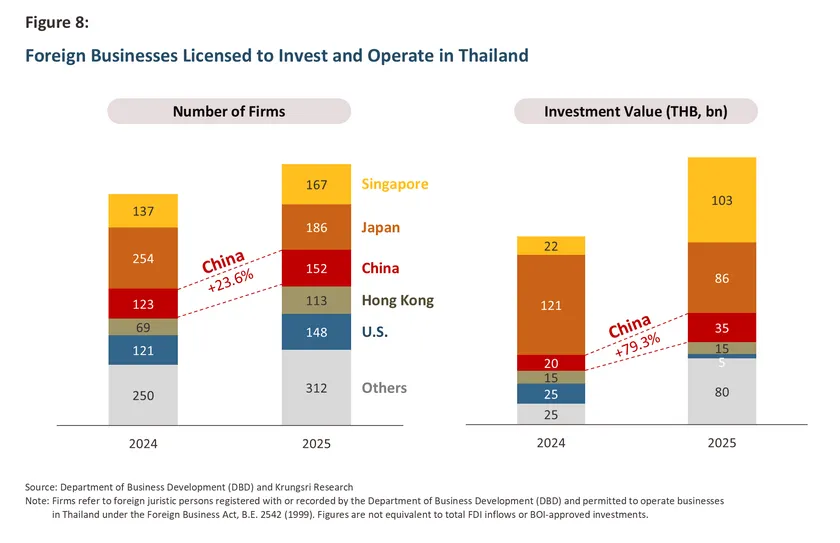
The growing role of Chinese investment in Thailand is also reflected in actual business registration data. In 2025, 152 new Chinese-owned companies were licensed to operate in Thailand, up 23.6% from 2024, while the corresponding investment value rose 79.3% over the same period (Figure 8).
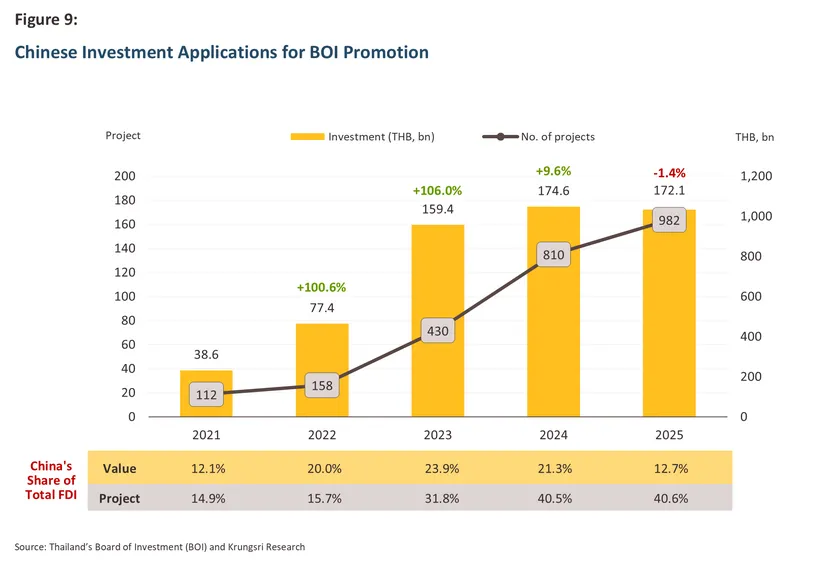
Chinese investors have also continued to apply for investment promotion from the Board of Investment (BOI) (Figure 9). Between 2021 and 2025, the value of applications from China grew by an average of 45.3% per year. The share of Chinese projects also rose significantly, accounting for more than 40% of all foreign investment promotion applications in 2024–2025.
Taken together, these data point to a clear conclusion:
Chinese investment inflows into Thailand have expanded continuously and risen significantly over the past two to three years, with China's role now approaching that of Japan and ASEAN, Thailand's traditional major investment sources.
Which Industries Does China Invest In?
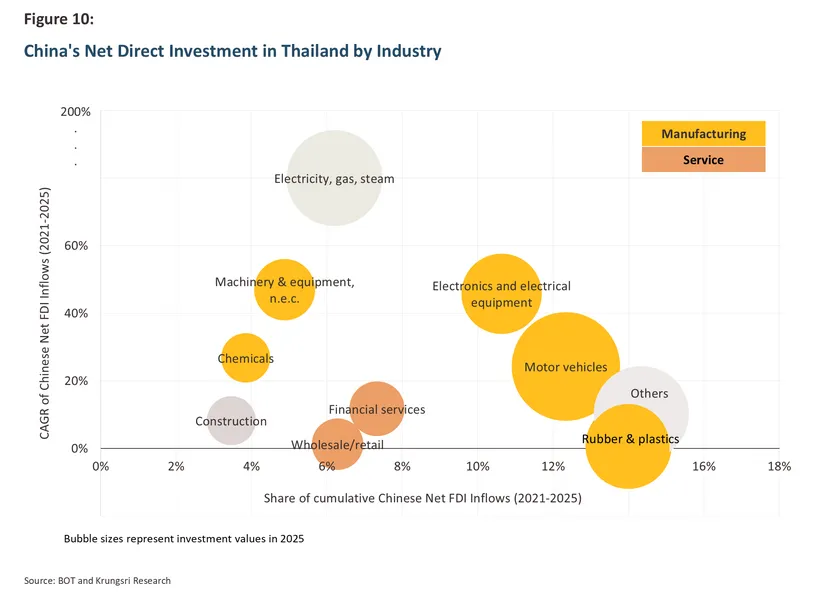
Chinese investment is concentrated in the manufacturing sector, which accounted for 62.4% of China's cumulative investment inflows in Thailand over 2021–2025, led mainly by the rubber and plastics, automotive, and electrical and electronics (E&E) industries. The services sector accounts for a smaller 16.3% share, driven primarily by financial services and wholesale and retail trade. Industries with the fastest-growing investment during this period include energy and utilities (electricity, gas, and steam), machinery and equipment, and E&E. These are all priority industries for China's outbound investment expansion (Figure 10).
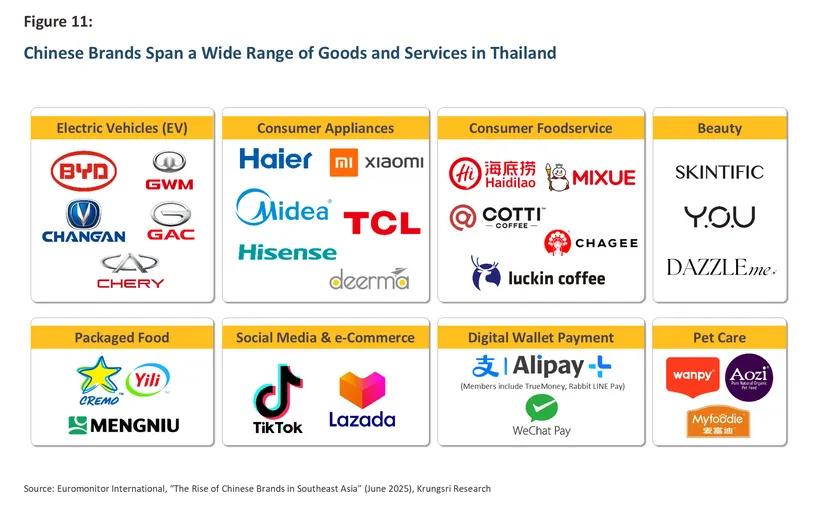
As Chinese investors have gradually expanded across Thailand's industrial and services sectors, Chinese brands have become key players across a wide range of goods and services (Figure 11)—from EV brands such as BYD, GWM, and GAC; electrical appliances such as Haier, Midea, Hisense, and TCL; to food and beverage chains such as Haidilao, Mixue, and Chagee, as well as the ice cream brand Cremo6/. In social media and e-commerce, Chinese platforms such as TikTok (ByteDance) and Lazada (Alibaba Group) play a major role in Thailand. In payments, China's Ant International has taken a stake in TrueMoney Wallet and partnered with Rabbit LINE Pay, making both payment systems members of AliPay+, an international payment network. Overall, Chinese goods and services have gained popularity in Thailand partly due to competitive pricing strategies, localization to the Thai market, and comprehensive distribution channel expansion.
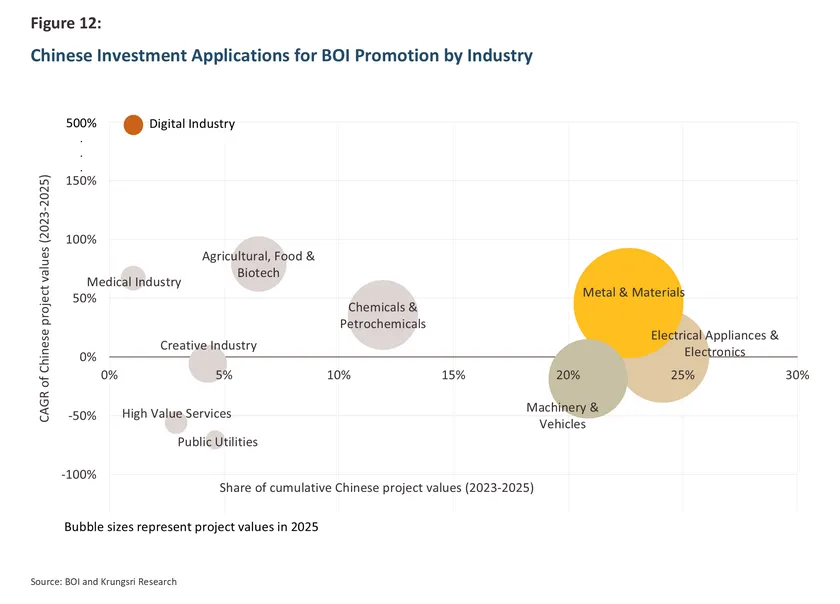
More recently, Chinese investment has moved beyond assembly-oriented manufacturing to cover more of the supply chain, particularly upstream raw materials and modern industrial infrastructure. This is reflected in the pattern of BOI applications from Chinese investors. Over 2023–2025, the E&E industry received the largest share of application value (24.1% of the total), increasingly driven by upstream activities such as semiconductor and printed circuit board (PCB) manufacturing. This was followed by metals and materials (22.6%), including upstream cell-level battery production for the EV industry, and machinery and vehicles (20.9%). Moreover, the digital industry recorded the fastest average growth in application value during this period, at 458% per year, lifted by investment in digital infrastructure such as data centers and cloud services (Figure 12).
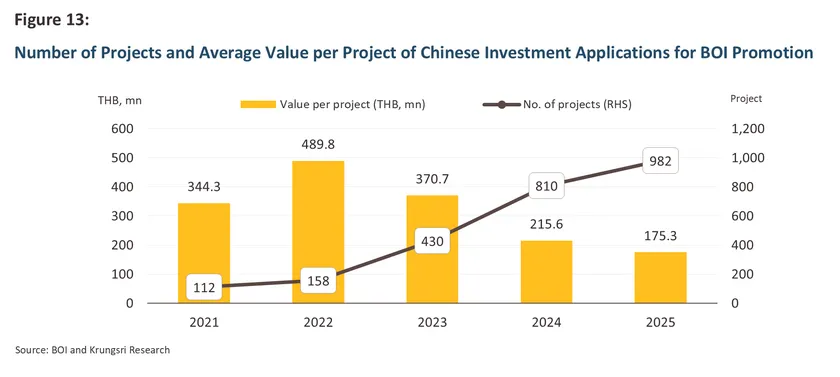
At the same time, the number of BOI applications from Chinese investors has risen significantly, while the average value per project has gradually declined (Figure 13). This suggests that smaller Chinese suppliers are increasingly investing in Thailand’s upstream supply chain, following the earlier entry of major producers in advanced-technology industries. This trend is consistent with the theory of “agglomeration economies”, whereby major Chinese manufacturers, such as EV and electronics producers, established production bases in Thailand first, subsequently attracting upstream parts producers—such as battery, PCB, semiconductor, and electronic component manufacturers—as well as other supporting businesses across the supply chain, including industrial automation, warehousing, and logistics, to strengthen China's production ecosystem in Thailand.
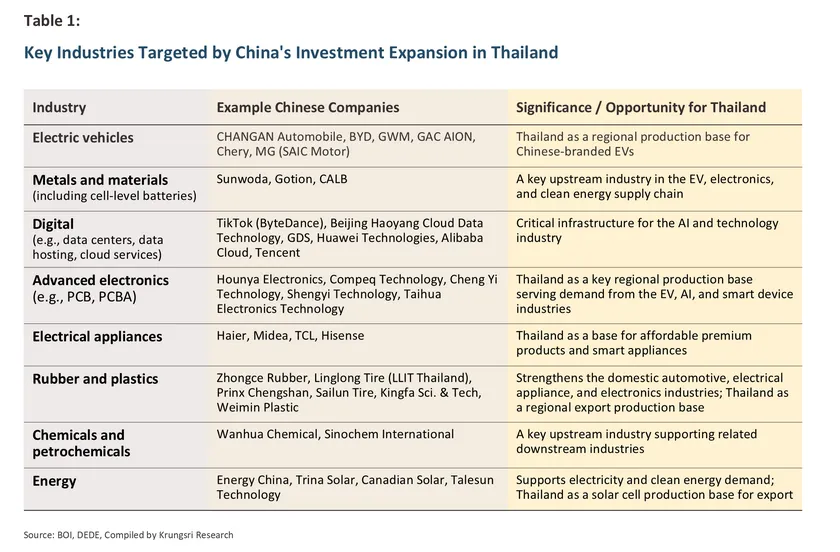
In summary, China's investment is expanding to cover more of the industrial supply chain. Table 1 summarizes the key industries targeted for China's investment expansion.
Where Is China Investing?
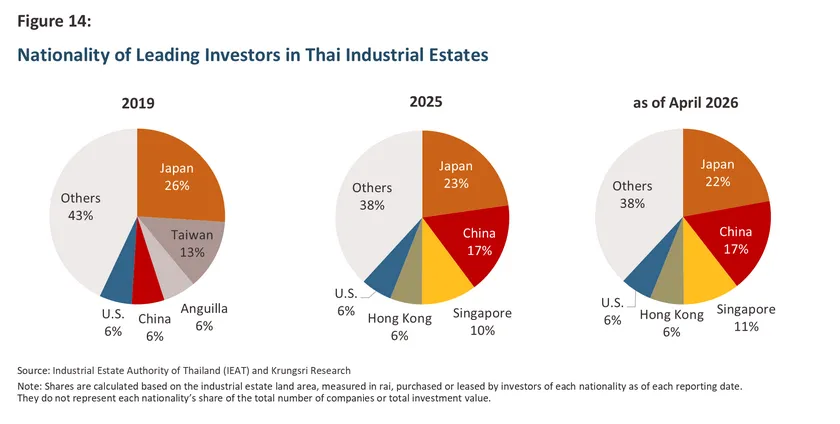
Chinese investors have gradually established production bases in industrial estates, becoming the second-largest customer group in Thailand's industrial estates after Japanese investors. The share of industrial estate land purchased or leased by Chinese investors rose from 6% of total area in 2019 to 17% as of April 2026 (Figure 14), while over the same period, the share held by Japanese investors declined from 26% to 22%. This reflects a shift in Thailand's industrial estate investor base from reliance mainly on Japanese investors toward a more balanced mix of both Japanese and Chinese investors as key customer groups.
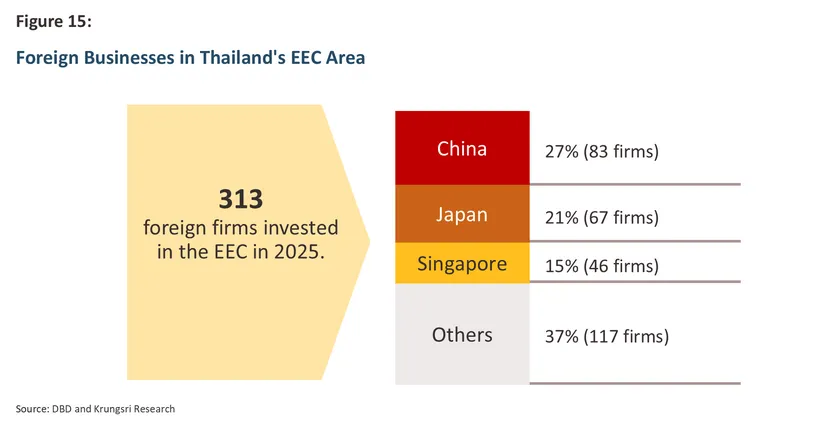
At the provincial level, Chinese investment is concentrated in the EEC, covering Chonburi, Rayong, and Chachoengsao provinces, given their well-developed infrastructure, adequate utilities, dense supplier bases, and strong connectivity to ports, roads, and major logistics networks. In 2025, Chinese-owned businesses accounted for the largest number of newly permitted foreign businesses in the EEC, at 83 firms, or 27% of all 313 foreign businesses in the EEC—ahead of Japan at 67 firms (21%) and Singapore at 46 firms (15%) (Figure 15).
The maturity of the industrial ecosystem is a key factor making the EEC well suited for Chinese companies to establish production bases and connect to their supply chains. The area combines industrial estates, special economic promotion zones, and well-developed transport, logistics, and utility infrastructure—including Laem Chabang Port, road networks, and stable electricity and water supply—alongside an established base of parts manufacturers and industrial service providers. These factors reduce the time and cost of setting up and starting operations, connect investors with suppliers and export channels, and support industries that require stable utilities and fully integrated production networks. The EEC's business activity structure is also closely linked to the industries in which China invests most heavily, including automotive, rubber and plastics, electronics and electrical equipment, machinery and equipment, and chemicals.
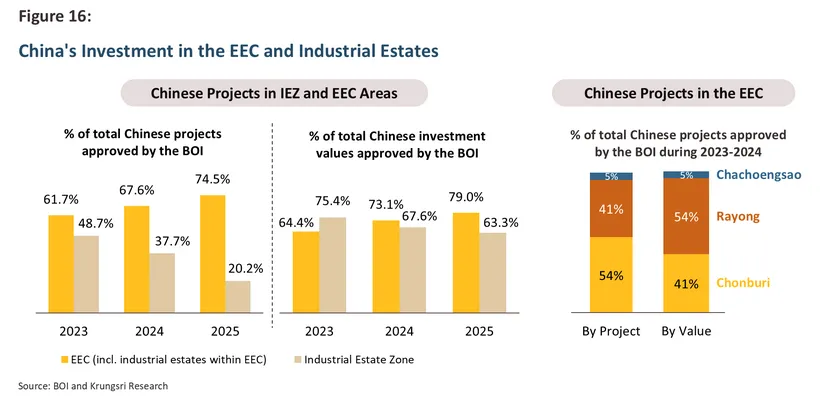
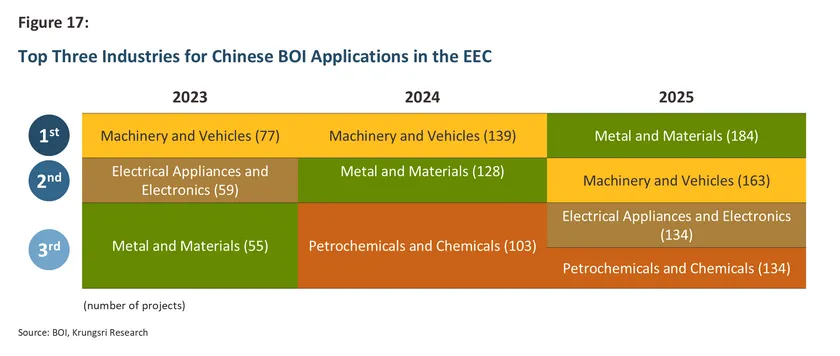
The EEC's role has grown steadily, now hosting around three-quarters of BOI-approved Chinese investment projects in 2025, up from 61.7% in 2023, while its share of investment value has risen similarly, to 79.0% (Figure 16). Rayong and Chonburi remain the primary bases for Chinese investment projects in the EEC, accounting for around 95% of both the number of projects and the investment value of BOI-approved Chinese projects in the EEC over 2023–2024. In terms of industrial structure, new Chinese investment in the EEC is increasingly shifting from downstream assembly toward upstream and midstream activities, with applications covering parts manufacturing, machinery, industrial materials, and higher value-added production processes—making China's supply chain in the EEC more complete and reinforcing the area's role as a regional production hub (Figure 17).
A closer look at Chinese investment by province and leading industries shows that Rayong hosts large-scale investment projects in EVs and advanced automotive, from major producers such as BYD, GWM, CHANGAN, GAC AION, and Chery, as well as a digital infrastructure project by Beijing Haoyang Cloud Data—underscoring the province's role as a hub for Chinese auto manufacturing and capital-intensive industrial or digital projects. Chonburi, meanwhile, has seen continued investment in automotive supply chain activities, both batteries and auto parts, with examples including Sunwoda and SAIC Motor-CP/MG, as well as a data infrastructure project by Digitalland/GDS.
However, China's investment network is expanding from its core bases in Rayong and Chonburi to Chachoengsao and other key industrial areas outside the EEC as well. Within the EEC, Chachoengsao hosts a project by Cheng Yi Technology (Thailand), part of the Shengyi Technology group, producing key raw materials for printed circuit boards (PCB), including prepreg and copper clad laminate (CCL). Prachinburi hosts a PCB production base by Taihua Electronics Technology within the 304 Industrial Park, which has infrastructure and utilities suited to the electronics industry. Bangkok and its vicinity, meanwhile, play a supporting role in digital infrastructure, data storage and processing, and digital platform operations (Table 2).
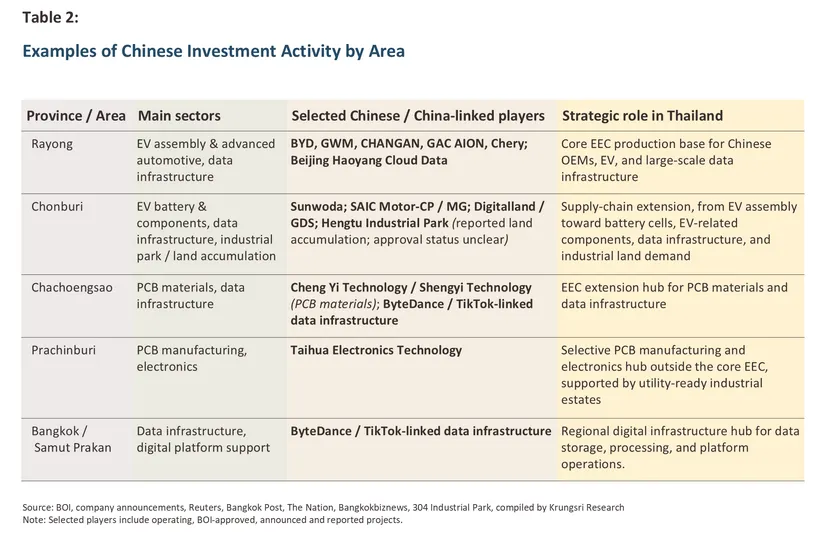
This overview reflects that Chinese investment in Thailand is expanding both deeper along the supply chain and across a wider geographic area, spanning upstream PCB raw materials and industrial materials, midstream batteries, auto parts, and circuit boards, through to downstream EV assembly and finished goods, as well as data centers and digital infrastructure that support the modern economy. The EEC remains the primary base for large-scale manufacturing activity, while other industrial areas play a supporting role in specialized activities linked to the same production network—making the ecosystem of Chinese investment in Thailand more diverse and increasingly integrated.
Krungsri Research View: Outlook for Chinese Investment, Opportunities and Challenges for Thailand
Outlook for Chinese Investment and Implications for Thai Industry
Krungsri Research expects Chinese investment in Thailand to continue expanding over the next 5-10 years, driven by long-term factors including US–China trade tensions, overcapacity across multiple industries, and slowing domestic demand in China. At the same time, Thailand retains strong appeal as an investment destination, given its potential as a production base, well-developed infrastructure, investment incentives, connectivity to ASEAN markets, skilled industrial labor force, and long-established supplier networks. As a result, Thailand is likely to maintain its position as one of the region's key destinations for China's industrial expansion, even as it faces competition from Indonesia, Malaysia, and Vietnam.
Going forward, Chinese investment is likely to shift from downstream assembly toward building a more complete production ecosystem covering upstream and midstream activities—particularly in EVs and electronics, which will remain important, through continued investment in battery cells, energy storage systems, EV components, electronic parts, and PCBs.
This is expected to accelerate industrial agglomeration in Thailand, especially in technology- and capital-intensive industries, as the entry of major producers tends to attract parts, raw material, machinery, and automation suppliers, along with logistics and other service providers.
This trend places Thailand's manufacturing sector at an important turning point—particularly auto parts producers, who must transition from internal combustion engine supply chains to EVs, and traditional electrical appliance and electronics manufacturers, who must upgrade toward smart electronics. Thai manufacturers may also need to adapt by upgrading technology, standards, and cost management to align with investor requirements, encouraging greater use of domestic parts and suppliers (supplier localization). If Thailand can successfully adapt, it stands to connect its existing production base with the modern industrial ecosystem in which Chinese companies are playing an increasingly leading role across ASEAN.
Opportunities and Challenges for Thailand
Chinese investment trends that align with Thailand's target industries present opportunities for the Thai industrial sector, including:
-
Driving Thai industry toward higher-value production: Thailand could emerge as one of the world's leading PCB producers and an important regional EV production base. Growth in these industries could attract further investment from other countries and benefit related upstream and downstream domestic industries.
-
Upgrading technology and clean energy infrastructure: China is one of the global leaders in both fields, as reflected in the continued expansion of Chinese technology investment in Thailand, while Chinese businesses in other industries are accelerating their shift to renewable energy through rooftop solar installations at their factories.
However, the inflow of Chinese investment also brings several challenges:
-
Creating domestic value added: As noted above, smaller Chinese suppliers are beginning to invest in upstream supply chain activities in Thailand, which could make it more difficult for Thai businesses to participate in Chinese supply chains. This also raises international trade risks, as insufficient domestic production or local content could result in more stringent scrutiny of Thai exports. Thailand should therefore promote the use of domestic raw materials and Thai suppliers, and build significant domestic value added, alongside developing production standards and labor skills that meet investor requirements, to maximize benefits for all stakeholders.
-
Balancing geopolitical tensions: Thailand needs to maintain good relations with all parties in order to continue attracting investment from countries beyond China.
-
Sufficiency of energy and resources: Industries of particular interest to Chinese investors, especially data centers, require substantial electricity and water, which could put pressure on the country's energy and resource security.
Ultimately, the extent to which Thailand benefits from Chinese investment will depend on its ability to manage the challenges outlined above. The public sector has an important role to play in managing geopolitical, energy, and resource risks, as well as in supporting greater integration of Thai businesses into Chinese supply chains, to foster sustainable domestic value added.
References
Board of Investment (BOI). (2026). “Advanced Electronics: The Foundation of the AI-Era Economy and a Key Opportunity for Thailand”. Retrieved from BOI News - Advanced Electronics: The Foundation of the AI-Era Economy... | Facebook.
Department of Business Development (DBD). (2026). “In the first four months of 2026, foreign investment in Thailand reached THB 129 billion, up THB 71.5 billion, or 124%, from the same period in 2025. China ranked first, with investment totaling THB 25.0 billion”. Retrieved from https://www.dbd.go.th/news/23622052569.
Ernst & Young. (2026). “Overview of 2025 China outbound investment”. Retrieved from https://www.ey.com/en_cn/insights/china-overseas-investment-network/overview-of-2025-china-outbound-investment.
Euromonitor International. (2025). “The Rise of Chinese Brands in Southeast Asia”.
Thansettakij. (2026).“Multinational Companies Accelerate Rooftop Solar Adoption, Investing THB 5.6 Billion to Drive Clean Energy”. Retrieved from https://www.thansettakij.com/sustainable/net-zero/663849.
1/ Legal criteria used to determine the origin or nationality of goods, applied in trade measures and preferential tariff treatment.
2/ A supply chain diversification strategy in which multinational companies retain production bases in China while adding at least one additional production base in another country, to reduce reliance on China alone.
3/ Countries that have signed cooperation documents under the Belt and Road Initiative with the Chinese government, comprising more than 150 countries across Southeast Asia, Central Asia, South Asia, West Asia, Central and Eastern Europe, and Africa.
4/ The Regional Comprehensive Economic Partnership (RCEP) is a free trade agreement between the 10 ASEAN member states and five partner countries—China, Japan, South Korea, Australia, and New Zealand—covering market access for goods, services and investment, and common rules of origin.
5/ CAFTA 3.0 (China-ASEAN Free Trade Area 3.0) is the third-stage upgrade of the China-ASEAN Free Trade Area, covering nine areas of cooperation including the digital economy, the green economy, and supply chain connectivity.
6/ The Chinese company Yili acquired the business in 2018 and grew its share of Thailand's ice cream marketfrom 6% in 2017 to 14% in 2024.