
Monthly Economic Bulletin (March 2026)

Monthly Economic Bulletin (March 2026)

17 มีนาคม 2569

Global: Escalating geopolitical tensions threaten disruption


Monthly Economic Bulletin
 

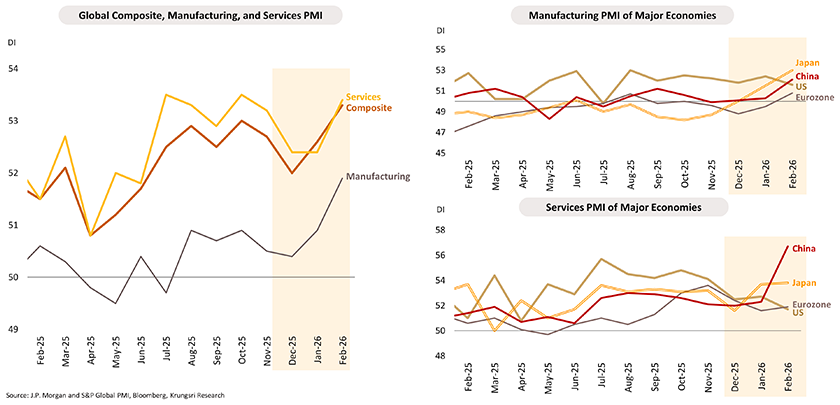
Global growth improved unevenly before the Iran war but faces significant downside risks from rising geopolitical tensions and trade policy uncertainty


Monthly Economic Bulletin


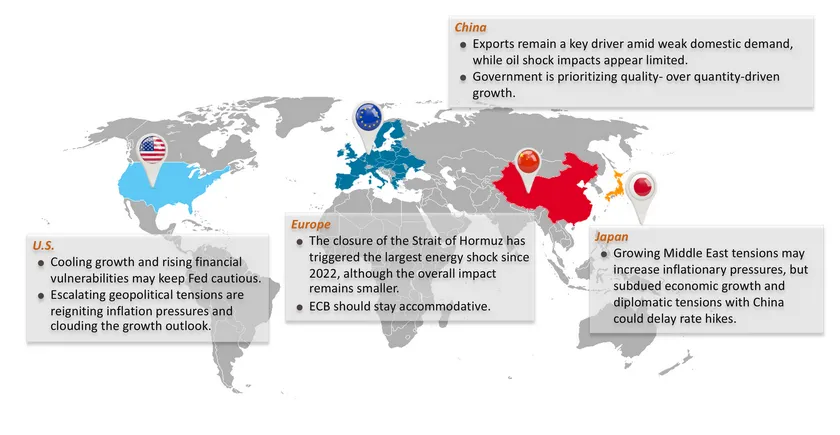
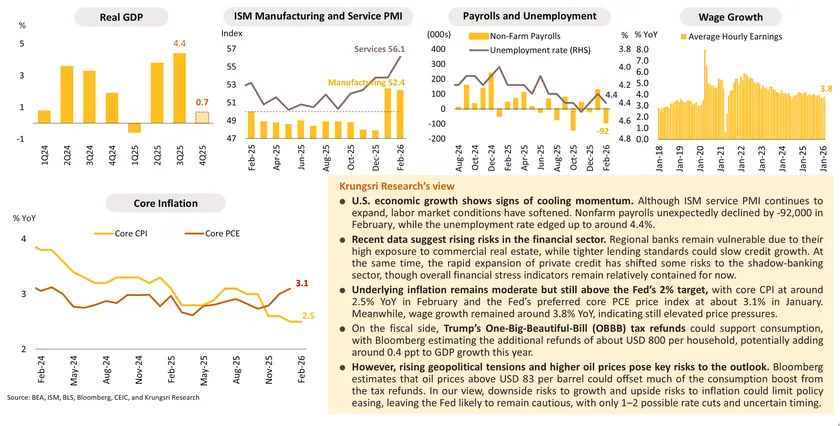
U.S.: Cooling growth and rising financial vulnerabilities may keep Fed cautious; escalating geopolitical tensions reigniting inflation pressures and clouding the growth outlook


Monthly Economic Bulletin  
 

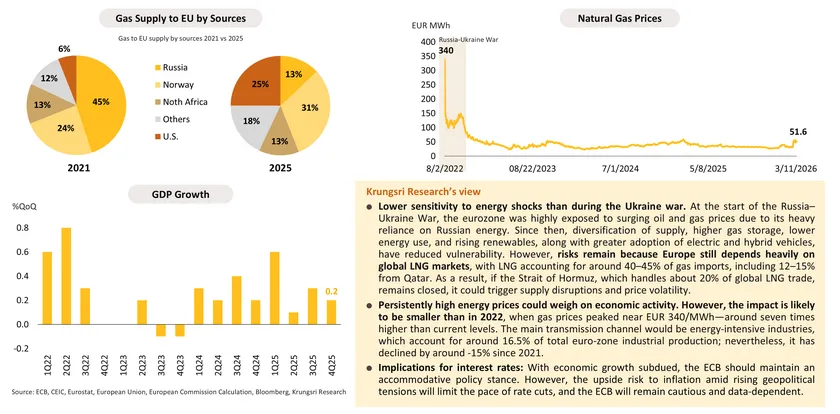
Eurozone: The closure of the Strait of Hormuz has triggered the largest energy shock since 2022, although the overall impact remains smaller; ECB should stay accommodative  


Monthly Economic Bulletin  
 

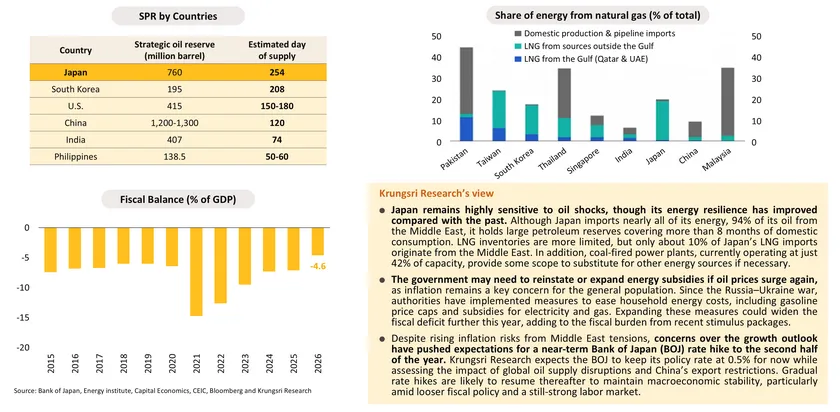
Japan: Growing Middle East tensions may increase inflationary pressures, but subdued economic growth and diplomatic tensions with China could delay rate hikes


Monthly Economic Bulletin  
 

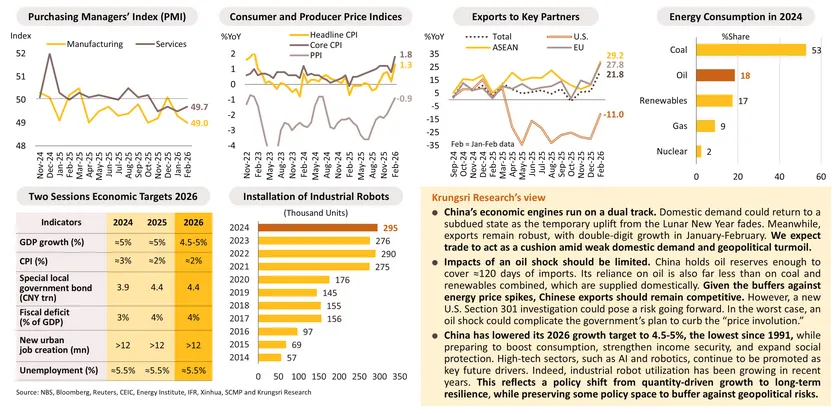
China: Exports to remain a key driver amid weak domestic demand, while oil shock impacts appear limited; government prioritizing quality- over quantity-driven growth 


Monthly Economic Bulletin  
 

Thailand: Mounting external risks may disrupt growth momentum

 
  • Thailand’s economic growth in 2026 is likely to soften amid fading stimulus, constrained public spending, potential U.S. tariffs, and materializing downside risks. 

  • Rising tensions in the Middle East could affect economic activity mainly through the supply side and higher energy costs, given that Thailand is a net energy importer. Spillovers through the demand side and financial markets could become material if tensions are severe and prolonged.

  • Tourism recovery slows as the Middle East tensions pose downside risks to the outlook.

  • Thai exports accelerate in early 2026, but U.S. tariff policy and the Middle East tensions could dampen growth. Despite IEEPA tariff being struck down, the benefit would be short-lived and would limit the gains, whereas tariff threats remain. Recently, the U.S. has announced investigations under Section 301 into 16 key trading partners, including Thailand, raising the risk of new tariffs and putting potential downward pressure on Thai exports.

  • Private consumption improves gradually in early 2026, supported by strengthening demands; momentum may weaken amid fading stimulus and underlying structural issues.

  • A faster-than-expected government formation could support policy continuity, budget disbursement, and economic sentiment. However, the direction and effectiveness of policy will still need to be closely monitored, especially as external risks intensify.

  • Private investment is picking up, while the realization of strong BOI applications will hinge on policy direction and external risks. 

  • The MPC cut the policy rate earlier than expected, adding that the 1.0% level is sufficiently accommodative. The Middle-East tensions pose upside risks to inflation, limiting further policy easing. 


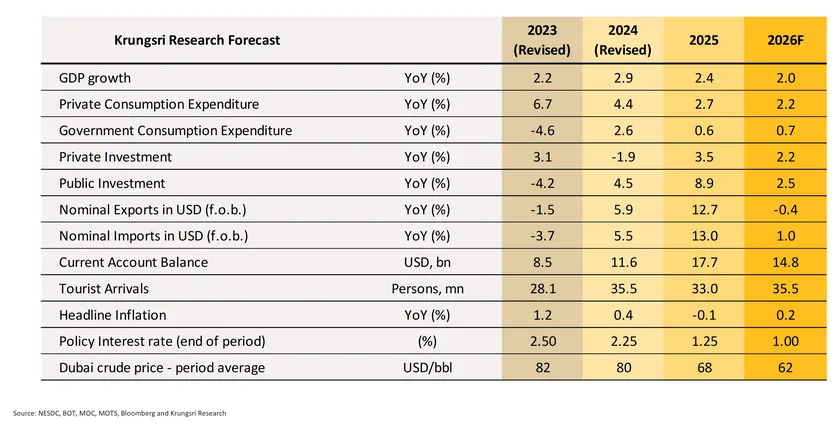
Krungsri Research Forecasts for 2026

Monthly Economic Bulletin  
 

Thailand’s 2026 economic growth likely to soften amid fading stimulus, constrained public spending and U.S. tariffs


Monthly Economic Bulletin  
 

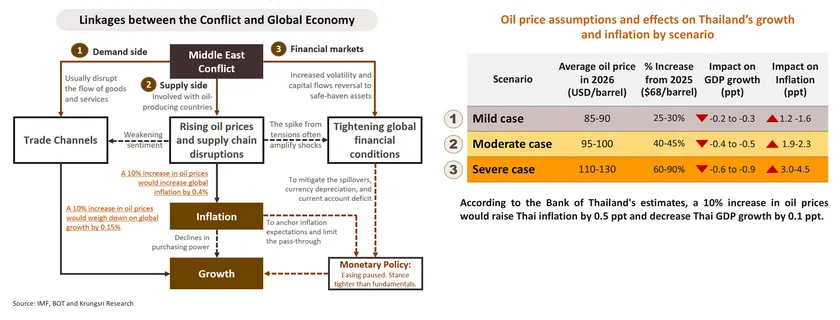
The Middle East conflict and the Thai Economy: Unrest in the Middle East can affect economic activities majorly through supply side

 
  • Unrest in the Middle East can affect economic activities through 3 primary channels: i) supply side, where rising oil prices can lead to higher production costs, inflation, and a subsequent decline in purchasing power and investment demand. Indirectly, it will also weaken consumer and business sentiment. In the worse case, it could lead to global supply chain disruptions; ii) demand side, resulting from disrupted trade, tourism, and investment; iii) financial markets, as rising tensions and uncertainties often amplify volatility, leading to risk-off sentiment that could trigger a flight to safe haven.  

  • The impact on the Thai economy depends on the intensity and duration of the conflict. Given the current situation, the primary effect is from the supply side due to the sudden increase in oil prices. Effects from financial markets are relatively limited, given Thailand's resilient external stability. In the worse-case scenarios, however, tightening financial conditions could eventually impact monetary policy and the economy.


Monthly Economic Bulletin  
 

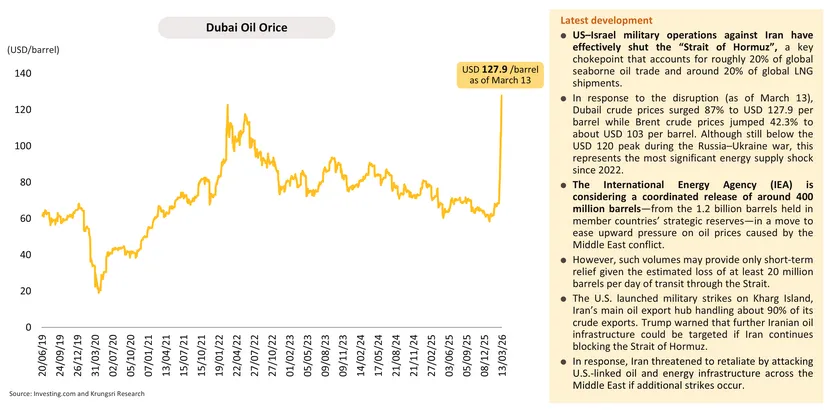
Dubai Oil Price: With the U.S. military operation in the middle east and Iran’s retaliation, oil prices (as of Mar 13) rose significantly to USD 127.9/barrel


Monthly Economic Bulletin  
 

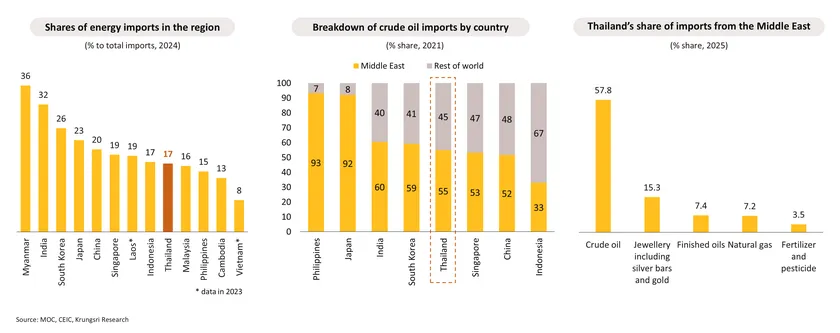
Supply side: as an energy importer, Thailand is likely to see higher inflation; prolonged tensions and greater supply chain disruption could intensify the effects 

 
  • The conflict has raised concerns over oil supply in the Middle East. As a net oil importer with a higher proportion of fuel imports compared to other countries in the region, Thailand is likely to experience increased inflation due to rising oil prices. However, this surge might be temporary if the shocks are short-lived. 

  • If the conflict persists, however, the effect on inflation will be intensified. This is due to the fact that the Middle East is Thailand’s primary source of imports of energy, fertilizer, and pesticides. Greater supply chain disruptions can also be expected, which may result in increased shipping costs, higher insurance rates, and transportation delays. 


Monthly Economic Bulletin  
 

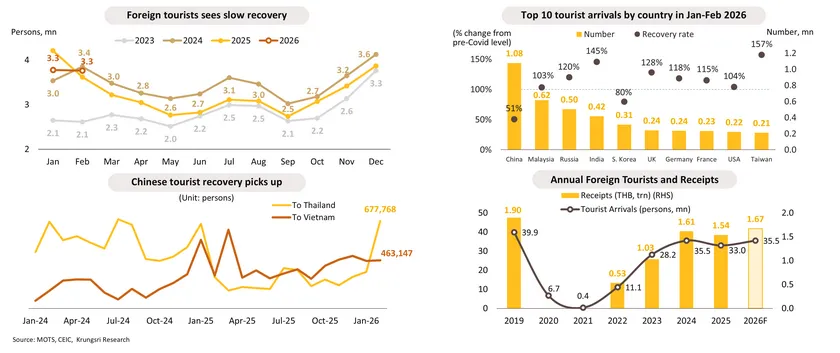
Tourism recovery slows as middle east tensions pose downside risk to the outlook


In Feb-26, Thailand welcomed 3.26 mn foreign visitors, slightly down from 3.28 mn in Jan-26. Supported by the Chinese New Year holiday, Chinese tourist arrivals spiked 82% YoY in February, lifting cumulative arrivals to +4.2% for Jan–Feb. However, the impact of rising tensions in the Middle East is beginning to be seen in the tourism sector. Security concerns, along with the closure of several airports in the Middle East—one of the world’s major transit hubs linking Europe and Asia—have started to reduce the travel of Western tourists. According to the Ministry of Tourism and Sports, during the first eight days of March, the number of tourists from Europe and the Middle East arriving in Thailand declined by -18% compared with the normal travel trend. This development therefore poses a downside risk to our forecast of 35.5 million foreign tourist arrivals this year.

Monthly Economic Bulletin
 

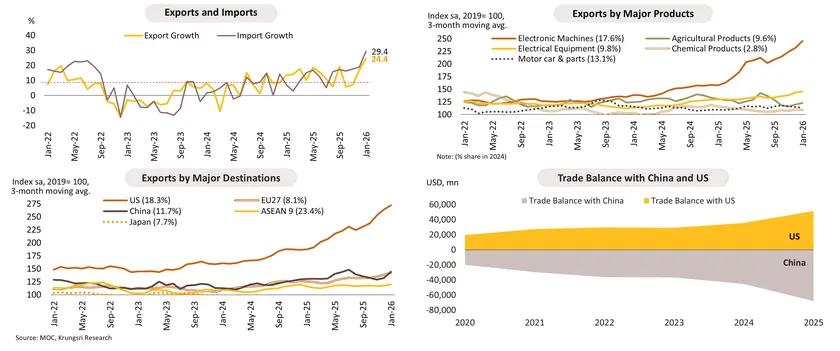
Thai exports accelerate in early 2026 but U.S. tariff policy and the Middle East tensions could dampen growth


Exports expanded by 24.4% YoY in Jan-26 while imports also grew sharply by 29.4%. The export growth was driven by key products such as computers and parts, integrated circuits, and chemical products. Exports to all major markets – including the U.S., EU27, Japan, China, and ASEAN – also expanded. Going forward, export growth is expected to slow down in 2026, reflecting the fading front-loading effect seen in 2025, the full-year impact of U.S. tariffs, weak global trade conditions, as well as potential supply disruption and rising production costs from the Middle East conflict.

Monthly Economic Bulletin  
 

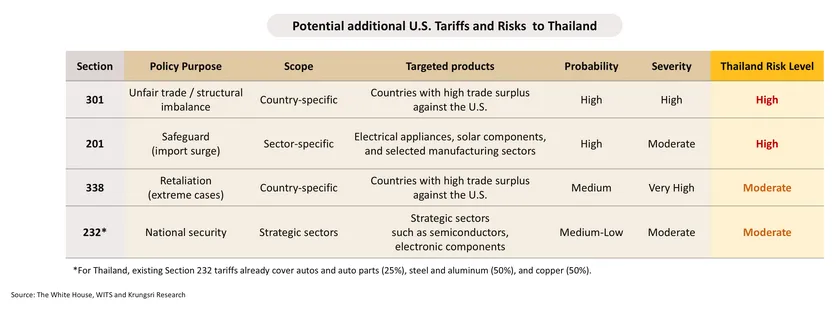
IEEPA-related tariffs struck down; short-lived and limited gains, continued tariff uncertainty.

 
  • The Supreme Court of the US (SCOTUS)’s ruling invalidates all tariffs imposed under IEEPA. These include the broad-based reciprocal tariffs, as well as the trafficking-, immigration-, and fentanyl-related tariffs imposed on imports from China, Mexico, and Canada under IEEPA authority.  Following the ruling, President Trump invoked Section 122, which authorizes temporary tariffs of up to 15% on imports for a maximum of 150 days.  

  • For Thailand, product-specific tariffs under Section 232 remain in place. Combining both broad-based (Section 122) and product-specific measures, the current effective tariff rate (ETR) remains high at 18.7%, despite a slight decline from 20.7% at the end of 2025. 

  • Thailand’s tariffs could be raised in the near term under alternative statutes. The tariff reduction from 19% to 15% is likely to yield only temporary gains. Any near-term boost may reflect front-loading, followed by a sharper payback. The 150-day window could be shortened if other tariff tools are activated or imposed in parallel. Recently, the U.S. has announced investigations under Section 301 into 16 key trading partners, including Thailand, raising the risk of new tariffs and putting potential downward pressure on Thai exports. Meanwhile, transshipment-related tariffs remain another ongoing risk for Thailand.


Monthly Economic Bulletin
 

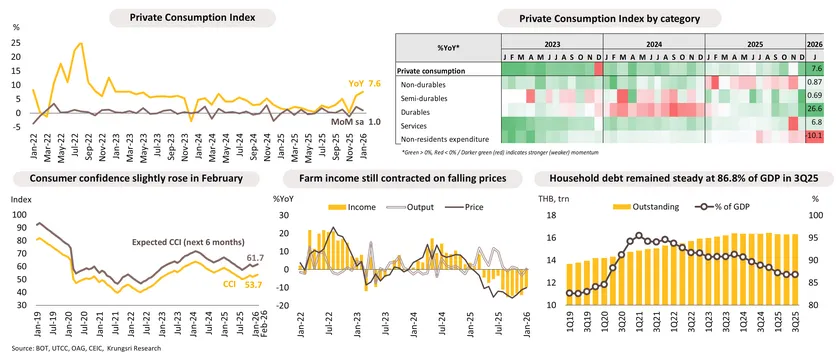
Private consumption improves gradually in early 2026 supported by strengthening demands; momentum may weaken amid fading stimulus and underlying structural issues


In Jan-26, the Private Consumption Index (PCI) continued to expand, driven by a strong recovery in durable goods purchases supported by EV subsidies and a gradual improvement in services in line with the tourism recovery. Nevertheless, the growth momentum may weaken as these temporary tailwinds have expired, alongside persistent structural constraints such as weak income growth and high household debt. Additionally, higher energy prices amid rising Middle East tensions could further dampen domestic spending.

Monthly Economic Bulletin  
 

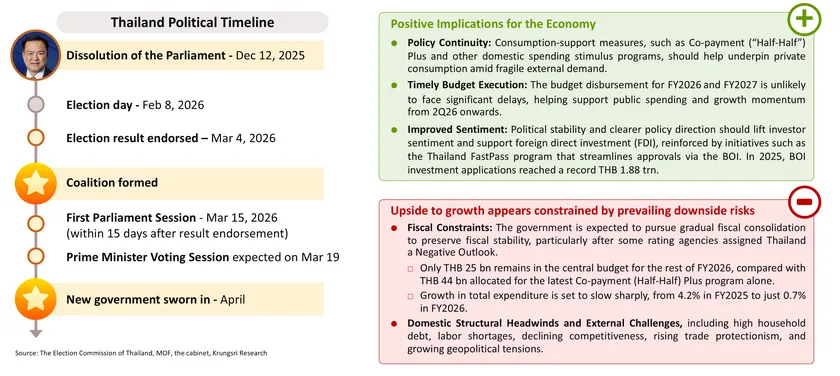
Political Development:  A faster-than-expected government formation could support policy continuity, budget disbursement, and economic sentiment


The Bhumjaithai Party gained the most seats in the House of Representatives (191 of 500), leading the government formation. A coalition with the Pheu Thai Party (74 seats) and smaller parties have secured a majority of about 291 seats. As the formation appears to be moving faster than previously expected, the new government could be formally sworn in around April. Still, fiscal constraints limit the growth upside. 

Monthly Economic Bulletin  
 

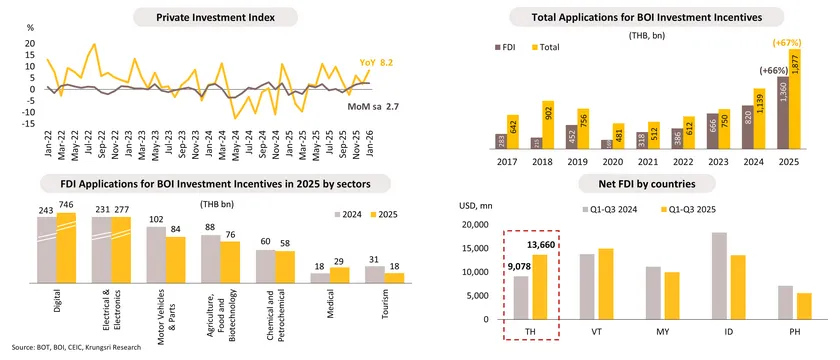
Private investment is picking up, while the realization of strong BOI applications will hinge on policy direction and external risks


In Jan-26, the Private Investment Index (PII) continued to expand by 8.2% YoY and 2.7% MoM (seasonally adjusted), reflecting a gradual recovery. In 2025, BOI investment applications rose to a record high of THB 1.88 trn. The three industries with the highest FDI Applications for BOI Investment Incentives were Digital, Electrical & Electronics, and Motor Vehicles & Parts. In the first 3 quarters of 2025, Thailand recorded the strongest FDI growth in ASEAN-5. However, the near-term outlook remains pressured by weak domestic demand, global economic uncertainty, and U.S. trade tariffs.

Monthly Economic Bulletin  
 

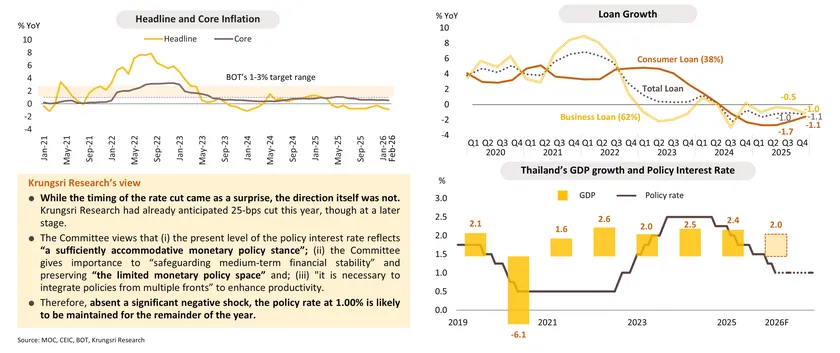
MPC cut the policy rate earlier than expected, indicating the 1.00% level is sufficiently accommodative; the Middle East conflict poses upside risks to inflation, complicating policy easing.


On Feb 25, the MPC delivered a 25-bp cut, bringing the policy rate to 1.00% to continue supporting economic recovery and alleviating debt burdens, amid the downside risks to growth, including subdued inflation and credit contraction. Shifting toward preserving policy space, the MPC will hold the current rate as viewed appropriate except for further substantial negative shocks. Notably, rising Middle-East tensions could raise inflationary pressures, complicating further accommodative monetary policy measures. 

Monthly Economic Bulletin  
 

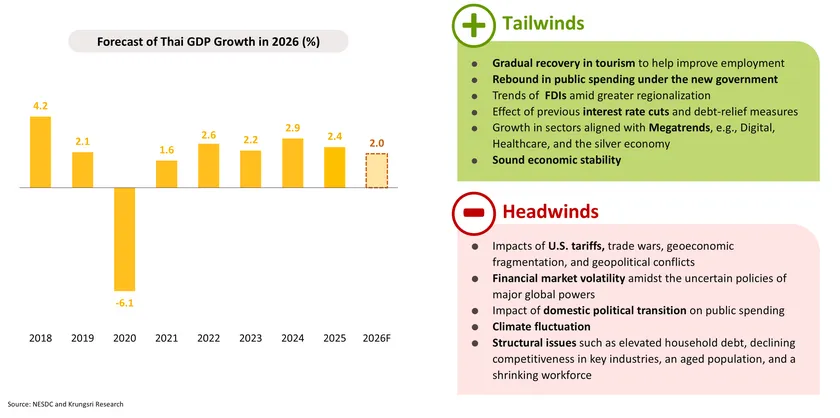
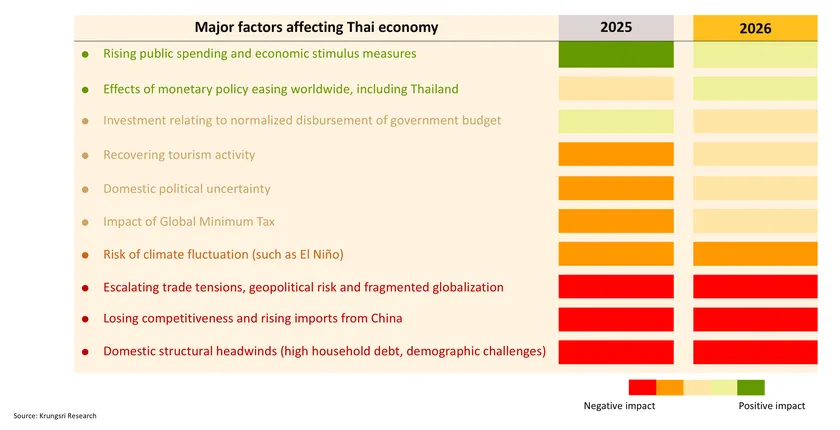
Key factors in 2026: Despite potential support from greater government stability, growth expected to moderate amid structural headwinds and emerging external risks


Monthly Economic Bulletin  
ประกาศวันที่ :17 มีนาคม 2569
ย้อนกลับ
พิมพ์สิ่งที่ต้องการค้นหา