
Thailand’s social structure is undergoing a significant transformation. Today, the number of individuals living alone—both single and non-single—is rising noticeably, particularly in urban areas. As a result, single-person households are becoming an increasingly important lifestyle trend, shaping the direction of housing demand, consumer products, and services.
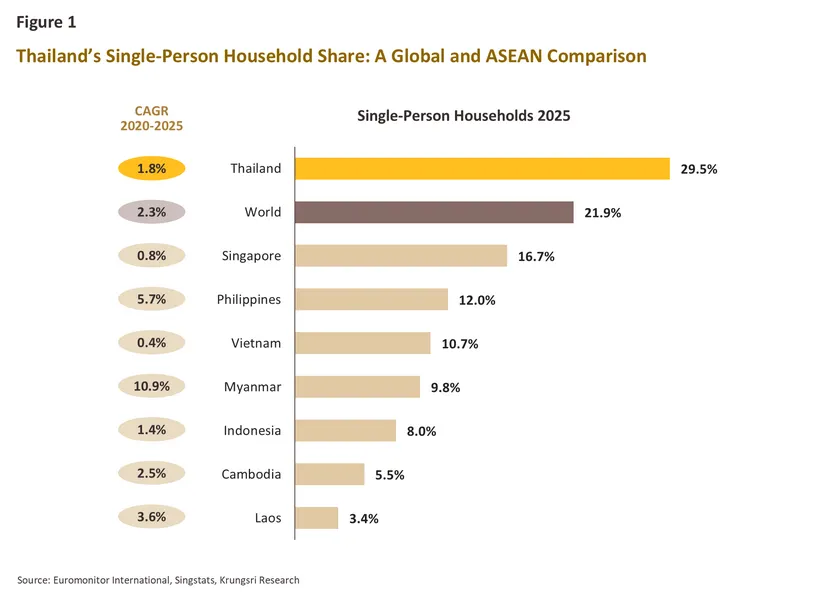
In 2025, the share of solo living in Thailand reached 29.5%, significantly higher than the global average of 21.9% and above many ASEAN peers. If this share continues to grow at an annual rate of 1.8%, it is projected that by 2042, up to 40% of all households in Thailand could be single-person households.
As living arrangements evolve, the market for products and services tailored to single-person households is expected to expand accordingly.

Individuals living alone tend to have distinct lifestyle needs that reflect greater personal autonomy—from compact urban housing, to products and services designed for single-person use, to communities that support independent yet high-quality living.
In this study, Krungsri Research explores the evolving patterns and characteristics of solo living, as well as how relevant sectors can adapt to and respond to this structural shift in the future.
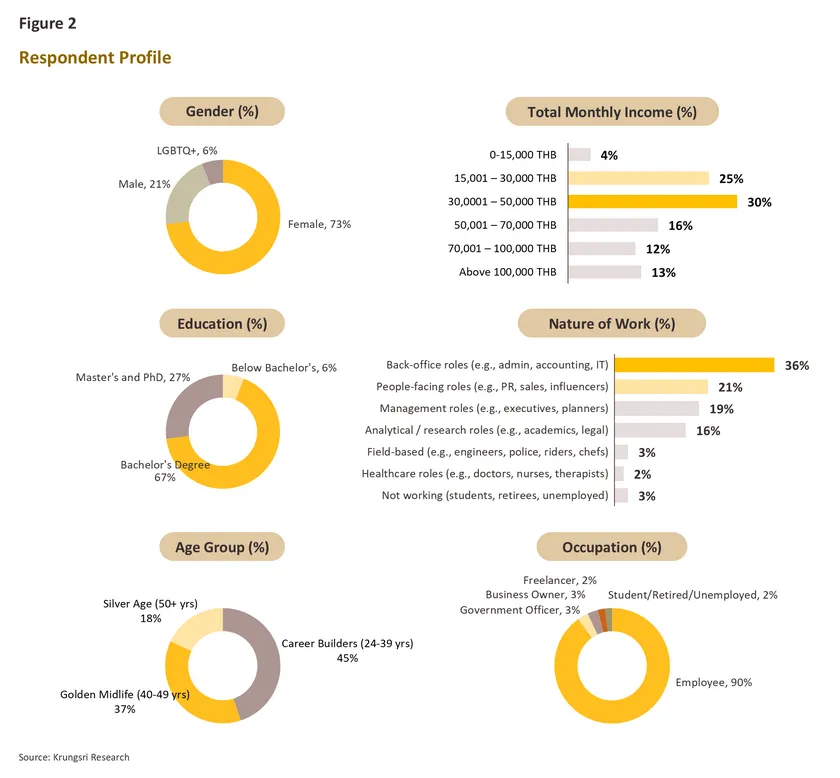
This report, titled “Exploring Solo Living Lifestyles,” is the second part of the Single Economy Survey conducted by Krungsri Research. The survey examines the behaviors and attitudes of urban residents aged 24 and above, based on data collected between November and December 2025. A total of 2,202 respondents participated through online channels. Findings from this dataset are published in two parts:
Part 1: The Single Economy: Life at Different Stages
Part 2: The Single Economy: Exploring Solo Living Lifestyles

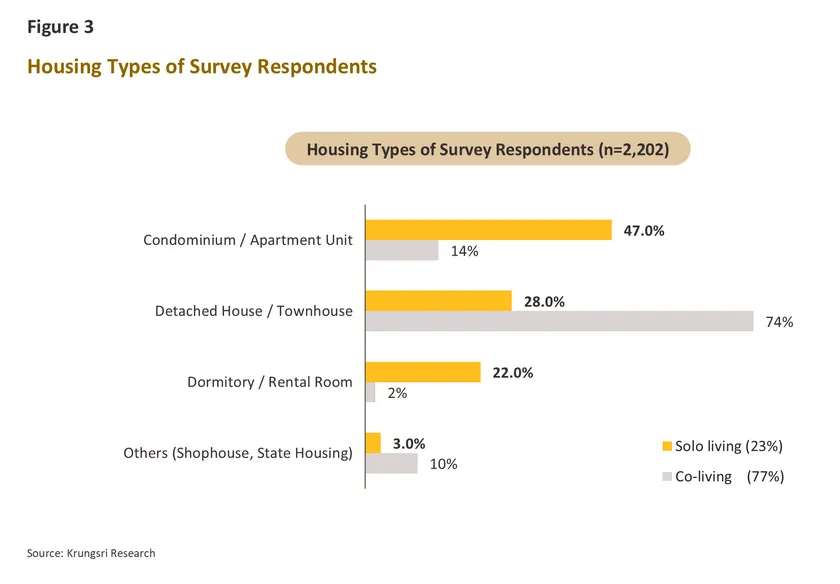
The survey finds that nearly one in four respondents live alone, while more than three-quarters live with others. Among those in shared living arrangements, 49% reside primarily with parents or older relatives, and 41% live with a partner or spouse. The remaining 10% live with siblings, extended family members, friends, or children.
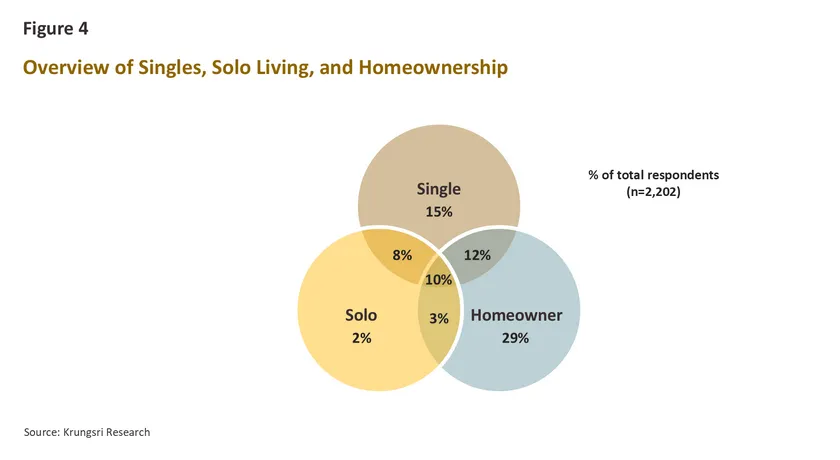
Among solo residents, 75% are single, while 16% are in a relationship but not married. Married individuals and those who are widowed or divorced each account for a relatively small share of around 4–5%. In contrast, among those in co-living arrangements, nearly half (48%) are married, while 30% are single, 18% are in a relationship, and 4% are widowed or divorced.

More than half of solo residents (approximately 56%) own their homes. The average age of homeowners is 43, compared to 36 for those who rent. In addition, homeowners earn, on average, about 76% more than renters.
In terms of housing type, nearly half of solo residents prefer condominiums or apartments, while almost three-quarters of those living with others reside in detached houses or townhouses. Notably, around one in ten respondents are single, live alone, and own their residence.

Econometric analysis highlights several key findings:
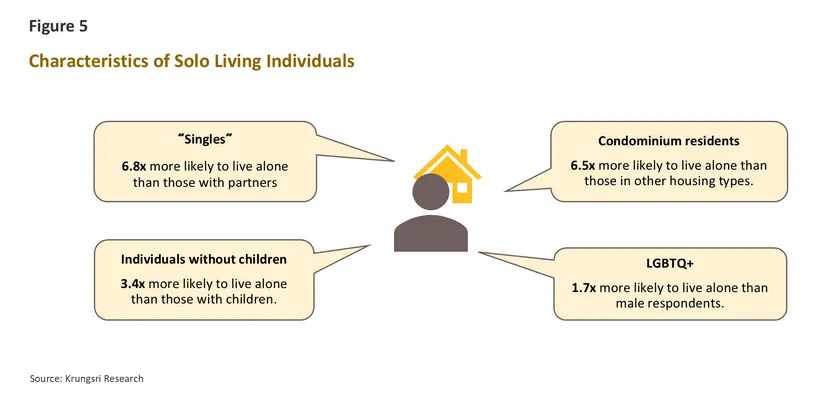
Respondents living in condominiums are approximately 6.5 times more likely to live alone than those in other housing types.
Around 31% of respondents without children live alone, compared to only 5% among those with children. Those without children are 3.4 times more likely to live alone.
Approximately 39% of LGBTQ+ respondents live alone—significantly higher than among female (23%) and male respondents (19%). LGBTQ+ individuals are about 1.8 times more likely to live alone than male respondents.
Overall, solo living is significantly associated with being single, not having children, gender, and residing in a condominium. In contrast, age, income, education level, and homeownership do not show a statistically significant relationship with living alone.

Looking ahead, a majority of respondents (73%) believe that they may eventually need to live alone and rely on themselves. However, living alone at present does not necessarily translate into a long-term expectation of doing so. Econometric analysis shows that this outlook is significantly influenced by age, gender, relationship status, and having children, while current living arrangements do not have a statistically significant effect. Older individuals are more likely to anticipate living alone in the future compared to younger groups. LGBTQ+ respondents and females are also more likely to agree with this view than males, by 2.8 and 1.8 times, respectively. In addition, single individuals are about 1.9 times more likely to share this perspective than those who are partnered or married, and those without children are similarly 1.9 times more likely than those with children.
In preparing for solo living in the future, most respondents prioritize physical and mental well-being (62%). This is followed by housing (19%), knowledge development (14%), and social connections (5%).
Notably, individuals currently living alone are about twice as likely to prioritize building social networks with friends or relatives compared to those in co-living arrangements. They are also around 1.5 times more likely to prioritize preparing suitable housing.
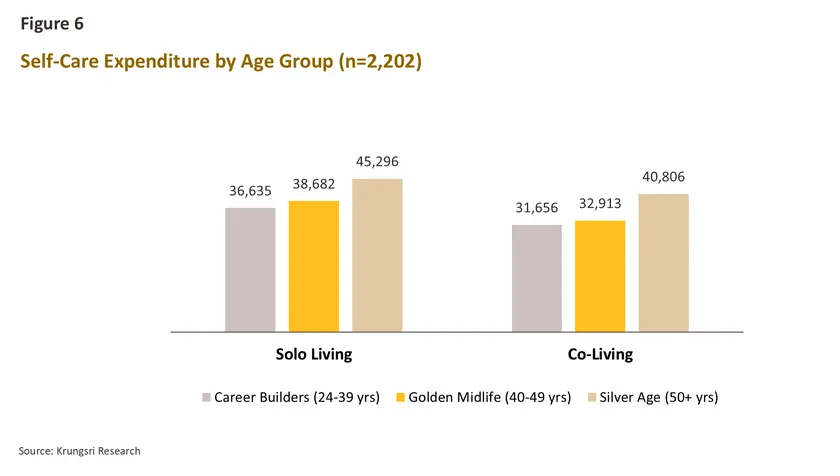
In terms of health-related spending, solo residents tend to spend more on self-care than those living with others. This may reflect the need to prioritize personal well-being when relying primarily on oneself, or greater flexibility in allocating personal budgets. Health expenditures also tend to increase with age.

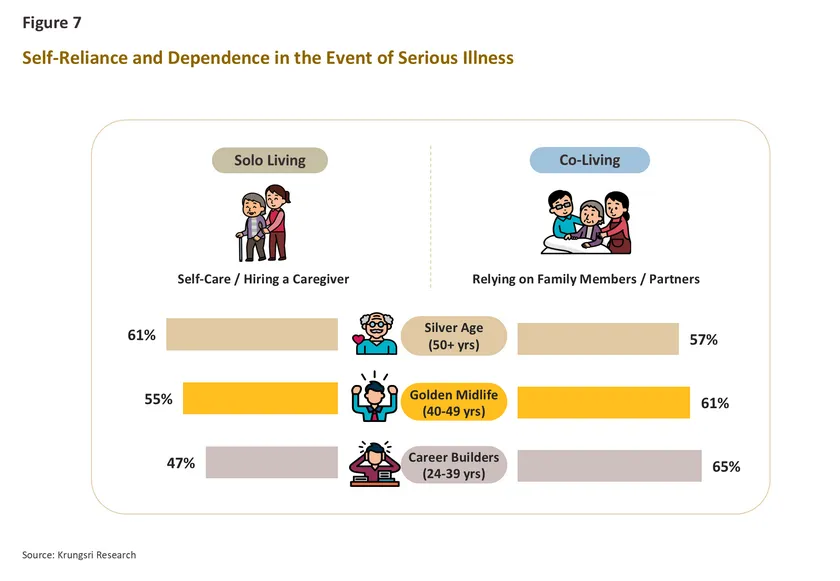
In the event of serious illness, survey results indicate that older individuals living alone are more likely to rely on themselves or hire caregivers. Among solo residents aged 50 and above, more than half (61%) state that they would care for themselves as much as possible or arrange for paid care. This share declines with age group, to around 55% among those aged 40–49 and 47% among those aged 24–39.
In contrast, respondents living with others tend to rely more on family members or partners for care. This is most evident among the 24–39 age group, where 65% would depend on others, followed by 61% among those aged 40–49 and 57% among those aged 50 and above.

Around 30% of respondents living alone report exercising or going to the gym weekly, significantly higher than the 25% observed among those living with others. This may reflect greater flexibility in time management and a stronger ability to maintain exercise routines among solo residents.
Choosing to live alone in Thai society stems from diverse factors, ranging from personal preference to life circumstances and necessity. Regardless of the reason, Krungsri Research findings suggest that individuals living alone tend to prioritize self-reliance, placing strong emphasis on self-care across various dimensions—particularly as they age. Their behavior reflects a high-potential consumer segment, especially in lifestyle, wellness, and preventive healthcare.
As the shares of singles, solo residents, and the elderly—referred to as the Single-Solo-Silver (3S) segment—continue to rise simultaneously, both production and service sectors will need to adapt. This includes leveraging hyper-personalization1/ and developing a deeper understanding of diverse consumer behaviors and values. In some industries, business models may need to shift from traditional economies of scale toward more agile and flexible approaches that cater to niche, individualized demand.
With the continued growth of single-person households, this trend represents not only a social shift but also a cross-sector challenge. The financial sector, for instance, should design products that support individual life planning—such as health insurance and savings solutions for those without dependents—while continuing to serve traditional family segments. The public sector may need to reassess welfare policies that have historically focused on conventional family structures, moving toward more individual-centered protection. At the same time, individuals themselves must recognize that living alone well requires forward planning—across finances, health, and social networks—rather than something that occurs by default.
For some, living alone may be a temporary phase. For many others, it is an intentional choice. In either case, the question of “who one lives with” may ultimately be less important than the extent to which one is prepared.
Euromonitor International. (n.d.). Households by type (single person). Retrieved March 31, 2026, from Euromonitor International database.
Euromonitor International. (n.d.). Number of households (sourced from national statistics and United Nations data). Retrieved March 31, 2026, from Euromonitor International database.
Singapore Department of Statistics. (2026, February 9). Table M810370. Retrieved March 31, 2026, from https://tablebuilder.singstat.gov.sg/table/TS/M810370