Executive Summary
The global energy crisis in 2026, triggered by escalating tensions between the United States and Iran, has renewed interest in Small Modular Reactors (SMRs). With their hallmark flexibility, enhanced safety features, and potential to address both energy security and sustainability, SMRs have moved to the forefront of the clean energy debate.
Thailand had previously included SMR capacity in its draft Power Development Plan (draft PDP2024), though the final direction of the plan remains pending. Going forward, SMR development could help meet Thailand's rapidly growing demand for clean electricity while reducing exposure to global energy shocks. That said, SMRs still face significant hurdles, most notably public concerns over safety and a per-unit electricity cost that remains higher than several competing technologies. Ultimately, SMRs may not be the single answer to Thailand's energy future, but they can serve as a "complementary force", developed in tandem with renewables to strengthen the country's clean energy infrastructure.
Introduction to Nuclear Power: Clean Energy with Extraordinary Potential
A nuclear power plant is a type of thermal power station that generates electricity from the heat released by nuclear fission reactions inside a nuclear reactor—without burning fossil fuels such as oil, coal, or natural gas. The heat from fission is used to produce high-pressure steam that drives turbines to generate electricity. Because no fuel combustion takes place, nuclear power is classified as a clean energy source with no direct carbon dioxide emissions during generation.
The development of nuclear power has unfolded across distinct generations. The pioneer era (1950s–1960s) saw the world's first commercial nuclear plant open in the United Kingdom in 1956. In the
second generation (1960s–2000s), commercial operations expanded globally—including Japan's Fukushima Daiichi plant—though these reactors relied on
active safety systems requiring human intervention and external power, making them vulnerable to cascading failures. The
third generation (2000s–present) introduced passive safety systems that use gravity, natural convection, and condensation—requiring no backup power or human action to maintain reactor safety. The industry is now moving toward a
fourth generation (from 2030 onward), which will emphasize maximized safety, economic competitiveness, and long-term sustainability.
Currently, nuclear power accounts for approximately 9% of global electricity generation, supplied by more than 440 commercial reactors operating across 31 countries.
The Chernobyl accident in Ukraine (then Soviet Union) in 1986, and the Fukushima Daiichi disaster following Japan's March 2011 earthquake and tsunami, raised serious public concerns about the safety of conventional large-scale nuclear plants—compounded by their high capital costs.
As a result, Small Modular Reactors (SMRs) have attracted growing interest as a technology capable of addressing these limitations—reducing costs and construction timelines, lowering accident risk, and meeting modern clean energy requirements. This report thus examines SMR technology, assesses its merits and challenges, and evaluates the prospects for SMR deployment in Thailand.
Getting to Know SMRs: Smaller Reactors, Bigger Safety
What Is an SMR and How Does It Differ from a Conventional Nuclear Plant?
A Small Modular Reactor (SMR) is a modern nuclear power reactor with a generating capacity of up to 300 megawatts-electric (MWe) per unit—roughly one-third the output of a conventional large reactor.
SMRs are defined by three core characteristics: (1) Small—a compact physical footprint;
(2) Modular—reactor systems and components are factory-assembled and shipped to the installation site as complete units; and (3) Reactor—nuclear fission is used to produce heat, which in turn generates electricity.
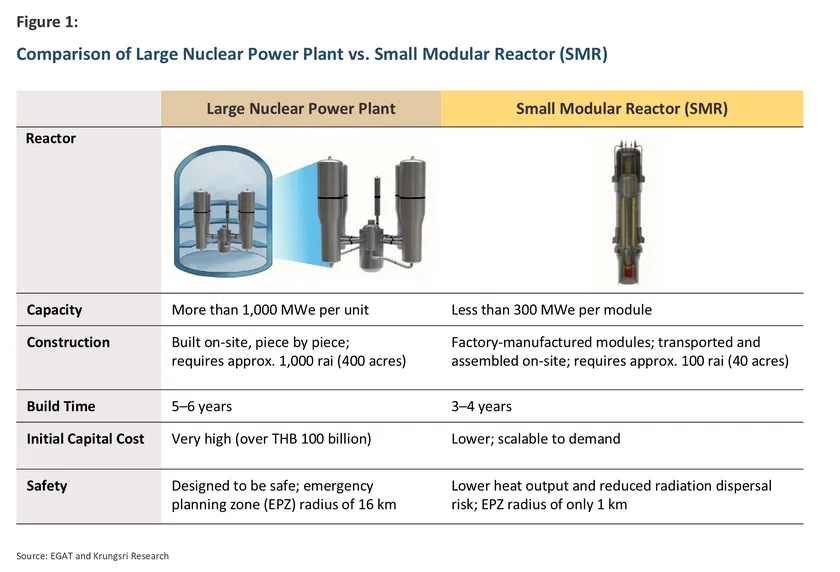
These attributes translate into lower upfront capital costs, shorter construction timelines, greater operational flexibility, and enhanced safety compared with large conventional plants (Figure 1).
SMRs generate electricity based on the same principles as large nuclear power plants, relying on nuclear fission. This process occurs when neutrons collide with the nuclei of fuel materials, such as uranium1/, causing the nuclei to split and release a substantial amount of thermal energy. The heat produced is then used to boil water into high-pressure steam, which drives a turbine to generate electricity.
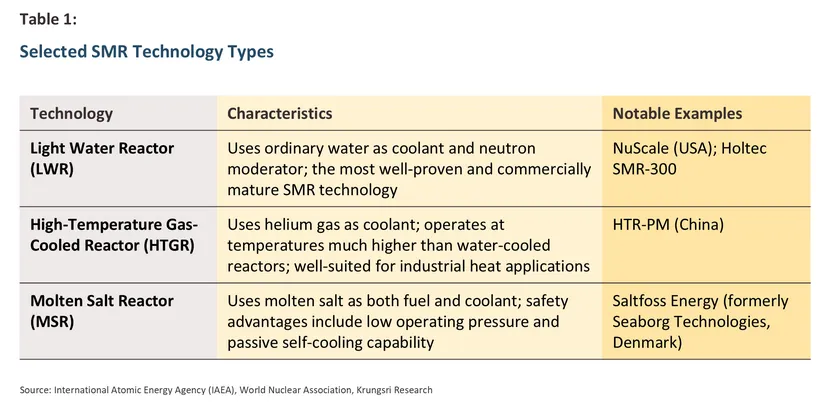
The cooling system plays a critical role in drawing heat away from the reactor core and preventing temperatures from exceeding safe operating limits. Coolant types vary by SMR design and include light water, helium gas, and liquid metals (Table 1).
A key safety advantage of SMRs lies in their passive cooling systems, which are designed to operate using natural forces such as gravity and natural circulation, without relying on water pumps or backup power. This enables continuous heat removal even in emergency situations. In contrast, older-generation nuclear power plants may experience cooling system failures during power outages—one of the key factors behind the Fukushima nuclear accident in 20112/.
The Global SMR Landscape
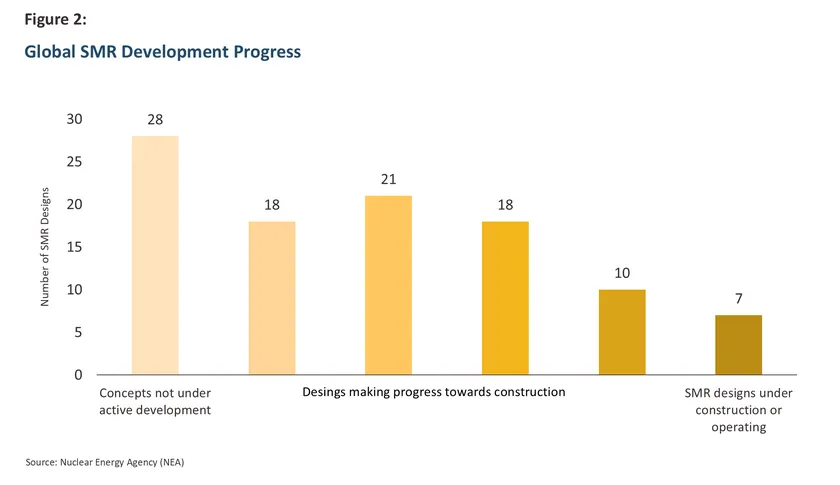
SMRs began attracting significant attention during the third and fourth generations of nuclear development. According to the Nuclear Energy Agency (NEA), as of 2025, seven SMR projects worldwide are either operational or under active construction, with more than 50 additional designs in the licensing and approval pipeline (Figure 2).
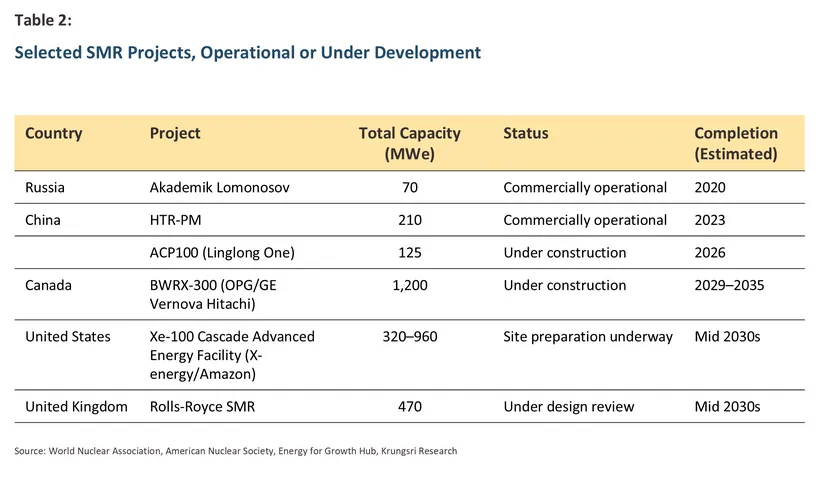
The two SMRs currently in commercial operation are Russia's Akademik Lomonosov—a floating nuclear power plant with 70 MWe capacity that began commercial service in 2020—and China's HTR-PM, a high-temperature gas-cooled reactor (HTGR) that entered commercial operation in 2023 with 210 MWe output. Moreover, several other projects are under construction or advanced development in China, Canada, the United States, and the United Kingdom (Table 2).
Within Southeast Asia, several countries have already incorporated SMR development into their national energy plans—including Vietnam, Indonesia, the Philippines, Myanmar, and Thailand (in the draft PDP2024). Malaysia and Singapore are currently studying the feasibility of including SMRs in their future energy strategies. This global momentum underscores why SMR technology can no longer be overlooked by Thailand.
SMRs in Thailand: Past Attempts, Present Moves, and Future Possibilities
Revisiting Thailand's Nuclear Power Journey
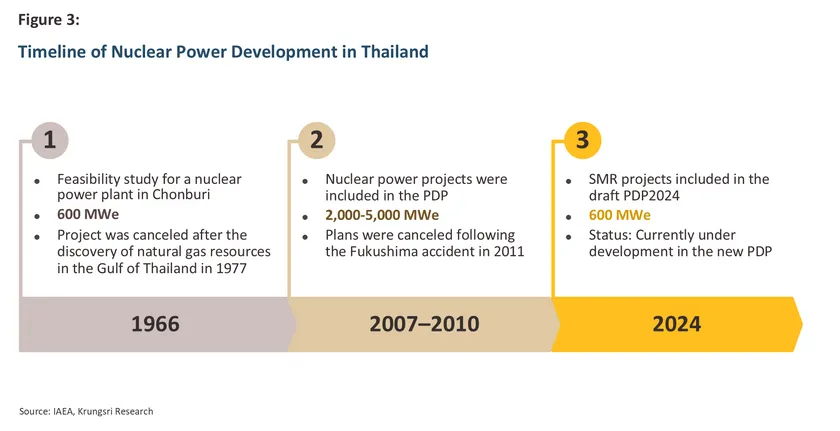
Thailand has made several attempts to develop nuclear power capacity. The key milestones are summarized below:
-
First attempt (1966): Thailand began exploring the feasibility of its first nuclear power plant in Chonburi province. The Electricity Generating Authority of Thailand (EGAT) received approval to acquire land in Si Racha district for a 600 MWe plant. However, the plan was shelved following the discovery of natural gas reserves in the Gulf of Thailand in 1977, which were estimated at the time to be sufficient for at least 40 years.
-
Second attempt (2007): Nuclear power was incorporated into Thailand’s national energy plan for the first time under PDP2007 and remained in PDP2010, which initially targeted 5,000 MWe of nuclear capacity before being scaled back to 2,000 MWe (PDP2010 Rev.3), with a planned commercial operation between 2020 and 2021. Following the Fukushima disaster in 2011, the government repeatedly postponed the program, and under PDP2018, nuclear power was ultimately removed from the plan.
-
Third attempt (2024): Nuclear returned to the agenda when SMRs were included in the draft PDP2024, with a combined capacity of 600 MWe—two plants of 300 MWe each, located in the Northeastern and Southern regions—targeting commercial operation by 2037. By that year, Thailand aims to reduce its dependence on coal and natural gas to 48% of total installed capacity, raise the share of renewables to 51%, while SMRs and new energy technologies together would account for approximately 1% of the generation mix. The roadmap remains uncertain, however, as Thailand is currently formulating a revised PDP for 2026.
How Ready Is Thailand for SMR Deployment?
Thailand already has an established legal and institutional framework for nuclear energy. The Office of Atoms for Peace (OAP) was established in 1961 under the Atomic Energy for Peace Act, and currently operates under the Nuclear Energy for Peace Act. Regulatory oversight is provided by the Nuclear Energy for Peace Commission, which places emphasis on both technological development and the regulatory framework for SMR deployment. In addition, Thailand has entered into cooperation agreements on nuclear energy and SMR development with several countries, including South Korea, China, and the United States. These partnerships aim to facilitate technology transfer and support the safe design and development of SMRs.
On the industry side, Thai power producers have been actively assessing the feasibility of SMRs. The Electricity Generating Authority of Thailand (EGAT) has conducted ongoing studies, while private sector players have become increasingly engaged—most notably Global Power Synergy PCL (GPSC), which is exploring a partnership with Denmark’s Saltfoss Energy, a developer of floating molten salt reactors (MSRs). Ratch Group PCL is also studying SMR deployment prospects in collaboration with Saha Pathana Inter-Holding PCL (part of the Saha Group). These developments suggest that Thailand is in the early stages of building readiness for SMRs across policy, technology, and international cooperation.
Opportunities and Challenges for SMR Development
Looking ahead, the development of SMRs in Thailand is likely to be supported by several key drivers, as outlined below.
-
Rising demand for clean energy: Companies in the technology sector3/, including Google, Microsoft, and Amazon Web Services (AWS), have announced plans to invest in data centers and cloud services in Thailand, with a key requirement being the use of carbon-free electricity on a 24/7 basis. At the national level, Thailand has also brought forward its net-zero greenhouse gas emissions target by 15 years to 2050. Together, these trends are expected to drive a substantial increase in demand for clean energy. In this context, SMRs—capable of providing both reliable and low-carbon power—could serve as a key enabler in achieving sustainability goals at both the corporate and national levels.
-
Energy security amid supply shocks: SMRs can enhance grid reliability and reduce Thailand’s exposure to global energy disruptions. The Russia–Ukraine war in 2022 and the Middle East conflict in 2026 led to sharp increases in liquefied natural gas (LNG) prices and periodic supply shortages, directly affecting Thailand’s electricity sector, which relies heavily on imported LNG—with approximately one-quarter of imports sourced from the Middle East. As SMRs are fueled by uranium, a resource with geographically diversified supply, their deployment could help mitigate risks associated with geopolitical instability and volatility in imported fuel prices.
At the same time, SMR deployment faces several key challenges, particularly in terms of safety and cost, as outlined below.
-
Safety concerns: Nuclear power continues to face public concerns over radioactive materials, largely stemming from past accidents such as the Chernobyl disaster in 1986 and the Fukushima accident in 2011, both of which resulted in severe radioactive releases. That said, SMRs incorporate enhanced safety features, including passive safety systems that can operate autonomously. In addition, SMRs are designed to limit the scale of potential impacts, as reflected in emergency planning zones that are significantly smaller—approximately 256 times smaller—than those of conventional large nuclear power plants4/. Nevertheless, SMR development still entails challenges related to radioactive waste management, emergency preparedness, and building public acceptance.
-
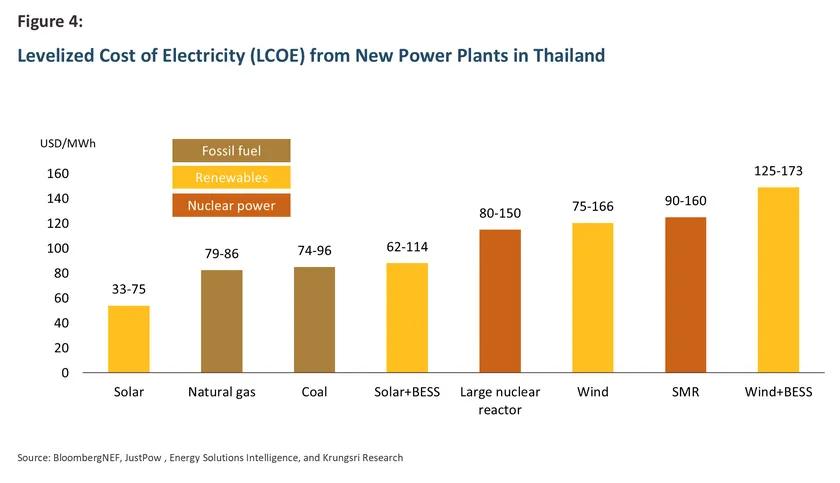
Cost and investment viability: SMRs have relatively high capital costs, with overnight construction costs estimated at around USD 5,000–10,000 per kW—higher than those of conventional large-scale nuclear plants due to more limited economies of scale. The levelized cost of electricity (LCOE) for SMRs is estimated at USD 90–160 per MWh, compared to USD 80–150 per MWh for large nuclear power plants and approximately USD 79–86 per MWh for natural gas-fired power plants in Thailand (Figure 4). However, over the long term, costs could decline as SMR technologies mature and achieve wider deployment. This is partly supported by lower fuel cost advantages, as SMRs require relatively small amounts of uranium and typically refuel every 3–7 years, whereas gas-fired power plants require continuous fuel input.
Krungsri Research View: Are SMRs a Clean Energy Option for Thailand, or the Solution?
As the world transitions toward clean energy, nuclear power cannot be overlooked as a viable low-carbon option—particularly Small Modular Reactors (SMRs), which address several key limitations of conventional nuclear technologies. These include greater flexibility in scaling generation capacity up or down, shorter construction timelines, and enhanced safety features, while maintaining the ability to provide stable, continuous clean electricity.
Looking ahead, electricity demand in Thailand—especially for clean energy—is expected to rise significantly, driven by emerging economic and industrial trends such as the digital economy, data centers, and electric vehicles. At present, renewable energy accounts for only around 10% of total electricity generation in Thailand
5/. The country also faces persistent energy security risks from its heavy reliance on imported LNG, made starkly visible by the latest energy crisis stemming from Middle East tensions.
Thailand thus confronts a dual challenge of securing its energy supply while making it sustainable. SMRs represent one credible answer to this complex equation.
However, the potential of SMRs comes with notable challenges. Safety concerns remain, particularly in relation to radioactive waste management, as well as the need to build public understanding and trust. In addition, SMRs involve relatively high capital and generation costs.
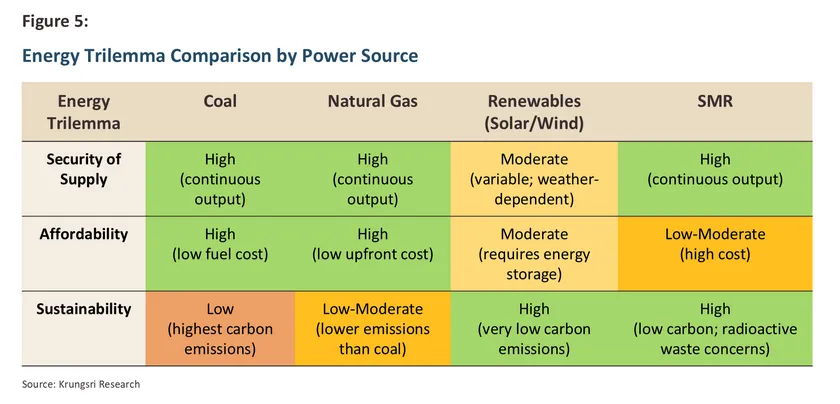
When assessed through the lens of the Energy Trilemma—balancing energy security, affordability, and sustainability—
no single technology is without trade-offs. Coal and gas offer supply security but are carbon-intensive, while renewable energy supports sustainability but faces intermittency challenges. SMRs, in contrast, offer advantages in both reliability and low-carbon generation, albeit at a higher cost.
Therefore, SMRs may not be the sole “option” or “solution” to Thailand’s energy challenges, but rather part of a broader “pathway” toward clean energy. Their role lies in complementing renewable energy—addressing its intermittency limitations. Ultimately, this integrated approach could help Thailand achieve its net-zero ambitions while fostering sustainable economic growth through a more secure and resilient energy infrastructure.
References
Bangkokbiznews. (2024). 'Ratch Group–Sahapat' to jointly study nuclear power plant in response to clean energy demand. Retrieved from https://www.bangkokbiznews.com/business/economic/1158357
BBC News. (2021). The Fukushima Disaster: What happened at the nuclear power plant. Retrieved from https://www.bbc.com/thai/international-56344107
Energy Solutions Intelligence. (2025). Small modular reactors 2026: Hype, costs & the real nuclear future. Retrieved from https://energy-solutions.co/articles/sub/small-modular-reactors-smr-nuclear-future
Formichella & Sritawat Attorneys at Law. (2025). Thailand's nuclear energy framework: Legal reforms after past accidents. Retrieved from https://fosrlaw.com/2025/thailand-nuclear-energy-framework/
International Atomic Energy Agency (IAEA). (2014). Thailand 2014: Nuclear power plants: Country profile. Retrieved from https://www-pub.iaea.org/mtcd/publications/pdf/cnpp2014_cd/countryprofiles/Thailand/Thailand.htm
International Atomic Energy Agency (IAEA). (2021). What are small modular reactors (SMRs)? Retrieved from https://www.iaea.org/newscenter/news/what-are-small-modular-reactors-smrs
JustPow. (2025). Summary of key findings from the research report ‘Thailand: Turning point for a net-zero power grid’ by BloombergNEF. Retrieved from https://justpow.co/article-summary-of-bnef-report-thailand-turning-point/
Nuclear Energy Agency (NEA). (2024). NEA small modular reactor (SMR) dashboard: Second edition. Retrieved from https://www.oecd-nea.org/jcms/pl_73678/nea-small-modular-reactor-smr-dashboard
ThaiPublica. (2024). SMRs—The Return of Nuclear, Part 6: The Geopolitics of Uranium Fuel Resources. Retrieved from https://thaipublica.org/2024/12/drmp6-smr-6/
Thansettakij. (2026). EPPO unveils 25-year electricity demand forecast — Data Centers and EVs as key variables driving demand toward 77,300 MW. Retrieved from https://www.thansettakij.com/sustainable/net-zero/655299
The Office of Atoms for Peace (OAP). (2025). Nuclear Energy for Peace Commission emphasizes safety and strong regulation in Thailand. Retrieved from https://www.oap.go.th/en/2025/12/16/laws-nuclear-energy-peace-safety-regulation-smr-oap-2/
The Standard. (2025). PTT sends GPSC to play the clean energy game — Explaining why Thailand needs SMR nuclear power plants, even if it takes 7 years. Retrieved from https://thestandard.co/ptt-gpsc-nuclear-smr-thailand/
Wood Mackenzie. (2025). Southeast Asia's nuclear ambitions require US$208 billion investment by 2050. Retrieved from https://www.woodmac.com/press-releases/sea-nuclear-potential-2025/
World Nuclear Association. (2025). Nuclear power in the world today. Retrieved from https://world-nuclear.org/information-library/current-and-future-generation/nuclear-power-in-the-world-today
Yada Hariraksaphithak. (2026). Chulalongkorn University’s Engineering Prepares for “SMRs”—Newer, Safer Small Nuclear Power Plants for Clean Energy in Thailand. Retrieved from https://www.chula.ac.th/en/highlight/286177/
1/ SMRs typically use uranium (U-235) as primary fuel. Global reserves are substantial, with major producers including Kazakhstan, Canada, Australia, and Namibia.
2/ The Fukushima nuclear power plant was impacted by an earthquake and tsunami, which overwhelmed its protective barriers and damaged the nuclear reactors, leading to the release of radioactive materials from the facility.
3/ Major technology companies are increasingly investing in SMRs. In 2024, Amazon announced an investment of over USD 500 million in SMR development in partnership with Energy Northwest. Meanwhile, Google, Microsoft, and Meta have also made investments in SMR projects.
4/ Calculated based on circular area, using the Emergency Planning Zone (EPZ) radius of 1 kilometer for SMRs and 16 kilometers for large nuclear power plants.
5/ Excluding large-scale hydropower